


Three trials open, three dashboards, three different numbers for the same brand, and a board meeting on Thursday. That is the week a lot of marketing leaders are having right now, and it usually starts the same way. You type your category question into ChatGPT, three competitors come back, you are not in the answer, and nothing in your analytics explains it because the thing that happened did not happen on your site.
Empact Partners is a B2B SaaS go-to-market consultancy, and Generative Engine Optimization, GEO for short, is one of our six workstreams. It is the work of becoming the brand AI engines name when a buyer asks their category question. We measure before we move, so we read these products closely before we put one in front of a partner. The first thing worth saying about them is that they are not competing versions of the same product. Each one is built to answer a different question. Buy the wrong one first and you will pay for a very good answer to a question you were not asking yet.
So here are six, in the order we would set them up for a SaaS team measuring from zero. One tool per question. Four more candidates lost their place because another tool already answered the question they were there to answer, and none of them lost on quality.
The Six Tools, In Setup Order
1. Qvery, for the baseline: are we in the answer at all?
Qvery is our sister company, so read this entry knowing that. We built it because our GEO work needed a number nobody was producing, and it is the first thing we set up on a partnership.
What it does is narrow on purpose. It builds a set of topics and buyer questions from a brand’s own context, runs them every day across ChatGPT and Google AI Mode in more than two hundred countries, records which brands each answer names and in what order, and logs every source the answer cites. Out of that comes the one number a board can hold, which is the share of your buyers’ questions where an engine names you at all, and how high up.
The mistake here is arriving at this question with a tool built for a later one. A source tracker tells you which pages the engines read. A crawler report tells you which bots fetched yours. Neither one is a baseline, and a program measured against no baseline reports movement it cannot separate from noise.
Run our own tests on it and Qvery passes some and not others. The question set is generated, so the number is only as honest as the questions, which is why we throw out branded prompts and anything shaped like “X versus Y” before a partner sees a figure. Those shapes bias the answer toward brands the asker already named.
It reports visibility and share of voice as two numbers rather than one, which matters more than it sounds. Visibility counts whether you were named at all. Share of voice weights where in the answer you landed, and a brand named last is not a brand named first. It also measures per country, because engines localize.
What it cannot do is see the prompt a real buyer typed, because nobody outside the engine can. And it covers two engines rather than nine, so if your category lives on Perplexity, that is a real gap and not a rounding error.
Verdict: the right first tool for a team that needs one defensible number, reported monthly, on questions its own buyers ask. Skip it if you already have a baseline you trust and your next question is which sources to go and earn.
2. AthenaHQ, for the sources: which pages do the engines read?
AthenaHQ runs a prompt set you own across eleven or so models, then takes every answer apart into the domains and individual URLs that produced it. Its Sources screen is the product: which sites the engines lean on in your market, which of them name your competitors, and a separate cut for the social platforms that carry so much of this, Reddit and YouTube and Quora among them.
This is the second question, and it only makes sense once the first one is answered. A source list does not tell you how you are doing. It tells you where the answer came from, which is where the work is, because AI visibility is won off-site, and in a crowded category your own website is a sliver of what an engine reads.
The test this one has to pass is citation weight over domain authority. What matters is how often a source gets pulled, not what its domain rating says, and the numbers are lopsided enough to change a plan. Across three weeks of answers captured in Qvery, ten domains carried a third of every citation and a hundred carried three-fifths, while two in five cited domains appeared exactly once. That is the shape of a good outreach list and a terrible spray campaign. The limit worth knowing: this list is per engine, not universal, and the two engines we track agree on almost nothing here.
On partner work this is the list we sort by citation weight and work down, because the pages an engine already trusts in a category are a shorter and better outreach target than anything a generic prospecting search returns.
Verdict: for a team whose baseline came back low and who now need somewhere to aim. Skip it if nobody on your side has the capacity to pitch, publish or earn a mention once the list exists, because what it hands you is a list of work rather than a report.
3. Scrunch AI, for access: can the agents reach our pages at all?
Scrunch calls itself an Agent Experience Platform, and underneath the phrase is the one measurement on this list where you own the ground truth. It reads your own server and edge logs to show which AI agents visited, what they fetched, what they got back, and where they hit an error, then goes further and serves agents a cleaner version of your pages.
The question it owns is whether the machines can read you. That is a different failure from not being recommended, and it is the only one you can fix entirely on your own property.
Here is where a buyer goes wrong. Crawler hits are not recommendations. An engine can fetch your documentation every day and still name three competitors when a buyer asks, because being read and being cited are separate events. Treat agent traffic as a visibility metric and you will report a rising line while your share of answers sits flat. We run this check early on partner work anyway, because a site an engine cannot parse makes every later investment slower, and a blocked bot is the cheapest problem on this entire list to fix.
Verdict: for teams with a large site, real documentation, or a security team that has been blocking things quietly. Skip it if your site is small, open and already being fetched, in which case a log file and an afternoon get you the same answer.
4. Peec AI, for perception: what does the engine say about us when it names us?
Peec runs a prompt set daily through the AI platforms’ own interfaces, which is table stakes by now. The part that earns it a place is Brand Perception, and inside that, its Objections view. It asks every tracked model why someone might not choose you, repeatedly, then groups the answers by meaning so the objections that keep coming back are visible as a set.
Perception is the fourth question, and it changes what marketing says rather than where it spends. Being named by an engine that then describes a feature you do not have is worse than being absent, because the absence costs you a shortlist and the description costs you the call.
The honest limit is where the objection comes from. It is the model’s theory of your weakness, built out of what the public internet says about you, rather than a survey of your buyers. That makes it a good map of what your own evidence implies about you and a poor substitute for asking a lost deal why they went elsewhere. Read it as a reading list of what you have failed to publish.
Verdict: for teams that are already being named and are losing anyway. Skip it while you are invisible, because a perception report on a brand nobody mentions is a blank page with a chart on it.
5. Profound, for demand: what are buyers asking in the first place?
Profound is the one in this category with the loudest claim about real conversations. It licenses prompt data from double-opt-in consumer panels, corrects it statistically, and sells the result as prompt volume: the questions people put to AI assistants in your category, with trend and intent attached. It tracks answers and agent traffic too, but the demand side is what nothing else on this roster does as well.
The question it owns is which questions belong in your sample, which is a real question and a different one from how you are doing on the sample you have.
The test this entry has to pass is the one we care about most, because nobody outside an engine can see the prompt that produced a particular answer or a particular citation. The platforms treat it as proprietary, so any tool that appears to show you the prompt behind your citation is reconstructing, not reporting. Profound is not claiming that, and the distinction matters: panel-based demand data is a legitimate estimate of what a population asks, and it is not a window into the one buyer who found you. Read it as the AI-era version of keyword research and judge it on that basis. Then ask any vendor selling something that sounds more precise which of the two they are doing.
Verdict: for teams at the scale where the question set is a program of its own, and for content planning where guessing the questions has stopped being good enough. Skip it if you could write your twenty highest-intent buyer questions from memory this afternoon, because you can, and you should.
6. Ahrefs Brand Radar, for the fast look: where do we stand right now?
Brand Radar sits inside a suite many marketing teams already pay for, and it answers the question differently from everything above it. Rather than run questions you wrote, it searches a large index of AI answers already collected, built from the questions its keyword database says people search. You type a brand, any brand, and get a picture with nothing to configure and no tracking period to wait through.
A look that fast is why Brand Radar is on this list, and it is also why it is last.
The test it fails, by design, is sample ownership. You did not choose those questions, and they come from search demand rather than from what your buyers type into a chat window, which Ahrefs says plainly enough in its own methodology. So the number answers how visible you are to the average asker of search-shaped questions, and that is a fine thing to know on a Tuesday and a bad thing to put in a board pack as your KPI. Use it to sanity-check a baseline that came from somewhere else, or to look at a competitor you are not tracking, which is the part no prompt-set tool can do for you.
Verdict: for the team that already owns the suite and wants a read this week. Skip it as your reporting number, for the same reason you would not report a category average as your pipeline.
.png)
What These Six Have in Common, and What It Costs You
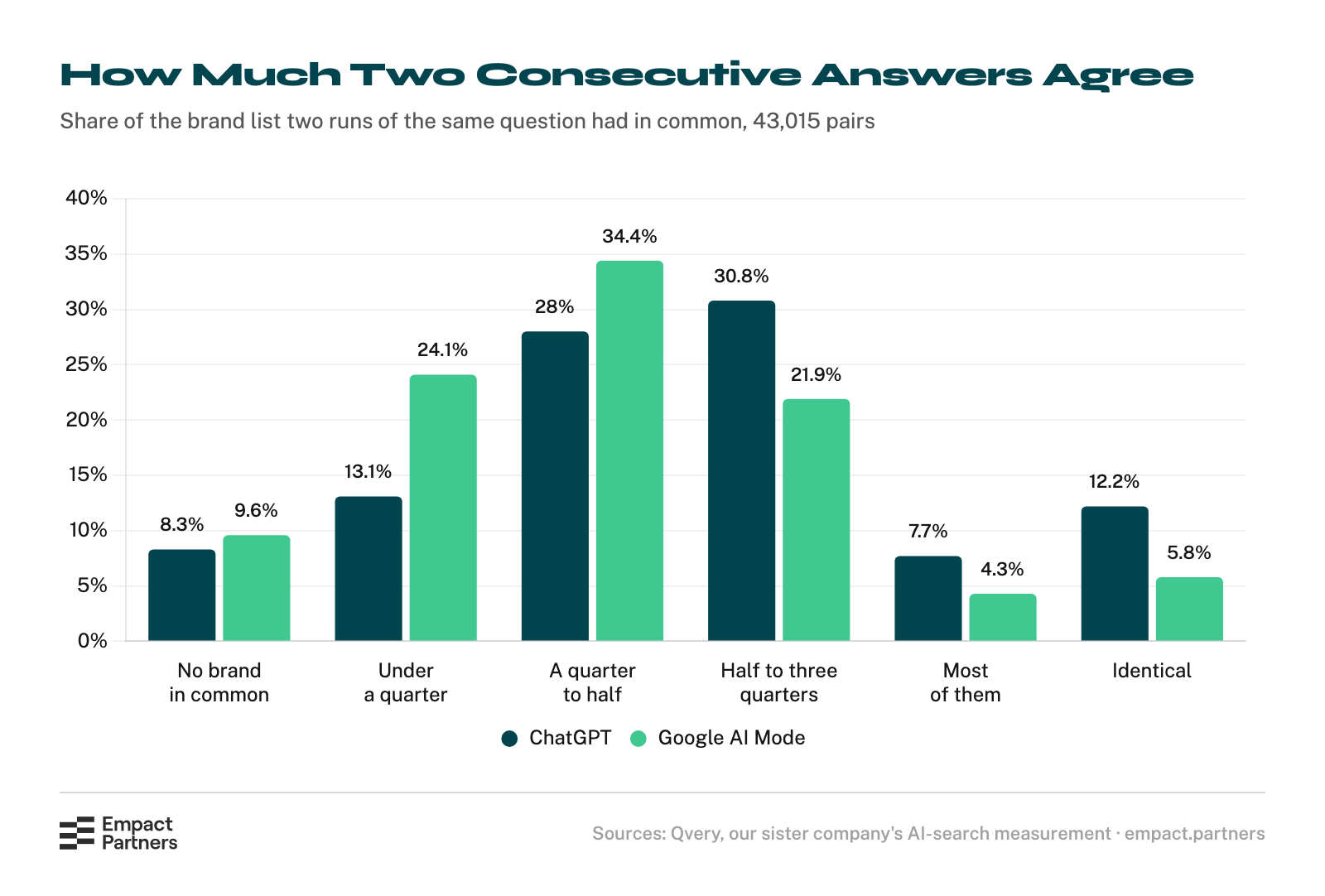
Every tool above reports a number, and every one of those numbers is built on a probabilistic answer that moves. We measured the movement rather than assuming it. Qvery captured 48,584 of them between August 29 and September 19 this year, on both engines, in the countries each question was tracked in, and we compared 43,052 pairs of those answers: what an engine said one day against what the same question got back from the same engine the next.
The same question, the same engine, the same country, one day apart: on average fewer than half the brands named came back. In nine pairs out of ten the list changed. In half of them the brand named first was a different brand.
Then we read the same question’s answers from both engines on the same day. They agreed on about a quarter of the names, and on 7% of the cited domains. Two times in three, the two answers cited no website in common at all.
None of that is a reason to stop measuring. It is the reason to know which question your tool answers before you sign, and the reason we run the same six checks on every one of them, our own included.
| The check | What it catches | What a failing answer sounds like |
|---|---|---|
| How many questions, and are they frozen? | A dashboard built on a handful of prompts, regenerated each run, reporting prompt drift as visibility | “We track a curated set and refresh it automatically” |
| Are branded and comparison prompts in the set? | A sample biased toward brands the asker already knows, which flatters incumbents and hides you | “We include your brand terms for completeness” |
| Visibility or share of voice? | Two different numbers reported as one, so a brand named last looks like a brand named first | “Our visibility score covers mentions and ranking” |
| Which engines, measured how? | One engine sold as the market, or answers pulled from an API rather than the interface a person uses | “We support all major models” |
| Per country, or averaged? | Markets that disagree, blended into a number that describes nowhere | “Global visibility, with regional breakdowns coming” |
| Whose prompt is it? | An estimate of the triggering prompt sold as an observation | “See the exact prompts driving your citations” |
Those six are what we ask before a number reaches a partner’s monthly report, and they are what a sales call cannot answer in generalities. Ask them in that order and most demos change shape around the third one.
The Question None of Them Answers
There is no ground truth in this category. Nothing any of these six tools reports can be checked against what buyers saw, because answers are personalized by context, history, location and whether somebody was logged in, and because the vendors cannot see the conversation any more than you can. A screenshot of one perfect answer proves nothing, and so does a screenshot of one terrible one.
The honest version of the job, then, is this. Pick the question you need answered, buy the tool built for that question, measure the same way every month, and treat the absolute number as less real than the direction it moves. The teams that get this right are the ones that stopped asking which tool is accurate and started asking which one is consistent.
Every tool on this list, ours included, is an instrument pointed at something that moves while you measure it.
What We Would Do On Monday
If you are choosing today, take the tests above and put them to whichever trial is open on your screen right now. If the vendor cannot tell you how many questions they run, whether the set is frozen between runs, and whether the number is visibility or share of voice, you have learned something more useful than another week of trialing.
The first hour of a GEO engagement here runs the same way. We audit which of your pages an engine can quote cleanly, list the third-party pages it already cites in your category, and set a baseline before we touch anything, because everything after that is measured against it. It takes months to move, we say so early, and the teams who want a spike self-select out.
If you would rather skip the trials, book a call with me and bring the five questions your buyers ask most, and I will tell you who owns them today.


