


Ask ChatGPT a question with a product’s name in it, and the answer cites that product’s own documentation. In October, Qvery put developer questions that named a product to ChatGPT and Google AI Mode. Every ChatGPT answer cited the named product’s docs, and so did every Google AI Mode reply that cited a page at all, 87.78% of them.
Qvery is a sister company of Empact Partners, the go-to-market consultancy that wrote this, so read that as an interested party’s number and check it by asking both engines three questions about your own product. If your docs sit under engineering, the pages the engines quote were written outside marketing, and there can be six hundred of them.
We audit software companies’ documentation inside our Generative Engine Optimization work, the work of getting a brand named when buyers ask AI engines about its category. We never start in the docs. We start with the questions buyers ask and the pages engines already cite for them, which is how to find the few pages worth your time.
Docs Decide the How-To Answers, and Lists Decide the Shortlist
Your name in the question gets your docs almost by default. The questions that decide whether a buyer finds you are the ones that never name you, and in the same research every ChatGPT answer to an unbranded how-to question still cited software makers’ own pages: their docs, product pages and blogs.
Buyers’ questions pull docs in too. In our cut with Qvery of 50,220 software-buying answers in 13 categories, collected from late August to mid-September, help and docs pages drew 17.2% of ChatGPT’s citations to vendors’ own sites. On Google AI Mode the share was 4%, so the two engines lean on docs very differently.
Docs lose one kind of question. In Qvery’s September research across ten industries, ChatGPT cited a list page in 60.27% of its answers to “best tool” questions and 6.22% to how-it-works ones. Docs will not put you on a shortlist. They decide what the engine quotes once the question names your product, a feature, or the job it does.
Write Down the Questions Before You Open the Docs
So the questions come first. Before anyone opens the docs, write down the questions you want your product named on, in the words a buyer would type. These families cover most of what an engine answers from documentation:
Most of these questions are already in the building, in the calls your sales engineers take, the tickets that arrive before a contract is signed, the comparisons buyers search for, and the AI referrals sitting in your analytics. Your docs host’s server logs show the other side: the pages assistants fetch when a user asks them something live.
Ten questions are enough to start an audit, because you ask each one several times. A visibility number you would put in front of a board is a different job, and we only report one when it rests on one to three thousand queries.
Make Sure an Engine Can Open Your Docs Before You Log a Single Answer
Check that an engine can open your docs, because if it cannot, the log will only ever show you rivals. In October we sent a plain request, the kind a crawler makes without running scripts, to the help centers and docs sites of the 2025 Forbes Cloud 100. 35 of 83 help centers sent back a bot challenge instead of the page. Not one docs site did.
On Zendesk, 32 of 37 help centers refused. Readable text came back from 91% of the docs sites and 42.2% of the help centers, so the help center is the half of the documentation most often shut. The work is site-wide and mostly engineering’s, and it can run while you write the question list:
None of this is a rewrite. It decides whether the engines can see the pages at all, which is why it comes first, and why it lands on engineering’s ticket list instead of on marketing’s writing plan.
The Engines Have Already Picked the Pages, So Read Their Citations First
Now ask the questions. Every engagement in our Generative Engine Optimization (GEO) work opens here. Put each one to ChatGPT and Google AI Mode in a fresh, logged-out window, five times, from your buyers’ market, and write down every page each answer cites.
Ten questions, five runs each on two engines, make a hundred answers. One person can log them in a day, and they are the baseline. The repeats matter because the cited pages move from one run to the next, and a single pass reports noise. Keep one row per answer:
| Field | What to write |
|---|---|
| Question | The exact words you asked |
| Engine and date | ChatGPT or Google AI Mode, and the day |
| Cited page | The full address, with tracking tags and highlight fragments stripped |
| Whose page | Yours, a named rival’s, or a third party’s |
| Kind of page | Help article, docs page, integration page, blog post, list, or thread |
| Named you? | Whether the answer named your product, cited or not |
| Right? | Whether what the answer says about your product is true today |
A sheet holds this for a while. Qvery’s agent asks both engines its questions every day and stores each answer in full with its citations, so the record keeps itself. Empact Partners runs the documentation audit on top of it: we agree the question set with the partner and read the citations together before anyone touches a doc page.

Read that way, the log stops being a visibility score and becomes a work list. Every cited page is yours, belongs to a rival you can answer, or tells you the question was never a docs question.
Your Audit List Is the Doc Pages Those Answers Touch
Put the log beside your docs site map and match each cited address to a page on it, to see which pages the questions touch. Clean the addresses first: strip tracking tags and highlight fragments, follow redirects, and fold old versions and locales into the page they belong to. Each question then lands in one of five rows:
| What the answers cite | What it tells you | What to do |
|---|---|---|
| Your doc page, saying something wrong | The engine trusts a page that is out of date | Fix it today, before anything else |
| Your doc page, saying it right | You already hold the question | Keep it current and dated |
| A rival’s doc page, and you have one | Yours lost on something you can see | Top of the audit: open both side by side |
| A rival’s doc page, and you have none | Nobody gave the engine your answer | Brief a new page with the engineer who owns it |
| No doc page at all | The answer comes from lists or threads | Not a docs job: it belongs to the off-page work |


Most of what lands on the list will be help articles and integration pages. In the same 13 categories, ChatGPT cited the pages around a vendor’s product 36,192 times: help and docs, integrations, the developer portal, community and templates. Three in four citations went to help and docs pages and one in five to integration pages.
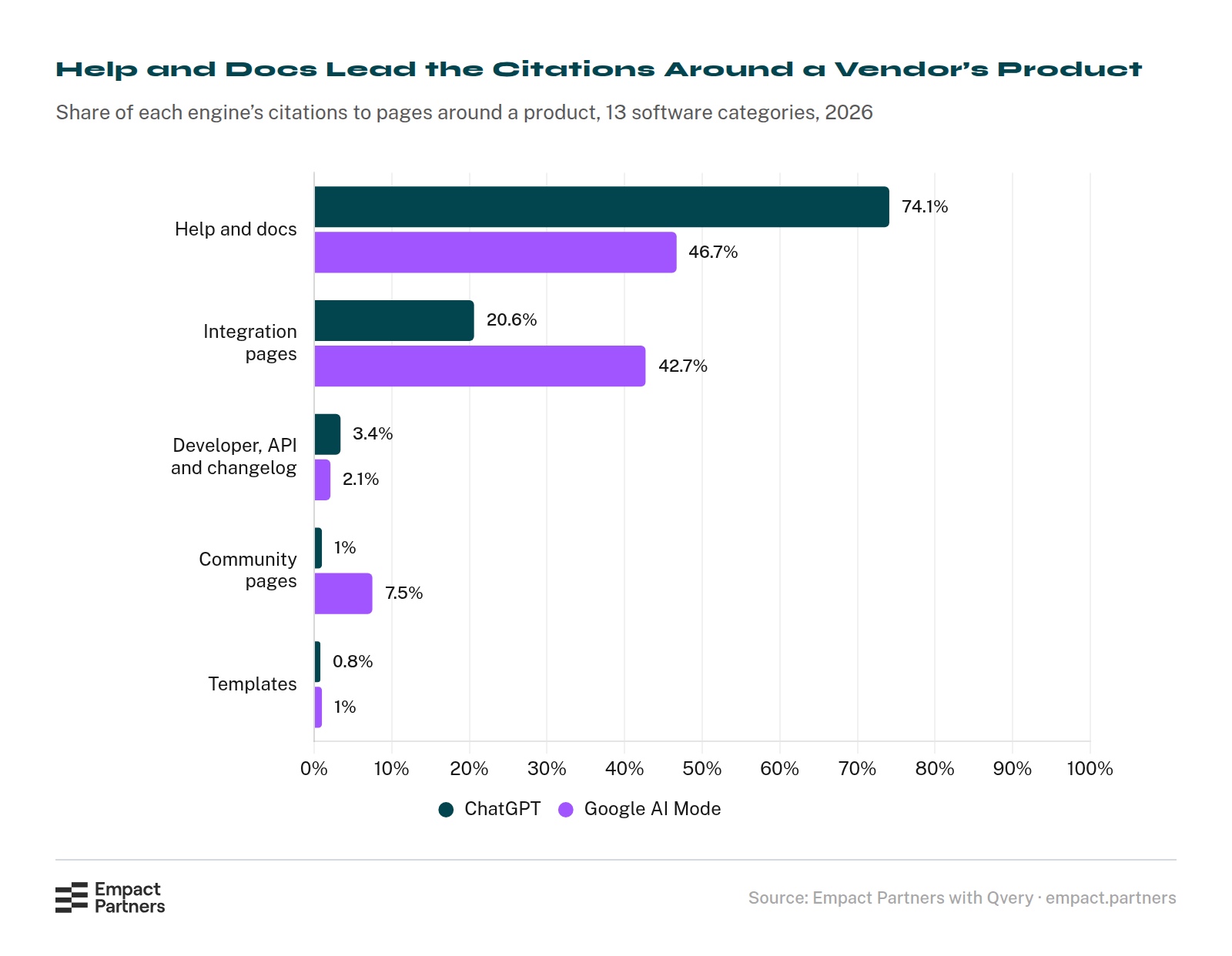
So start the audit in the help center and the integration pages. The developer portal, the API reference and the changelog drew 3.4% of ChatGPT’s citations to those pages, and 2.1% of Google AI Mode’s. Google AI Mode also leaned on integration pages almost as much as on help and docs.
Empact Partners ran the same order of work with PDF Reader Pro, in search rather than in AI answers. An audit came first: we read through hundreds of existing posts and pruned the ones holding the publication back. Then two writers built how-to guides on what users were searching for.
By the case study’s figures, those guides bring in 15 to 20% of sales each month, and overall sales stand 85% above where they were in June 2023, when the partnership began. What carries over to docs is that the questions people asked decided which pages got the work.
Open the Page the Engine Chose and Match What It Answers
For every row where a rival’s page won, open it beside yours and note its heading, how soon it answers, the specific fact yours leaves out (the limit, the version, the field name), and when it was last updated. The formatting matters less than the answer.
A University of Toronto study published in October looked at 158,099 answers to commercial questions and compared pages from the same website. Those whose title and paragraphs matched the questions people ask were cited more. FAQ blocks, structured data and summary boxes made a difference only when one website was set against another.
Whether ChatGPT’s own search pulled a page up explained 32% of the variation in how often pages got cited, against 2.8% for everything on the page, so being found counted about eleven times as much. A page gets found by answering, near the top and in plain words, the narrow question the engine searched for. On your own page:
Each of those is something the rival’s page already does for your buyer, and next month’s record shows whether yours now does it too.
Re-Read the Same Questions Every Month and Let the Citations Grade the Work
Ask the same questions on the same engines every month and compare the logs: which of your pages entered the citations, which rival pages still win, and whether the answers name you as well as cite you. Count the name as carefully as the link, because the buyer reads the answer and rarely opens the footnote.
Read each engine on its own. They lean on docs so differently that the same fix can move ChatGPT’s citations and leave Google AI Mode’s where they were, and an average of the two hides both.
When you rewrite a batch of pages, leave two or three comparable pages untouched and track them too. The engines change what they cite on their own, so if the pages you rewrote and the pages you left move together, the platform moved, and if they separate, your rewrite did something.
The part that takes quarters
You can run the first pass yourself, with ten questions, two engines, a sheet and an hour with the docs site map. After that the work slows, because it means keeping the record every day across engines and markets, rewriting the pages the audit shortlists with the engineers who own them, and staying with it for the quarters citations take to move.
Empact Partners runs that part. Qvery keeps the daily record and we run the documentation audit. The rewrites follow the process we use for anything an engineer knows best: we interview the engineer who owns the page and write the draft, the engineer reviews it, and it goes through a second review and our final edit.
Across our GEO work, momentum shows within three to six months and real visibility takes a year or more. Until then, the monthly record is what shows which pages moved.
Docs Are the Half of the Answer You Already Own
The same record also names the choosing questions no doc page can win, where the answer is built from other people’s lists and threads. They belong to the rest of our formula, GEO = UGC + Mentions: user-generated content, meaning the threads and reviews where users talk about you, and mentions on the independent pages that name you.
Docs are the half you own outright. A buyer who found your name on someone else’s list asks the engine the next question with your name in it, and the answer cites your docs, right or wrong. That is why the audit’s first row is the wrong page an engine already trusts.
If your docs run to hundreds of pages and the AI answers in your category keep citing someone else’s, book a call with me to talk through whether this is work we should do together.


