


In our own category, ChatGPT and Google AI Mode cited no website in common on 75.9% of the questions both answered with a source, in the same weekly run.1 Most AI visibility reports still hand a marketing team one number, read off one engine or averaged across several, and that number quietly assumes the engines read the same web.
The engines don’t, and how far apart they sit decides which engine a team should measure first and what to work on there. Four published studies, two runs of our own and the records of Qvery, our sister company, each measure the gap a slightly different way, and read together they settle that decision.
Empact Partners runs go-to-market work as a consultancy embedded in B2B software marketing teams. Our Generative Engine Optimization (GEO) work, getting a brand into the answers buyers get from AI engines about its category, starts by taking this number apart, and we built the Empact Panel to do that weekly for ChatGPT, Google AI Mode and Claude.
Highlights
Read together, the engines barely share their sources and largely share the brands they name. A single visibility score is an average of two or three different measurements, the source work has to be planned engine by engine, and the work that gets a brand named is the part that carries from one engine to the next.
ChatGPT and AI Mode Rarely Cite the Same Website in Our Category
Every week the Empact Panel puts the same 500 questions about B2B marketing services and AI visibility to ChatGPT and Google AI Mode, from the US, Germany, the UK and the Netherlands, and keeps every page each answer cites. Across five October runs we compared the engines question by question, on the 2,340 question-runs where both cited a source:
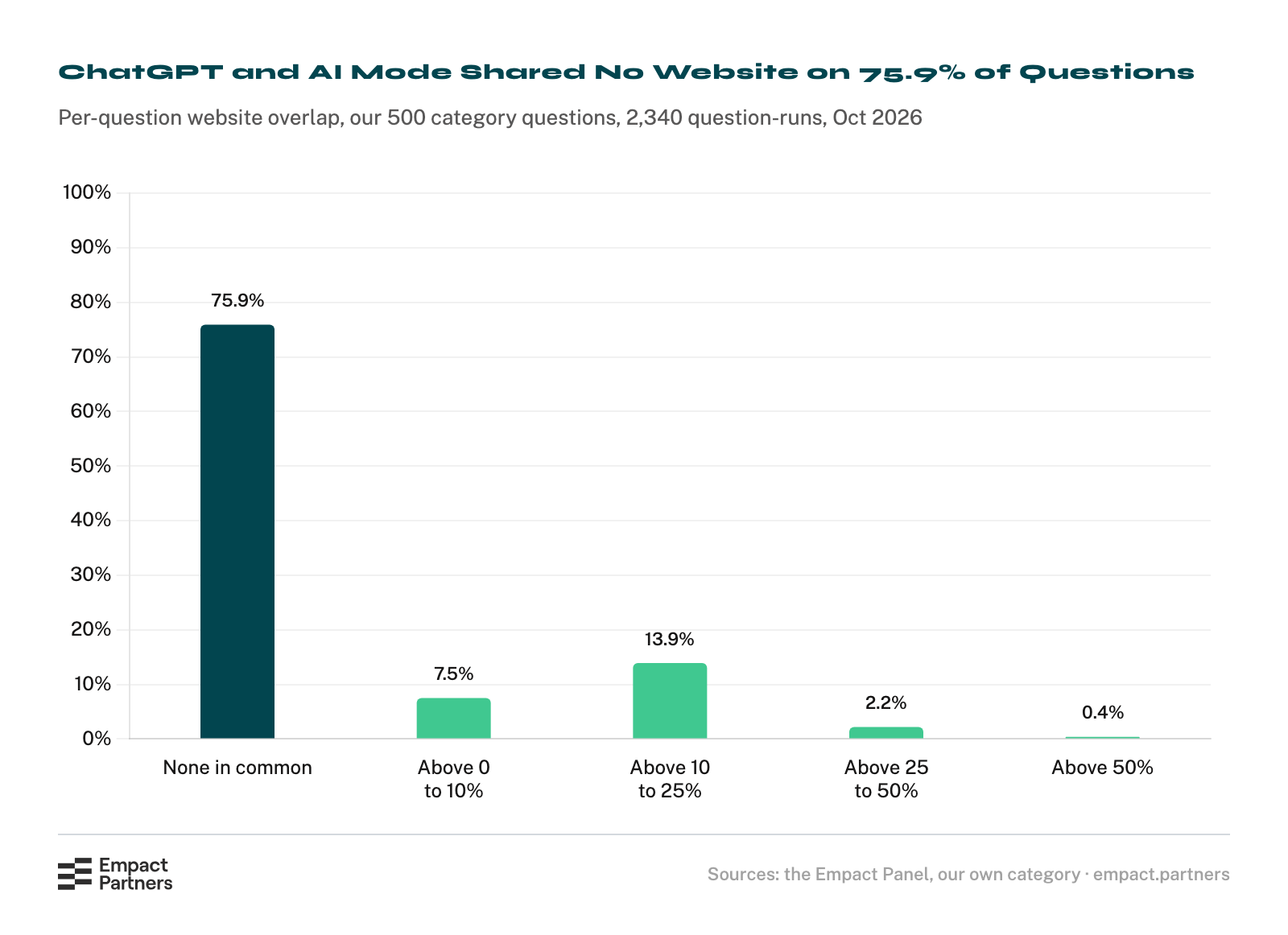
So a citation on one engine tells a brand almost nothing about the other. The engines are not reading separate webs, either: over the month 453 websites were cited by both somewhere, 17.8% of the 2,541 either cited.1
Both engines know many of the same sites and pick different ones for each question, which is why a list of the sites “AI cites” in a category, built from one engine, misleads on the other.
Empact Partners splits the visibility number into one line per engine at the start of every GEO audit, before anyone decides what to work on, and the Panel’s weekly reports for the partners whose GEO we run keep the engines apart for the same reason.


Each Engine’s Most-Cited Websites Are a Different List
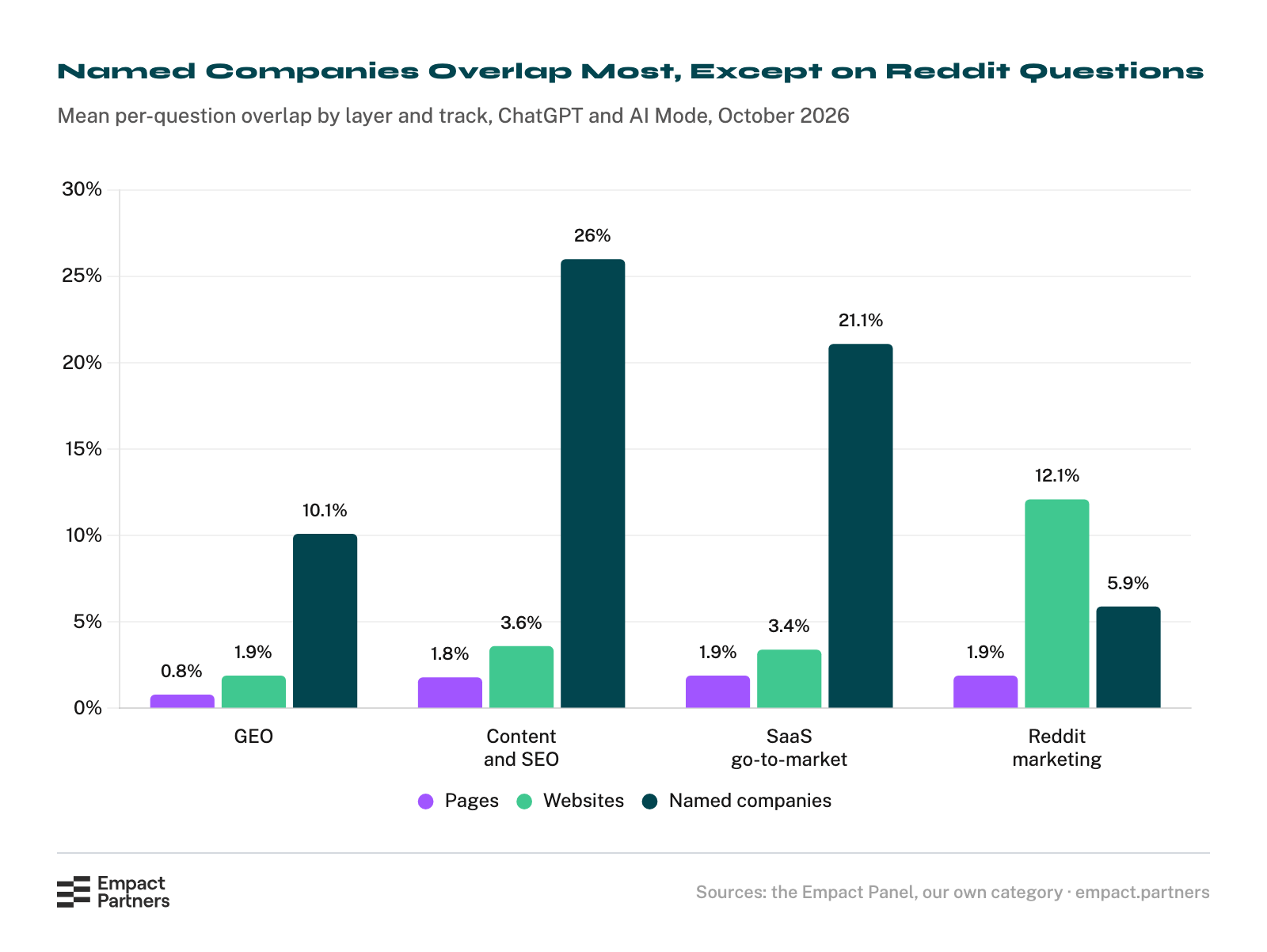
Rank the websites each engine cites by the share of its answers that cite them, and the two top-20 lists for our category share 6 of 20.1 The rest differs in kind as well as in name:
The public platforms split the other way, Reddit and LinkedIn above all:1

Asked which firm to hire, ChatGPT reads the firms’ own websites, and mostly not their ranked lists: 21% of the firm pages it cited were titled as one, against 55.4% of AI Mode’s.1 AI Mode reads what people post on Reddit and LinkedIn. Claude, on its 50 questions, leans on Wikipedia instead: 16.3% of the answers its search returned.1
The split maps onto how we run GEO, which we write as GEO = UGC + Mentions: the conversation buyers have about a brand on public platforms, and the third-party pages that name it. In our category AI Mode leans hard on the first half, while ChatGPT reads the companies’ own websites before either.
The Reddit and LinkedIn presence we build for partners sits where AI Mode reads. For ChatGPT the first job is the partner’s own pages, which is where our Content Marketing work takes over.
Our category is one category. Qvery’s GEO Agent puts the buyer questions it tracks to ChatGPT and Google AI Mode daily and keeps the answers, 724,399 of them since October 2025,4 and its September read of crypto buying questions found the same mirror with other names in it. Share of exchange answers citing each review site:5
| Review site | ChatGPT | Google AI Mode |
|---|---|---|
| Coin Bureau | 26.69% | 0.86% |
| NerdWallet | 2.12% | 36.21% |
| Investopedia | none | 33.62% |
Both engines cited about as many websites per answer, 3.64 against 3.21,5 so the split is a choice of sources and not a difference in volume. Qvery is our sister company and sells the measurement it describes, so give its figures the scrutiny you would give any vendor’s, and check the method printed under each linked article before leaning on one.
Across Four and Five Engines, Most Cited Websites Appear on One Only
The larger studies ask more engines and find the same thing at scale. Writesonic put 161,286 prompts to ChatGPT, Gemini, Perplexity and Google AI Overviews and published the comparison in July 2026, matching websites prompt by prompt. On the 70,879 prompts where all four cited something:
Wellows counted 22.7 million citations from five engines (ChatGPT, Gemini, Perplexity, AI Overviews and AI Mode) between January and June 2026, on questions from the brands it tracks, 84% of them asked in the US. On the 531,889 questions all five answered with a source, 79.6% of website citations reached one engine only, and 0.31% reached all five.2
At the exact page the split is wider. Kevin Indig’s Growth Memo, on a random 20,000 prompts from Omnia’s monitoring pool (mostly European markets, published May 2026), found 91.07% of cited URLs in only one of ChatGPT, Perplexity and AI Overviews, and 2.37% in all three.7
Our own run asked a different set of questions: 120 B2B software buying questions, once each, of ChatGPT, Google AI Mode, Gemini and Claude on 4 November 2026. 80.8% of website citations came from one engine only, and 0.5% from all four.8 Pair by pair, the engines shared between 5.8% and 13.8% of their websites per question.8
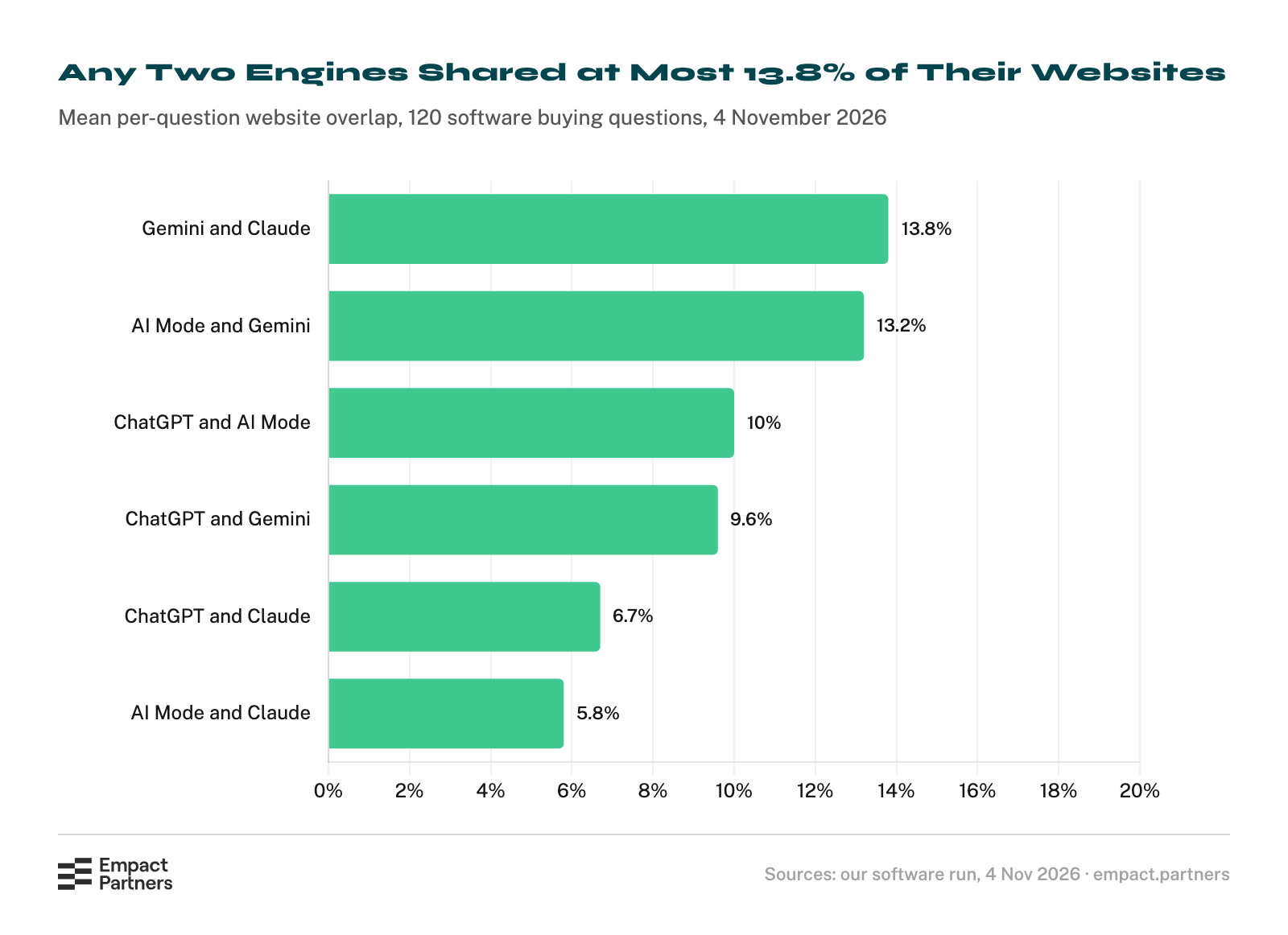
Four instruments, with different engines, markets and questions, and one shape: most of what any engine cites, no other engine cites for the same question. The share every engine agrees on stays under 4% in all four.
Google’s Two Search Surfaces Share More With Each Other Than With ChatGPT
The pair that overlaps most is Google with Google. In Wellows’ data AI Overviews and AI Mode shared 24.5% of websites per question, against an average of 7.3% for engines from different companies.2 ChatGPT sits at the far end: 76.3% of its sources were cited by none of the other four engines on the same question, against 49.7% for AI Mode.2
Even Google’s pair is far from one engine. Ahrefs compared the AI Overview and the AI Mode answer to the same query on 540,000 US query pairs from September 2025 and found 13.7% of citations in common,9 while the two answers were 86% alike in meaning across 730,000 pairs.9 Reading the answer tells you nothing about which pages fed it.
| Pair | Measured by | Shared | Unit |
|---|---|---|---|
| AI Overviews and AI Mode | Wellows | 24.5% | websites |
| AI Overviews and AI Mode | Ahrefs | 13.7% | citations |
| AI Mode and Gemini | Our software run | 13.2% | websites |
| ChatGPT and AI Mode | Our software run | 10% | websites |
| Engines from different companies | Wellows | 7.3% | websites |
For a team choosing where to start, that makes the Google surfaces partly one job and ChatGPT a second one. Work that earns citations in AI Overviews carries some of the way into AI Mode. Nothing in these figures says it carries into ChatGPT.
Brands Carry Over Between Engines More Than Pages Do
One layer up, the picture changes. Wellows measured the same questions three ways: two engines landed on the same exact page 6.8% of the time, the same website 10.9%, and the same named company 30.3%, counting only pairs where both named one.2
Our category climbs the same ladder from lower down: 1.3% of pages, 4% of websites and 15% of named companies in common per question.1

The tops of the two engines’ lists for our category make the same point at a glance.1
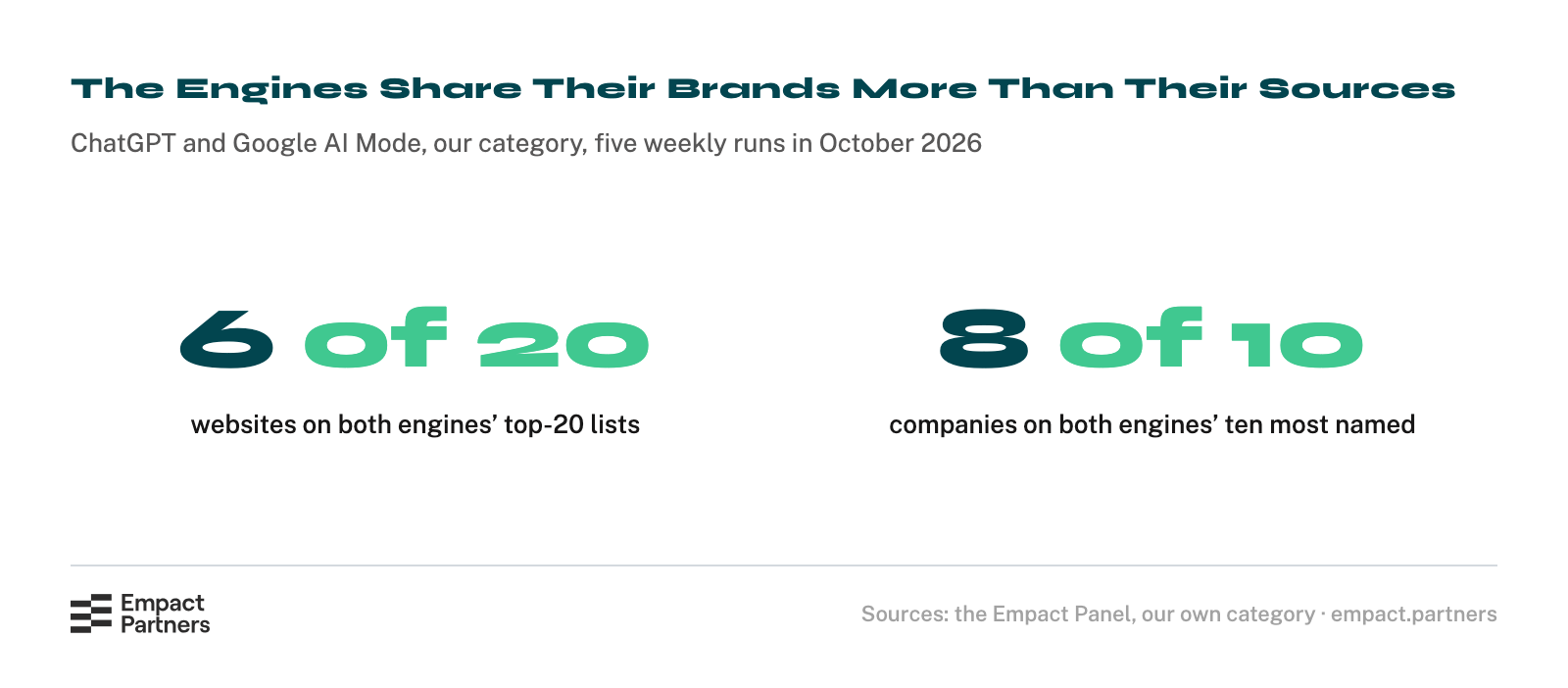
The ladder holds in three of our four tracks. On the Reddit-marketing questions websites overlap more than companies, 12.1% against 5.9%,1 because what both engines cite there is mostly Reddit itself: 154 of the 191 shared websites.1 GEO questions overlap least, at 1.9% of websites.1
Three instruments measure carryover one brand at a time, how often the second engine names a company the first one named, and each uses its own ruler:
| Direction | Who is counted | Measured by | Carried over |
|---|---|---|---|
| AI Overviews to AI Mode | every person or brand named | Ahrefs9 | 61% of response pairs |
| ChatGPT to AI Mode | one company, its own buyer questions | Qvery3 | 80.98% of the time |
| AI Mode to ChatGPT | one company, its own buyer questions | Qvery | 56.15% |
| ChatGPT to AI Mode | every company in our category | Empact Panel1 | 23.4% |
Qvery counts one company on questions written about its own market. Our Panel counts every company either engine names across a category, long tail included. A company asked about on its own questions keeps most of its naming across engines, and across a long tail about a quarter carries.
The mentions are the half of GEO that travels. A brand named in a thread, or on a page an engine already reads, gets that credit on whichever engine reaches it, while a page built to be cited works on the engine that cites it.
Empact Partners runs both halves in one GEO roadmap for that reason: the mentions are built once, and the citation work is planned engine by engine.
A Blended Score Can Rise While One Engine Drops You
Qvery’s August records for the business software companies its GEO Agent tracks put a number on what averaging hides. The typical company was named in 19.38% of ChatGPT’s answers and 47.50% of AI Mode’s,3 and it was a regular on AI Mode only, named in half its answers or more, on 18.48% of its questions, against 2.40% on ChatGPT only.3
One company’s two months show the failure in a single row. Between July and August its ChatGPT rate fell, its AI Mode rate rose by more, and so the average of the two went up.3 The blended number reported a better month in the same weeks ChatGPT was dropping the company.
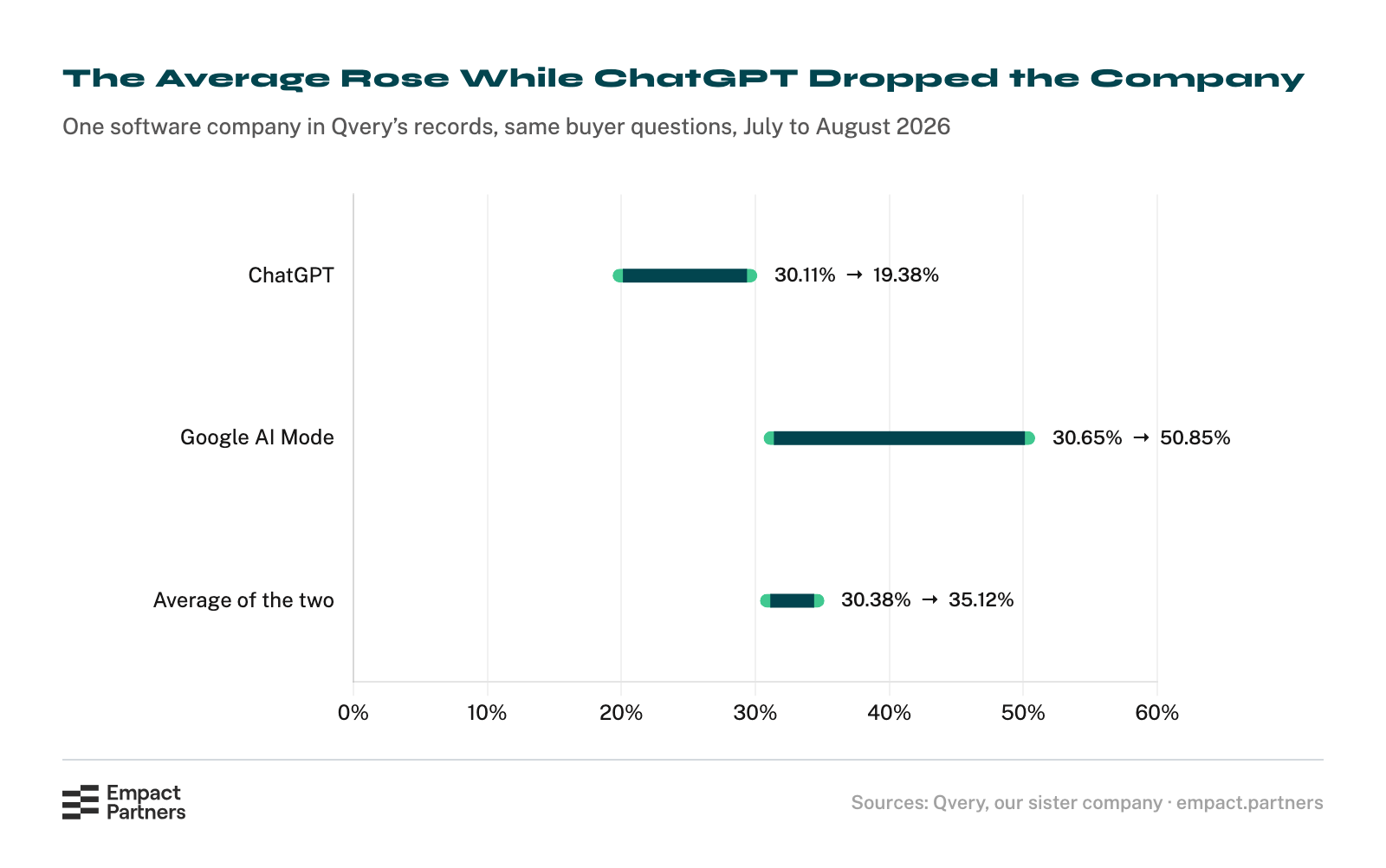
Put together, these figures settle the order of work for a team that has one number and has to decide what to do with it:
- Give each engine its own line. Report the average beside the lines, never instead of them, because it can rise in the month one engine drops you.
- Start where the gap is and where your buyers ask. In Qvery’s software records ChatGPT named the typical company less than half as often as AI Mode did, so for most of those companies the first gap was ChatGPT’s.
- Read that engine’s own source list before planning. In our category ChatGPT’s list is the firms’ own websites and AI Mode’s is Reddit and LinkedIn, so the same quarter’s work lands on different engines.
- Treat AI Overviews and AI Mode as partly one job. They share more than three times as many websites as engines from different companies do.
- Build brand presence once. Named companies overlap several times more than pages do, so the mentions work carries to every engine.
A GEO partnership with Empact Partners runs in that order. It opens with an audit that splits the partner’s visibility by engine and reads each engine’s sources, then a roadmap that puts the mentions work and the engine-specific source work in motion together, owned by a named senior consultant who works in the partner’s own channels.
From there the Empact Panel’s weekly reports keep every engine on its own line, and the horizon is quarters rather than weeks, because GEO takes months before momentum shows.
Watch one thing for the next quarter: each engine’s line on its own, and under it the share of that engine’s answers that cite a page you own or a page that names you. When the two lines move apart, the average sits between them and looks steady, and the lines are the reading to act on.
If your AI visibility report gives you one number and you need to know which engine is leaving you out, book a call with me, and let’s see whether we could work together.
Sources
- Empact Partners, the Empact Panel, our own category: 500 questions on B2B marketing services and AI visibility asked of ChatGPT and Google AI Mode from the US, Germany, the UK and the Netherlands, with a fixed 50 of them asked of Claude (the pages its web search returned), five runs on 4, 9, 18, 23 and 30 October 2026, 5,250 answers, compared question by question within each run; read 6 November 2026.
- Wellows, “89% of What ChatGPT Cites, Perplexity Never Touches”, 2026.
- Qvery, “Measuring AI Engine Visibility for SaaS When ChatGPT and Google AI Mode Disagree”, 2026.
- Qvery, our sister company, the GEO Agent’s records: 724,399 completed answers, ChatGPT since 28 October 2025 and Google AI Mode since 18 December 2025; read 6 November 2026.
- Qvery, “The Crypto Review Sites ChatGPT Cites Are Not the Ones Google AI Mode Cites”, 2026.
- Writesonic, “Do AI Engines Cite the Same Sources? We Studied 161,286 Prompts Across 4 Platforms”, 2026.
- Growth Memo (Kevin Indig), “The Consensus Gap”, 2026.
- Empact Partners, our software run: 120 B2B software buying questions in 15 categories, US English, one answer each from ChatGPT with web search, Google AI Mode, Gemini and Claude (Sonnet 4.6 with Anthropic’s web search tool; the pages its answer cited), 4 November 2026; read 6 November 2026.
- Ahrefs, “Are AI Mode and AI Overviews Just Different Versions of the Same Answer? (730K Responses Studied)”, 2025.


