


If your team has already read the engines’ own guidance, do not buy it another AI search course. The guides are free and the tactics are public. What decides whether ChatGPT or Google’s AI Mode names your product is work on pages you do not own: the list articles, review pages, and threads its answers quote.
That work needs one owner, a fixed set of buyer questions to aim it and to judge it, and quarters rather than weeks. A course can explain all three. It cannot be the owner, and it cannot wait out the quarters. The exception is a team that cannot yet read an AI answer for its sources, and that team should buy the teaching first.
Empact Partners is a consultancy that has sat inside software companies’ marketing teams since 2020, running their B2B go-to-market work. Getting a partner named on the pages AI engines quote is the core of our Generative Engine Optimization work, so we sell what this verdict recommends. It also costs us a sale: a team without the basics should buy the course first.
Google’s Guide Already Covers the Pages You Own
A widely shared argument this October said most teams paying for AI search training do not need it, because the engines’ own documentation is free. It got the documentation right.
Google’s guide to its AI features says a page has to be indexed and eligible to show with a snippet. Beyond that there are “no additional technical requirements,” and specific optimization “isn’t required” for AI Overviews or AI Mode. The word that dropped out as the argument spread was technical, and it scopes the guide to what Google needs from a page you control.
When we counted what Google’s own AI Mode cites in our own category, most of it came from pages somebody else wrote. No webmaster guide can make a stranger add your product to their list. That takes outreach, asking someone who owes you nothing for a yes, and the skill is closer to selling than to search.
Getting Named on Other People’s Pages Is a Sales Pipeline
We count this work the way a sales team counts a pipeline, because that is how it behaves. Across the mention campaigns we have run for nine partnerships, we have pitched 1,310 publishers by email. Of those, 154 agreed and 110 of the pages are live, which is about twelve pitches for every page that now names a partner’s product.
For most of it, we find the software list articles in the partner’s category and ask the people who wrote them to add the partner where it fits, a method we call Existing Article Outreach. A yes, when it comes, comes fast: the median placement went live ten days after the first email.
The slow part is everything around the yes. Separately from those campaign counts, we read every thread in which a publisher wrote back, 438 of them between May 2025 and early November 2026, and recorded how each one ended as the thread itself tells it. More ended in a no than on a live page, and about a third turned on a request to be paid.
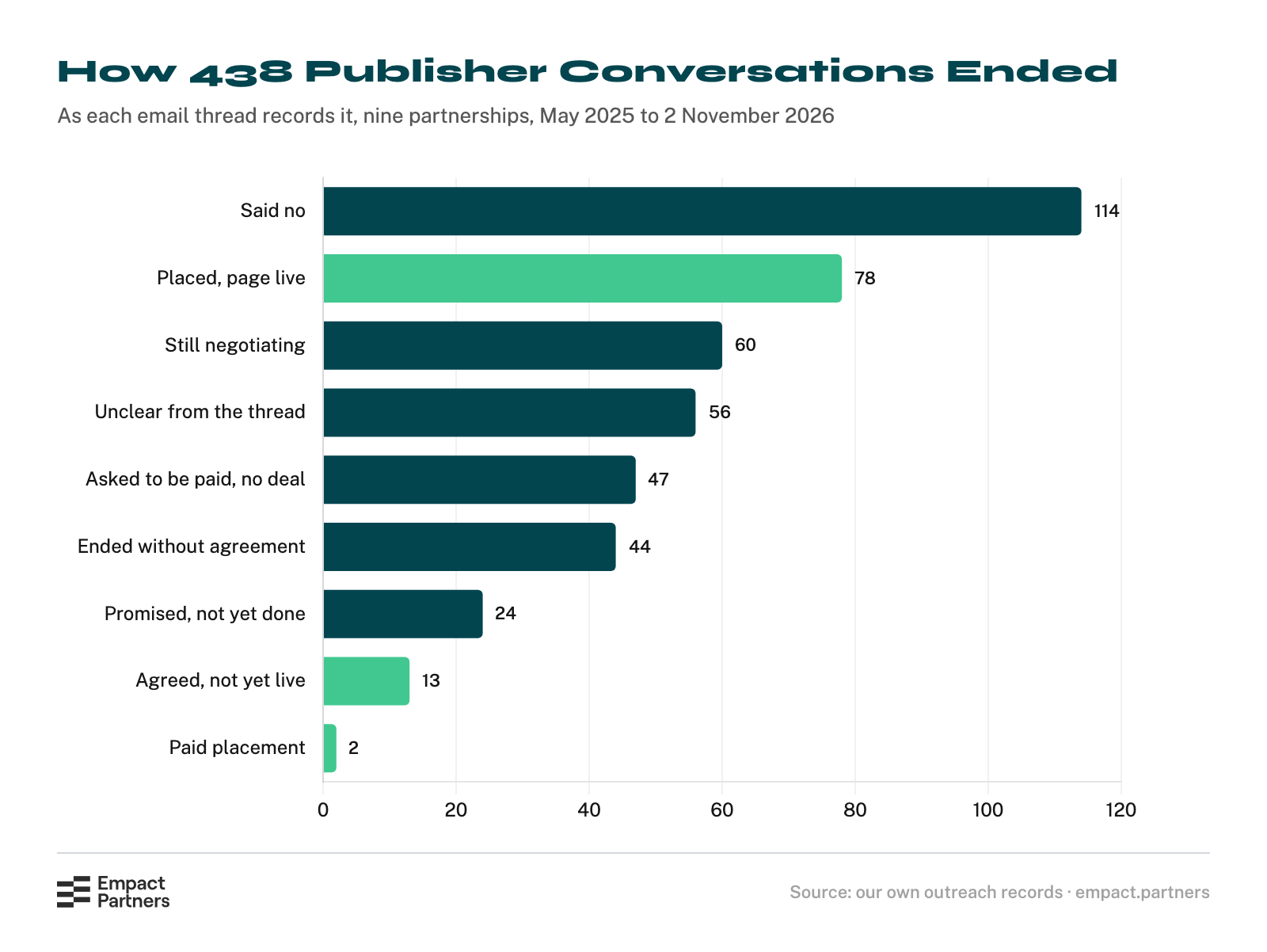
None of that is a knowledge problem. Anyone on your team who has read about AI search knows list articles matter. Knowing it does not send the fortieth email of the week. Someone has to send it, answer the editor who wants money for the slot, and check a month later that the entry is still on the page, because some entries disappear.


We Owned the Outreach and Still Pitched the Wrong Pages
An owner is necessary, and our own record says it is not enough. We drew up our outreach lists from databases of software list articles, picked for fit and for the publisher’s standing, before we measured every week what the engines cite for each partner. The measurement showed how much of the work had landed on pages the engines were not reading.
Of the 118 placements we had secured through outreach and could follow in the weekly reports from mid-September to early November, an engine cited 11 in an answer to one of the partner’s own tracked questions. Half of the 118 had been secured before that partner’s first weekly report existed.
The other 107 are real, verified entries on live pages. In eight weeks, no engine we track cited one of them for those buyers’ questions.

The Empact Panel is the measurement we built for that. With each partner we write the questions its buyers ask, approve the set, and freeze it before the first answer is collected. Changing one word stops collection until the set is approved again.
Every week ChatGPT and Google AI Mode get the same questions, and Claude a sample of them. The report that comes back ranks the cited list articles that leave the partner out, heaviest first, and names the domain to pitch first. Our outreach now starts from that list, a rule we wrote down in November 2026.
A cited article that leaves the partner out is the best target there is. Picking that page is where the measurement does its work, before the first email goes out.
But My Team Still Needs Somewhere to Start
That objection is fair, and for some teams it settles the question. A team that has never read an AI answer for its sources needs teaching before it needs an owner. And a program where someone checks the team’s work against the same questions every week is a different purchase from a course, and close to what this argument asks for.
For a team past that line, the start is four decisions, and none of them needs a syllabus.
Those four decisions are also how a Generative Engine Optimization partnership with us opens. We start with an audit, then write the questions with your team and freeze the set on the Empact Panel. A named senior consultant owns the outreach and the community threads, and each week a report names the next page to pitch.
Fund the Owner and the Questions Before Another Course
If your team already knows the material, put the next course’s budget into one person’s time on the outreach and into a set of questions nobody will touch for a year. Then wait, which is the hard part.
How long to wait is the part we can answer least precisely. Our published horizon for this work is three to six months before momentum shows and a year or more before the visibility is significant.
Our weekly reports cover eight weeks, too short to say how long a new placement takes to appear in an answer. That is why the questions have to stay unchanged: an unchanged set is the only way to hold anyone to that horizon, us included.
If your team knows the material and the answers in your category still name three competitors and not you, pick a time in my calendar and we’ll find out whether this is work we should run together.


