
Get Your SaaS Product Considered for Existing Listicles
Get your SaaS product onto the comparison listicles buyers and AI answers read: pick them, write the request, measure the demand.
 Gia RadnaiWith
 Vlad Shvets and
 Sharné McDonald
On this page
Empact Newsletter
One email a month on what is working in AI search and SaaS go-to-market.
The comparison listicles your buyers read can leave your product off, and often the editor simply doesn’t know your product exists. Writing to every “best” listicle a search turns up spends time on pages your buyers may never read. Pick a few and send each editor one good request.
We use the name Existing Article Outreach for writing to the editor of a published comparison listicle and asking them to consider your product. It is one part of building mentions, the digital public relations (PR) work of getting your product named on other people’s sites. The goal is leads that fit what you sell, and a placement is only the first step toward them.
AI answers now lean on those listicles. Over ten weekly rounds from September to November 2026, the Empact Panel we run for one partner recorded its buyers’ answers citing 62 best-of listicles, and only one of them named the partner. The ranking below shows who the listicles named instead.
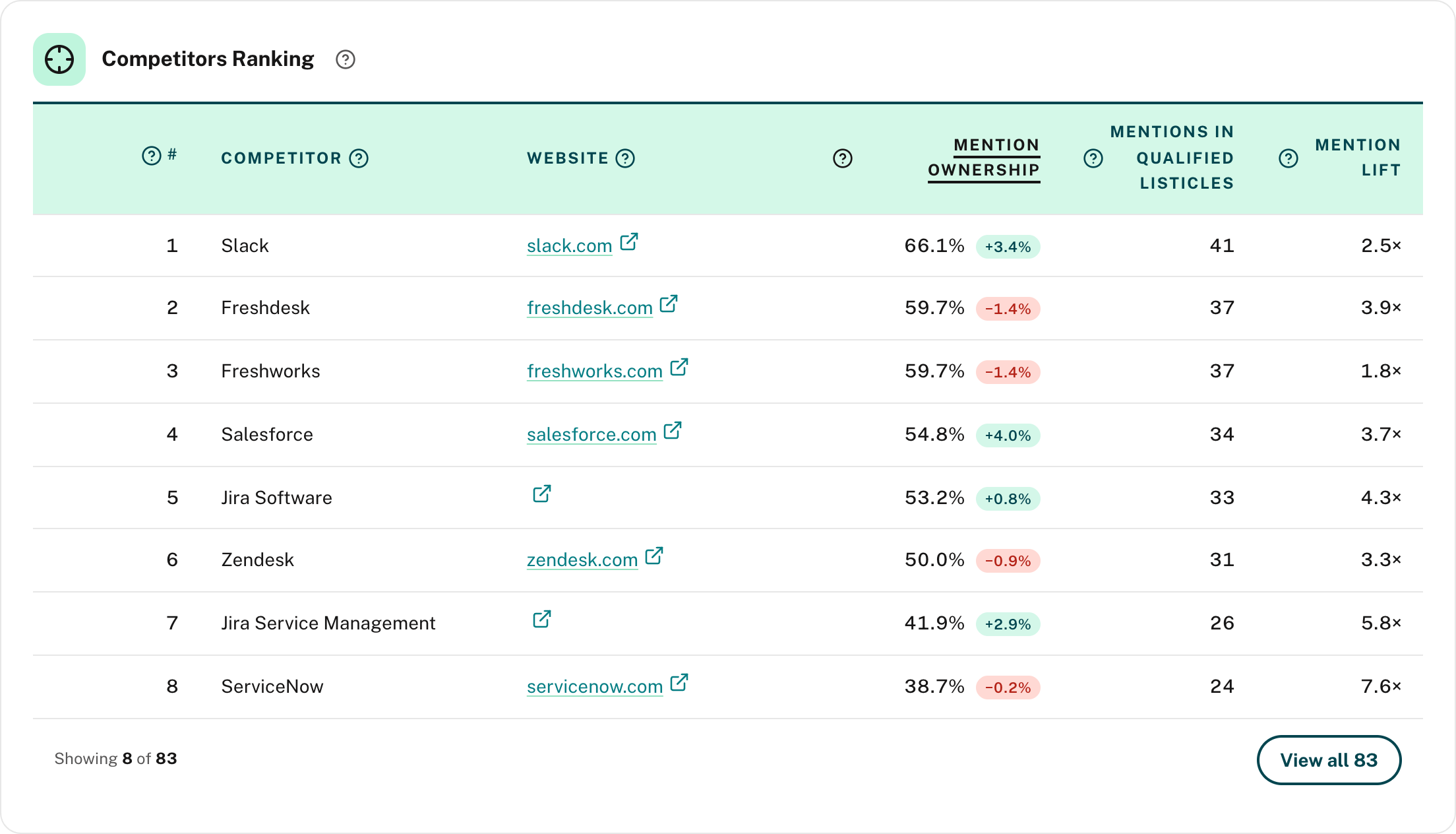
We keep the partner anonymous, and the rivals in the ranking are real. We counted a listicle only if at least 1 in 200 of the answers with sources cited it. The leading rival is on 41 of the 62 listicles, and five more rivals are on at least half of them 1.
Empact Partners writes to the editors of listicles like these for SaaS companies, so their products get named where buyers and AI answers look. When 61 of the 62 leave a partner out, the first job is deciding which of them are worth an email.
Why a Mention on a Comparison Listicle Counts Without a Link
Buyers often find the vendors worth considering on someone else’s comparison page before talking to any of them, so a name without a link still puts you in the comparison. It reaches the AI engines too. When Ahrefs studied 75,000 brands, mentions across the web tracked how often Google’s AI Overviews named a brand far more closely than backlinks did 2.
The correlation was 0.664 for mentions, a strong link, against 0.218 for backlinks, a weak one. So a placement can do two jobs. If it carries a link, it can send visits, which your analytics will show. Linked or not, it can reach the engines that read the listicle, which only their answers will show.
How to Pick the Listicles Worth a Request
A search for “best” listicles in your category returns far more pages than deserve a request, and a site-wide authority score says little about one page. Before you write to an editor, check the page against these five.
What each page has to pass
- Its readers are the buyers you sell to
- Your product belongs beside the ones already listed
- The page is kept up to date
- It ranks for your category’s searches, or AI answers cite it
- You can reach the person who edits it
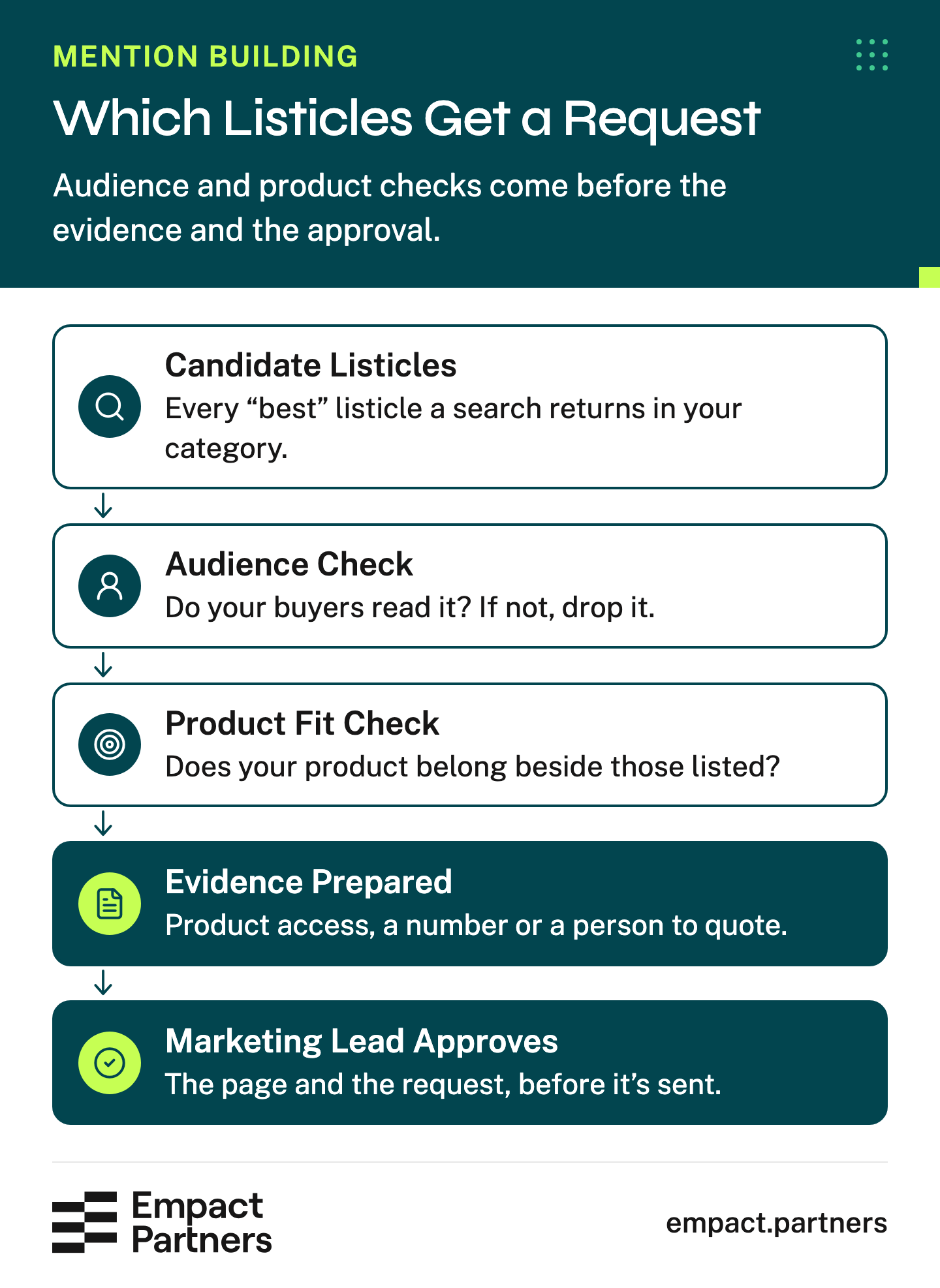
The audience check matters most, because a small blog your buyers read is worth more than a big publication they skip. Run the audience and product checks first, because they remove the most pages, and the other three on what is left. As the drawing below shows, the evidence and sign-off covered in the next section come only after that.
Finding the candidate pages is the slow part, and the report below does it for you. Run the Listicle Inclusion Report on your website to see which best-of listicles ChatGPT and Google surface in your category. It also shows who already made the cut and a way in for your product.
What to Put in an Inclusion Request
An editor has no reason to update a listicle for you, so the request has to make it better for its readers. Each request takes five steps, from a sign-off before anyone writes to a look at the live page afterwards.
Each request, in order
Get the page approved.
Have your marketing lead sign off the page and the evidence before anyone writes.
Say why it fits this listicle.
Name the reader or use case it doesn’t cover yet.
Offer something readers can use.
A trial account, a figure from your own data or an expert who can comment.
Write once, to one named editor.
A short email about one page, signed by a person.
Check the live page.
Confirm your product appears before you record the placement.
Steps two and three take the longest, because you have to read the listicle closely enough to see which readers it misses, and that gap is what your request argues.
An editor is most likely to add you when your product serves a reader the listicle misses.
Our four-page playbook covers the same ground with the AI engines in mind. It shows how to find the listicles ChatGPT and Google AI Mode cite for your buyers, earn an entry and count what changes.
How to Tell Whether a Placement Brought Demand
The placement itself, the AI citations of the listicle, the visits it sends and the leads it brings each tell you something different. Only visits and leads say anything about demand.
Scroll horizontally to see all columns when the table is wider than this page.
| What you record | Where you check it | What it tells you |
|---|---|---|
| The placement | The live listicle | The request landed |
| Citations of the listicle | The AI answers to your buyers’ questions | The listicle reaches the engines |
| Visits from the listicle | Referral traffic in your analytics | Readers clicked through |
| Leads | Your customer records’ source field, and asking new leads | Where buyers say they found you |
Even the lead record has a limit. The source field holds what the lead told you. It shows where they say they found you, and it cannot prove that the listicle made them buy. For an unlinked mention it is still the only trace, because a mention without a link sends no referral visits you can trace back to the listicle.
So judge each listicle on its visits and leads, over months rather than weeks, because AI search takes that long to build momentum.
Empact Partners plans this outreach in quarters for that reason. We would start with the cited listicles that name your rivals and skip you, since those already reach your buyers’ answers. Our consultants read each one closely, with AI agents helping on the research, so every request argues the gap that listicle leaves. The work covers four things:
Existing Article Outreach, as we run it
- A shortlist of cited listicles that name your rivals and skip you, each put through the five checks
- A request to each editor, built on the reader the listicle misses
- A log of each placement once it is live on the page
- A weekly look at the AI answers, which show whether a listicle reaches the engines while the leads build up
Frequently Asked Questions
Where should our first inclusion requests go?
To the listicles your buyers already read, in your own category, where your product would sit naturally beside the ones named. Prefer pages updated in the last year and pages the AI answers to your buyers’ questions cite, and skip any listicle whose editor you can’t identify. Niche blogs and software review sites usually pass these checks sooner than big general publications.
Can anyone guarantee a listicle will add our product?
No. The editor decides what the listicle includes, and a good request only makes a yes likelier. If someone guarantees inclusion, ask whether the spot is editorial or paid and what exactly the guarantee covers. A request that fills a real gap for the listicle’s readers, with evidence attached, is the best odds you can get without paying. When an editor says no, ask what would change their mind. The answer often tells you which listicle to try next.
Does a mention on a listicle help if it doesn’t link to us?
Yes, for consideration. Buyers read the name, and AI answers that cite the listicle can carry it into their recommendations. A link adds a path for visits and makes the result easier to measure. Count the two separately, and never refuse an unlinked mention your buyers read. If the editor is open to it, ask for the link once the mention is live. Give a reason that serves their readers, such as a page that explains the feature they wrote about.
How do we know whether a listicle placement brought leads?
Check referral visits from that page in your analytics and the source field in your customer records, and ask new leads where they heard of you. A placement alone proves only that the request landed. Give each placement a few months before you judge it, because many buyers read a listicle long before they contact anyone.
Can an AI agent send the requests for us?
An agent can draft them, which saves time. It can read each listicle, note who is on it and write the ask from facts you have approved. A person should send each request in their own name, after the marketing lead has approved the page and the evidence. The person who signs it answers for its accuracy and should handle the editor’s replies too.
What should we do when a listicle editor asks to be paid?
Decide it as a paid placement, separately from your outreach. A paid spot can rotate out or expire when the term ends, and it should be labeled as sponsored. If you’d rather not pay, answer with what the readers get instead, such as product access or a number worth citing. We cover the trade-offs in guest posts versus paid placements.
How long does an editor take to add a product?
There’s no fixed timetable, because most listicles are updated on the editor’s schedule rather than yours. Check the page’s last-updated date before you write, since a listicle refreshed last month may not change again for a while. If the page is updated without you, one polite follow-up is fair. A second is usually one too many.
Does being on a listicle help us appear in ChatGPT answers?
Being on a cited listicle can help. Best-of listicles are among the pages AI engines cite when buyers ask which tools to use. One that is already cited for your buyers’ questions is worth more than one that isn’t. Being on a cited listicle still doesn’t guarantee that the answer names you. Check the answers again a few weeks after the placement goes live.
How is Existing Article Outreach different from buying a placement?
Existing Article Outreach asks for editorial consideration on a listicle that already exists, and the editor keeps control of what it says. Nothing is paid, so nothing expires when a contract ends, and the placement stays while the editor thinks your product belongs. The cost is your team’s time. Readers also trust a listicle more when they know the editor picked every entry.
How many listicles should we approach in the first month?
Fewer than a search suggests. Start with the listicles that pass every check, which in most categories leaves a handful rather than dozens. A handful of well-made requests teaches you what editors in your category want, and the next batch gets better for it. Keep a note of every reply, including the refusals, because the reasons editors give are the cheapest research you will get on how your category sees your product.
What if a listicle names us but describes the product wrongly?
Write to the editor with the correction and a source for it, such as the current pricing page, a changelog entry or a screenshot. Editors tend to fix errors faster than they add products, because a wrong entry makes their listicle look stale. Check the AI answers that cite the listicle afterwards, since an engine can repeat the old description until it reads the page again.
Sources (2)
- Empact Partners, "Empact Panel mentions board for one partner, kept anonymous" (2026)Empact Partners' own data↩1the 62 verified best-of listicles its buyers’ questions drew citations to across the ten collections from September 1 to November 5, 2026 (ChatGPT, Google AI Mode, Claude), each cited in at least 0.5% of the answers carrying a citation, with the share of those listicles naming the partner and each rival.
- Ahrefs, "An Analysis of AI Overview Brand Visibility Factors (75K Brands Studied)" (2025)↩1

Keep reading
Mention Building How to Find the Software Roundups AI Engines Cite
Find the roundups AI answers cite, check whether they name your SaaS product, and choose which editors to approach.

Mention Building How To Earn Mentions When Your Site Has A Low Domain Rating
Get named in best-of listicles AI answers cite when editors reject your rating: offers they value, limits set early, your side delivered.

Mention Building When Cited Listicles Deserve Your Link Budget
Which listicles AI engines cite for software buyers, what our Panel data shows about listicles and links, and which ones to pitch.