Ask ChatGPT for the best CRM software and you get one shortlist. Ask it for the best CRM for a 20-person sales team that already runs on Google Workspace and you get a different one. We ran that pair of questions across 30 B2B software categories, and the brand ChatGPT named first changed in 21 of 30.1
Most teams still check their AI visibility with one bare prompt and a screenshot. Their buyers almost never ask the bare prompt. Empact Partners starts a Generative Engine Optimization (GEO) engagement by finding out what buyers type and what the engines answer when they do.
The buyer surveys say the same from the other side. Vendor research has moved into the chat window, and it arrives there carrying the buyer’s own situation.
Highlights
Read together, they describe a buyer who does the first round of vendor research in a chat window, in their own words, and then checks the answer somewhere you can see. The words decide the list. The check decides whether you stay on it. Both happen before anyone fills in a form.
B2B Buyers Do Their Vendor Research in AI, and Rarely in One Assistant
The first thing to settle is whether this is a habit or an experiment. It’s a habit. Semrush surveyed 622 US B2B professionals in March and April 2026, and its findings cover the 519 who use AI at work:
Those shares add up to far more than one tool per person, which is the finding. The average buyer in that sample uses more than one assistant, so a brand that checks one engine is checking part of the room.

G2 asked 1,076 software decision-makers around the world the same kind of question in March, and the picture is a heavy, settled user:
The people who sign off start there too. Of the 101 mid-market SaaS CMOs Wynter surveyed in January, 68% start their vendor search in an AI tool before a search engine, and 65% start in peer communities.6 Wynter says those answers describe its sample, not every buyer.
Responsive’s survey of 350 B2B buyers, published in October 2025, shows where the shift runs furthest. 80% of tech buyers use generative AI at least as much as search for vendor research, 21 points ahead of other industries, and 56% of tech buyers count chatbots as a top source for finding new vendors, against 28% elsewhere.8
The click, when it comes, mostly comes from one place. Demandbase counted ChatGPT-referred visits to the B2B sites on its platform at roughly 645,000 a month in June 2025. A year later:3

Over the same year, Perplexity referrals fell and Gemini and Claude stayed flat.3 So ChatGPT sends the traffic you can see. The research behind it is spread across several assistants, and most of it never clicks at all.
Buyers Type Their Situation, and the Situation Rewrites the Shortlist
If buyers spread their research across assistants, the obvious worry is the engine: are we in ChatGPT, are we in Gemini? The bigger lever turns out to be the sentence. The same Semrush sample says what buyers put into it:
So the buyer’s real question carries their situation, and fit is what gets a vendor noticed. Fame barely registers. The useful question is what the situation does to the list.
We measured that from the US, logged out, on the evening of 14 October 2026. ChatGPT and Google AI Mode each got one buying question in 30 B2B software categories: twice bare, and once with a constraint a buyer would add, such as team size, budget or an existing stack.
We listed the brands in each of the 179 usable answers and compared the lists.1 Measured as the share of brands two answers have in common:
The constraint also moves the top of the list. Asked twice, the first-named brand held in 23 of 30 categories on ChatGPT and 26 of 30 on Google AI Mode.1 With the constraint added, it changed in 21 of 30 on ChatGPT and 21 of 29 on Google AI Mode. The two engines named the same leader for 22 of 30 bare questions and for only 12 of 29 constrained ones.1

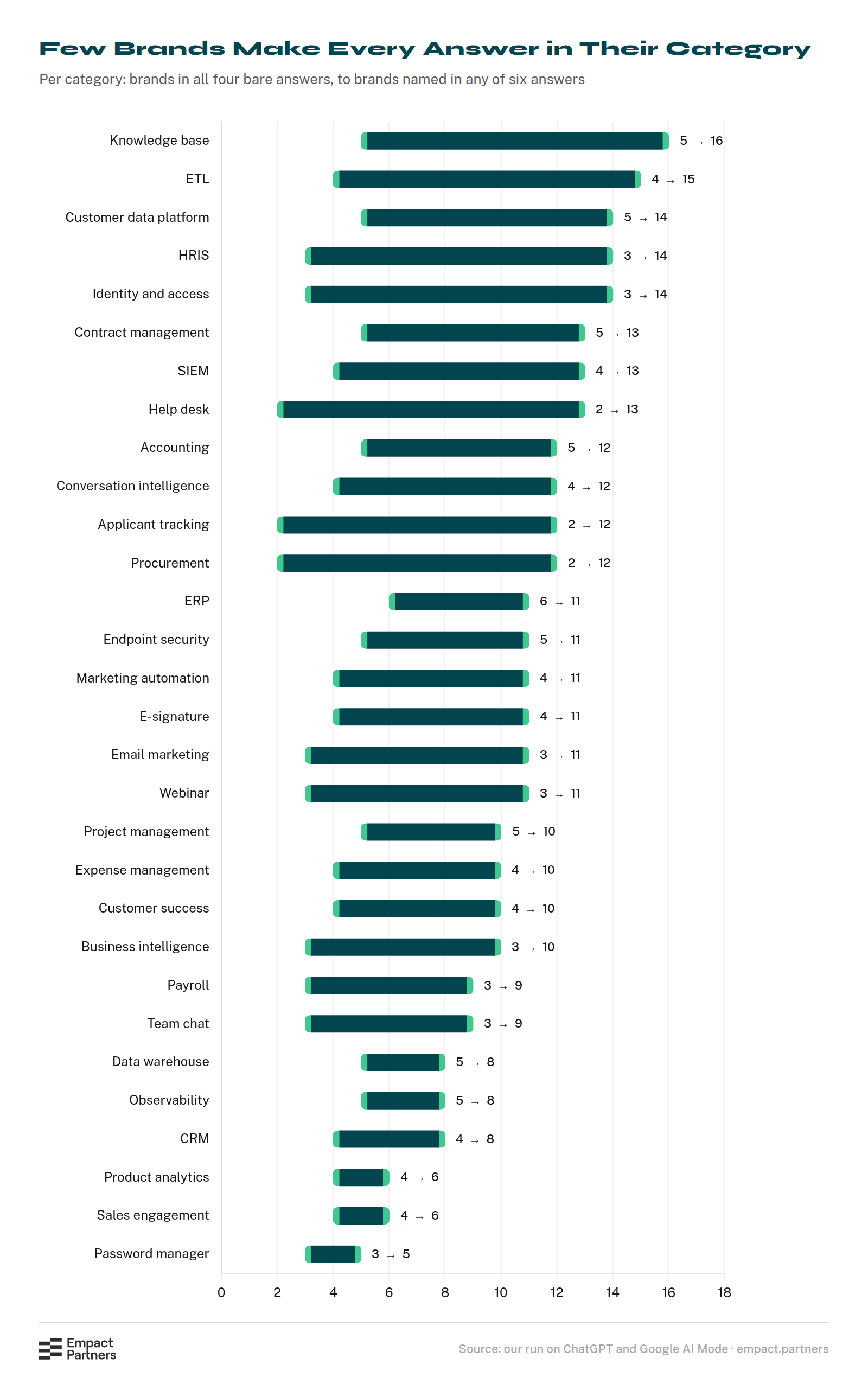
Under all that movement there is a small fixed point. In the median category, 4 brands appeared in every bare answer on both engines, out of 11 named anywhere in the category’s six answers.1 The rest of the shortlist depends on who asks, where and how.
The mechanism shows up in research by Qvery, our sister company, which measures how AI engines answer buying questions. Qvery ran paired bare and one-constraint buying questions on the same two engines in August. The bare questions were answered from review and roundup publishers, and the constrained ones from vendors’ own domains.9
The most-present outside source appeared in 12.00% of bare answers and 10.00% of constrained ones, so no single publisher owns either list.9 We built Qvery, so weigh that accordingly, and check its numbers rather than take our word for them.

.png)
The order of the levers is why our GEO workstream starts with the questions and not the engines. We pull the constrained questions out of a partner’s sales calls and run each one on both engines next to its bare twin, so the first report shows which situations name the partner and which don’t.
.png)
The Buyer Checks the Answer on Your Site, on Google, and With Your Rep
A list from a chat window doesn’t close a deal on its own, and buyers don’t treat it as if it could. The Semrush sample says what happens the moment an AI names a vendor:
The Google check is less of a mirror than it looks. When Qvery set the domains ChatGPT and Google AI Mode cited against Google’s organic top 10 for 922 tracked queries, 28.3% of ChatGPT’s queries had no cited domain ranking there at all, and 15.2% of Google AI Mode’s.10 A buyer who checks the answer on Google often lands on pages the answer never read.
Trust is rising and so is the checking. In TrustRadius’s January survey of 1,862 technology buyers, 54% say AI made research easier, up from 40%, and 72% always or very often verify what it tells them, up from 58%. At the same time 47% trust online resources less than a year ago, up from 39%.4

Asked how far they trust AI, 2% said always, 20% very often and 60% sometimes.4 Easier and trusted are not the same thing.
Part of that verification lands on your sales team. Gartner surveyed 645 B2B buyers in August and September 2025:
When an AI answer conflicts with a brand a buyer already trusts, 24% go to peer reviews next, in G2’s March survey.7
Put the check beside the run and the job splits in two. Getting named in the constrained answer is one job. Surviving the visit to your own pages is the other, and those are the pages the constrained answers are built from. That half is content marketing: pricing, comparison and use-case pages written for the situations buyers type.
The Shortlist Is Drafted Before the First Sales Call
By the time a buyer talks to anyone, the list has done most of its work. In the Semrush sample, 92% say AI has shaped their vendor shortlist, 45% of them significantly, and 66% have spotted vendors missing from AI results.2 Only 39% say most of their colleagues research vendors with AI, so the person who found you may be the only one who saw that answer.2
The people who sign show up prepared. Among Wynter’s 101 CMOs, 48% arrive “very familiar” with a vendor before the first sales call, up from 22% a year earlier.6 Responsive found 61% start with a preferred vendor in mind, and 45% are open to switching from it.8 TrustRadius found 67% ended up buying their first-choice product.4
The next step is already visible in G2’s June survey of 1,038 decision-makers:
An agent asked to build a shortlist will write the buyer’s constraints into its own questions. That makes the constrained answer matter more.
Where GEO Fits, and Why We Run It Beside Content
Empact Partners is a go-to-market consultancy that has run this work from inside B2B software teams since 2020, and Generative Engine Optimization is one of our six workstreams. We write it as GEO = UGC + Mentions: what real users say in public, and the independent pages that name you. The run above sets the order:
- The audit. The constrained questions from the partner’s sales calls, run on both engines beside their bare twins, so the gaps are counted per situation instead of guessed from one screenshot.
- The pages. Vendor-side pages that answer those situations, because that is what the constrained answers are built from and where the buyer’s check lands.
- The mentions. Outreach to the roundups and review pages that answer the bare question, which takes quarters, not weeks.
With Lative, a sales planning platform for RevOps teams, the category was too new for any buyer to type its name. They could only describe the problem. So we built the explanation from interviews with Lative’s team, its customers and outside experts, and published it as the eBook that defines Growth Efficiency, the term Lative was coining.
The measurement is ours, and it runs on Qvery. The number to watch is the share of your buyers’ real, constrained questions where both engines name you, counted across many questions, never one prompt. What our evidence can’t settle yet is how much of that becomes pipeline, because nobody measures the buyer who saw the answer and never clicked.
If your buyers are building shortlists in AI and you’re not sure which of their questions you’re missing from, book a call with me, and let’s see whether we could work together.
Sources
- Our run on ChatGPT and Google AI Mode: the same buying question in 30 B2B software categories, asked bare twice and once with one buyer constraint, United States, logged out, collected through DataForSEO on 14 October 2026; 179 answers, with the brands each named counted for this article, read 14 October 2026.
- Semrush, “How AI tools shape the B2B buying process: A survey of 600+ US business professionals”, 2026.
- Demandbase, “ChatGPT Referrals to B2B Websites Nearly Quadrupled in a Year, Demandbase Data Shows”, press release, 2026.
- HG Insights, “Trust More, Verify Everything”, on the TrustRadius 2026 B2B Buying Disconnect Report, 2026.
- Gartner, “Gartner Survey Finds 69% of B2B Buyers Turn to Sales Reps to Validate AI-Generated Insights”, press release, 2026.
- Wynter, “How B2B SaaS CMOs Buy Software in 2026”, 2026.
- G2, “New G2 Research: Half of B2B Software Buyers Now Start Their Research With AI Chatbots”, release of The Answer Economy report, 2026.
- Responsive, “GenAI Overtakes Search for a Quarter of B2B Buyers, Signaling a Major Shift in Enterprise Purchasing”, on the Inside the Buyer’s Mind report, 2025.
- Qvery, “How to Generate LLM Tracking Queries Without Doing It by Hand”, 2026.
- Qvery, “AI Engine Citations vs Google Organic SERPs: Only 13.9% Overlap”, 2026.
- G2, “G2 2026 Buyer Behavior Report”, 2026.