Of all the citations ChatGPT and Google AI Mode gave to “best tools” roundups in one B2B software category, across two weekly samples this autumn, 45% of those citations went to sites rated below 40 for Domain Rating. These were roundups published by someone other than the vendors they rank. In a consumer finance software category the figure was 60%.
Those pages are the ones a prospect list filtered at DR 40 throws away. If the list on your desk is sorted by rating, it rests on one assumption: the higher a site’s rating, the more a mention there is worth in an AI answer. Placement price sheets rest on it too. For AI visibility it runs backwards, and the rating is the last thing to sort by.
Empact Partners is a go-to-market consultancy that works from inside B2B software companies’ marketing teams. In Generative Engine Optimization, or GEO, the workstream that gets partners named when buyers ask an AI engine their category question, this sort is the first thing we run on a mention list.
Domain Rating Became the Price of a Mention Because It Is One Number
Domain Rating is Ahrefs’ score of how strong a site’s backlink profile is, from 0 to 100, on a logarithmic scale. Moving from 70 to 80 takes far more links than moving from 20 to 30. Moz’s Domain Authority and Semrush’s Authority Score do the same job with their own data, so the argument applies to all three, though our numbers use Ahrefs’.
The rating became the currency of placements for reasons that made sense when links were the thing being bought:
None of those reasons is about AI visibility. Our own link-building work weighed authority and traffic together for years, and for links it was the right filter. A mention program inherits that filter by habit, and the habit has a cost: the rating describes a domain’s links, and an engine choosing what to quote is not reading links.
The best case for domain rating, stated fairly
The authority camp has real data. SE Ranking studied 129,000 domains and 216,524 pages across 20 niches and found that sites with more than 32,000 referring domains were 3.5 times as likely to be cited by ChatGPT as sites with up to 200. Big, heavily linked sites do get cited more, across the web as a whole.
Ahrefs, which created the metric, looked from the other side. In its study of 75,000 brands, how often ChatGPT named a brand tracked the brand’s web mentions about two and a half times as closely as the brand’s own Domain Rating. Both findings are correlations, and both hold at once.
The two studies answer different questions. SE Ranking’s answers whether a site gets cited for something, somewhere. Yours is narrower: which of the sites showing up in your own category’s answers deserve an approach? That question needs no forecast, because you can look.
An Engine Picks the Page That Answers the Question, Not the Domain
An AI answer with sources is a search run on the buyer’s behalf. ChatGPT and Google AI Mode break a question into smaller searches, read what comes back, and quote the pages that answer each part. Take “best expense software for a 20-person team”:
Domain rating enters at step two and nowhere else. A heavily linked site ranks for more searches, so its pages land in the pool more often. Google AI Mode draws on Google’s own index, where that effect is strongest. ChatGPT runs its own search and leans on it less.
Step four explains the page in a citation report that seems to be about something else. The engine cited it because it backed one minor claim, a definition or a price, inside an answer about your category. That is a citation, and it is not a sign of fit, which is why every candidate gets a relevance check before anyone counts it.
About Half of Roundup Citations Go to Sites Below DR 40
We took every citation in the 36,000 ChatGPT and Google AI Mode answers our panel collected for one B2B software category on 30 September and 7 October 2026, and the 4,000 from a consumer finance software category on 15 and 25 September. We then looked up Ahrefs’ Domain Rating for the 3,000 most-cited sites, about nine in ten of all citations.
The cut that matters for mention building is the third-party roundup: a “best X tools” list published by someone other than the vendors it ranks. It is where a mention is won by asking, and the engines lean on roundups hard. A roundup of some kind sat among the citations of 59.6% of B2B answers that cited anything, and of 54% in the consumer category.
In the roundups, the ratings stop lining up with the citations. In the B2B category, 45% of the rated roundup citations went to sites below DR 40, and a floor of DR 50 would have discarded 58% of them. In the consumer category, 60% sat below 40, and 41% below DR 20.
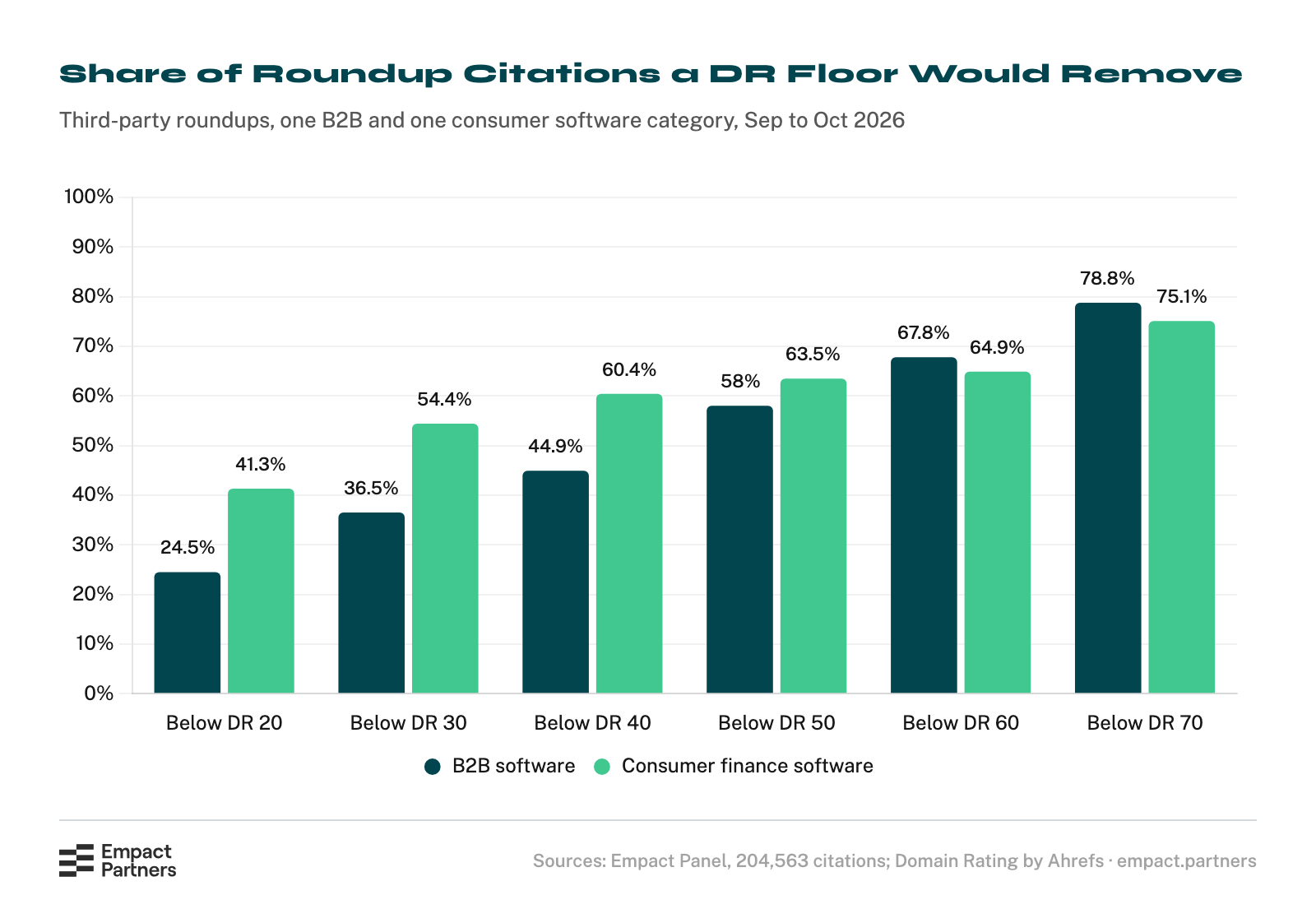
The top of the list says it more bluntly. Of the 50 roundup sites the two engines cited most in the B2B category, 21 rated below 40, 12 of them below 20, and only five rated 80 or higher. In the consumer category, 36 of the 50 rated below 40 and 26 below 20. The most-pulled independent lists in both markets are small sites.
Where the high ratings sit
The high ratings are in the citations too, on two kinds of site. Platforms, meaning Reddit, YouTube, LinkedIn, and review directories such as G2, have a citation-weighted median rating of 99 in the B2B category and 95 in the consumer one. The vendors’ own pages sit at 77 and 71.
Platforms and vendors’ pages are sites you join, review on, or own, and none of them is won by an editor saying yes. So the rating does predict something in AI answers: the platforms and the established vendors.
In the editorial middle, where mention building happens, it says little about which pages get pulled, and a filter built on it removes about half of what the engines read.
.png)
A fair worry is that a site rated 3 is a spam site. Our panel checks every roundup site it cites and tags it legitimate, uncertain, or spam, and it put 1.8% of B2B roundup citations on domains it judged spam. A small rating usually means a young or narrow site, not a fake one. Who runs it is still a question for the relevance check.
The one place domain rating does touch AI visibility
The engines differ in the direction the mechanism predicts. In the B2B category, 52% of ChatGPT’s rated roundup citations sat below DR 40, against 36% of Google AI Mode’s. Below DR 50 it was 67% against 47.5%. AI Mode reads Google’s index, where heavily linked sites rank more often, so its roundups skew toward higher ratings.
If AI Mode is the engine your buyers use, rating deserves a little more weight as a tiebreaker. If ChatGPT is, it deserves less. Ahrefs found the same tilt across its 75,000 brands, with Domain Rating tracking visibility most closely in Google’s AI Overviews, then AI Mode, and least in ChatGPT.

.png)
The Kinds of Site, and the Job Each Does Inside an Answer
A mention list mixes site types that behave nothing alike. Each plays a different part in an answer, is reached through a different person, and is won with a different ask, which is why we sort a list by type before we score anything in it. The weights below are the share of answers in our panel that cited each type at least once.
| Kind of site | Share of answers citing it (B2B / consumer) | Its job inside an answer | What you ask for |
|---|---|---|---|
| Roundups and “best X” lists | 59.6% / 54% | The shortlist: which products exist and how they rank | Inclusion, from the editor or the site’s marketing contact |
| Vendors’ own sites, yours and competitors’ | 77.1% / 66.6% | Product facts, pricing, documentation | Nothing: you publish yours, and check a competitor’s list for an omission |
| YouTube | 8.1% / 6% | Demos and explanations, mostly in Google AI Mode | A review or walkthrough from a creator who uses the product |
| Reddit, forums, and Q&A | Reddit 7.1% / 11.9% | Lived experience: what users say after buying | Nothing: you take part, as yourself |
| 7.6% / 0.8% | A practitioner’s view, in B2B answers | Posts and comments by people, not the brand page | |
| Review and directory platforms | 4.7% / 1.6% | Ratings and social proof | Reviews from real customers |
| Media and trade publications | Not counted separately | Validation and news | A quote, a data point, or a story worth reporting |
Two things in that table run against instinct. Platforms are a small slice of software answers: together they carried 6.6% of the B2B citations and 4.9% of the consumer ones, against roughly two in five for the vendors’ own pages and about a fifth for roundups. And the roundups are where the shortlist forms.
In the AI search citation statistics we published in September, a vendor listed on a cited roundup was named in 52.6% of ChatGPT’s answers, against 11.2% for one the roundup left out, an association rather than proof that the listing caused the naming. It is still the strongest reason we know to treat roundups as the first column of targets.
Most of those roundups are published by software companies, often ones that sell beside you rather than against you: a payroll vendor’s blog ranking expense tools, a CRM’s list of email platforms. In the same count, three in four cited roundups, 74.8%, lived on a software company’s own site. Those lists are approachable, and the ask goes to marketing.
The Mix Follows Your Buyer
The same table, filled in for a different market, comes out a different shape. B2B buyers read practitioners and review platforms. Consumer buyers read other consumers. In our panel LinkedIn appeared in 7.6% of B2B answers and 0.8% of consumer ones, and review directories in 4.7% against 1.6%. Reddit went the other way, 7.1% against 11.9%.
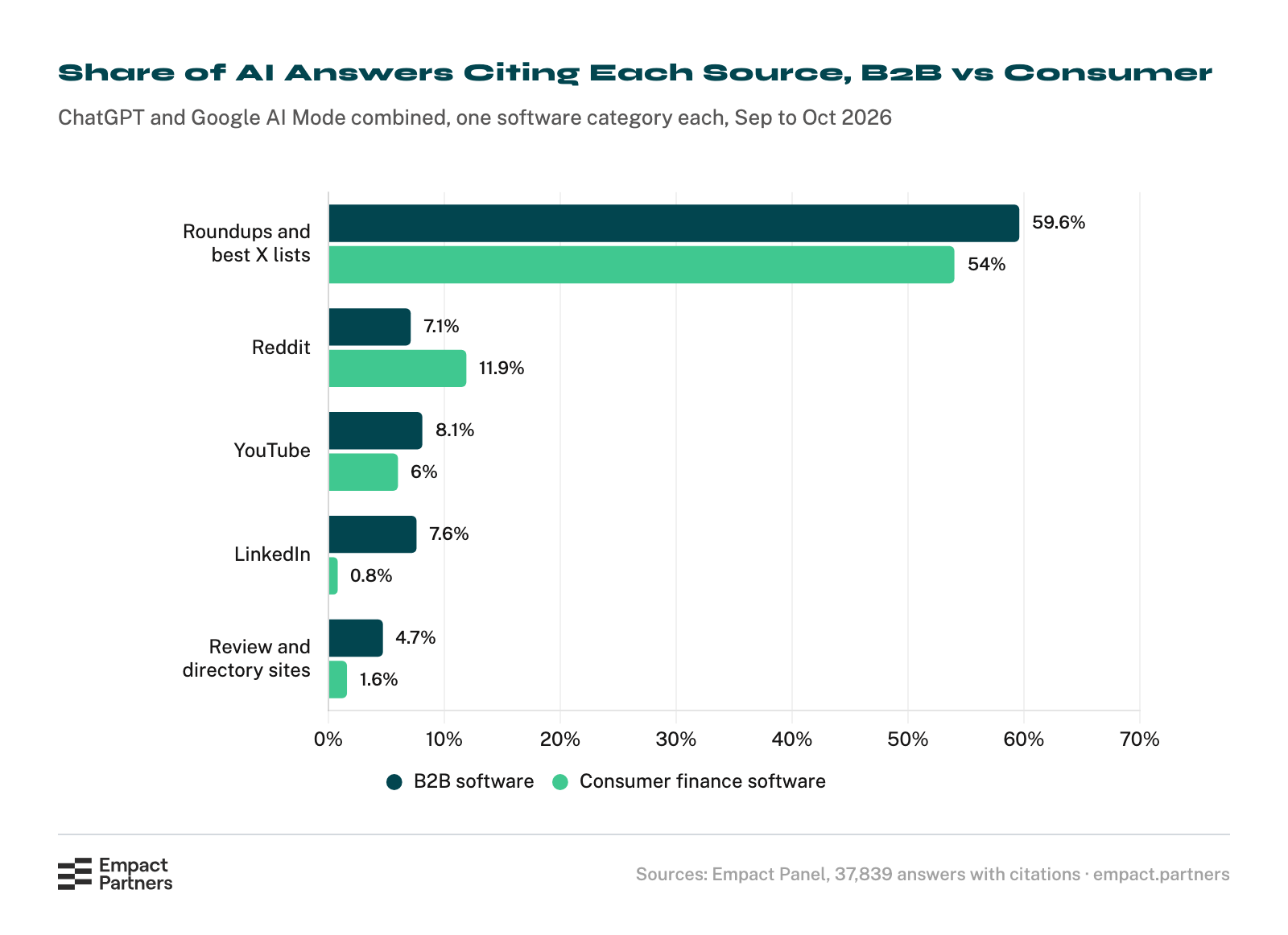
The roundups differ by market too. The citation-weighted median rating of a cited third-party roundup was 44 in the B2B category and 24 in the consumer one. Small independent comparison sites write a consumer category’s shortlist far more often, so a rating floor costs a consumer brand even more of what the engines read.
We saw the same split across partners’ citation research before the panel could count it, which is why we build every target list per industry and per persona. A list a peer used in another category is a list of the wrong pages. The engines’ answers to your own buyers’ questions are the only source list that applies to you.
Every Citation Is a Candidate Until Someone Checks It
The citations an engine gives for your category are where the list starts, and none of them comes pre-vetted. An engine will cite a page that backed one sentence: a government page for a compliance fact, a dictionary for a definition, a competitor’s pricing page for a number. Each shows up as a citation, and none of them will ever mention you.
When we run this for a partner, the check is short, and a person does it. For every candidate:
The same thing happened years earlier on a keyword-built prospect list in a link-building engagement: most of what the tools surfaced did not survive a person reading it. Most rows are real citations and dead ends at once. The few that survive are worth more effort than the whole list was ever going to get, and their size and sameness decide the approach.
Traffic and Domain Rating Break Ties, and Never Make the List
Rating and traffic still belong on the sheet, in the last column, read together. A training session we ran for a partner’s own marketing team put the rule plainly: judge a site on authority and on real traffic, never one alone, because a high-authority page that nobody visits sends nobody to you.
Traffic matters for the human half of the journey. A buyer who reads an engine’s shortlist often copies a name into Google and lands on the pages that rank, so a cited page with real readers works twice. It barely matters to the engine: SE Ranking found a site with 20 visitors and one with 20,000 scored about the same for ChatGPT citations.
The shape of a site’s traffic line says more than its height, and a practitioner on Reddit named the pattern that gives away a site selling placements:
“For me, seeing a massive incline and then decline in traffic, or seeing a traffic high point and a consistent decline, is a sign that the site is being used for guest posts and has lost value. There’s something about it that makes my alarm bells ring.” r/SEO, April 2026
Put together, the two columns sort every candidate into one of four cases:
| Cited for your questions | Not cited for your questions | |
|---|---|---|
| High rating, real traffic | The strongest row on the sheet. Approach it first. | A human channel, not an AI one. Judge it as PR. |
| Low rating, little traffic | Worth a mention for AI visibility. Keep the ask small. | Not worth an approach. |
The row that costs teams money is the high-rated site the engines never pull for your questions. It is worth nothing to your AI visibility at any price, however good it looks in a report. The low-rated site they pull every week is the row a rating filter deletes, and it is usually the cheapest mention on the sheet.
A link is optional, the name is not
Link builders also choose sites by whether a link is followed. For AI visibility that column can go: an engine reads the sentence that names you, and the link beside it changes nothing about whether the name gets lifted into an answer. We count a mention on a reputable page, linked or not, as the unit of this work.
Ahrefs’ 75,000-brand study points the same way, with link metrics tracking AI visibility only weakly on every engine it measured while web mentions tracked it strongly. A followed link still has its old job in Google rankings. It is a bonus on a mention, never the reason to choose the site.
The Sheet Has Five Columns, Filled in This Order
One row per candidate, five columns, filled left to right, because each column decides whether the next is worth filling. Three example rows, from three kinds of site:
| Site | Source type | Relevance | Citation weight | Traffic and rating |
|---|---|---|---|---|
| An independent comparison site, DR 12 | Roundup | Pass: names three of your competitors, not you | Cited for 9 of your 25 questions, both engines | Little traffic, steady. Tiebreaker only |
| A general business publisher, DR 91 | Media | Pass: one article on your category | Cited for 1 of 25, AI Mode only | High traffic. Treat as PR |
| A government guidance page, DR 93 | Reference | Drop: backed a compliance fact | Cited for 4 of 25 | Not relevant |
The order, and the judgment call inside each step:
The trap at step four is turning the count into the next number everyone chases, and a practitioner on Reddit saw it coming:
“Feels like we might be building the next DR before we’ve even finished arguing about the last one lol.” r/aeo, September 2026
Citation weight only means something per question set, per engine, and per month. It is a sort key for your own list, never a score for a site.
What an afternoon gets you, and what it does not
Steps one to six fit in an afternoon with a spreadsheet. The sheet you end with is built from the pages your buyers’ engines read, which a prospect list sorted by rating never is. Run it before you buy anything.
An afternoon will not give you the same count across hundreds of questions, every week, in every country you sell in, and that is usually where an in-house version stops. Our weekly panel runs that count for GEO partners, and the outreach to the rows that survive is the other half of the work. It takes quarters.
Where a partner wants the count in its own dashboard, Qvery, our sister company, tracks AI visibility as software. We built it because our own work needed that number, which makes this a recommendation from an interested party: discount it, and ask to look at the raw answers behind any chart it shows you.
What We Do With the Handful That Survives
A sorted sheet is the start of mention building, not the result. A GEO engagement at Empact Partners opens with an audit and a baseline of what the engines say about the category today, and a named consultant owns the list from there, splitting the rows that pass by their size and how alike they are.
Every ask offers something back, because a mention is a trade: product access for a real review, a data point worth citing, a customer who will talk. Then the panel tells us, week by week, whether the pages we reached are the ones the engines now cite with the partner’s name in them.
The number to watch after the first placements land is how many of your buyer questions cite a page that names you. It moves over quarters, not weeks.
If you hold a list of sites and a quarter’s budget and cannot tell which rows the engines read, book a call with me to find out whether Empact Partners is the right team to run it.