


Forty rows in a spreadsheet, sorted descending. The top of the list is publications that will not reply, the middle is trade sites somebody has heard of, and the bottom is a handful of small blogs that got in because one of them sends traffic. A quarter of outreach is about to run against that order, and the order came from one column.
The column is domain rating, or domain authority, or authority score, depending on which tool produced the sheet. It is a reasonable thing to sort by if the goal is a backlink, because that is roughly what it was built to predict.
The goal here is different. The goal is that when a buyer asks an engine which software to use, the answer is assembled partly from pages that mention you. So the question to ask of the sheet is which of these forty pages an engine pulls when that question gets asked, and nobody has asked it.
Your Target List Is Sorted By A Number Nobody Checked Against The Answers
The useful sort key has a plain name. Citation weight is how often an engine pulls a given source for the questions your buyers ask, relative to how many answers it gives. It is a count you can take, not a score anybody sells.
That is a different unit from the one most target lists are built on. We treat a mention as being referenced on a reputable page, with a link or without one, which is broader than a backlink and closer to what the engines seem to read. A page that names you and does not link to you still shapes the answer when the engine pulls it.
Which means the sheet has two candidate sort keys, and only one of them has ever been checked against a real answer. One is a number a tool reported about the page. The other is how often that page turns up when your buyer’s question gets asked.
A Site With An Authority Score Of 34 Collected Seven Hundred Citations
In September a publisher posted his own figures in r/SEO, against himself. Three-month-old domain, authority score of 34, a hundred and seventy-nine referring domains, most of the growth in the previous six weeks.
“Cited pages sit at roughly 700. Brand mentions sit at five. That’s about 140 citations per single mention. The split is 659 ChatGPT, 32 AI Overviews, 22 AI Mode, zero Gemini.” — u/Proper-Neighborhood6, r/SEO, Sep 2026
An authority score of 34 is the kind of number that puts a site at the bottom of a target sheet, or off it. Seven hundred cited pages is the kind of number the top of the sheet is supposed to produce.
.png)
The last clause of his figure is worth a second look. Zero on Gemini, six hundred and fifty-nine on ChatGPT, from the same pages on the same site. The engines do not share an index, so a brand is not cited or uncited in general. It is cited per engine, which makes “are we getting cited” the wrong shape of question before it is even the wrong metric.
Cited Pages Do Skew High-Authority, And That Is Still Not The Lever
Here is the part that argues against us, and it is better met now than later. Pull a list of pages an engine has cited in your category and those pages will skew toward bigger domains. AuthorityTech, reading Ahrefs’ own citation inventory, put it carefully: a distribution of cited pages is not evidence that the authority metric causes the citation.
The reason the skew exists is dull. Good pages tend to rank, pages that rank tend to get retrieved, and pages that rank tend to sit on domains that have been publishing for years. Authority correlates with all three without being read by anything.
So sorting by it gets you to the right pages by accident. The accident holds often enough to feel like a method, and it fails exactly where it matters: the trade forum with no authority score that answers your buyer’s question, and the national publication with a huge one that has never covered your category at all.
What Happened When We Put The Metrics Side By Side
Empact Partners builds mention target lists inside Generative Engine Optimization, which is the workstream aimed at getting a brand into the answer when somebody asks an engine what to buy in its category. The measurement behind the sort key comes from Qvery, our sister company, which tracks what the engines answer and what they cite.
In September it tested the suspicion directly, on the SaaS brands ChatGPT already named. It put three authority measures against one other thing, which was simply whether a brand appears on the roundup pages the engine was citing for those questions.
Roundup presence tracked naming more closely than any of the three authority measures. Backlinks rank came second, a long way behind. Organic traffic was the weakest of the four. Referring domains landed between them, and the comparison against it did not clear the bar Qvery set in advance, so that one stays open rather than settled.
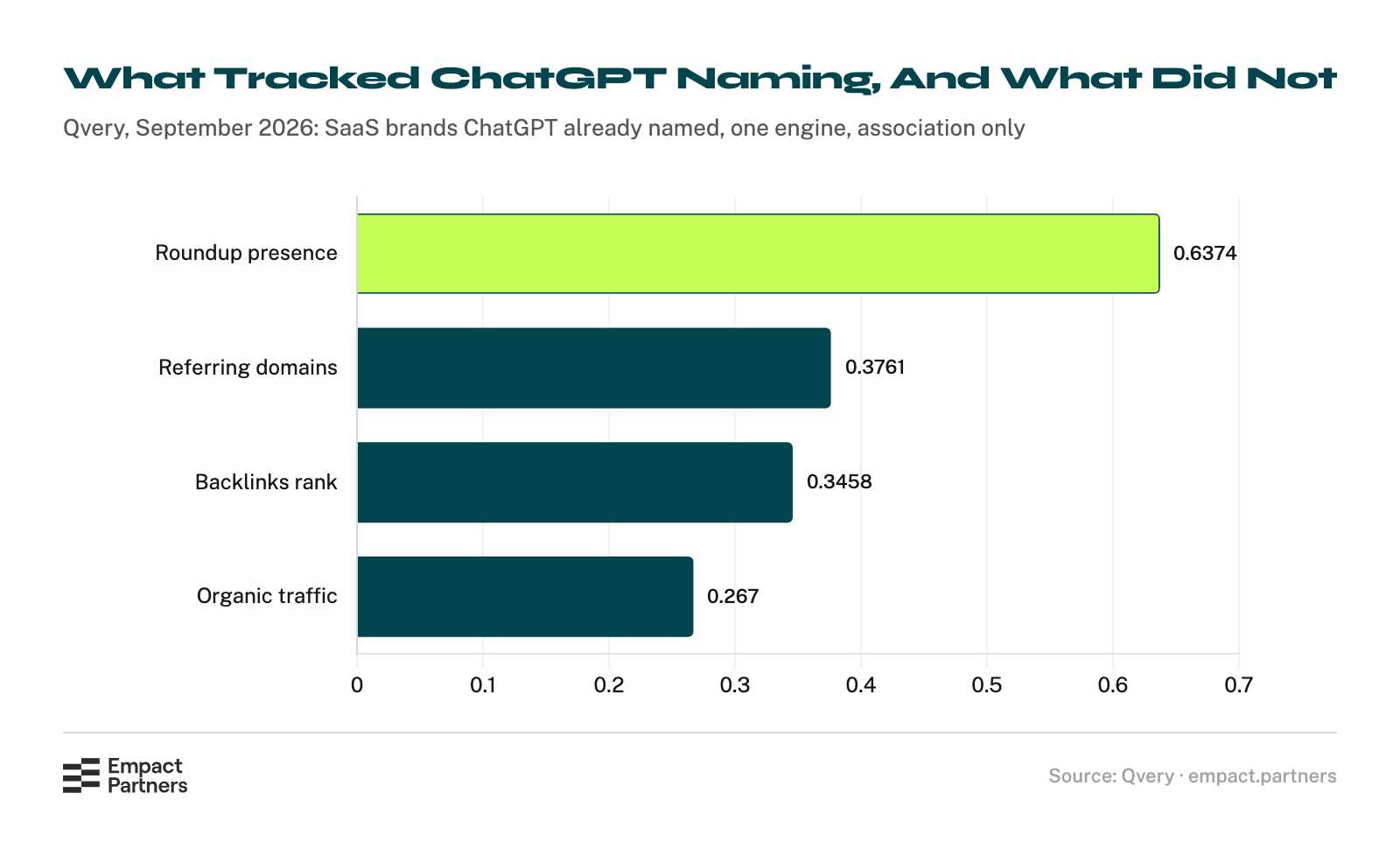
Both halves of that are ours, so discount the finding as far as you think an interested party deserves, and ask us for the answers it was counted from.
The limits are Qvery’s own and they matter. One engine, one month, and only brands ChatGPT already named five times or more, so it describes what keeps a named brand named and says nothing about getting named the first time. It is an association, and no budget decision follows from it alone.
Being Pulled And Being Named Are Two Different Things
The publisher’s ratio of roughly a hundred and forty citations per named mention is not a failure. It is two mechanisms being counted as one, and the top reply in his thread separates them better than our own notes do.
“The citation count is a retrieval signal, your content is getting pulled because it ranks and matches the query, that part your SEO work is clearly earning.” — u/alaattincagil, r/SEO, Sep 2026
Being pulled is retrieval, and a re-sorted mention list is aimed squarely at it. Being named is closer to recognition the model already carries, which accumulates over a longer period and from more places than a mention list touches.
Worth knowing before you set a target, because a program judged on named mentions in its first quarter will read as a failure while the thing it was built to move is moving.
The Re-Sort Takes An Afternoon
Nothing below needs a tool you do not have.

.png)
The List Is Different In Every Industry
The part that does not transfer is the list itself. What counts as a valuable mention target is industry-specific, and across our mention work the weight sits in different places by vertical:
Which of the three carries your category is a question your own cited set answers and a universal source list cannot. That is the reason we build these per industry and per buyer rather than keeping one roster of good sites, and it is the part of the work that does not survive being templated.
What We Would Do With Your Forty Rows
We would run the count above before any outreach, re-sort the sheet by it, and then start the slow half. Getting onto a cited page is manual, personal outreach to an editor who has their own reasons for publishing, repeated across a list.
Our own experience is blunt about the shortcut. AI-written personalization does not yet move a real, busy human on the other end, and a list worked that way mostly produces silence.
What this costs after the afternoon
So the honest split. The re-sort is an afternoon and you can run it this week. Earning the placements it points at is a quarter of somebody’s job, and it is the half that most mention programs quietly stop doing around week six.
If your own target list is sorted by domain rating and the outreach is about to start, that order is worth an afternoon before the quarter. Book time with me and we can decide together whether it is ours to run.


