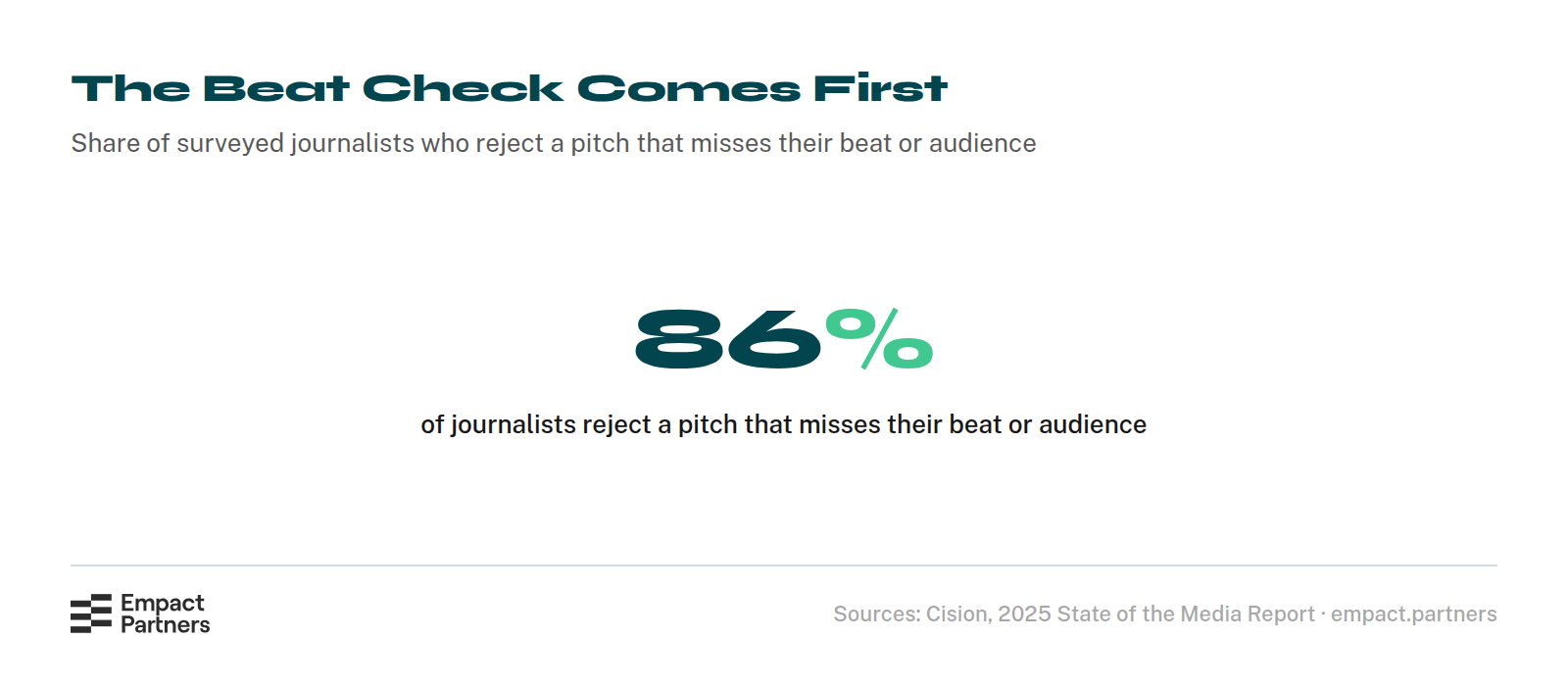
86% of journalists reject a pitch the moment it misses their beat or their audience, whatever the story inside it turns out to be.2 That is the assumption most digital PR budgets are quietly built on, that a strong enough story gets read regardless of who it was sent to, and it is wrong for most of the mail that goes out.
Digital PR survives on everyone else. This year’s own numbers say two things about that at once: the work is paying off faster and more often than its reputation suggests, and it is getting harder to run well in exactly the way that first figure predicts.
Highlights
Those five add up to one shape. Digital PR is working, priced modestly, and running on less caution than it carried two years ago. Practitioners are not imagining the results, and they are also not checking pitches the way they used to, and nobody yet has a verified number for what the new AI-citation interest returns.
Digital PR Now Means A Specific, Shifting Mix Of Tactics
Digital PR is the practice of getting a brand’s story, data or expert covered by journalists and outlets an audience already trusts, rather than published on the brand’s own site. It covers several distinct formats, and this year’s survey shows the mix moving fast.
Press releases are back at the center of it: 72.8% to 85.1% of surveyed digital PR professionals say they pitch press releases, a rise of more than twelve points in a single year.1 Data-led content, original research or a proprietary dataset built to give a journalist something worth writing about, is now the single most common tactic of all, pitched by 95.9% of respondents.1
Crisis communications entered the mix as its own line item this year, run by 34.5% of teams that answered.1
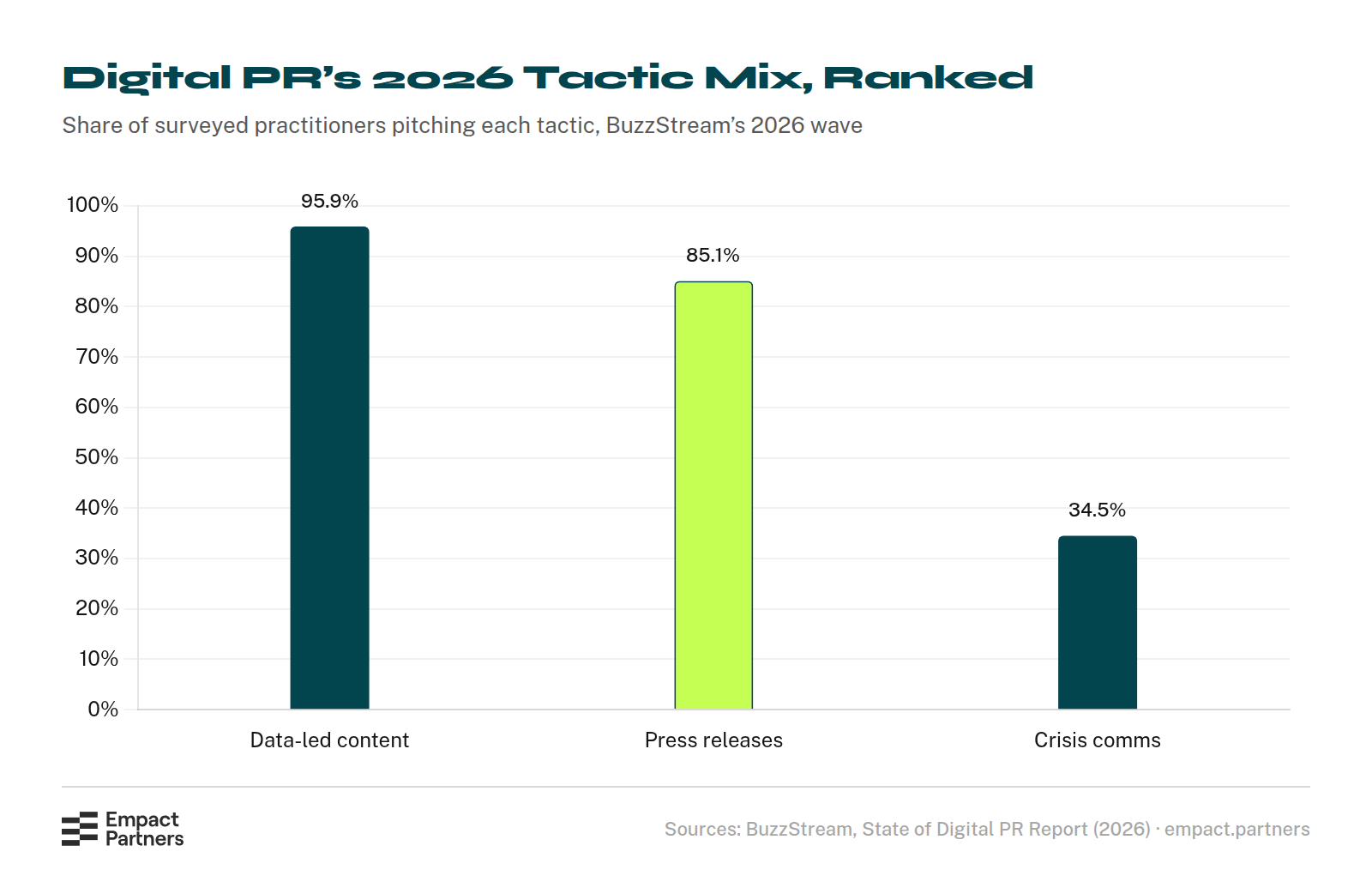
The formats differ in what they ask a brand to have ready. A press release needs actual news, an announcement worth the wire. Data-led content needs a dataset most brands are already sitting on and have never turned into a story. Both compete for the same few minutes of a journalist’s attention, and most pitches lose that competition before anyone reads what they are pitching.
A Pitch Has To Pass A Beat Check Before Anything Else Matters
86% of journalists surveyed by Cision across nineteen markets say they immediately reject a pitch that is not aligned with their beat or their audience, whatever it says after that.2
That single number explains why personalization keeps rising on the sending side. 41.6% to 48% of digital PR professionals now say they always personalize an email pitch to the journalist receiving it, a jump of more than six points in a year.1
The press release itself has not gone away as a resource, even with so many new formats competing for the same space. 72% of surveyed journalists still call it the most useful thing a PR team can hand them.2 And the relationship that gets a pitch opened at all rarely needs a story attached yet: 85% say a simple introduction email, with nothing to pitch, is the best way to build it.2
Coverage is the part of digital PR that touches how a company is perceived. A story a journalist chose to write, in a publication their own readers already trust, reads as earned in a way a brand’s own announcement never does.
That trust is also exactly why the beat check is unforgiving. A misdirected pitch does not just get ignored, it spends a little of the credibility the next pitch to that same journalist will need.
Digital PR Now Sits Closer To SEO Than To A Dedicated PR Team
Just over half of surveyed digital PR professionals, 53.4%, say they work most closely with SEO, up from 50.9% the year before.1 The share working most closely with a dedicated PR team moved the other way, from 14.5% to 10.1%.1
The shift is real, not a rounding error. Digital PR is becoming a tactic SEO runs that happens to talk to journalists, and less an activity a comms department owns on its own.
Running it is not expensive by marketing standards. 60% of surveyed teams report a monthly digital PR budget under $10,000, and 25.7% run under $5,000.1 The high end is getting pricier, though. The share reporting a cost per link of $750 or more rose from 3% to 10.2% in a year, so the cheap end of the market held steady while the expensive end got noticeably more expensive.1

Empact Partners runs digital PR inside the SEO workstream for exactly this reason. It is a lever inside a broader search program now, not a parallel discipline a partner has to staff and coordinate on its own.
Digital PR Pays Off Faster Than Its Reputation Suggests
85.2% of surveyed digital PR professionals say it takes no more than six months to see measurable results from a campaign, and 81% say they land first coverage within a week of starting one.1 That is faster than the category’s reputation as a slow, unpredictable grind would suggest, at least for the practitioners still running it well.
What counts as a result is shifting, though. Quality links remain the top way practitioners judge a campaign, named by 85.1%, ahead of total mentions at 72.3% and total links at 70.9%.1
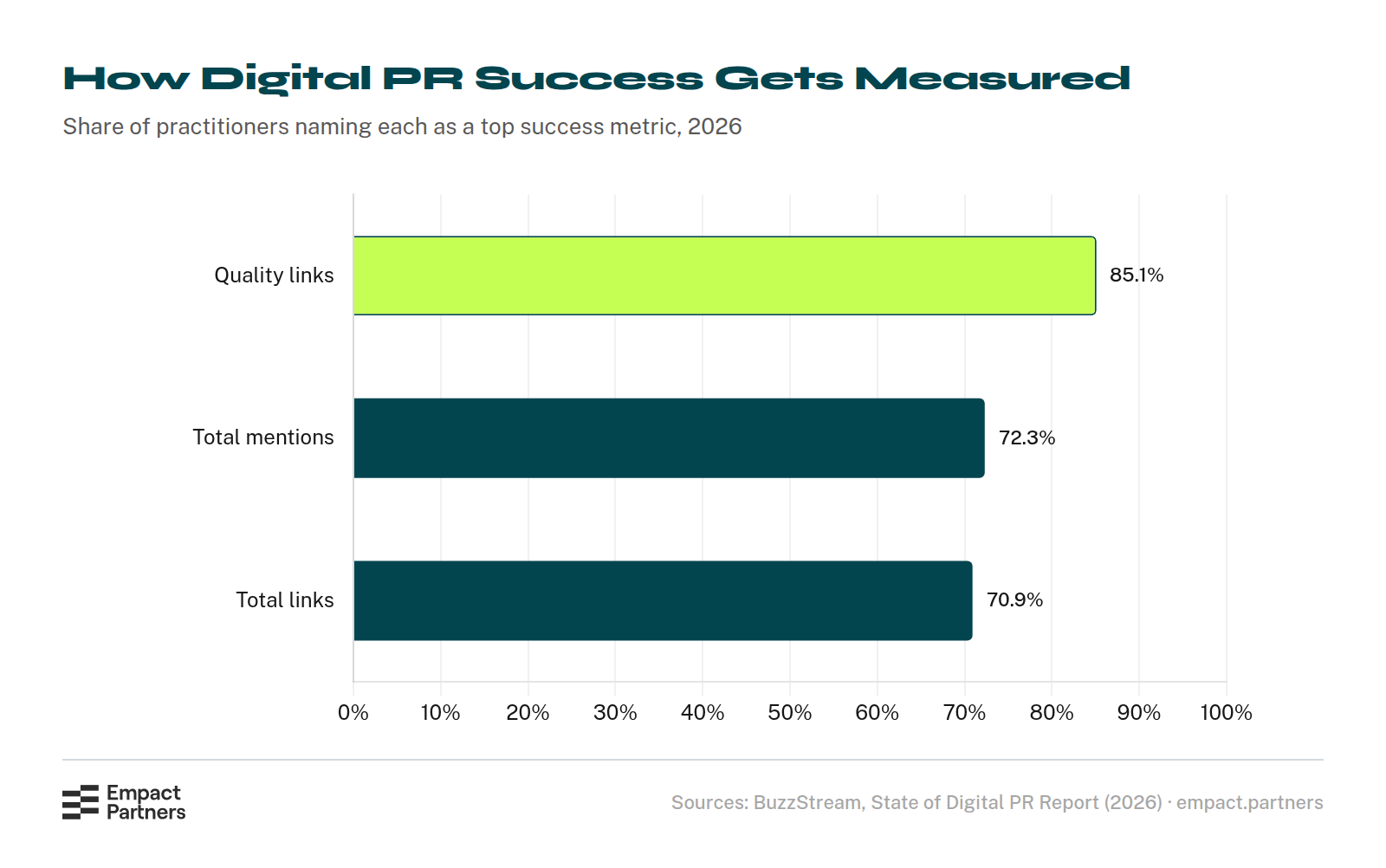
Organic traffic and rankings used to be the metric practitioners reached for right after links. Not anymore. The share naming it as a success measure fell from 78% to 63.5% in a single year, the sharpest drop anywhere in the survey.1 Practitioners are trusting what they can point to today, a link or a mention, over what they can only infer weeks later from a ranking move.
Digital PR Got More Effective And More Difficult In The Same Year
68.2% of surveyed digital PR professionals believe the work is more effective than it was twelve months ago, a gain BuzzStream itself describes as roughly a fifth higher than last year’s belief.1 In the same survey, 75% say digital PR is more challenging this year than last, up four points.1 Both are true of the same twelve months, reported by the same group of people.
The same wave moved several metrics at once, in both directions:
Three of those six rose and three fell in the same twelve months. That is not noise. It is a field reallocating effort toward the things it can prove (a link, a personalized pitch) and away from the things it cannot (a ranking move, a dedicated PR handoff).
The reason it is getting harder is specific rather than vague. 26.4% name getting coverage at all as their single biggest challenge, ahead of measuring impact and keeping up with change.1 60.8% say finding the right journalist for a campaign has gotten harder over the past year.1
Fewer relevant journalists to pitch, against the same or greater volume of stories competing for their attention, is not a mystery. It is arithmetic.
.png)
That checking is exactly what is slipping industry-wide. 56% of surveyed professionals still verify a journalist’s fit by reading their recent work before pitching, down eight points from last year.1 Manual media-list building, the slower and more accurate alternative to a bought list, rose from a quarter of respondents to 32.4% over the same period.1
Practitioners are building lists by hand more often and checking them less, the opposite of what a journalist’s instant beat check rewards.
None of this means digital PR stopped working. It means the practitioners doing best right now treated this as the year to tighten process, not loosen it, while the total volume of pitches in every inbox kept climbing.

.png)
AI Has Already Changed Digital PR, And Journalists Have Not Signed Off On It
AI has already reached deep into how digital PR gets done, on the practitioner’s side of the inbox at least.
Adoption is real and it happened fast. What it has not produced yet is a reliable way to prove any of it worked: 55.4% of practitioners now count AI citation mentions as one of their success metrics, a category that did not exist in last year’s survey.1 Watching for a brand name inside a chatbot’s answer is a different thing from a verified count of how often it appears, and the survey does not say which of the 55.4% have closed that gap.
The other side of the inbox is less convinced. 72% of surveyed journalists say they worry about factual errors in AI-generated PR content, the same population that gives a pitch one look before rejecting it.2 A pitch that reads as AI-written still has to clear the same beat check as everything else, and a factual error is a faster way to fail it than a missed beat ever was.
Nobody has a verified figure for what share of digital PR coverage an AI engine cites, in SaaS categories or anywhere else, Empact Partners included. That number is worth having. Practitioners are reaching for it before anybody has produced it.
Digital PR Earns Its Place Inside An SEO Program On Specific Terms
Put together, the numbers argue for a specific use of digital PR rather than a blanket one. It is real, and it pays off within a season for a well-run program. It does something content marketing alone cannot: a journalist’s byline lends credibility a brand’s own blog post never will, which is why 72% of journalists still rank the press release above the newer formats competing with it.2
Digital PR is also unpredictable in a way a content-led SEO program is not, because it depends on a beat check the sending side never controls.
That trade-off matches what Empact Partners has seen running the SEO workstream across partnerships. Digital PR is costly and unpredictable in a way content-led link building is not, because a pitch depends on a journalist’s calendar and a news cycle nobody on our side controls, while a link magnet page depends only on its own quality and distribution. Reputation gets maintained over quarters. It does not get launched with one campaign.
Empact Partners recommends digital PR when the goal is credibility a category’s own buyers will recognize: a launch, a funding round, a genuine dataset worth a journalist’s time. It recommends the content-led route first when the goal is steady, compounding growth on a fixed budget, because that motion does not depend on any one journalist’s calendar. Most partnerships run both, in a mix that shifts with the season.
The number worth watching next year is not effectiveness or difficulty on their own. It is whether the gap between them keeps widening, because a channel that gets more effective and more difficult at once is sorting itself into teams that do the diligence and teams that do not, and there is no version of that sort where skipping the diligence wins.
If you are weighing a digital PR retainer against a content-led SEO program, book a call with me, and let’s work out together which one earns its budget.
Sources
- BuzzStream, “State of Digital PR Report (2026),” by Vince Nero, published 19 February 2026. Survey of 150+ digital PR professionals, BuzzStream’s own subscriber and user base. Read 22 September 2026.
- Cision, “2025 State of the Media Report,” press release published 7 May 2025. Survey of more than 3,000 journalists across 19 global markets. Read 22 September 2026.