
How to Get SaaS Content to the People Deciding a Purchase
Choose the buying decision, reach its owner through a credible route, and measure replies that move the conversation forward.

On this page
Empact Newsletter
One email a month on what is working in AI search and SaaS go-to-market.
Content written to help buyers decide often never reaches the person who signs off on the purchase. It goes out on the blog, in the newsletter and on social feeds, where practitioners read it, and the budget owner at the account never sees it. The deal then waits on a conversation that piece could have started.
Empact Partners writes guides and expert pieces with a SaaS company’s own experts, for buyers weighing a purchase. That content marketing only helps a deal once the person who signs has read it.
Start From the Buying Decision
Publishing more does not fix this, since nobody can tell whether the person deciding received any of it. A newsletter can show how many people opened an issue, but not whether the head of support at one account read the benchmark written for her.
An open count cannot tell you whether the person who signs at an account read the piece meant for them.
So start from the buying decision. Find out who owns it and which route they trust, then put the decision, the owner and the route on a one-page brief before anyone gets an email.
Practitioners still matter, because they evaluate the product and often pass a piece to the person who decides. Keep your publication and other distribution channels running, as they produce the evidence a brief points to. The measure changes, though. Instead of channel totals, check whether the people named on each brief received it.
Each brief names three people, alongside the decision and the evidence it carries:
Write a Brief for Each Account
Work account by account. Before anything is sent, the account owner should be able to read one short brief that names the decision and the people around it:
Scroll horizontally to see all columns when the table is wider than this page.
| Field | Example for a hypothetical account |
|---|---|
| Buying decision | Replacing the support ticketing system this year |
| Budget owner | The head of customer support |
| Trusted contact | A support lead who already uses your product |
| Account owner | The account executive on your team who covers this company |
| Evidence | A benchmark of resolution times for teams of that size |
| Route | An introduction from the support lead, then a short note |
| Next action | A review of the benchmark with the budget owner |
The evidence row needs the most care. Give the budget owner an original angle on their decision, one that shows what it changes for their team. For a head of support replacing a ticketing system, resolution times bear on the decision now, and a feature comparison matters later, once two products are on the shortlist.
Leon Claassen, who wrote this guide, is a Senior GTM Consultant at Empact Partners. He sets one test for whether a brief is ready:
Before anything goes out, name the person and the decision it is for. If the account owner cannot say both in one sentence, the brief is not ready, however good the content is.
 Leon Claassen on LinkedInOpens in a new tab
Drafting a brief for every target account takes research hours a lean team rarely has. A briefing agent can write the first draft from your sales records and the pieces you have already approved. It reads the account’s notes, fills each row, picks the piece whose evidence fits and marks the rows it is unsure of.
The playbook below was written for sales calls, and the account research it sets up is the same research these briefs need. It shows how to give every call a one-page brief a rep can check in minutes, and how to count the time that saves.
Choose the Route to the Budget Owner
The stronger route is usually a trusted contact who passes the piece on, ideally with a line of their own on why it matters. When no such contact exists, the fallback is one short email from the account owner with the evidence attached. Either way, the account owner approves the send:
Before the account owner sends anything
- The brief names the buying decision and the budget owner
- The evidence bears on that decision and what it changes for the budget owner’s team
- The route is someone the budget owner already listens to, or one short note
- The account owner has approved what goes out
- One person owns the follow-up, by name
The drawing shows the path a piece takes once the brief is written. It starts at the decision and its budget owner, passes the account owner for approval and goes out by the route.
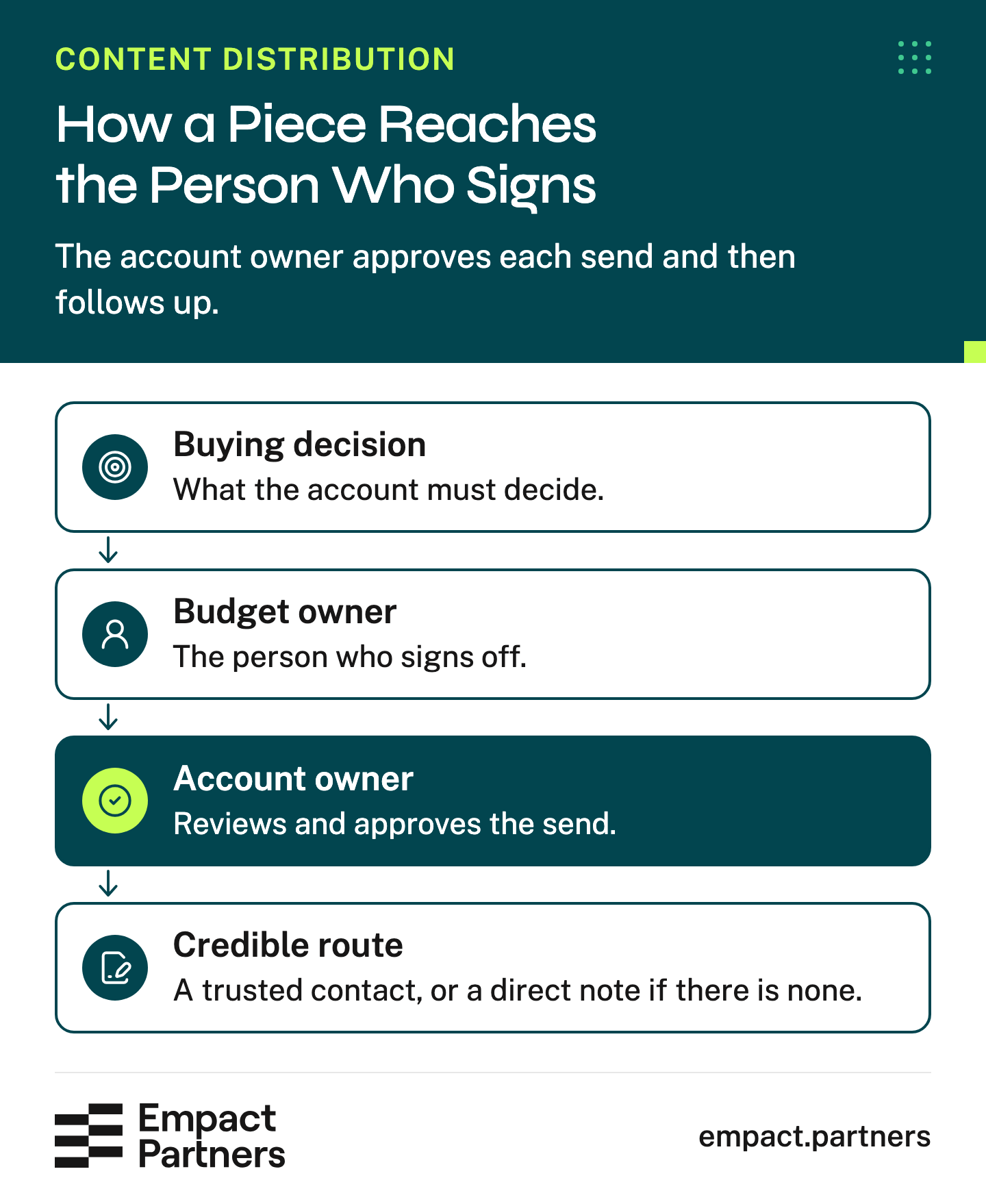
The order matters, because a route picked first tends to favor whoever replies fastest, who may have no say in the purchase.
Salespeople face the same problem when they try to bring the person who signs into a deal, and on r/sales they call that person the DM, short for decision maker. In one thread about it, three answers show how they learn who approves and whether their contact runs the purchase:
Tips from Reddit
What salespeople on r/sales ask before going around their contact
How did the process work last time they made a similar purchase? What level does it require board or CFO approval?
In some cases the DM may have delegated the process to your contact.
My strategy is to be a project manager for the buying process.
Check the second point before going around anyone. Where the budget owner has handed the evaluation to your contact, a note over the contact’s head can damage the one relationship you have at the account. So the account owner first asks the contact how the decision is being made.
When no contact can pass the piece on, the account owner emails the budget owner directly, and that email has to carry the evidence alone. It and each follow-up after it need their own reason to go out.
The free preview below drafts four emails for your buyer, each tied to the signal that should send it. The account owner keeps the ones that fit this account and rewrites them in their own words.
How to Tell Whether Your Content Reached the Budget Owner
Track what the people named on the brief do with the piece, one by one, and record what each signal shows. An open only shows that a message loaded, not who read it, and a forward you cannot confirm stays unknown. Three signals are worth counting:
Count these, person by person
- The budget owner replying about the piece or raising it in a conversation, the only confirmed receipt
- A trusted contact saying they passed it on, and to whom, recorded as their report
- A request for a next conversation, recorded as interest from that person
Write each answer on the brief itself, so the next piece for that account starts from what happened to the last one rather than from a dashboard total.
When your best pieces keep missing the people who sign, we would start by asking your account owners which buying decisions are open at their accounts right now. Then we would look for the evidence in what you have already published, since reworking a piece is quicker than writing a new one.
If researching every account slows your team down, we can also build the briefing agent described above. These are the parts we would take on with your team:
What the work with us includes
- Your published pieces reworked for the decisions your account owners face
- New guides and expert pieces, written with your own experts, where a decision has no evidence yet
- An agent that researches each target account and drafts its brief from your CRM, owned by someone on your team
Frequently Asked Questions
Should we stop writing for practitioners?
No. Practitioners test the product, compare it with what they use today and often forward the piece that convinced them to whoever approves the spend. They need different material, though: the steps and how the product behaves, where a budget owner needs evidence for the decision and the cost of choosing wrong. Keep both kinds in the library, and let each brief say which piece goes to which person at the account.
What if we cannot reach the budget owner?
Go through someone they already trust: a practitioner who uses your product, a partner who works with them or an advisor they consult. With nobody like that, one short note from the account owner is the fallback. Never promise access you do not have, and never ask a contact to forward a piece they have not read. If you do not know who the budget owner is yet, neither route works, so ask anyone you know at the account how the purchase will be decided.
How do we find out who owns the budget?
Ask your contact how the last similar purchase was approved, above what amount a second signature is needed and whether finance or procurement joins. Then look in your sales records for earlier deals, renewals or evaluations that name an approver. Write the answer on the brief with where it came from and when, so the account owner can tell a fact from a guess. Recheck it after any reorganization or new hire at the top of that team.
Do we need new content for every executive?
No. Reuse the evidence you already publish and change the framing: which decision it informs, what it means for that executive’s team and what they should do next. A benchmark written for practitioners can go to a budget owner with two lines on what it implies for their renewal. Write something new only when the evidence for a decision does not exist, and then write it once for every account facing that decision.
How long should a note to a budget owner be?
A few sentences, short enough to read on a phone between meetings. Name the decision it concerns, give the one piece of evidence that matters most and end with a question the budget owner can answer in a line. Link the full piece rather than pasting it in. A note runs too long when it carries more than one link, a paragraph about your company or a question that needs a meeting to answer. The fix is to go back to the brief and pick one piece.
How many follow-ups are reasonable?
Each follow-up needs its own reason: a new piece of evidence, a change at the account such as a new hire, or an answer to something the budget owner asked. Stop when no new evidence, change at the account or answered question justifies another note, and write that reason on the brief. The account owner approves every follow-up, as they did the first note. Two or three spaced notes, each with a real reason, tell you more than a long automated run.
How do we know the content reached the right person?
Only the budget owner replying about the piece, or raising it in a conversation, confirms it. A trusted contact who says they passed it on, and to whom, gives you a report, so record it as theirs. A reply from anyone else shows interest rather than receipt, and a click only shows that something happened to the message. When you cannot confirm who received it, mark it unknown on the brief, since your next move at that account depends on an honest record.
What can a briefing agent do without sales approval?
A briefing agent can research the account and draft the brief from your sales records and approved pieces. It hands a row to the account owner when the notes disagree, when the likely budget owner changed recently or when no approved piece fits the decision. The note, the route and every follow-up wait for the account owner. Set it up so it cannot send anything.
Who on our team should own distribution to executives?
The account owner for each account, meaning the person sales already holds responsible for it. Marketing supplies the pieces, the briefs and the counting, and the account owner decides what goes to people they know. Write one named owner on every brief, never a team. If the brief leaves unclear who approves and who sends, a note can go out late or twice, and the budget owner gets the same piece from two people.
How many accounts should we start with?
Start with accounts where a buying decision is already live and the account owner is willing to work through a brief with you. Take only as many as your account owners can review a brief for in the first week. For a small team that might be ten. Add accounts once the first briefs have produced replies you can count. Taking on more than they can review means briefs go out with the research skipped and the approval rushed.
Keep reading
Content Marketing Hire a Content Writer or a Consultancy? Decide Who Owns the Work
Choose a writer, a senior content lead or a consultancy by the work your SaaS team needs owned, reviewed and measured.

Content Marketing Turn SaaS Expert Interviews Into Content Your Buyers Use
Choose what to reuse from expert interviews, who approves it, and which channels deserve your SaaS team's time.

Content Marketing What To Give A Content Agent Before It Drafts Anything
Give your content agent approved proof, buyer language and a clear owner so your team spends less time fixing generic drafts.