Every six months, someone declares backlinks dead. It happened when social signals were supposedly going to replace links. It happened when AI content was going to make original content irrelevant. And now it’s happening again because AI search engines don’t use backlinks as a direct ranking signal.
The declaration is always wrong. But this time, it’s wrong in an interesting way — because while backlinks still matter, the reason they matter has fundamentally shifted. And if you’re still building links the same way you did in 2020, you’re essentially navigating with a paper map while everyone else switched to GPS.
The Short Answer: Yes. But The Long Answer Changes Everything.
At Empact Partners, we’ve helped build over 500 DR40+ backlinks for flair alone — contributing to their 1,600% organic traffic growth over three years. We know link building works. But we also know that in 2026, mentions are often more valuable than links. The distinction matters, and understanding it changes how you allocate your off-page budget.
Think of it this way: backlinks used to be the whole meal. Now they’re a side dish — still important, still nutritious, but no longer the thing you build the entire plate around. The main course? Contextual mentions across the sources AI engines actually read and cite.
.png)
Backlinks versus Mentions: What’s The Difference?
The distinction is simple but consequential. A backlink is a hyperlink from one website to another — a clickable URL. A mention is any reference to your brand in context — with or without a hyperlink. Every backlink contains a mention, but not every mention contains a backlink.
In traditional search, this distinction barely mattered. Google’s algorithm was built on links. No link, no signal. But AI engines don’t process web content through a link graph. They process it through natural language understanding. When a G2 review says “we switched to HubSpot and our close rate improved 30%,” the AI understands that as a positive endorsement of HubSpot — regardless of whether “HubSpot” is hyperlinked.
| Dimension | Backlinks | Mentions |
|---|---|---|
| What it is | A hyperlink from another site to yours | Any contextual reference to your brand, with or without a link |
| Impact on traditional search | Direct ranking signal (PageRank) | Indirect signal at best |
| Impact on AI search | Indirect (helps the source page rank, which helps retrieval) | Direct signal (AI reads and understands contextual brand references) |
| Source types that matter | High-DR editorial sites, resource pages | Review sites, Reddit, forums, podcasts, comparison articles — any discussion source |
| How to build | Guest posts, HARO, broken link outreach, digital PR | EAO, community engagement, review solicitation, expert contributions, Reddit |
| Scalability | Limited by editorial gatekeeping | Higher — more source types, more opportunities |
| Authenticity signal | Moderate (links can be manufactured) | High (organic mentions from real users are hard to fake) |
| Cost per placement | Higher (editorial links require more effort) | Lower per mention, but requires sustained community investment |
The short version: backlinks still help your Google rankings, which indirectly helps AI search (because Google AI Mode uses ranking signals). But mentions directly help AI search, because AI engines read and understand them regardless of whether a hyperlink exists.
Why Backlinks Still Matter
Let’s be clear: we’re not anti-backlink. We build backlinks for our partners every month, and they deliver results. Reports of their death have been greatly exaggerated — much like reports of email’s death, which is now on its fourth decade of being “over.”
Google isn’t going anywhere
Traditional Google search still drives the majority of web traffic for most SaaS companies. Google AI Mode adds an AI layer on top, but the organic results are still there. And organic rankings still depend heavily on backlinks.
A strong backlink profile from DR40+ domains signals authority to Google’s algorithm, which translates directly into higher rankings and more traffic. We built flair’s off-page presence through 500+ DR40+ backlinks over three years. That link profile was a primary driver of their 1,600% traffic increase. Those results are real and repeatable.

.png)
Backlinks help AI search indirectly
When a page that mentions your brand ranks well in Google, it’s more likely to be retrieved by AI engines during their real-time search process. So a backlink that helps an article rank better in Google also increases the probability that the AI retrieves that article — and if the article mentions your brand, you benefit.
The chain is: backlink → better ranking for the source page → higher retrieval probability → more AI citations. It’s indirect, but it’s real. And it’s measurable — tools like Qvery track exactly which sources AI engines cite, so you can see the relationship between well-linked pages and AI visibility firsthand.

Why Mentions Are Now More Important
While backlinks remain useful, the balance has shifted. In 2026, a SaaS brand with 200 contextual mentions across review sites, Reddit, and comparison articles — but only 50 backlinks — will typically have stronger AI search visibility than a brand with 200 backlinks and 50 mentions. The mention footprint is the primary driver of AI search recommendations.
Mentions exist in places links don’t
Reddit threads don’t typically contain dofollow backlinks, but they contain detailed product discussions that AI engines cite heavily. Forum posts, community discussions, Quora answers, podcast transcripts — all of these are mention-rich environments where backlinks are rare or nonexistent.
If your off-page strategy only counts links, you’re ignoring the largest and fastest-growing source of AI search signals. That’s like measuring a restaurant’s reputation by counting only Yelp reviews while ignoring the 500 people talking about it on social media.

Mentions are harder to manufacture
An organic mention from a real user carries authenticity that a placed backlink simply doesn’t. And AI engines are getting better at distinguishing between the two. The brands investing in genuine community presence now are building a moat that will be very difficult to replicate later.
How We Build Both: The EAO + Outreach Approach
At Empact Partners, our off-page strategy combines traditional link building with systematic mention building. We call the mention-building component Existing Article Outreach (EAO) — finding articles that already rank, already get cited by AI engines, and adding our partners’ brands to those articles through personalized outreach.
The process
We identify target articles using Qvery citation data — the articles that AI engines actually cite when they answer queries in our partner’s category. Then we use proprietary AI systems and outreach platforms like Instantly.ai to craft personalized campaigns that offer genuine value to the article’s author in exchange for including our partner’s product.
The outreach isn’t cold spam. Every email is personalized, contextual, and offers something the author wants — whether that’s updated information for their article, a unique data point, or a product trial they can genuinely review. The response rates are dramatically higher than traditional link-building outreach because we’re offering value, not asking for a favor. (Revolutionary concept, we know.)

The 2026 Off-Page Budget Split
If we were advising a SaaS CMO on how to split their off-page budget between backlinks and mentions, here’s how we’d recommend it, depending on their starting point.
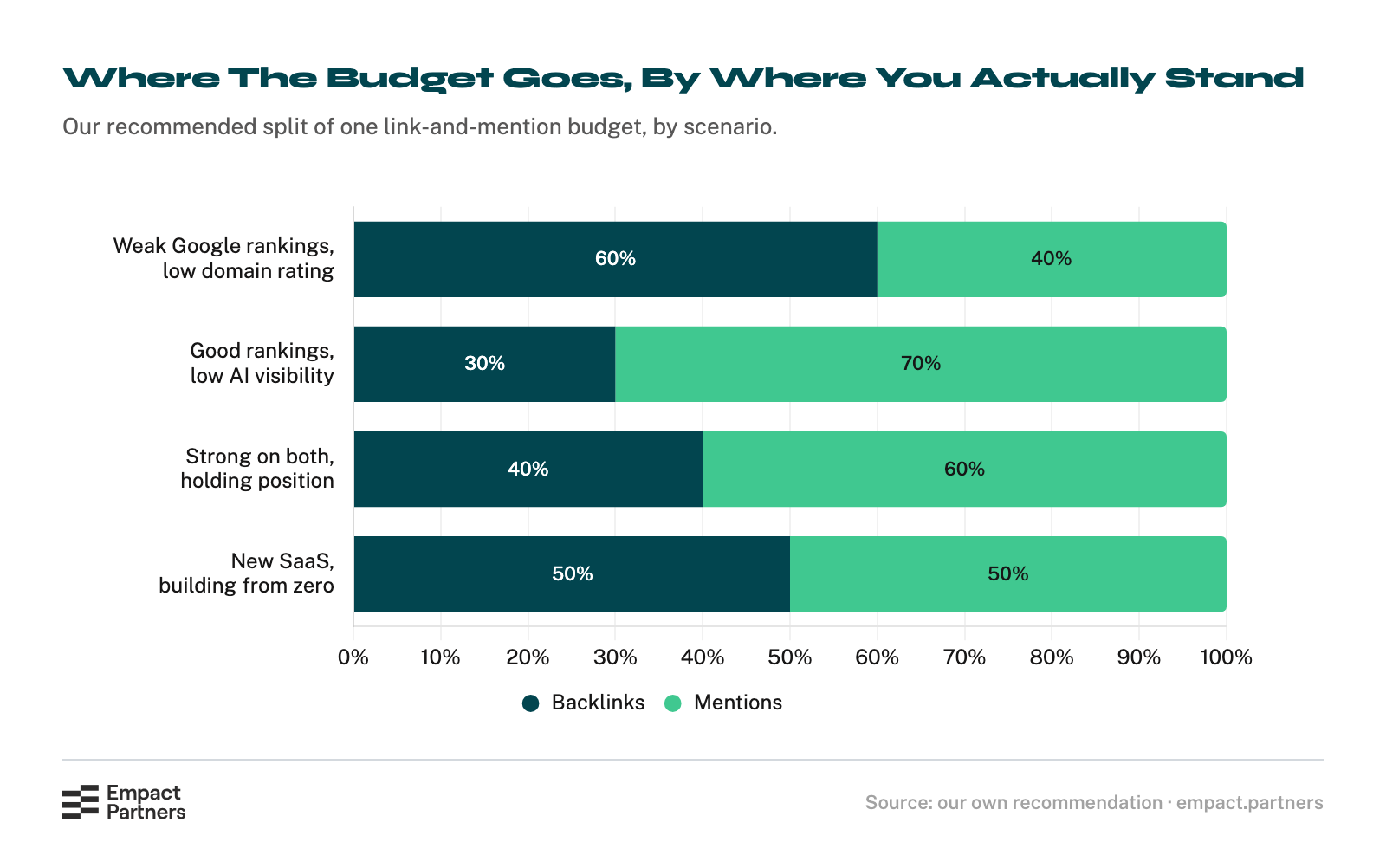
| Scenario | Backlinks | Mentions | Rationale |
|---|---|---|---|
| Weak Google rankings, low DR | 60% | 40% | You need domain authority first. Links drive rankings that then get retrieved by AI engines. |
| Good Google rankings, low AI visibility | 30% | 70% | You rank fine but AI engines don’t cite you. The gap is mention footprint and community presence. |
| Strong on both, maintaining position | 40% | 60% | Maintain link velocity while expanding mention footprint to stay ahead of competitors. |
| New SaaS, building from zero | 50% | 50% | Build both simultaneously. You need domain authority and mention footprint in parallel. |
The exact split depends on your specific situation. But the trajectory only goes one way. As AI engines continue to grow their share of search traffic, the value of mentions relative to links will keep increasing.
If you want help figuring out the right split for your SaaS brand, or if you need a team that can execute both link building and mention building at scale, that’s exactly what we do.