


In the week of 28 September 2026, a Perplexity answer that cited anything listed 10.7 sources, and a ChatGPT answer listed 35.5.1 Perplexity is usually described as the engine that cites far more than ChatGPT. Counted that week, across about 2,200 prompts a day, it did not.
This page is for the marketing lead deciding whether Perplexity gets work of its own inside an AI search plan. It sets the dated Perplexity figures beside our own records and Qvery’s, and keeps what Perplexity says about itself apart from what others measured.
Empact Partners, a go-to-market consultancy for B2B software companies, runs Generative Engine Optimization (GEO) for its partners: the work of getting a product named in AI answers. Perplexity is the engine our own measurement covers least, which is why the question deserves numbers.
Highlights
Read together, they describe an engine that is steady in what it shows, shaped by Google’s rankings and by Reddit more than ChatGPT is, and nearly invisible from a company’s own side. That is a case for measuring Perplexity on its own before giving it a budget of its own.
Perplexity Lists About Ten Sources an Answer, and the Count Holds
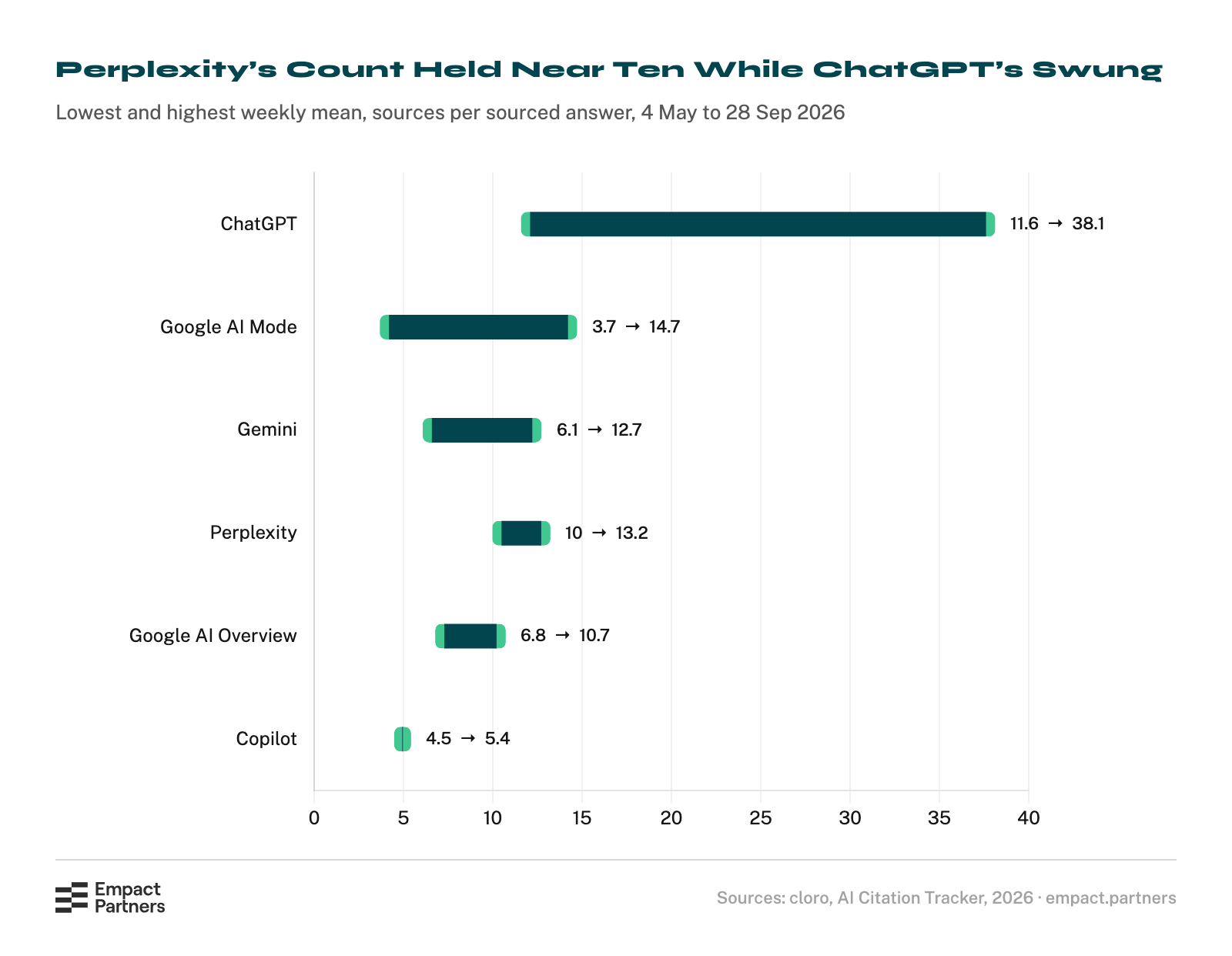
The AI-engine data company cloro sends about 2,200 prompts in 38 countries to six engines every day, and publishes the mean number of sources each engine lists under an answer that cites anything. Its tracker held 2,016,347 answers from 1 May to 30 October 2026. Perplexity was last measured in the week of 28 September, the one week all six share:

The longest source list that week was ChatGPT’s, by more than three to one, and Perplexity sat beside Gemini in the middle. A team that set Perplexity apart because it cites more was reading a ratio this count does not support.
What an engine lists is also not what it read. In about 14,000 search conversations logged on LMArena, researchers including Tim O’Reilly found that Sonar, Perplexity’s API model, visited about 10 relevant pages per query and cited three to four.6 Listed, read and credited are three numbers, and a per-answer figure means little until it says which.
Perplexity’s count also held still while the two engines most plans already watch did not. From the week of 4 May to the week of 28 September 2026 its weekly mean stayed between 10 and 13.2.1 ChatGPT’s went from 14.2 to 35.5 over the same weeks, and Google AI Mode’s fell from 13.9 to 4.4.1
Our own count of the engines we measure
The Empact Panel is the measurement we run every week for more than a dozen partners, on ChatGPT, Google AI Mode and Claude. Its own tenant asks our category’s 500 questions, about B2B marketing services and AI visibility. In four runs from 4 to 23 October 2026 it counted, per answer that cited anything:
Google AI Mode reads about the same on both instruments, 3.8 on ours and 4.4 on cloro’s. ChatGPT reads 8.1 on ours and 35.5 on cloro’s in the same weeks.
The gap is the counting rule. cloro counts every entry in the source list ChatGPT returns. Our Panel counts the citations it captures, once tracking tags and repeats are stripped. The instrument decides the number, so a ratio between two engines counted by two different counters measures the counters.
Qvery, our sister company, measures ChatGPT and Google AI Mode and, like our Panel, does not ask Perplexity. Its records hold 723,341 completed answers since October 2025.8 Qvery is ours, so weigh its figures as you would any company’s research about its own market, and check the method on each linked article before leaning on one.


Qvery’s study of citation trends shows the same swing on its own questions: ChatGPT’s sourced answers carried 24.82 links in February 2026 and 9.55 in April, while Google AI Mode’s rose from 18.70 to 21.46.9 If the count does not set Perplexity apart, the next candidate is where its sources come from.
Perplexity Says It Runs Its Own Index, and Its Citations Track Google’s Top 10
Perplexity’s own account of where its answers come from is short, and it is worth reading before anyone else’s. From its help center and its Search API launch in September 2025:
Each line is Perplexity describing itself. The independent measurement points somewhere less obvious.
Ahrefs searched 15,000 long-tail prompts on Google and asked the same questions of the assistants. In a study published in August 2025, 28.6% of the URLs Perplexity cited ranked in Google’s top 10 for that prompt.2 For ChatGPT, Gemini and Copilot the figure hovered around 8%.2

Perplexity runs its own crawler and index, and in that study its citations still followed Google’s first page more closely than the assistants that draw on Google’s or Bing’s. Pages in Google’s top ten made up more than a quarter of what it cited.
Qvery checked the engines it measures against Google on 15 October 2026, with US buyer questions:
Those figures come from different questions, a year later, on two other engines, so they do not compete with Ahrefs’s number. What they add is that even Google’s own AI Mode drew fewer than one citation in ten that day from Google’s top ten pages.
Reddit’s lawsuit adds an allegation about how a Perplexity answer can carry what Google indexed. In its complaint of 22 October 2025, Reddit says it published a test post that only Google’s crawler could reach, and that Perplexity’s answers produced its contents within hours.13 Perplexity is contesting the suit, and a complaint is not a finding.
On Perplexity, then, the pages that rank for a buyer’s question are a larger share of the answer’s sources than on ChatGPT, and the ranking work and the AI work are closer to one job. At Empact Partners that job belongs to Search Everywhere Optimization, the SEO workstream that treats AI engines and the communities they cite as search surfaces beside Google.
Reddit, Video and Review Sites Fill Perplexity’s Source List
The domain counts say where the rest of Perplexity’s sources come from. Profound, which sells AI-visibility tracking, counted the domains behind 680 million citations on ChatGPT, Google AI Overviews and Perplexity from August 2024 to June 2025. As a share of all citations on each platform:

Both halves of the formula our GEO work runs on are on that list: what users say about products in public, and what third parties write about vendors. Reddit and YouTube are the first half, and Gartner, Yelp and G2 the second. Wikipedia, which led ChatGPT’s citations in the same study at 7.8%,3 is missing from Perplexity’s top ten.
Semrush’s thirteen weekly snapshots from July to October 2025 put Wikipedia near 0.8% of Perplexity’s citations.14 Its separate Reddit study, 217,000 prompts with data refreshed in October 2025, found a Reddit link in only 3.5% of Perplexity answers, but at about position 3 among the citations.15
ChatGPT Search carried Reddit in 12.6% of its answers, at position 7.15 When Perplexity cites Reddit, it puts it near the top, and the share moves fast. Xfunnel, which sells AI-search analytics, tracked 561,415 Perplexity citations in early 2025 and saw Reddit’s share go from 0.11% to 4.55% between 16 March and 6 April.16
That jump, about forty-fold, is the figure Reddit’s complaint cites against Perplexity.13 On the engines Qvery measures, two engines sit further apart still: Qvery’s count of Reddit citations found Reddit in 18.45% of Google AI Mode’s buyer answers in late September 2026, and 0.89% of ChatGPT’s.17
Empact Partners runs both halves of that formula for partners. On the user side it is threads from people who have used the product, posted in the communities buyers already read. For KKday, a three-month Reddit campaign of original threads drew 3,208,973 views, 4,250 upvotes, 4,029 comments and 60+ explicit mentions of the brand.18
On the mentions side it is Existing Article Outreach: getting a partner’s product into the software lists and review pages that already rank and already get cited.
Your Logs and Your Robots File Will Not Show You Perplexity
In August 2025 Cloudflare said it blocked Perplexity’s declared crawlers on brand-new domains, then watched an undeclared crawler with a generic Chrome user agent fetch the pages anyway. It put that traffic at 3 to 6 million daily requests, against 20 to 25 million for Perplexity’s declared agent.19
Perplexity replied the same day that the 3 to 6 million requests came from BrowserBase, a cloud browser service, and that its own agents fetch a page only when a person asks.20 The two accounts disagree, and nobody outside either company can settle it.

Our own logs show why a marketing team cannot settle it either. From 29 September to 26 October 2026, the domains on Empact Partners’ Cloudflare account, mostly retired publishing sites that now redirect, received requests naming Perplexity’s crawlers. Checked against the address lists Perplexity publishes:
A dashboard that counts Perplexity visits by user agent, on domains like ours, is counting impostors almost entirely. The finding covers our own domains over four weeks, and it is enough to stop reading a log line as proof that Perplexity read a page.
Blocking is not what keeps most companies out either. On 29 October 2026 we read the robots.txt rules for the page each cited site was cited for: every site ChatGPT, Google AI Mode or Claude cited in our Panel in October, and every site in Qvery’s September answers across ten industries.
Sites shut out OpenAI’s and Anthropic’s crawlers about three times as often as Perplexity’s. A company missing from Perplexity’s answers is rarely missing because its own robots file closed the door.

The most cited site in our own Panel shows how loose the link between blocking and citing is. Reddit drew 1,763 of 24,998 citations there in October 2026, and its robots.txt disallows PerplexityBot and Googlebot alike.21 Profound’s count from August 2024 to June 2025 still has Reddit as the domain Perplexity cites most.3
Perplexity’s help center says a blocked page may still be indexed by its domain, its headline and a brief summary.22 In February 2025 the Tow Center at Columbia found free Perplexity identified all ten excerpts from paywalled National Geographic articles, although the publisher disallows its crawlers.23
The same Tow Center test found Perplexity naming a news excerpt’s source wrongly on 37% of queries, against 94% for Grok 3.23 Its citations are not always right, and they are still the only record of what it read.
The same blindness is why the Empact Panel reads three engines and not four. When we tried to collect Perplexity answers for a study on 13 October 2026, the logged-out site refused automated visitors on every route we had, and a commercial collector returned an empty record. Perplexity has to be read where a person can read it.
Perplexity Sends a Shrinking Share of AI Referrals, and More per Page It Reads
If you cannot see Perplexity coming, the next question is whether enough people arrive from it to justify the reading. Statcounter counts referrals from AI chatbots to the more than 1 million websites carrying its code, over 3 billion page views a month. From April 2025 to September 2026:

Perplexity was the second source of AI referrals in every month of 2025 the series covers, and is now the third, with about one referral in seventeen. That is a small audience to give a budget line of its own.
What it does with what it reads runs the other way. Cloudflare’s network data for July 2025 put Perplexity at 194.8 crawls per referral, up from 54.6 in January, against 1,091.4 for OpenAI and 38,065.7 for Anthropic.24
Per page read, Perplexity sends far more visits back than the others, which fits an engine built around citing its sources. Fewer people arrive from it, and it reads less for each visit it sends.
Give Perplexity Its Own Measurement Before Its Own Budget
The figures support one separate line for Perplexity in an AI search plan, and it is a measurement line. Ask Perplexity the questions your buyers ask about your category, logged in, the same set every week. Read three things in each answer: whether your company is named, which sources rank in your Google top ten, and which threads and review pages it cites.
Perplexity’s count holds near ten, so a change in its list is a change in which sources it chose. That makes it the easiest of the engines to read on its own, week against week.
The work that follows is mostly work the plan already has. Pages that rank carry further on Perplexity than on ChatGPT, and that is the SEO half. The threads and third-party lists carry the rest, and that is the GEO half. A Perplexity budget that buys neither is buying a ratio.
When we take this on with a partner, it opens with an audit of the questions their buyers ask and where the answers name them, then a roadmap for the SEO, Reddit and list work. A named senior consultant runs it in the partner’s own channels, with specialists for each workstream, and the measurement ships as standing reports. The horizon is quarters: GEO takes months before the answers move.
Over the next quarter, watch how many of your category questions Perplexity answers with your name in them, run after run, and how many of the pages it cites for those questions sit in your Google top ten. If the first rises while the second stays flat, Perplexity has started choosing on something these figures did not measure.
If your CEO is asking whether Perplexity needs a budget of its own and you would rather answer with its answers than with a ratio, book a call with me, and let’s see whether we could work together.
Sources
- cloro, AI Citation Tracker: How Many Sources Each AI Engine Cites, 2026. Independent tracker: 2,016,347 answers to about 2,200 prompts in 38 countries on six engines, 1 May to 30 October 2026; weekly values read 31 October 2026.
- Ahrefs, Only 12% of AI Cited URLs Rank in Google’s Top 10 for the Original Prompt, 2025. Independent study: 15,000 long-tail prompts, cited URLs matched to Google’s top 10.
- Profound, AI Platform Citation Patterns: How ChatGPT, Google AI Overviews, and Perplexity Source Information, 2025. Independent study: 680 million citations, August 2024 to June 2025.
- Empact Partners, our own Cloudflare analytics: every request naming an AI agent at the 10 zones with traffic on Empact Partners’ own account, mostly retired publishing domains that redirect, 29 September to 26 October 2026, each checked against the operator’s published address lists; counts recomputed 31 October 2026.
- Statcounter Global Stats, AI Chatbot Market Share Worldwide, monthly, April 2025 to September 2026. Independent: referrals from AI chatbots to over 1 million websites; downloaded 31 October 2026.
- Ilan Strauss, Jangho Yang, Tim O’Reilly, Sruly Rosenblat and Isobel Moure, The Attribution Crisis in LLM Search Results, arXiv, 2025. Independent paper: about 14,000 LMArena conversation logs.
- Empact Partners, the Empact Panel, our own category: 500 questions about B2B marketing services and AI visibility, each asked of ChatGPT and Google AI Mode and a 50-question subset of Claude, in four runs on 4, 9, 18 and 23 October 2026, 4,200 answers; read 31 October 2026.
- Qvery, our sister company, the GEO Agent’s records: 723,341 completed answers, ChatGPT since 28 October 2025 and Google AI Mode since 18 December 2025, no other engine; read 31 October 2026.
- Qvery, our sister company, AI Search Citation Trends, March 2026: Half the Sources, Nearly the Same Shortlist, 2026, updated 20 October 2026.
- Perplexity, its own statement, How does Perplexity work?, Perplexity Help Center, read 31 October 2026.
- Perplexity, its own statement, Introducing the Perplexity Search API, 2025.
- Qvery, our sister company, AI Citations vs Google Rankings: 89.6% of ChatGPT’s Sources Aren’t on Page One, 2026, updated 15 October 2026.
- Reddit, Inc. v. SerpApi LLC, Oxylabs UAB, AWMProxy and Perplexity AI, Inc., complaint, US District Court for the Southern District of New York, 1:25-cv-08736, filed 22 October 2025, paragraphs 68 to 71. A party’s allegation, not a finding.
- Semrush, The Most-Cited Domains in AI: A 3-Month Study, 2025. Independent study: 230,000 prompts, weekly snapshots, 14 July to 12 October 2025.
- Semrush, We Analyzed 248K Reddit Posts: What Drives Visibility in AI Search, 2025. Independent study: 217,000 prompts, data refreshed October 2025.
- Xfunnel, Did Perplexity Sign a Deal with Reddit?, 2025. Independent analysis: 561,415 Perplexity citations, 9 February to 6 April 2025.
- Qvery, our sister company, Reddit AI Citations in 2026: Google AI Mode Cites the Threads, ChatGPT Dropped Them in August, 2026, updated 15 October 2026.
- Empact Partners, KKday case study, our published partnership result, read 31 October 2026.
- Cloudflare, Perplexity is using stealth, undeclared crawlers to evade website no-crawl directives, 2025. Perplexity disputes it.
- Perplexity, its own statement, Agents or Bots? Making Sense of AI on the Open Web, 2025.
- Empact Partners, our own access run: robots.txt and edge checks on the 2,303 sites ChatGPT, Google AI Mode or Claude cited in the Empact Panel in October 2026 and the 6,652 sites in Qvery’s September 2026 answers across ten industries, read 29 October 2026.
- Perplexity, its own statement, How does Perplexity follow robots.txt?, Perplexity Help Center, read 31 October 2026.
- Tow Center for Digital Journalism, AI Search Has A Citation Problem, Columbia Journalism Review, 2025. Independent test: 1,600 queries on eight tools, February 2025.
- Cloudflare, The crawl-to-click gap: Cloudflare data on AI bots, training, and referrals, 2025. Independent: Cloudflare network data, January to July 2025.


