Public bodies appear in 62.18% of the answers AI engines give to questions about insurance a buyer is required to hold.1 Most marketing plans in regulated markets assume the opposite, that the company selling the policy is the one explaining it.
The same pattern runs through insurance, fintech, legal, and healthcare. The buyer researches with AI and decides with a professional. The engines build that research from whoever explained the subject in public, and in these four industries that is rarely the vendor.
Highlights
Together they describe one sequence. A regulated buyer asks an engine to explain, the engine answers from regulators, review hubs, and publishers, and the buyer takes the decision to a licensed person. A vendor’s own pages are cited least on the first questions, where the buyer is still learning what to ask.
What Regulated Industry AI Search Statistics Measure
Regulated industry AI search statistics are counts of what AI engines cite, and what buyers say they trust, in markets where the seller’s own words are restricted by law. Each term in that sentence gets one plain definition:
These statistics exist because the general numbers mislead here. The AI search benchmarks we see quoted most come from software, where a vendor can publish almost anything it likes. A marketing lead in insurance who plans from software benchmarks is planning for a market she is not in.
Getting a brand cited and named in those answers is a discipline with a name, Generative Engine Optimization, or GEO. Empact Partners runs it as one of six workstreams for B2B software companies.
The formula is short: GEO = UGC + Mentions. UGC, user-generated content, is what real users say about you in public. Mentions are what independent pages say about you. In a regulated market both halves pass through a compliance review before they exist, which is why these markets need numbers of their own.
Finance And Insurance Carry The Heaviest Federal Rulebook Of The Four
Regulation appears wherever a mistake is hard to undo and the buyer cannot check the product in advance. An insurer is paid today for a promise it keeps years later. A lender holds other people’s money. A lawyer or a doctor knows far more than the person paying. In each case the law does the checking the buyer cannot.
Why regulation exists is the easy half. How much of it an industry carries is harder to say, because we found only one public project that ranks whole industries by the weight of their rules.
The Mercatus Center’s RegData project counts the restrictive words in federal regulation: shall, must, may not, prohibited, and required. Each one is a thing a company has to do or may not do. What the count shows for the financial sector:
So by the one count available, finance and insurance is the most regulated of the four industries here. That makes insurance and fintech the two to read first, since both sit inside it.

The count has a blind spot, and it changes the claim. It reads federal text only. Law and medicine are regulated mostly through state licenses, bar rules, and medical boards, which it never sees. We found no published count that ranks all four on one scale.
Insurance carries a second layer of its own. It is regulated state by state, and the states have begun writing rules for AI itself. 25 jurisdictions have adopted the insurance regulators’ model bulletin on how insurers may use AI systems, and 4 more states run their own version.10
The rules make a company’s own pages say less
The impact on search is indirect, and it is large. A regulated company cannot publish a confident sentence about a policy, a loan, a legal outcome, or a treatment without review. Its pages say less than a software company’s, say it later, and qualify what they say.
The buyer’s question does not wait for the review. Somebody answers it: a regulator, a comparison site, a publisher, a forum. Those are the pages an engine finds when it goes looking.
Here is how the four industries line up before each gets its own section. Regulators are named for the United States, where most of the figures were collected.
| Industry | Regulated mainly by | What buyers say about AI | What the engines cite |
|---|---|---|---|
| Insurance | State insurance departments | Not covered by the surveys here | A public body in 62.18% of required-cover answers1 |
| Fintech | Federal and state financial regulators | 20% are interested in AI financial advice12 | A review hub in about 73% of answers13 |
| Legal | State bars and courts | 65% have used AI for legal help5 | A brand’s site in 22% of information answers3 |
| Healthcare | Licensing boards and health agencies | 32% used AI for health advice in a year8 | A brand’s site in 33.88% of information answers4 |
Insurance Answers Cite Public Bodies More Often Than Insurers
Most of the citation figures from here on come from Qvery, our sister company. It runs buyer questions through ChatGPT and Google AI Mode every day, in more than 200 countries. We share owners, so discount our enthusiasm accordingly and open the studies yourself. Each is linked where it is used and again in the Sources.
Qvery’s insurance study ran a set of insurance questions through both engines in September 2026. It split them into cover a buyer is required to hold and cover a buyer chooses, and it left car insurance out. Of the answers that cited any source:
Read the first two lines together. When cover is compulsory, a regulator or government page shows up in more answers than all the insurers’ websites put together. Qvery’s list of the domains behind those answers includes a federal consumer bureau, a state insurance regulator, and government business portals from two countries.
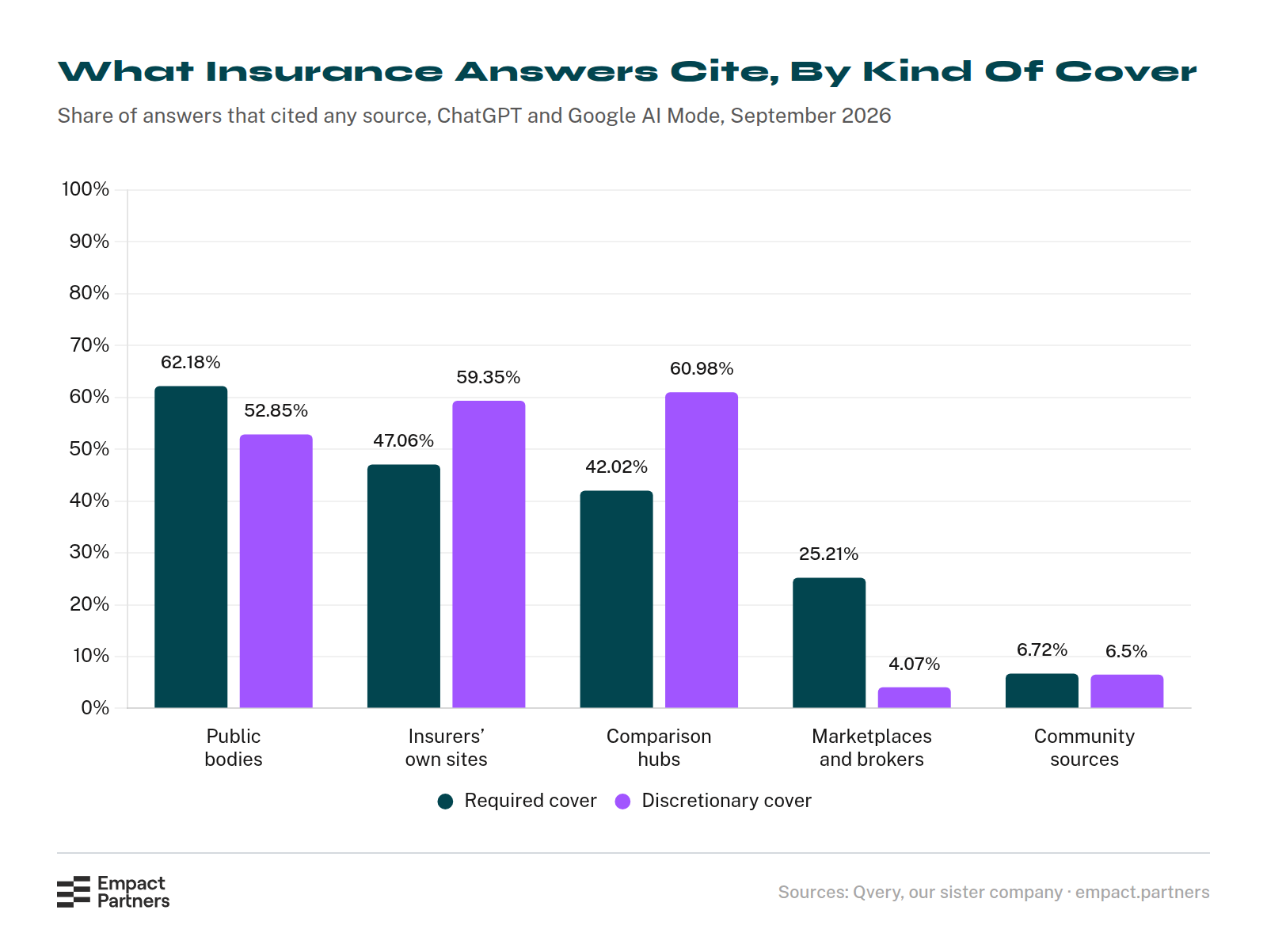
The list is also short. Four domains cover half of the required-cover answers that cited anything, and sixteen cover four fifths.1 A marketing team is not up against the whole web for these answers. It is up against a list it could read in one sitting.

.png)
The sources change when the buyer describes themselves
Car insurance got a study of its own a month earlier, in August 2026. Qvery asked the same kind of question two ways: generically, and with the driver described by details such as age, state, or claims history. Among answers that cited any source:
In the driver-specific answers the two big carriers and J.D. Power drop out of the leading group. Qvery prints no percentage for them there, because the counts get too small to carry one. A specific buyer gets a more scattered set of sources, and a household name helps less.

A smaller insurance brand can read that scatter as good news. The generic question belongs to the comparison giants. The specific one (a young driver in one state with one claim) is still open, and specific questions are the ones a buyer asks last, just before choosing.
A narrow venue turned 100,000 wasted views into leads
Our own record has one result that belongs beside those figures. A specialized insurance brokerage, a partner of ours, had run five Reddit posts to nearly 100,000 views and zero leads.
We moved the program into 8 to 12 small subreddits where its real buyers ask questions. It then produced about 40 qualified leads in one month, and more than 20 of them arrived in the first ten days.7
One partnership is a story and never a rate. What transfers is the mechanism. In a regulated category a broad audience cannot act on what it reads, and a narrow one can. That work is the UGC half of GEO, done where a regulated buyer already asks.
Money Questions Send The Engines To Review Hubs First
Fintech sits in the same federal sector as insurance, with the same kind of rules on what a company may promise about returns, rates, and risk. Its buyers are careful with the engines too.
In the FINRA Foundation’s national study of more than 25,500 adults, 20% of adults said they would be interested in getting financial advice from AI.12 The question measured interest in advice, and it was asked in 2024. It suggests people draw a line between asking an engine to explain money and asking it what to do with theirs.
Qvery’s fintech measurement study shows what the engines cite for consumer money questions. It ran in September 2026 and sorted the questions into a money-in side and a money-out side. Shares are of answers that cited any source.13
| Source type | Money-in questions | Money-out questions |
|---|---|---|
| Personal-finance review hubs | 73.17% | 73.39% |
| Brands’ own domains | 44.72% | 55.65% |
| Regulators and public bodies | 26.02% | 15.32% |
| Comparison marketplaces and credit-score services | 3.25% | 30.65% |
| Video | 13.82% | 8.06% |
Review hubs are in roughly three of four answers on both sides. Brands’ own sites are in about half, and Qvery treats those two brand figures as equivalent. Regulators appear in about a quarter of money-in answers, well under the share public bodies reach on required insurance, in a different question set.
The field is small here as well. Four domains cover half of the cited answers on each side, and nine or ten cover four fifths.13
A provider’s own site still appears in three of four product answers
A second September study asked a narrower question: when a buyer is choosing a financial product, do the engines cite a provider’s own website? It put the same needs two ways, as a choice between providers and as a direct request.
The pages behind those citations were mostly not marketing pages. Among the owned pages cited most often, Qvery’s readers counted eight help or policy pages, five pricing or fee pages, and five product pages.14
Legal Buyers Research With AI And Decide With A Lawyer
Law is regulated differently from finance. The rules sit with state bars and courts, they license the person more than the product, and in most places only a licensed lawyer may give legal advice. An engine answering a question about a divorce stands close to that line.
Buyers have stepped up to it anyway. Rev, a transcription company, commissioned a survey of 1,002 adults in December 2025. It is a vendor’s survey and unweighted, so read it as a direction. What it found:
Put the first and last lines side by side. In every 100 people, 65 have used it and 20 trust it a great deal. A law firm or a legal software company works inside that gap. The buyer arrives informed, wary of what informed them, and looking for a person to confirm it.

Information questions about law rarely cite any brand
Qvery’s law firm statistics used a fixed set of legal questions in September 2026, asked in the United States, the United Kingdom, Canada, and Australia. It is the largest set used here, with 714 recommendation answers and 300 informational ones. Shares are of all valid answers.
The 22% is the figure to hold on to. When someone asks what a legal term means or what their rights are, nearly four answers in five cite no brand’s site at all. The explanation comes from somewhere else, and that source has the buyer’s attention at the moment the problem gets its name.
The engine split matters for planning. Platform domains show up in a quarter of Google AI Mode’s recommendation answers and rarely in ChatGPT’s. A legal brand measured on one engine is reading half its position.
Health Questions Get Fewer Brand Sites And More Institutions
Healthcare is regulated for the plainest reason of the four: the harm is physical. Licensing boards govern who may treat, privacy law governs what happens to a patient’s records, and a claim about a treatment is held to a standard most software copy never meets.
People use AI for health anyway. Two national surveys in 2026 asked how, Pew Research Center’s of 3,488 adults in June and KFF’s of 1,343 adults in February and March:
The KFF pair says the most. People who use AI for health mostly trust it, and most of them still go to a doctor afterwards. Among adults who have never used it, about eight in ten trust it little or not at all.8
So health has the same shape as law. AI handles the orientation, a licensed person handles the decision, and trust follows use.
The two engines source health answers differently
Qvery’s healthcare study ran a September 2026 question set covering telehealth, health insurance plans, online therapy, online pharmacy, coaching, and dental and vision providers, plus a set of information questions. The table gives shares of each engine’s recommendation answers.4
| What the answer cited | ChatGPT | Google AI Mode |
|---|---|---|
| A brand-owned domain | 68.89% | 73.89% |
| A government or university health domain | 35.56% | 13.89% |
| A platform site | 2.96% | 28.33% |
With both engines pooled, 70.14% of recommendation answers cited a brand-owned site, and 33.88% of information answers did.4 Platform and community sites appeared in 9.31% and 4.28%.4
The table works as a planning document. ChatGPT reaches for government and university health domains in more than a third of its recommendation answers. Google AI Mode reaches for platforms in more than a quarter of its own.
Regulated Answers Cite Brand Sites Less Often Than Software Answers Do
Each industry so far has been read alone. Qvery’s legal and healthcare studies share a ruler with its software study from the same month: the same two engines, and the same unit, the share of all valid answers that cite at least one brand-owned domain.
Qvery does not make the comparison itself, because the question sets differ. What follows is our reading of three published studies, and a bearing more than a measurement.
On “which one should I pick” questions the gap is modest, thirteen to seventeen points below software. Fintech’s 73% on choosing questions lands in the same band.14
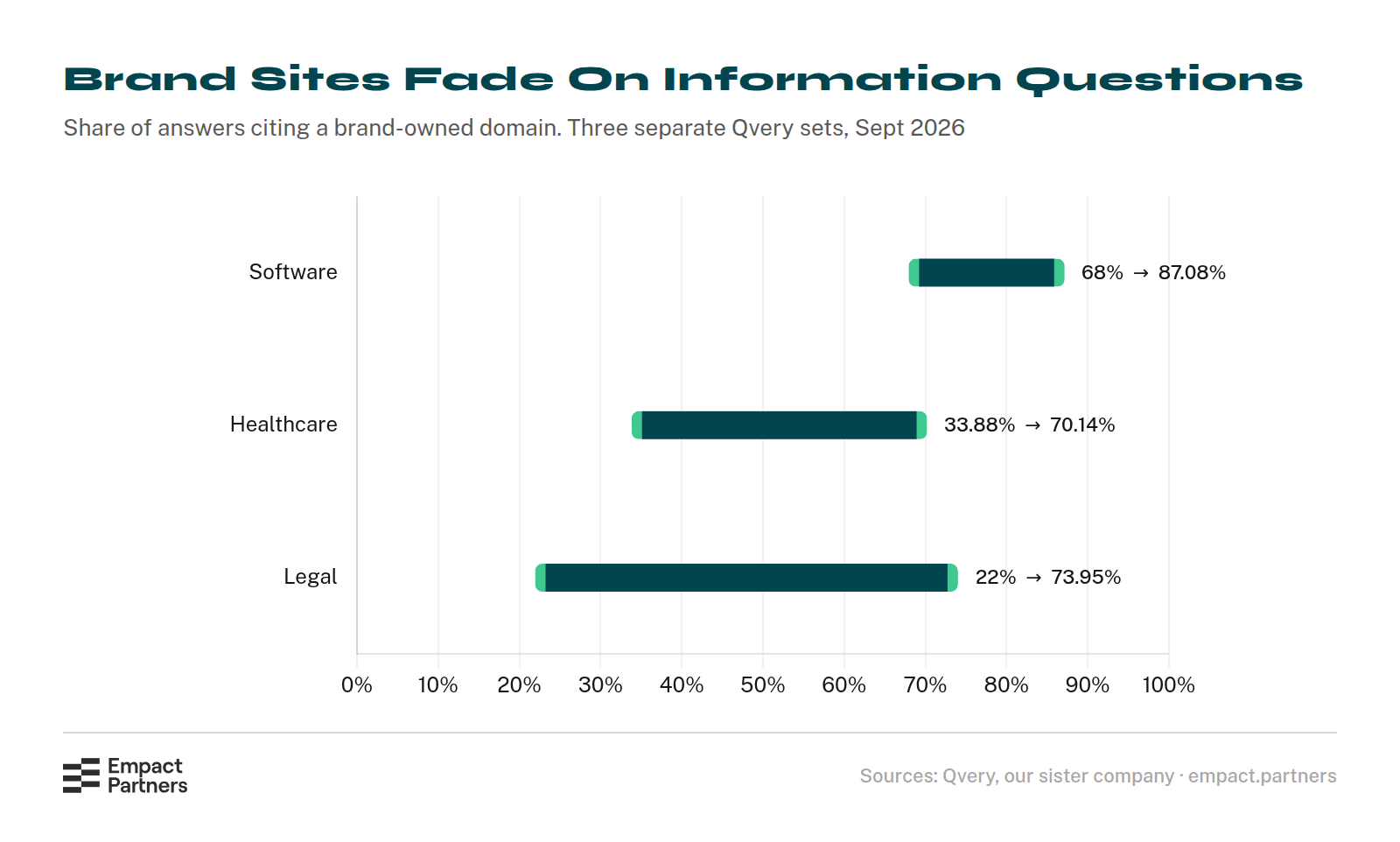
On “what does this mean” questions the gap is wide. Software answers cite a brand’s site more than two times in three. Legal answers do it about one time in five, and healthcare answers one time in three.
.png)
Platforms and communities point the same way. They appear in 20.42% of software recommendation answers, and that figure already leaves out the named review sites.2 The comparable layer is 8.4% in legal and 9.31% in healthcare. The forums that weigh so much in software answers are less than half as visible in these two.
Three things these figures cannot settle
We found no published share of all citations going to government, regulator, and news domains in these categories against a software average. We found no published count of how many brands an answer names in each. And every figure above records what sat beside an answer, never why the engine chose it.
Insurance could not join the comparison either. Its study divides by answers that cited a source, and the others divide by all answers. The insurance figures stand on their own, and they point the same way.
Compliance Review Belongs At The Angle Stage Of The Work
Put the industries together and one sequence repeats. The buyer asks an engine to explain. The engine answers from public bodies, review hubs, and publishers. The buyer takes the decision to a licensed person. A vendor enters late, on the comparison question, unless it supplied some of the explanation.
Supplying it is the work. Empact Partners is a B2B SaaS consultancy. Since 2020 it has run go-to-market programs from a seat inside each partner’s own marketing team. In a regulated market a GEO engagement opens with an audit of which sources the engines cite in the partner’s category, then a roadmap that splits the work in three:
The compliance reviewer joins at the first step, which is the main way content marketing in a regulated market differs from the software kind. We bring two or three angles for a piece, and the reviewer rules on them before anything is drafted. The outline and the draft go past the same person.
A rejection at the angle stage costs an afternoon. A rejection of a finished article costs the month, and usually the writer’s appetite for the next one.
One route that works in software works badly here. In one credential-sensitive category, cold outreach for expert quotes drew a handful of replies to several hundred emails. A professional with a license is careful about lending a name to a stranger. So the experts come from the partner’s own team.
None of this is quick. Citations move slowly because the pages engines trust change slowly, and a reviewed page takes longer to publish than an unreviewed one. The horizon is quarters, and a team that needs a result this month should spend its budget elsewhere.
The figure to watch is the information-question rate. If legal’s 22% and healthcare’s 33.88% start climbing toward software’s 68%, vendors in those markets have begun publishing the explanations, and the opening is closing.
If compliance keeps stopping the content your buyers are asking the engines for, book a meeting with me, and let’s find out whether this is work for the two of us.
Sources
- Qvery, “What Answers An Insurance Question In AI Search,” by Vlad Shvets, 4 September 2026. A targeted set of insurance questions on ChatGPT and Google AI Mode, September 2026. Read 6 October 2026.
- Qvery, “How Often AI Answers Cite G2 for SaaS Questions,” by Vlad Shvets, 22 September 2026. SaaS recommendation and information questions on ChatGPT and Google AI Mode, September 2026. Read 6 October 2026.
- Qvery, “Law Firm AI Search Statistics 2026,” by Vlad Shvets, 22 September 2026. A fixed legal question set in four countries, 714 recommendation and 300 informational answers. Read 6 October 2026.
- Qvery, “Healthcare AI Citations: What the Engines Cite in 2026,” by Vlad Shvets, 22 September 2026. A fixed September 2026 healthcare question set. Read 6 October 2026.
- Rev, “Survey: 65% Use AI Legal Advice, But Accuracy Concerns Remain,” 28 January 2026. 1,002 adults, 2 to 3 December 2025, unweighted, commissioned by Rev. Read 6 October 2026.
- Mercatus Center, “Regulatory Accumulation in the Manufacturing Sector,” by Patrick McLaughlin, Jonathan Nelson, and Oliver Sherouse, RegData 3.0. Read 6 October 2026.
- Empact Partners, insurance brokerage case study. One partnership. The Reddit views and the qualified leads are the ones its public page prints. Read 6 October 2026.
- KFF, “Tracking Poll on Health Information and Trust: Use of AI For Health Information and Advice,” 25 March 2026. 1,343 U.S. adults, 24 February to 2 March 2026. Read 6 October 2026.
- Mercatus Center, “Regulatory Accumulation in the Financial Sector,” by Patrick McLaughlin, Oliver Sherouse, and Stephen Strosko, 31 August 2017. Counts as of 2016. Read 6 October 2026.
- National Association of Insurance Commissioners, “Implementation of NAIC Model Bulletin: Use of Artificial Intelligence Systems by Insurers,” status as of 1 April 2026. Read 6 October 2026.
- Qvery, “Car Insurance AI Visibility: Which Sources Decide Which Insurers Get Recommended,” by Vlad Shvets, 27 August 2026. A targeted set of car insurance questions, August 2026. Read 6 October 2026.
- FINRA Investor Education Foundation, “FINRA Foundation Releases Sixth Wave of the National Financial Capability Study,” 16 July 2025. More than 25,500 U.S. adults, June to October 2024. Read 6 October 2026.
- Qvery, “How A Fintech Company Can Measure AI Visibility Of Its Products,” by Vlad Shvets, 4 September 2026. A targeted set of consumer fintech questions, September 2026. Read 6 October 2026.
- Qvery, “Do AI Engines Cite Fintech Brands’ Own Websites? Yes, And These Are The Pages,” by Vlad Shvets, 22 September 2026. Consumer-finance needs asked two ways, September 2026. Read 6 October 2026.
- Pew Research Center, “From Diagnoses to Treatments, Why Americans Use AI Chatbots for Health,” 25 August 2026. 3,488 U.S. adults, 22 to 28 June 2026. Read 6 October 2026.