Every SaaS marketing team has a version of the same conversation happening right now. Someone pulls up ChatGPT, types in a buying query for their category, and their brand isn’t in the answer. Then they try Google AI Mode. Same result. Then Perplexity. Still nothing.
The response is always some variation of: “We need to do something about this.” The problem is that “something” usually means a blog post titled “Why AI Search Matters” and a Slack thread that dies after three days.
This guide is the antidote to that pattern. Not a conceptual overview. Not a “why AI search matters” primer. If you need that, read our breakdown of how ChatGPT and Google AI Mode actually work. This post is the operational playbook — five steps, in order, with the specific actions we run across our partnerships at Empact Partners.
What AEO Actually Is (And Why Your Existing Playbook Won’t Cut It)
AEO — AI Engine Optimization — is the practice of making your brand consistently appear when AI search engines answer buying queries in your category. Not sometimes. Not for vanity queries. For the queries that actually drive pipeline.
You might also hear the term GEO (Generative Engine Optimization). Same concept, different acronym. We use AEO because it’s more precise — we’re optimizing for AI engines specifically, not “generative” anything in general. The distinction matters about as much as the difference between “growth hacking” and “growth marketing” — which is to say, not at all, but people will argue about it on LinkedIn regardless.
Here’s what makes AEO fundamentally different from traditional search optimization: AI engines don’t rank pages. They retrieve passages, synthesize information from multiple sources, and generate a recommendation. This is RAG architecture — Retrieval Augmented Generation.
The AI engine first retrieves relevant passages from its index, then generates a response using those passages as context. Your job isn’t to rank a page. Your job is to make sure your brand appears in enough high-quality passages across enough authoritative sources that the AI engine can’t generate a recommendation in your category without including you.
.png)
The formula we use across our partnerships is simple: GEO = Optimized Website Content + Third-Party Mentions + UGC. Miss any one of those three pillars and you’re building on a foundation with a load-bearing wall missing. Let’s walk through each step.
Step 1: Run A Visibility Audit
You can’t optimize what you can’t measure. Before changing a single page or sending a single outreach email, you need to understand where you stand — and where your competitors stand relative to you.
Use Qvery to run an AI search visibility audit. Qvery’s AI Engine Researcher agent auto-generates relevant queries for your category, runs them across ChatGPT and Google AI Mode in 200+ countries, and captures every citation. Here’s what the dashboard looks like:

The key metrics to baseline:
Qvery tracks all of this automatically, daily. Here’s how queries and their AI engine responses look inside the platform:

Then audit your existing content. Read through your top 30 pages and identify “citation candidates” — paragraphs containing unique insights, original data, or specific expertise that an AI engine would want to cite because it doesn’t exist elsewhere.
Most SaaS websites have extensive content libraries and almost zero citation candidates. The content is competent but generic. It says the same things the same way as every competitor. Which, to be fair, is exactly what happens when you outsource your blog to a content mill and call it a “content strategy.”

.png)
Step 2: Fix Your Website Foundation
Before investing in content and mentions, make sure your technical foundation actually supports AI search discovery. These are quick wins — most take days, not months — and most SaaS sites are missing them entirely.
Schema markup and structured data
Implement comprehensive schema markup. At minimum: Organization schema, Product schema, FAQ schema on relevant pages, Article schema on blog posts, and Review schema if you display testimonials. We covered this in depth in our piece on why schema markup matters for AI engines.
Schema doesn’t directly influence AI engine recommendations. But it strengthens your entity signals — helping AI engines recognize your brand as a distinct entity in your category. Google’s AI Mode uses structured data more heavily than ChatGPT does, so schema is particularly high-leverage if Google is a meaningful traffic source for you.
Entity establishment
AI engines build entity graphs — internal representations of who you are, what you do, and how you relate to competitors. The more consistent and widespread your brand signals, the stronger your entity. Ensure your brand exists on these platforms:
- Crunchbase: Complete company profile with accurate category, funding, and team information. This is one of the first places AI engines look for SaaS entity data.
- LinkedIn: Active company page with regular updates. Not “post once a quarter” active — genuinely active.
- G2 / Capterra: Claimed profiles with complete product information and 20+ reviews minimum.
- Product Hunt: Current listing if you’ve launched there.
- Wikipedia: If your brand is notable enough. You don’t create this — it exists because your brand is genuinely notable. But if it exists, make sure it’s accurate.
Consistent naming matters more than you’d expect. If your Crunchbase says “Acme Inc.” and your G2 says “Acme” and your website says “acme” — that’s three different entities as far as an AI engine is concerned. Pick one. Use it everywhere. This is the kind of thing that sounds trivially obvious until you realize your own brand has four different versions floating around the internet.
Passage-level content architecture
AI engines cite passages, not pages. A brilliant insight buried in paragraph 14 of a 4,000-word guide is less likely to be cited than the same insight presented as a clear, self-contained section with a descriptive heading. Restructure your highest-priority pages so that each section can stand alone as an answer to a specific question.

Step 3: Build Your Mention Footprint
Your website is one pillar. AI engines read what everyone else says about you, alongside what you say about yourself. Think of it like a hiring decision: your resume matters, but references matter more. Third-party mentions are your references in AI search.
Existing Article Outreach (EAO)
EAO is the most efficient way to build mentions on pages that AI engines already cite. The process:
- Use Qvery’s citation data to identify the specific articles and domains appearing as sources in your category
- Craft personalized outreach to the authors of those articles
- Earn placements that include your brand — not just backlinks, but contextual mentions with your key use cases
We built an entire outreach infrastructure using AI systems and Instantly.ai to run these campaigns at scale across our partnerships. The approach is detailed in our EAO guide. The key insight: you’re not building links for domain authority. You’re earning mentions on the exact pages that AI engines already trust and cite. The distinction sounds subtle. The results are anything but.
Here’s how Qvery surfaces the citation sources that should inform your outreach targets:

Review site investment
Review sites are among the most frequently cited sources in AI search for SaaS categories. G2, Capterra, TrustRadius — these aren’t just social proof for your pricing page. They’re citation sources that AI engines pull from when generating recommendations. Aim for 30+ reviews minimum, with detailed use-case descriptions that give AI engines specific context about when and why to recommend your product.
The content that actually gets cited
Not all content is created equal in AI search. Here’s what gets cited — and what doesn’t:
| Content Type | Why AI Engines Cite It | Example |
|---|---|---|
| Product tutorials | Specific, product-unique information that doesn’t exist elsewhere | “How to build a multi-step form with conditional logic in [Product]” |
| Original research | Primary data AI engines can’t find from other sources | “We analyzed 500 SaaS pricing pages — here’s what converts” |
| Expert perspectives | Named-author insights with genuine opinions and experience | “Why we stopped using NPS and what we track instead” |
| Comparison content | Honest feature comparisons that help AI match recommendations to queries | “[Product] vs [Competitor]: Which is better for teams under 50?” |
Notice what’s not on that list: “The Ultimate Guide to [Category].” Generic comprehensive guides don’t get cited because AI engines have access to dozens of them. They have no reason to cite yours over anyone else’s. Every piece of content should pass the “only you” test: could only your team, with your product and your data, have written this?
Step 4: Invest In UGC And Reddit
Here’s a number that should reshape your marketing budget: close to 20% of AI search citations come from Reddit. Not from corporate blogs. Not from publications. From Reddit threads where real users discuss real products. If you’re not present in those conversations, you’re invisible in a fifth of all AI search results. That’s not a rounding error — that’s a structural gap.
But Reddit engagement is not a sprint. It’s not even a marathon. It’s more like gardening — you show up consistently, contribute genuinely, and eventually things grow. Budget six months minimum before expecting meaningful results. The companies that try to “hack” Reddit with promotional posts get downvoted into oblivion faster than you can say “obvious shill.” Ask me how I know.
The community-first approach that actually works:
- Answer questions genuinely in subreddits where your audience lives. Don’t pitch. Help.
- Share original insights that demonstrate expertise without mentioning your product in every sentence.
- Engage with competitor threads — when someone asks about alternatives, a thoughtful, honest response from a real account carries enormous weight.
- Build karma and history before ever mentioning your product. AI engines evaluate account credibility too.
Beyond Reddit, consider HackerNews, Stack Overflow, and niche industry forums. Each platform has its own culture and rules. What works on Reddit will get you banned on HackerNews, and vice versa. Learn the room before you speak.

Step 5: Measure And Iterate
AEO isn’t a project with an end date. It’s an ongoing practice — like traditional search optimization, but with different metrics and faster feedback loops. The companies that treat it as a one-time initiative end up right back where they started within two quarters.
The monthly review
Track these metrics monthly using Qvery:
Quarterly strategy adjustment
Every quarter, review the overall trend and adjust your allocation across the three pillars. If your mention footprint is strong but your content isn’t getting cited, shift investment toward content. If your content is excellent but nobody’s talking about you, shift toward mentions and community engagement. The ratio evolves as your situation changes — there’s no permanent “right” split.
Here’s what the maturity curve looks like based on what we’ve seen across our partnerships:
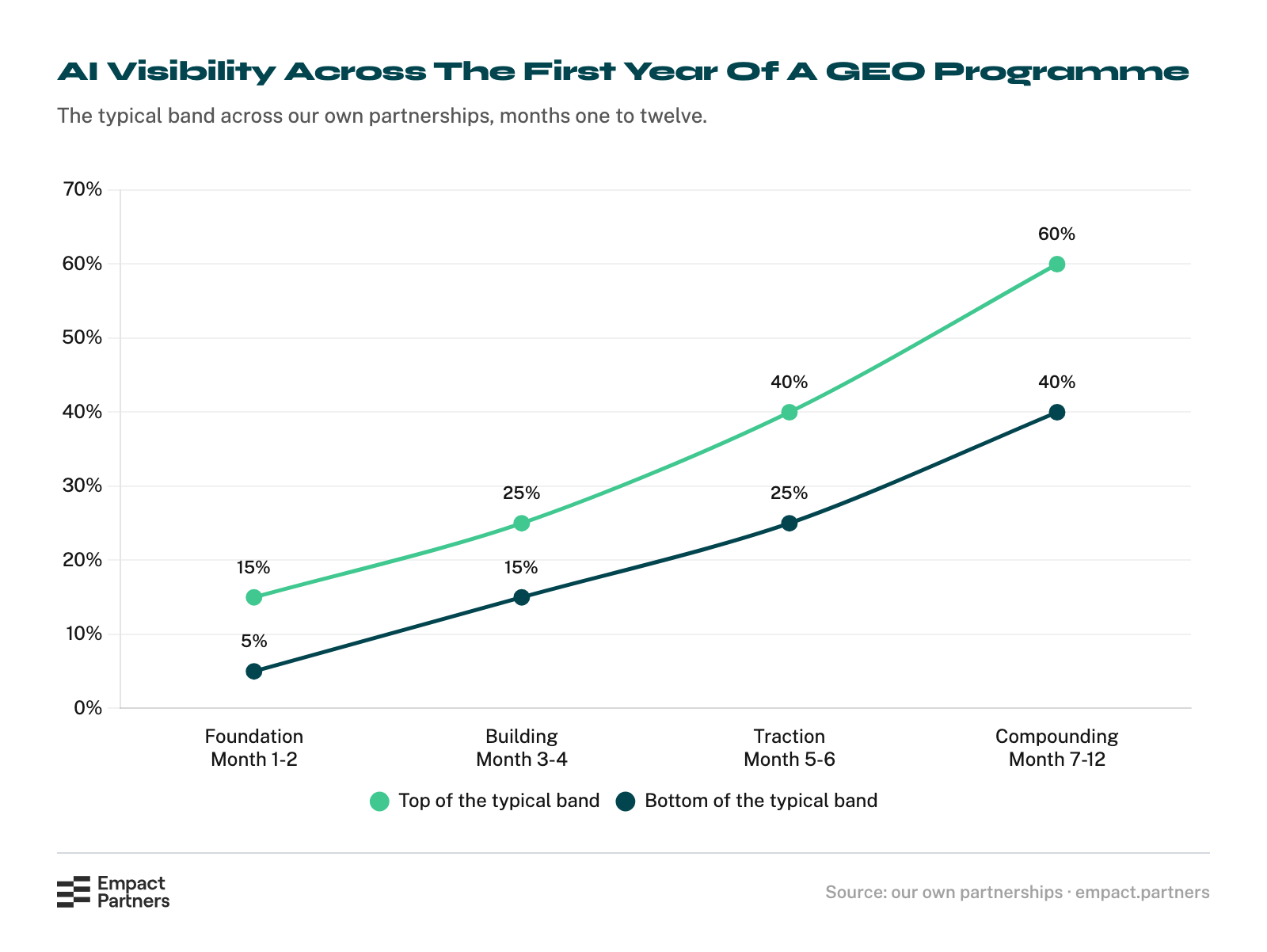
| Stage | Timeline | What’s Happening | Typical Visibility |
|---|---|---|---|
| Foundation | Month 1-2 | Technical setup, audits, baseline, content planning | 5-15% |
| Building | Month 3-4 | New content publishing, first mention campaigns, community engagement | 15-25% |
| Traction | Month 5-6 | Mentions landing, content cited, organic community discussions | 25-40% |
| Compounding | Month 7-12 | Flywheel kicks in — content, mentions, and UGC reinforcing each other | 40-60% |
| Leadership | Month 12+ | Category leadership — consistently first recommendation, highest share of voice | 60%+ |
These timelines are realistic, not aspirational. Companies starting at zero typically see meaningful improvement in 3-4 months and significant competitive advantage in 6-9. The compounding effect is real — but it requires consistent investment across all three pillars. Partners like Linearity (250K+ monthly organic sessions), flair (1,600% organic traffic growth), and Feathery (300% organic growth, profitable in 10 months) didn’t get there by dabbling. They committed to the system.
The Empact Partners Approach
Everything in this guide is what we do, every day, for our partners. We run the audits. We build the content. We run the EAO campaigns. We manage the Reddit presence. We track everything through Qvery and adjust monthly. It’s not magic — it’s systematic, sustained execution across all three pillars.
Over the past six years, we’ve refined every step of this process. The partners who work with us don’t need to build this capability internally. They get a team that’s already done it dozens of times — and a consultancy that’s been doing this work since before it had a name.
If you want to stop guessing about AI search and start seeing where you actually stand — and more importantly, start moving the numbers — let’s start with a conversation.