


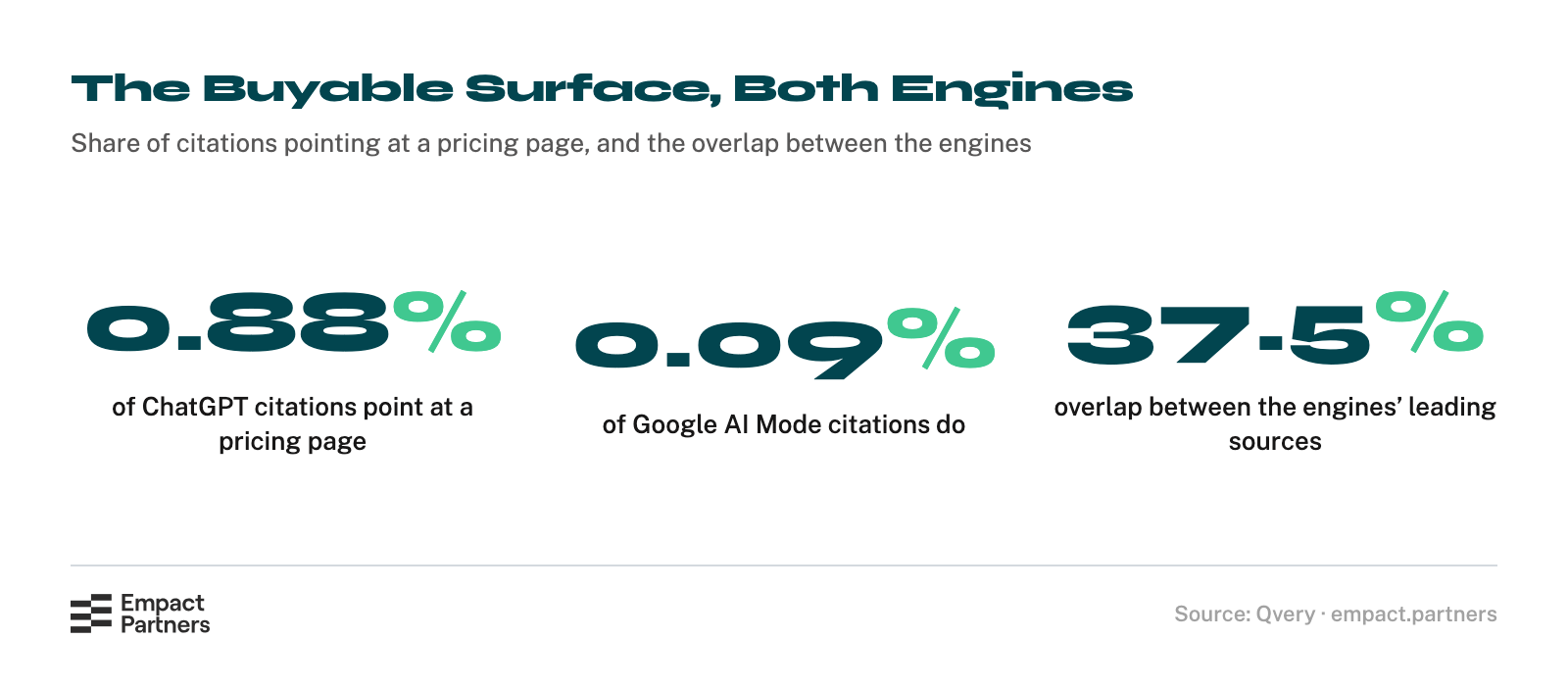
Between 1 July and 17 August this year, ChatGPT pointed at a pricing page in 0.88% of the citations it made when it answered a question in the software categories we track. Google AI Mode managed 0.09%.8 ChatGPT can now complete a purchase without leaving the chat, Google has published the standard meant to do the same, both card networks have shipped rails for it, and the page a buyer would have to act on is almost never the page either engine cites.
That gap is the whole subject. Agentic commerce gets discussed as a payments problem, and for a software company it is a visibility problem wearing a payments costume.
Highlights
Read together, those say something narrower than the headlines and more useful. The transaction layer is real, dated and shipping. The demand is real and growing fastest somewhere other than software. And the thing standing between a software company and an agent that could buy from it is not a checkout integration. It is that the engines have almost nothing of yours to hand over.
The Rails Are Built, And Nobody Has Published A Usage Rate
The disclosures are easy to line up, because every one of them is dated and on the record. OpenAI launched Instant Checkout in September 2025, on the Agentic Commerce Protocol it co-developed with Stripe, starting with US Etsy sellers and single-item purchases, with the merchant staying the merchant of record.2 That opened a buy button to US users of a product OpenAI says 700 million people use each week.2 Google published the Universal Commerce Protocol in January 2026, co-developed with Shopify, Etsy, Wayfair, Target and Walmart.3 Mastercard launched Agent Pay in April 2025, with agentic tokens, a requirement that agents register and be verified, and an IBM partnership aimed squarely at business buying.5 Visa shipped Agent Score in June 2026.4
Notice what none of them contains. Not one of those announcements publishes a usage rate, a transaction count, or any measure of how much is being bought this way. They tell you the rails exist. They do not tell you there is traffic on them, and the companies that would know are the ones staying quiet.
Visa’s announcement is the one worth reading twice. Agent Score, in Visa’s words, “allows merchants to evaluate their websites for agentic commerce readiness”, by testing “whether AI agents can navigate, understand and complete tasks on a merchant’s website”.4 A card network built a test for whether a machine can read your site. That is a company with real money at stake deciding the binding constraint is comprehension rather than payment.
The Traffic Is Real, And Software Is In The Slow Lane
Adobe measures this across more than a trillion visits to US retail sites, which makes it the largest published count of what generative AI is sending anywhere. Last holiday season, traffic to retail sites from generative AI tools grew 693.4% year over year.1 The same measurement by industry: travel 539%, financial services 266%, tech and software 120%, and media and entertainment 92%.1
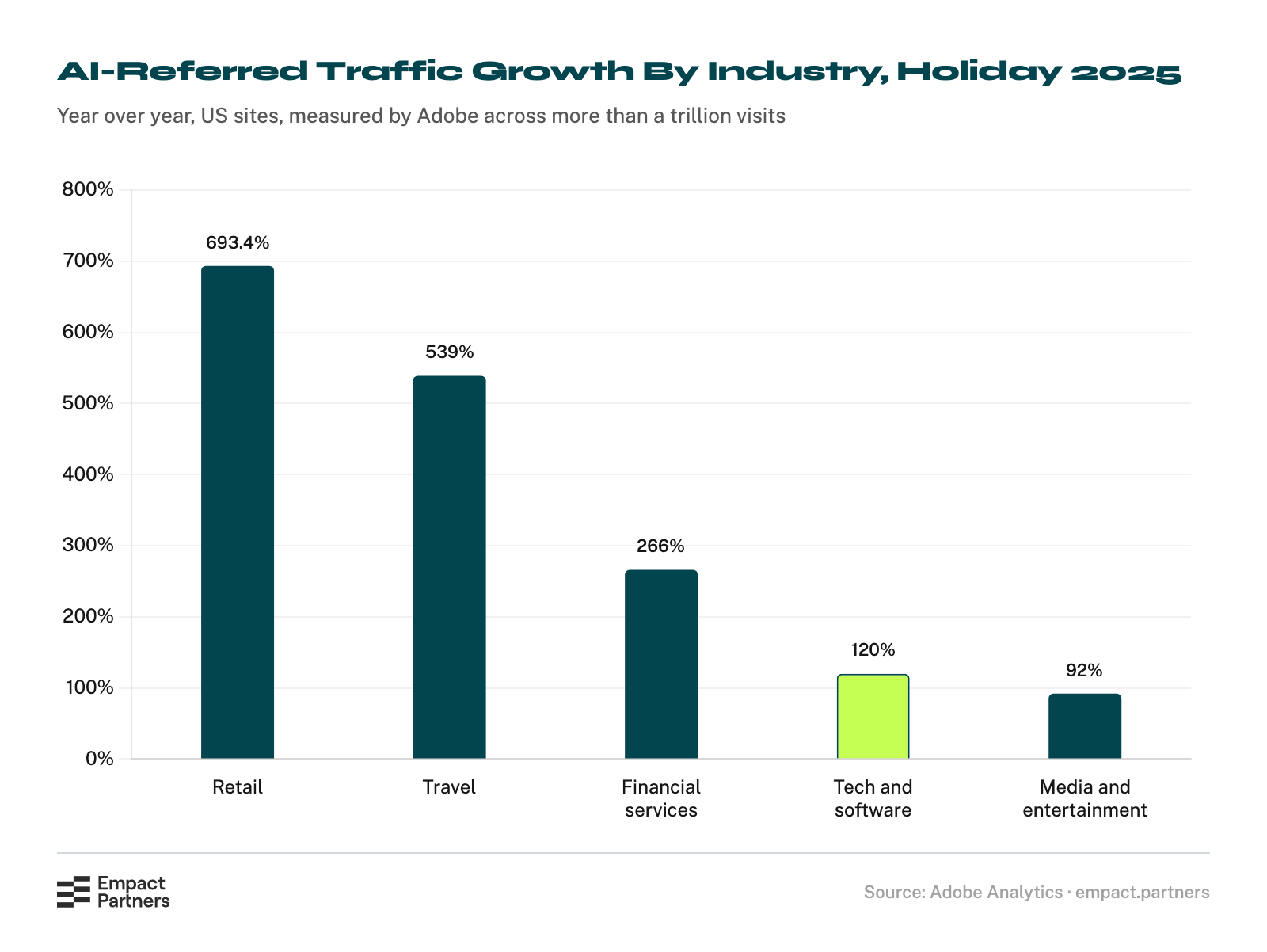
Tech and software is the slowest of the five. That is the number a software marketing leader should sit with, because it cuts both ways. The wave is real, and it arrived in your category last and smallest.
The quality half is better news, and it is also retail’s. AI referrals converted 31% better than other traffic sources, revenue per visit from AI traffic rose 254%, and 81% of consumers using AI assistants for shopping said the assistant improved the experience.1 People who arrive from an engine arrive further along, because the engine already did the narrowing.
People Delegate The Shortlist Long Before They Delegate The Card
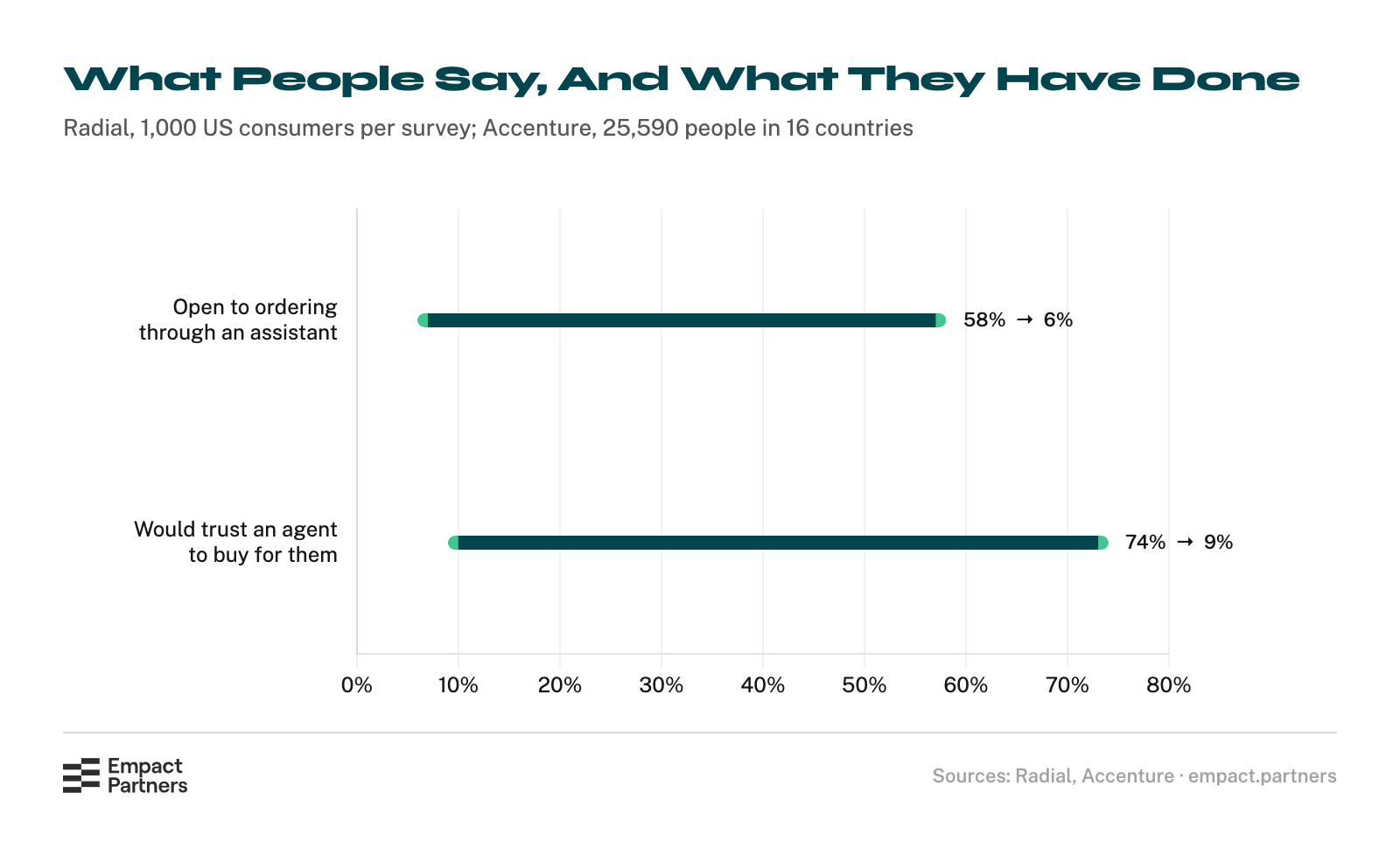
The consumer research is consistent to the point of being boring, which is usually how you know it is measuring something. Radial, across two surveys of a thousand US consumers each, found 58% open to placing an order through an AI assistant and 6% who have done it.6 Accenture, across 25,590 people in sixteen countries, found 74% who say they would trust a personal AI agent more than their best friend to buy on their behalf, while 32% would let it decide inside defined boundaries and 9% would let it act on its own.7
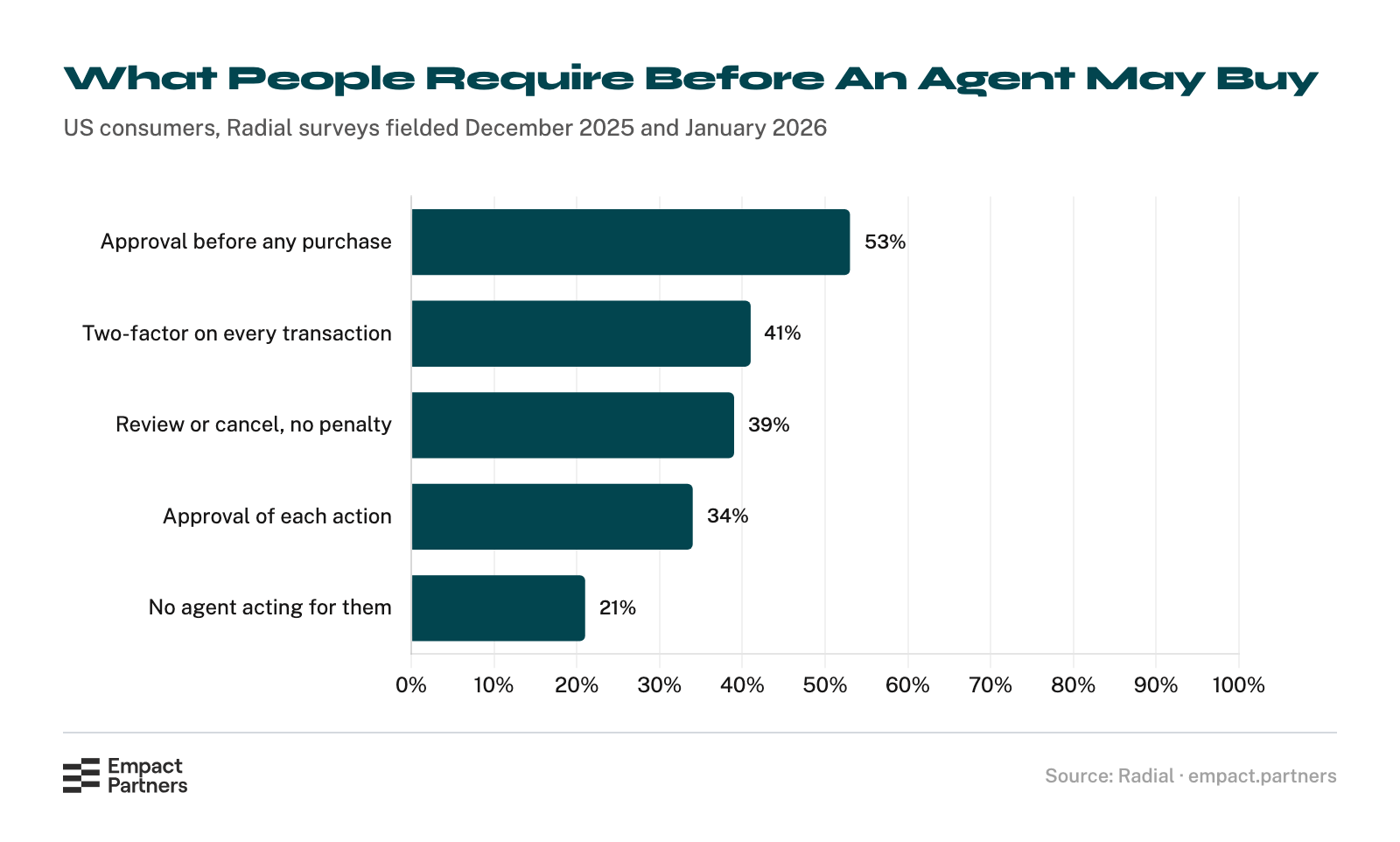
The conditions people attach are the interesting part. 53% require approval before any purchase goes through, 41% require two-factor authentication on every transaction, and 39% want to review or cancel without penalty.6 Asked how much latitude an agent gets, 34% would approve each action, 23% want suggestions only, and 21% want no agent acting for them at all.6
Put those beside where a shopping journey starts today, which is 5% with AI tools, against 34% with search engines and 32% with marketplaces,6 and the sequence is clear enough. The step people are handing over first is the choosing. The paying comes later, hedged with approvals, and for a software buyer it may never arrive in the form the announcements imagine.
Which makes the choosing the thing worth measuring. So we measured it.
What The Engines Cite When Somebody Asks About Software
We count this in Qvery, our sister company, which measures brand visibility across ChatGPT and Google AI Mode and captures every citation behind every answer: roughly 749,000 answers so far, 2.06 million distinct cited URLs and 9.7 million answer-to-citation links, refreshed daily. Read the numbers below knowing we own the instrument.
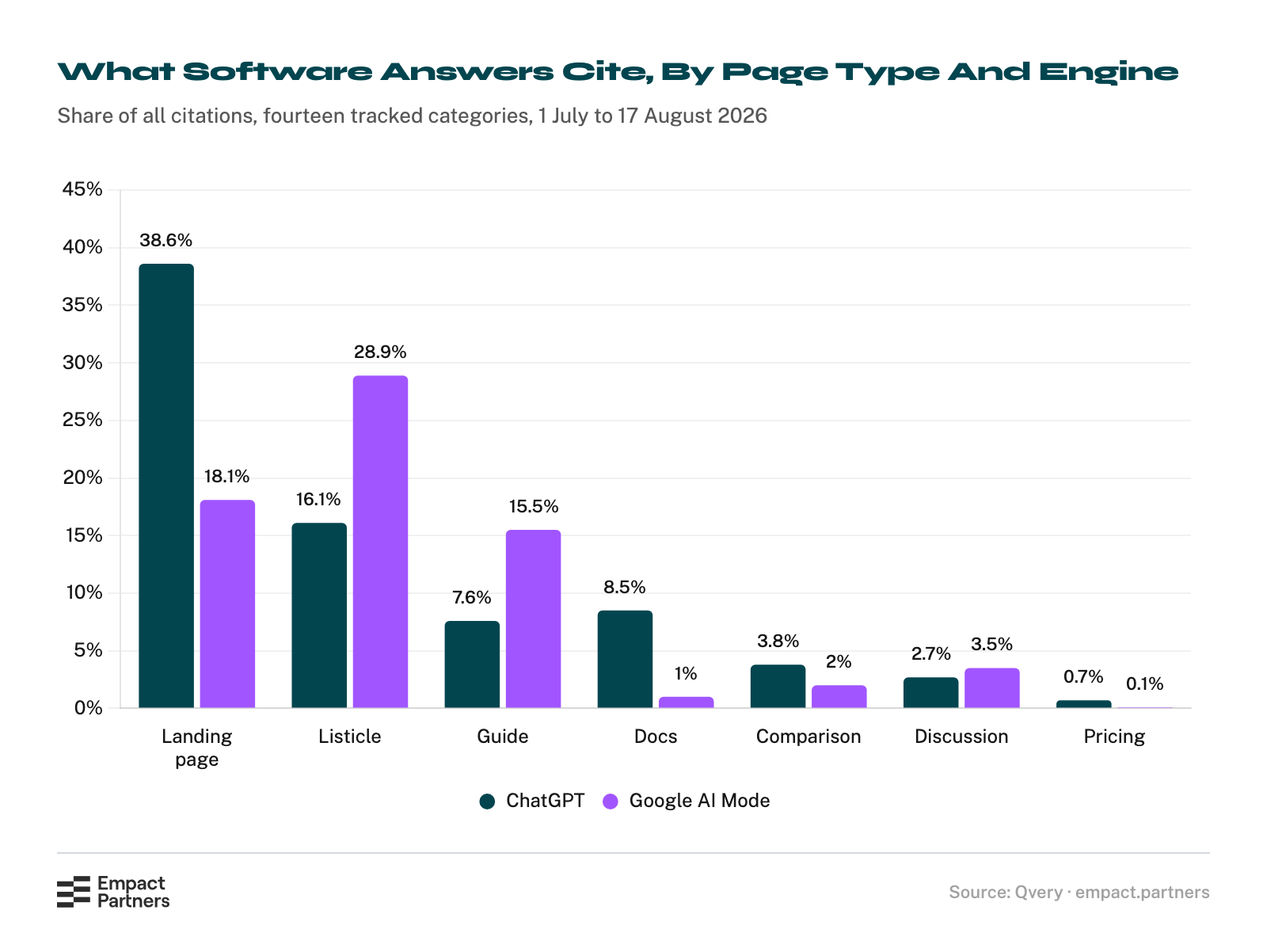
For this piece of work Qvery counted every citation in every answer across fourteen tracked software categories between 1 July and 17 August 2026, and classified each cited URL by the kind of page it is. Pricing pages were 0.88% of ChatGPT’s citations and 0.09% of Google AI Mode’s. Signup, trial and registration paths were 0.12% and 0.01%. Checkout and cart paths were 0.01% and almost nothing.8
At the level a reader experiences, the same run says 6.9% of ChatGPT’s answers and 1.1% of Google AI Mode’s cite at least one page a buyer could act on, over 50,744 and 52,863 answers.8 Turn those around and they are the finding: 93% and 99% of answers about software carry nothing buyable at all.
.png)
What fills the space instead is somebody else’s page. Landing pages take 38.6% of ChatGPT’s citations and 18.1% of Google AI Mode’s. Listicles take 16.1% and 28.9%.8 Documentation is 8.5% on ChatGPT against 1% on Google AI Mode, and guides run the other way at 7.6% and 15.5%.8 A ranked list on a publication neither engine owns is the single most cited thing Google AI Mode reaches for in these categories, and it is where the shortlist an agent would inherit gets assembled.

.png)
Two checks before anyone quotes that at a board. The pooled figure is a middle and not a rule: across the fourteen categories the ChatGPT share runs from 1.1% to 42.4%, median 5.6%, and thirteen of the fourteen run the same direction, with the two engines level in the fourteenth.8 And this is not a software problem. In a separate sweep across nine industries in April, buyable pages were under 1% of citations in eight of them on both engines.9 Healthcare was the exception. Travel, finance, ecommerce and the rest sat in the same near-zero band.
Two Engines, Two Shelves, And What That Decides
The two engines are not reading the same internet. In Qvery’s own collection across 108 US product recommendation queries, the engines’ leading source lists overlap by 37.5%.10 Our software cut says the same thing from the other side: the documentation ChatGPT leans on barely registers for Google AI Mode, and the guides Google AI Mode leans on are a thinner slice of ChatGPT’s. Whether ChatGPT and Google AI Mode name you is close to two separate questions.
Empact Partners is a B2B SaaS go-to-market consultancy, and getting named on those third-party pages is one of the six workstreams we run for software companies. Generative Engine Optimization means becoming the brand an engine names when a buyer asks its category question, and the order the work happens in is worth stating plainly. We run it as GEO = UGC + Mentions: what real users say about you in public, plus what independent pages say about you. An engagement opens with an audit of which of your own pages an engine can quote cleanly, then a list of the third-party pages it already cites in your category, then the slow half, which we call Existing Article Outreach: taking the articles an engine already quotes and getting your product into them. You supply product access and one reviewer. A quarter later we count the same list again. Nothing here moves in a fortnight, and we say so before anyone signs.
The listicle share is why that method exists rather than a better blog. Ranked lists are 16.1% and 28.9% of what these engines cite in software categories, and neither engine cares whose list it is.
What None Of This Settles
No origin anywhere publishes how many software purchases an AI agent has completed, and neither do we. Our measurement stops at what an engine cites, which is not evidence that a citation causes a purchase. Every willingness figure above is a consumer survey about consumer buying, and somebody who will let an assistant reorder shampoo is not a procurement committee.
One more limit, on our own instrument. Citations per answer in our collection moved from 27 to 5 and back to 26 inside the year, as the collection itself changed.8 So there is no trend line here, and you should treat anybody’s month-over-month chart of AI citations with the suspicion it has earned.
Watch one number instead, this quarter: the share of answers in your category that name you at all. While that reads near zero, a checkout integration buys you nothing, because the agent that might use it will never be handed your page. When it moves, the buyable pages are worth making legible, and Visa has already published what a machine is going to try to do on them.4 Send me the five questions your buyers ask and I will tell you who owns them in the answers today.
Sources
- Adobe, “AI-driven traffic surges across industries with retail experiencing biggest gains”, 2026. Adobe Analytics, measured across more than a trillion visits to US retail sites, November to December 2025, with a companion survey of more than 1,000 US respondents. Read 19 September 2026. business.adobe.com
- OpenAI, “Buy it in ChatGPT: Instant Checkout and the Agentic Commerce Protocol”, 2025. Read 19 September 2026. openai.com
- Google, “New tech and tools for retailers to succeed in an agentic shopping era”, 2026. Read 19 September 2026. blog.google
- Visa, “Visa Announces New AI, Stablecoin and Token Innovations to Power Intelligent, Programmable Commerce at Visa Payments Forum”, 2026. Read 19 September 2026. usa.visa.com
- Mastercard, “Mastercard unveils Agent Pay, pioneering agentic payments technology to power commerce in the age of AI”, 2025. Read 19 September 2026. mastercard.com
- Radial, “Radial Survey Finds 58% of Consumers Are Open to Using an AI Agent, Yet Only 6% Have Done So”, 2026. Two surveys conducted by Dynata, 1,000 US consumers aged 18 and over in each, fielded December 2025 and January 2026. Read 19 September 2026. radial.com
- Accenture, “Talk to my AI agent: The new rules of brand value”, 2026. Survey of 25,590 people across 16 countries. Read 19 September 2026. accenture.com
- Qvery, the software-category run for this article. Every citation in every ChatGPT and Google AI Mode answer across fourteen tracked software categories, 1 July to 17 August 2026: 793,054 and 736,409 citations over 50,744 and 52,863 answers. Each cited URL classified by page type, from its tag and its path. Counted 19 September 2026.
- Qvery, the nine-industry sweep. Every citation in every ChatGPT and Google AI Mode answer across nine benchmark industry categories, 10 April to 4 May 2026, between 3,700 and 35,300 citations per industry and engine. Counted 19 September 2026.
- Qvery, “ChatGPT And Google AI Mode Cite Different Shopping Sources”, 2026. 108 US product recommendation queries across six retail categories, each run three times on ChatGPT and once on Google AI Mode, August 2026. Read 19 September 2026. qvery.ai


