


Affiliate marketing is not dead. The affiliate content site is, and the two keep getting the same obituary all year.
The difference between them is what each one gets paid for. An affiliate content site earns by manufacturing search traffic to comparison pages, then renting out the click at the end of it. A partner program earns when somebody it sent you arrives and converts inside your product. Google moved a great deal of that search traffic to Reddit and to large publishers in 2023, and AI engines now answer the comparison question inside the answer. Both of those took the click. The conversion was never theirs to take.
That holds for recurring-revenue software with a program somebody in your building owns, and not for consumer coupon and deal sites, which are a different business with different economics. It is also not a promise that your partner volume is safe, because when an engine recommends a vendor directly, fewer buyers pass through anybody’s partners at all. One of these structures can still be measured after the click goes. The other one cannot.
Read this knowing who wrote it. Empact Partners runs Search Everywhere Optimization as one of its six workstreams. Search stopped being one box on one site, so that workstream covers every surface a buyer searches, the AI engines and the communities they cite included. We are a go-to-market consultancy for B2B software, working inside partners’ own marketing teams since 2020, and getting a partner’s product named on pages that already rank is work we sell. That makes this a recommendation with a stake in it. The first move in it is an audit you run yourself in an afternoon, and if that audit comes back clean, you do not need us.
Every Serious Version of This Argument Says the Content Site Is Finished
The strongest case against me is the one our own team has been making internally since 2023.
A content library built mostly on comparison and versus pages is fragile. We have watched one that had built substantial monthly traffic that way lose the large majority of it across successive core updates. It was not a partner of ours and it was not a careless operation. It was a site that kept doing the thing the format rewarded, right up until the format stopped being rewarded.
That visibility went to Reddit and to the other places where people talk about software in public, and we have treated that as a structural change rather than a bad quarter ever since. Then AI engines finished the argument. A model restates public comparison content freely, and cites it without sending anybody anywhere. That is a direct threat to any business that monetizes the traffic it generates itself, whether the money arrives as ad revenue, as affiliate commission, or as leads the blog collects.
So on the sites, the objection is correct, and I am not going to argue with it. If your partner roster is mostly independent comparison blogs, expect that roster to shrink, and expect the survivors to be sitting inside large publishers.
What nobody can tell you is how much of your program’s revenue those sites represent. I cannot, and neither can whoever quotes you a percentage. The loudest numbers in this argument come from a network defending its own category and from tool vendors writing about their own market, which is several interested parties and no measurement. That is why this is an argument about exposure rather than about market share. Exposure you can check yourself, tonight, against your own contracts.
.png)
The Payment Structure Is What Died, and Somebody Chose It
Not every partnership has the same shape. Ours come in four: paid on clicks, paid on affiliate terms, paid for sponsored content, or built around content co-created with the partner’s own experts. The shape is a decision somebody makes at the start, and most of the damage in this business comes from treating it as something you inherit.
We have sat on the publisher side of that decision. A vendor deal promoted their premium tier, and the content drove clicks and very few conversions. When the vendor reviewed it afterwards, nobody had ever agreed which conversions counted or which markets they had to come from, so the deal was measured against criteria invented after the fact. The lesson we wrote down at the time was to define the metric and the audience before anything goes live, and it has survived everything that happened to search since.
That deal did not fail because the content was weak. It failed because nobody had named what was being bought, so the click was the only thing left to count, and the click was worth less than both sides had assumed. The affiliate relationships that died in 2023 died of that same thing, with an algorithm arriving later to take the blame.
Operators running these programs have arrived at the fix on their own. When somebody describes what they pay for now, it is an event inside their own funnel, named before the partnership starts: a paid subscription, an application they approved, a trial a human asked for, a meeting that happened. Spam stops paying at that point, because every one of those events needs a payment to clear or a person inside the company to approve it.
The failure they describe instead is a partner bidding on the vendor’s own brand name and invoicing for demand the vendor had already created. That one survives an outcome deal, because the buyer does convert. It is the reason a program is a workstream rather than a page.
| The deal | Paid for traffic | Paid for a named outcome |
|---|---|---|
| What the partner sells you | A click on a page they built | A buyer who converts in your product |
| When the metric gets agreed | After the first invoice | Before launch |
| What a core update takes | The traffic the page depended on | Nothing directly |
| What an AI answer takes | The click the page was selling | Some volume, never the measure |
| What you see in your own analytics | Sessions and a referrer | Payments, trials, applications |
| What fraud looks like | Brand bidding, manufactured signups | Manufactured signups earn nothing, though brand bidding still needs policing |
The Page the Affiliate Published On Is the Page the Engines Quote
The comparison page did not go anywhere when its traffic did. It changed hands.
We measure AI search with Qvery, which is our own sister company, so weigh the recommendation accordingly. Qvery tracks what ChatGPT and Google AI Mode cite when buyers ask their category questions, and it can classify about 12% of those citations by title pattern. Inside that set, listicles are 45.8% and reviews and comparisons are another 19.4%, which puts the ranked list and the comparison page close to two thirds of every citation we can put a name to.
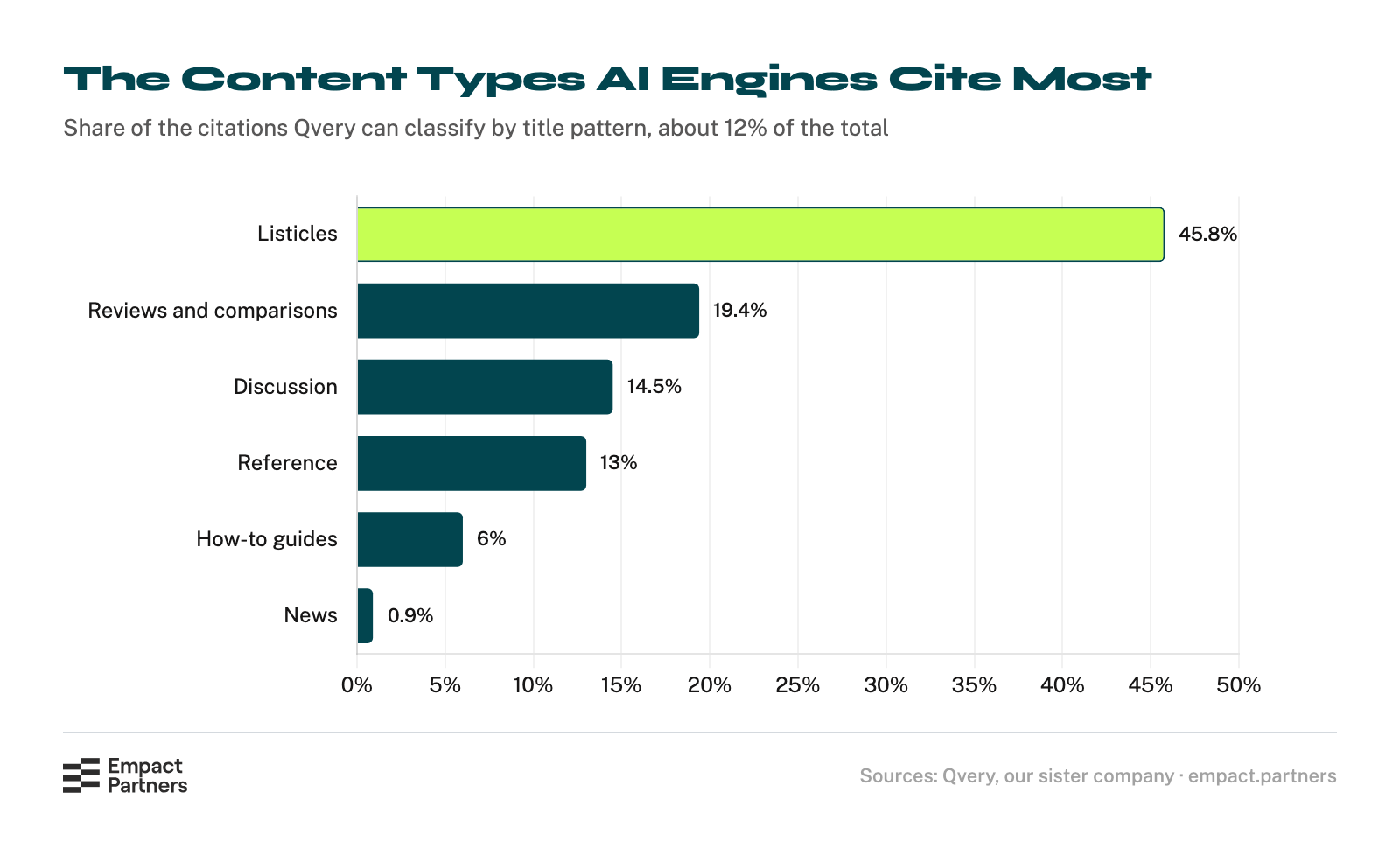
So the format did not lose its value in 2023. It lost its business model. Engines quote that format more than any other we can classify, because a ranked list is the answer they are assembling, already assembled. What changed is that you can no longer own the surface by building one yourself. You get named on the ones that already exist.
Existing Article Outreach is our own method inside that workstream. We take the software listicles that already rank and already get cited, and work to get a partner listed in them.
An engagement opens with an audit and a roadmap rather than a content calendar. We bring the page list. The partner supplies product access and one reviewer who can answer an author’s questions. What lands is placements on pages that were already being quoted. Momentum takes months rather than weeks, and we say that before anyone signs anything.
A placement does not pay you in clicks either. It buys presence on a page your buyer reads and an engine quotes, and you watch it the way you watch a mention, by whether your name is in the answer when somebody asks. That is the same trade your partner program is making. You are paying for a buyer who arrives, rather than for the traffic that carried them.
If you run a partner program, you already do half of this work. The standard advice for recruiting affiliates is to search for the best-of posts in your category, find the ones your competitors are already in, and email whoever wrote them. Same motion, and the same page list. What differs is what you pay for at the end of it.
We have been working in this market for years. wecantrack sells affiliate tracking, a product that exists because somebody has to prove which click became a payment. What we ran for them was content and off-page work rather than their partner program. They came to us at roughly 490 organic visits a month, and three years later that was more than 12K, carried by expert-led articles and by link magnets that earned their own backlinks.
Keep the Program. Rewrite Every Deal That Pays for a Click.
The audit is dull and it takes an afternoon. Open every partner and affiliate agreement you have and ask two questions of each one. What does this deal pay for? And when was that agreed?
What the deal pays for is the question that decides. A deal that pays for a click is buying you traffic, whoever agreed it and whenever they did. A deal that pays on a payment, a trial somebody asked for, or an application you approved is buying you a buyer.
When it was agreed tells you which of those you will be able to defend. A metric agreed before launch is one both sides can still read the same way two years later. A metric that arrived in the argument after the first invoice never gets settled, it gets negotiated, usually by whoever is angrier.
Keep the deals that pay when something happens inside your product, because they are worth more than your CFO thinks. Rewrite the rest around a number you can see in your own analytics, and put that number in writing before the next piece of content goes live. A partner who will not move onto those terms has just told you what they were selling.
Then the conversation with your CFO changes. You are not defending a channel that three blog posts have declared dead. You are defending a set of deals, each of which costs you nothing until a buyer you did not have becomes a buyer you do. That is a much shorter meeting.
Do the audit before you cut anything. If every deal already pays for something that happens inside your product, you have nothing to buy from us or from anyone else, and that is the likeliest good outcome here. If it comes back the other way, send me the deals that failed. We can go through the roster together, and you will know within an hour which of them are worth rewriting and which were only ever renting you a click.


