
AI Agents Move Pipeline Only When They Remove a Handoff
Agents made each step faster and left the waits between people in place. Fund the next one only if it removes a handoff.
 Shanal GovenderWith
 Vlad Shvets
On this page
Empact Newsletter
One email a month on what is working in AI search and SaaS go-to-market.
Your reps research an account in a minute now. The first reply to an inbound lead is drafted before anyone opens the form, and the call notes write themselves. The weekly report is ready before anyone asks for it, and it shows the same pipeline it showed in the spring.
An agent added to a workflow nobody changed makes each step faster. The lead still waits at every handoff between people, and that waiting is where its time goes. For the work your team controls, rebuild the workflow around the agent so those handoffs disappear and one person owns the route, or don’t start the agent project. Your buyer’s procurement runs on a different clock.
Empact Partners builds AI agents for SaaS companies’ marketing and sales teams, aimed at the handoffs where their leads stall.
A Lead Loses Most of Its Time Waiting for the Next Person
The work on an inbound lead takes minutes. Someone reads the form, checks the company, writes a reply, books a call and logs it. The lead’s days go somewhere else. It waits for the sales development rep (SDR) to open the queue, then for the account executive’s calendar, then for the follow-up somebody promised. Every one of those waits sits between two people.
An agent added to one of those steps makes the minutes shorter. It doesn’t touch the waits, because the step still hands its output to the same person, who picks it up when they get to it. Taking the handoff out is what shortens the wait itself:
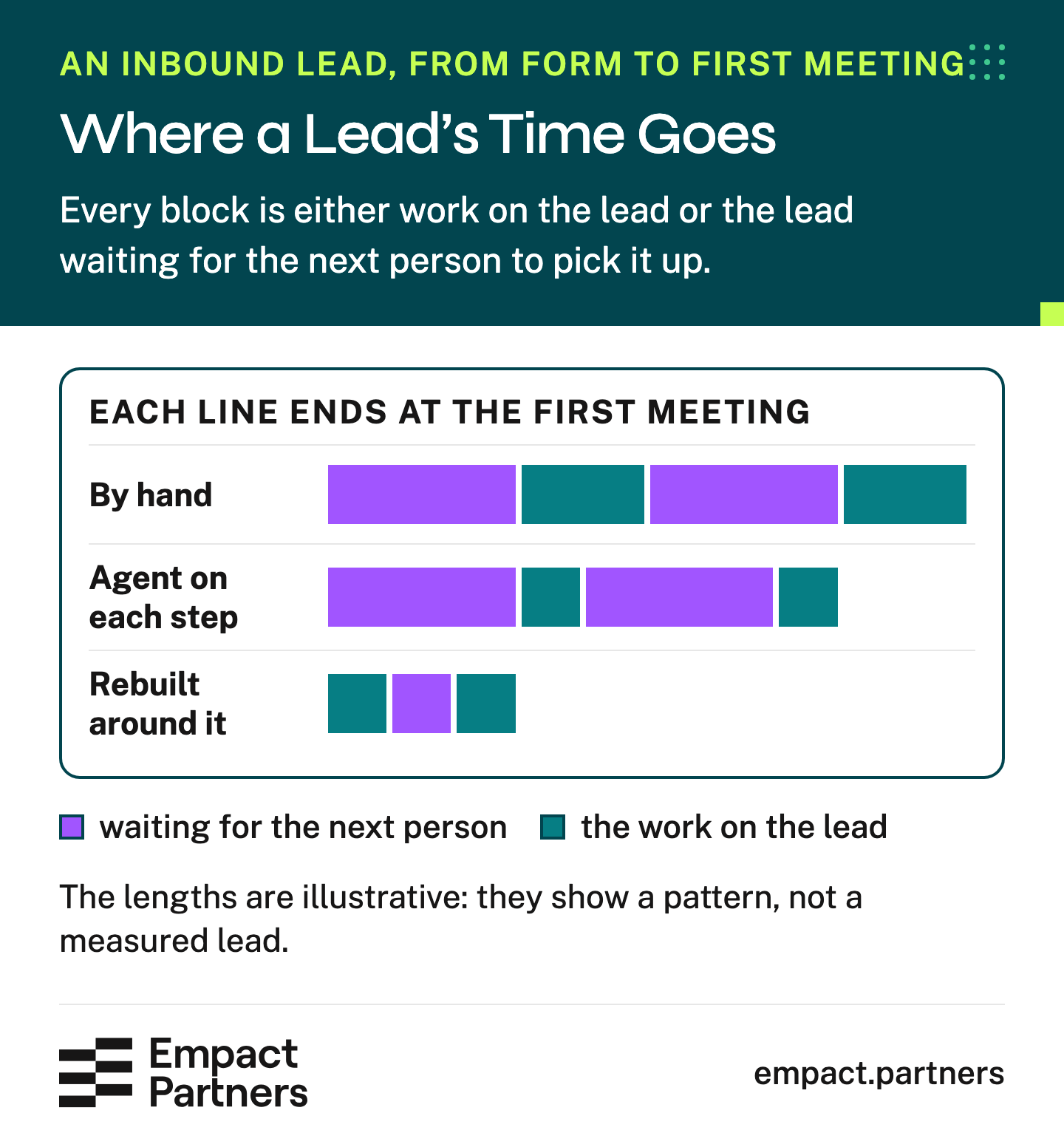
The middle line shows a faster team whose leads still reach the first meeting late. The work got faster, and the first meeting landed at nearly the same point, because nothing changed about who waits for whom.
Our own sales record shows how little a fast step explains on its own. In October we read every conversation with every company in our CRM. Then we set the deals we won beside the ones still open or parked in nurture, which we call stalled here:1
So the stalled deals were the faster ones at the proposal, and speed at that step did not separate them from the deals we won. What we can see is where many of them stopped. After the buyer’s last message, 57 of them never got another email from us.
Open any deal that went quiet and find the last message in the thread. If the next move was yours, that move is the first thing to fix, and an agent that drafts proposals faster won’t send it for you. Measure how long your deals wait before you measure what an agent saves.
 Shanal Govender on LinkedInOpens in a new tab
So the question for any agent project is which wait it takes out. The inbound path is the easiest place to see it.
What a Rebuilt Inbound Path Looks Like
Take the path most SaaS teams hand to an agent first, an inbound lead on its way to a first meeting. In the usual version an agent enriches the form the moment it arrives. Then the lead sits in the SDR’s queue, the way it always did.
An agent added to one step leaves every wait between people where it was.
A rebuild asks which handoffs still need to happen once an agent can do the work on both sides of them, and it leaves people only the calls that need judgment. Here is a typical SaaS inbound path, shown as a pattern rather than a partner’s deployment, step by step:
Scroll horizontally to see all columns when the table is wider than this page.
| Step | An agent added to the old path | The path rebuilt around the agent | Who decides |
|---|---|---|---|
| The form arrives | Enriched in seconds, then it waits in the SDR’s queue | Enriched and scored on arrival, against fit rules your team wrote | The route’s owner writes the rules |
| Qualification | The SDR qualifies it on a call when their calendar allows | A lead that clearly fits skips that call, and an unclear one goes to a person with the research attached | A person, on the unclear leads |
| The first reply | Drafted faster, sent when the SDR gets to it | Sent on arrival, with the account executive’s calendar for a lead that fits | The owner approves what the reply says |
| Booking | The SDR hands the lead to the account executive with a note | The lead books the account executive directly | No one, because the handoff is gone |
| Before the call | The account executive researches the account again | The agent writes the brief into the record the account executive opens | The account executive reads it |
| The CRM | Someone types up the outcome later | The record is built from the email and the booking | No one |
Three transfers disappear: the queue for leads that clearly fit, the SDR’s handover to the account executive, and the typing into the CRM. People keep the fit rules, the unclear leads and the meeting itself. One person owns the route from form to meeting, judged on how long it takes and how many meetings it books.
We run the first part of this on our own site, and it shows what happens when only one step changes. When someone runs one of our free AI tools, an agent writes the report and emails it. The lead goes into our CRM for the owner of that workstream.3
The first two reports of November reached the person five and nine minutes after they asked, each with a link to book a call. Nine days later the deal was still a lead, and the follow-up we owed was a week overdue. The report took minutes. The wait moved to the next step, which still belonged to a person.
Three Cases Where Rebuilding the Work Moved a Number
Our own CRM is the plainest case we have of a handoff removed and a number moved. Until 29 September, someone had to copy each reply onto our board by hand before the deal existed. The CRM that replaced the board builds the record from the email itself, so a reply opens a lead without anyone copying it:2
By 18 August those 49 replies had never reached the board, so the pipeline dropped them without a sound. In the week we measured, with the copying step gone, the gap was gone too. The only reply without a deal was a decline, and a decline never opens one. Two cases from outside our walls point the same way.
Ingka Group, the largest IKEA retailer, says its chatbot Billie resolved about 47% of the customer inquiries it received from 2021 to 2023, saving nearly €13 million.5 It also retrained 8,500 call center workers for remote design and sales, a channel that sold €1.3 billion in its 2022 financial year. The savings came from the bot. Ingka links that channel to the people the bot freed from routine calls.
Hyunjin Kim, Dahyeon Kim and Rembrand Koning ran a field experiment across 515 high-growth startups.4 Firms randomly shown how others had reorganized their work around AI were 18% more likely to win paying customers and made 1.9 times the revenue, with the same demand for labor. On an inbound route, a rebuild still leaves decisions about which leads fit and what the agent may send.
Name the person who owns what happens after the agent before anyone builds it. Give them the fit rules the agent follows, and judge them on the time from form to first meeting. If nobody can be named, the follow-up the old handoff carried has no owner, and a good lead can sit untouched for a week.
Shanal Govender on LinkedInOpens in a new tabA removed handoff doesn’t remove the responsibility it carried. Somebody on your team has to own the rules the agent follows and answer for the route when a good lead slips through. The same person decides what the agent may send without anyone checking it first.
Our playbook takes one recurring campaign through that change in 90 days, until your own team runs its agents without us:
Isn’t the Buyer’s Procurement the Real Bottleneck?
The best objection comes from the buyer’s side of the table. Your reps are faster, and the buyer’s legal team isn’t. A rep can build a quote in twenty minutes, and the deal can still sit in procurement for a month while the buyer’s legal team asks for changes. Your team’s speed can’t make another company sign sooner.
All of that is true. Rebuilding your inbound path won’t shorten anyone’s procurement, and the hours your team saved are capacity worth having. Count them as capacity, though. They aren’t pipeline.
Before the first meeting, the waits between your own people are yours to remove, whatever the buyer does. After the proposal, some waits are the buyer’s and some are still yours. In our own record, 57 of the 142 stalled deals got no further email from us after the buyer’s last message. Practitioners who hit the same wall this year time the whole route, not the task:
Tips from Reddit
What practitioners track instead of task time
Second, measure lead time from idea to shipped, not task time. Task time is the number that looks great in an AI rollout and tells you nothing about delivery.
I would track idea to prod as one number. If that number is not moving, the speedup is local, not real.
things like approval or pricing waiting time, number of times quotes are being revised, stakeholder changes, and procurement turnaround get help you know where your deal processes slow down
The first two come from software teams. For an inbound team, the closest equivalent is the time from form to first meeting. Track it apart from the share of open deals where the next move is yours and overdue, so your own waits don’t hide behind the buyer’s.
Approve the Next Agent Project Only if It Removes a Handoff
So before you approve the next agent project, ask whoever proposes it for four things:
- The handoff the agent removes, named as a step that will stop happening.
- The person in charge of the route once it is gone, and the rules the agent will follow.
- The measure, agreed before anyone builds: time from form to first meeting, meetings booked, or a number your team already reports.
- What the people who did the old step will do with their time.
A project that names none of them is a speed project. It can still be worth buying as a tool for one person’s job, but it hasn’t shown how it will move the pipeline, so don’t budget for it as if it will.
Empact Partners would start with the waits. Our consultants map where your team’s hours go, find the handoff where your leads stall, and agree with you the number the rebuild has to move. Then we build agents for the repeat tasks on that route, each with an owner on your team. We train your team on the rebuilt workflow too.
If you have a workflow in mind already, try the free AI Agent Blueprint on its most repetitive task. You get back a step-by-step plan for the agent, the point where a person signs off, and who would own it:
Once the rebuilt route runs, watch the number you agreed, such as the time from form to first meeting on an inbound route. If it hasn’t dropped, look for the handoff that is still there before you blame the agent.
Frequently Asked Questions
How long before a rebuilt workflow shows up in pipeline?
Read the time from form to first meeting first. If the rebuild removed the waits it set out to remove, they show there from the first leads through the new route. Meetings booked take longer to read, because your normal lead volume has to pass through the route first.
Pipeline and revenue take longer to read, because they move at the pace of your sales cycle. Agree before the build which number you will judge the project on, and when you will read it.
Should we switch off AI tools that only save time?
No. A tool that gives a person back an hour is worth paying for if that hour goes somewhere useful. Keep it, and count it as capacity rather than pipeline. The mistake is funding it as a workflow project and expecting the funnel to move. If nobody can say what the saved hours are spent on now, find that out before you renew the contract.
Does buying an AI SDR count as rebuilding the workflow?
Only if it removes a handoff. An AI SDR that writes and sends more first emails is a speed project on the front of the route. Check where its replies wait for a person to read them, and where booked calls wait for someone to pass them on.
Ask the vendor the same four questions you would ask your own team, starting with which step stops happening once it runs.
Which workflow should we rebuild first?
Start with the route where leads wait longest between two people and the work on each side repeats. Measure your own waits to find it. Inbound, from form to first meeting, is a common candidate, and so is the follow-up after a call, which is where our own stalled deals went quiet.
Measure that route’s time end to end before you change anything. Then rebuild one route at a time, so you can tell which change moved the number.
Does the CRM have to be clean before a rebuild?
Not all of it. An agent that scores leads needs the fields its fit rules read, such as company size and region. Fix those first, and the rest can wait.
If the rebuilt path builds new records from the email, the form and the booking, it takes manual typing out of them. The fields still need checks, so review a sample in the first weeks, and clean the old records while the new route runs.
What happens to the people whose step the agent takes over?
When an agent takes over their step, people move to work that needs judgment, such as the unclear leads, the calls and the follow-ups a buyer expects from a person. Ingka’s call center staff moved into remote design and sales once the bot took the routine queries.
Say what the new work is before the build starts. A team that doesn’t know what it will do next tends to keep the old step alive in a spreadsheet.
Who should own the rebuilt workflow?
One person on your team who can change the rules the agent follows and who answers for the measure you agreed for that route. For inbound, that is usually whoever already owns lead routing in marketing operations or revenue operations.
The owner reviews the leads the rules can’t decide, and decides when the agent may send without a person checking each message. It should never be the vendor who built it.
How do we measure whether the rebuild worked?
Measure the route rather than the step. Three numbers do it. The first is the time from form to first meeting. The second is meetings booked from inbound leads that fit, and the third is the share of open deals where the next move is yours and overdue.
Take each before you change anything, so you have a baseline. Hours saved and drafts written measure capacity and output. They tell you nothing about whether a lead reached a meeting sooner.
Does the same rule apply to outbound?
Yes, and the waits sit in different places. Outbound loses its time after the reply. The reply waits for someone to read it, the record waits for someone to log it, and the call waits for someone to send the link.
Rebuild the route from reply to meeting before you add an agent that writes more first emails. If replies already wait in your inboxes, more first emails mostly produce more replies waiting in the same places.
Can we rebuild a workflow with the tools we already have?
Usually. Most of a rebuild moves work between tools a team already runs, such as its form, its calendar and its CRM. What changes is which steps a person touches, not where the data lives.
If a tool can’t take an action the route needs, such as offering a calendar in a reply, that is the moment to look at replacing it.
Isn’t skipping the qualifying call risky for bigger deals?
Check what the qualifying call adds for leads that clearly fit your best customers. If it mostly repeats what the form and the enrichment already say, the rebuilt path can skip it. For an unclear or very large account, keep the call, and send those leads to a person with the research attached.
Write the fit rules so that deal size alone can route a lead to a person, and review the leads the rules let through during the first weeks.
Sources (5)
- Empact Partners, "our own sales record" (2026)Empact Partners' own data↩1↩2every conversation with every company in our CRM, read in October 2026 (213 companies), recomputed on 26 November 2026.
- Empact Partners, "our own CRM" (2026)Empact Partners' own data↩1↩2the hand-filed board as measured on 18 August 2026 (98 companies with a human reply to our outreach), and the health check of the CRM that replaced it, for the seven days to 26 November 2026.
- Empact Partners, "the first AI-tool leads on our own site, 17 to 26 November 2026" (2026)Empact Partners' own data↩1
- Hyunjin Kim, Dahyeon Kim and Rembrand Koning, "Mapping AI into Production: A Field Experiment on Firm Performance" (2026)↩1SSRN working paper, 30 March 2026, papers.ssrn.com.
- Ingka Group, "AI and Remote Selling bring IKEA design expertise to the many" (2023)↩1newsroom, 29 June 2023, ingka.com.
Keep reading
AI Agents 6 Best Call Recorders for AI Agents That Read Sales Calls
Compare six call recorders by transcript access, permissions and cost, and choose one for your sales-call agent.
AI Agents How To Build An Outbound Reply Agent That Learns From Edits
Your reviewers fix the same AI reply drafts every week. This loop turns a correction made twice into a dated rule the next draft follows.
AI Agents What A Marketing Engineer Should Build In The First 90 Days
Plan a marketing engineer's first quarter: audit the data, supervise one agent and use its results to decide what to build next.