


When Google AI Mode named a software vendor in the answers our panel collected this September, that vendor’s own website was among the sources about one time in four. ChatGPT did better by the vendor, at about one time in two.1 The rest of the time, every page cited beside the name belonged to somebody else.
Hold that number against the usual first move, which is rewriting your own pages. Half of B2B software buyers (51%) now start their research in an AI chatbot more often than in Google,2 so the pages those answers stand on decide who makes the shortlist.
Our own run covers 72,000 software-buying answers from ChatGPT and Google AI Mode, plus 2,700 from Claude. Beside it sit research by Qvery, our sister company, and the published studies that measured the same thing, each read at its origin.
Highlights
Read together, they say the vendor pillar is the largest source and the least yours. Engines lean hard on software companies’ sites, but much of that weight sits on other vendors’ comparison pages, and the platforms that matter change with the engine and the week. What goes with being named is presence on the pages the engine already reads.
Software Answers Run Mostly on Software Companies’ Own Sites
Our panel asked ChatGPT and Google AI Mode 72,000 unbranded buying questions in one B2B software category between 2 and 23 September 2026, and we classed each of the 451,803 citations by the kind of site it sat on:
About 14% of citations sat on a long tail of some 14,000 domains nobody classed by hand, so each class share is a floor.1
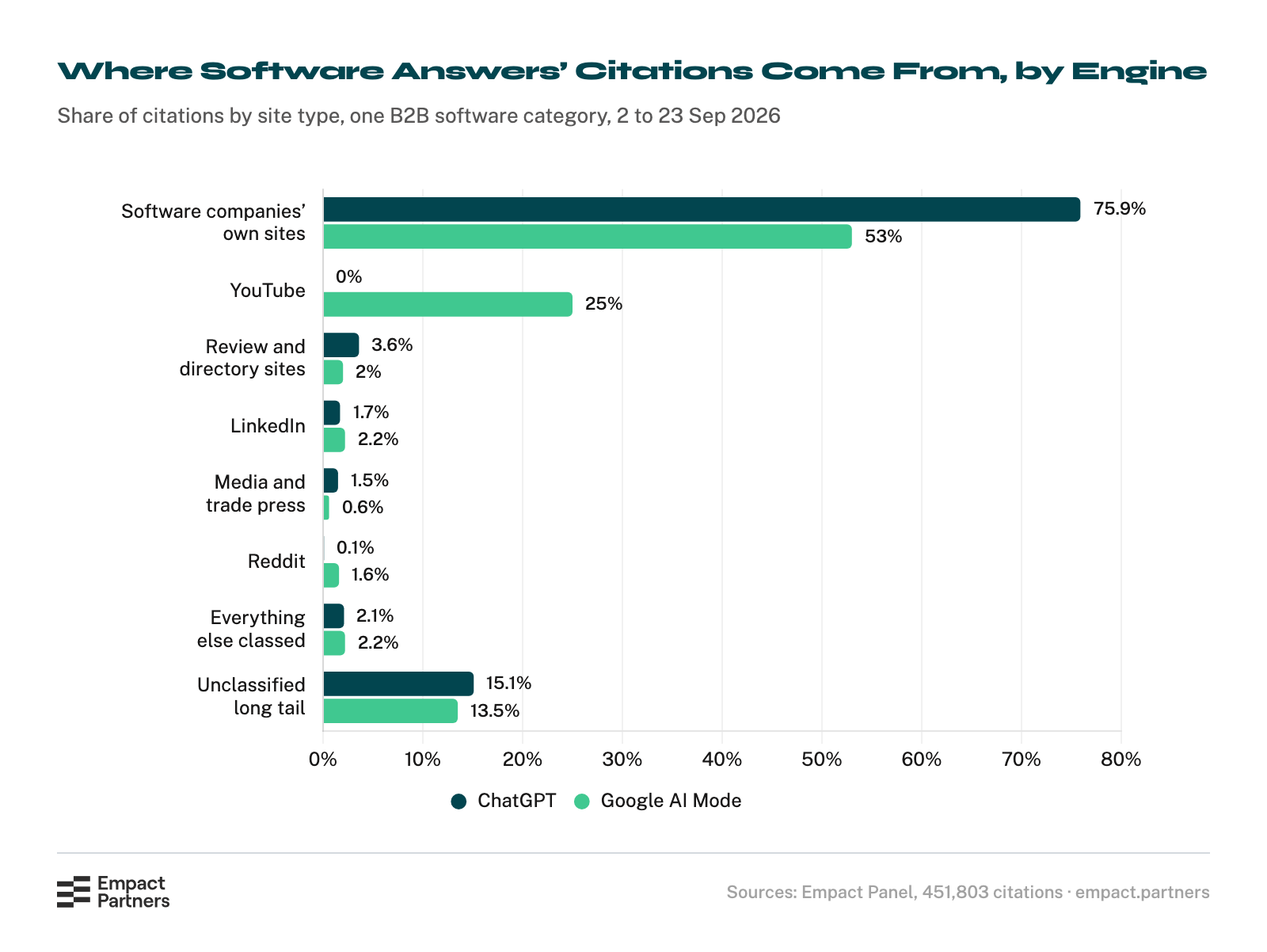
So the vendor pillar is the biggest thing an engine reads when the question is which software to buy. It is also split thin. The ten most-cited domains carried 33.9% of ChatGPT’s citations and 42.3% of AI Mode’s, and the median vendor domain held 0.04% of all citations.1
Published studies put the vendor side anywhere from about a quarter to nine in ten, and most of that spread is where each study draws the line between “brand” and “earned”:
| Study | What it measured | What it found | What counts as the vendor side |
|---|---|---|---|
| Profound | 11.84 billion citations, eight engines, all industries, April to July 2026 | 57% of citations went to company sites; 47% on ChatGPT and 69% on Gemini5 | Any company’s own site, competitors included |
| Qvery, our sister company | SaaS recommendation questions, ChatGPT and Google AI Mode, September 2026 | A brand’s own domain in 91.1% of ChatGPT’s answers and 75% of AI Mode’s6 | Any brand’s own domain, counted per answer |
| Kevin Indig for G2 | About 35,000 ChatGPT citations on software prompts, December 2025 | Vendor or unmapped sites were 70.4% of cited domains7 | Vendors, plus anything not mapped |
| Citera | 10,382 B2B SaaS keywords, four engines, May 2026 | 29% brand-owned and 61% earned8 | The brand’s own content; review sites and LinkedIn count as earned |
| Chen et al. | Software vertical, API models, August 2025 | 26.7% brand and 72.7% earned, US9 | Official vendor sites; review and comparison sites count as earned |
| Muck Rack | 25 million links, three engines, 17 industries, 2026 | 84% earned media10 | Earned includes other companies’ own sites |
Line them up by what they count and they agree more than their headlines do. Where another company’s site counts as a company site, software sits at the vendor-heavy end: Profound’s median SaaS company gets only 11.4% of its citations from earned media.5 Where review and comparison sites count as earned, the same answers look earned-heavy.

.png)
Qvery, our sister company, reads what ChatGPT and Google AI Mode answer every day, roughly 750,000 answers since late 2025, and its September SaaS studies are one ruler in that table. Because it is ours, weigh its numbers accordingly: each Qvery study cited here is linked with its method, so you can check the evidence rather than take our word.
Empact Partners, a go-to-market consultancy, has worked from inside software companies’ marketing teams since 2020. This map is the first thing we build in Generative Engine Optimization (GEO), the workstream that makes a partner the brand an engine names for its category.
Before any content is written, we collect the category’s answers, class every cited page, and hand the partner the list of pages the engines already trust.
Your Own Site Backs Fewer of Your Mentions Than You Think
Being among the most-cited kinds of site is not the same as backing your own mentions. The test is simple: when an answer names a vendor, is that vendor’s own site among its sources?
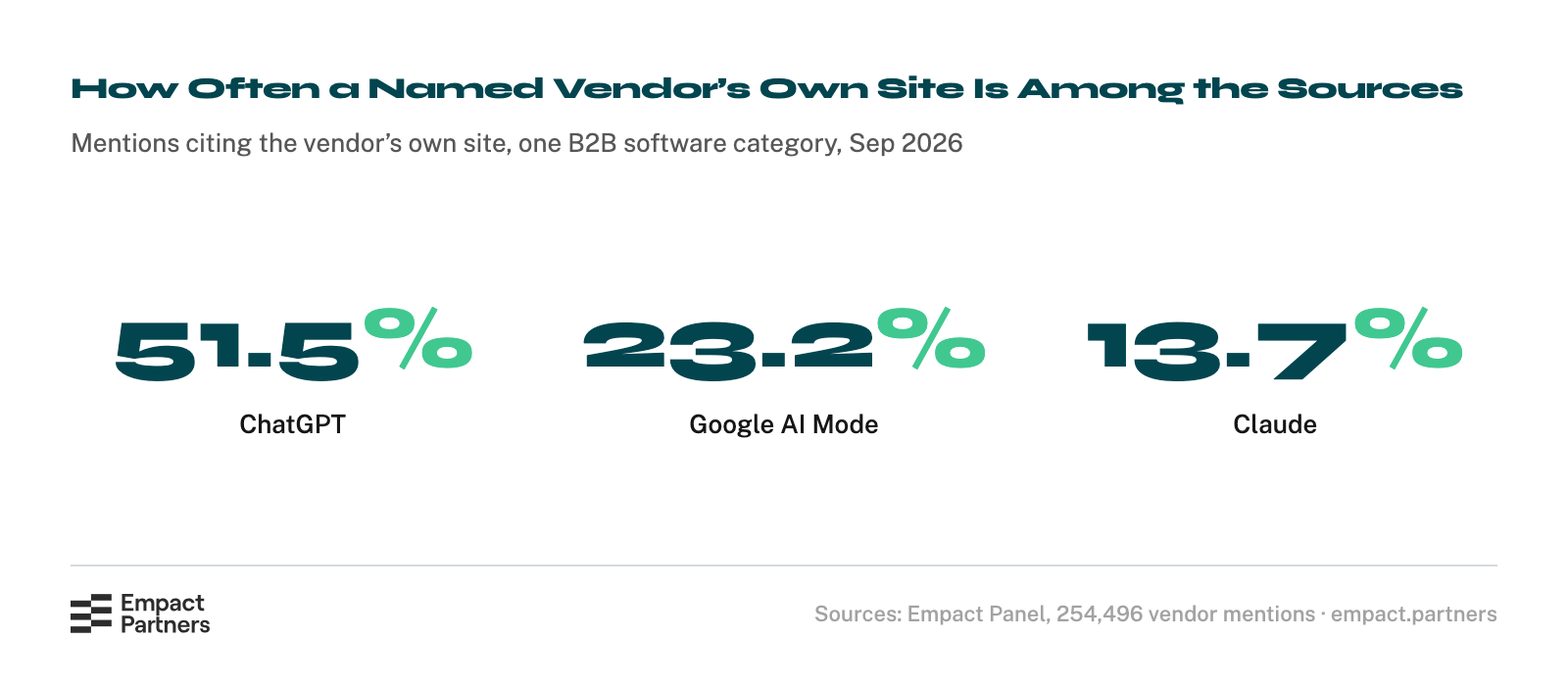
On Google AI Mode, three mentions in four came with no page of the vendor’s own among the sources, and on Claude closer to nine in ten.1 ChatGPT cites the vendor about half the time, which still leaves half of its mentions with only other people’s pages beside them.
When a vendor’s site does get cited, it is rarely the page a marketer would pick:
So the site pillar earns its citations through product and feature pages that answer a specific buying question, and it loses the argument on price, reputation and comparison to other people’s pages.
Writing pages an engine can quote is the site half of the work. Our Content Marketing workstream plans them from the same map a GEO engagement starts with.
Roundups Are Where the Shortlist Forms, and Vendors Write Most of Them
A roundup is the “best tools for X” page, several products ranked or compared, and the engines lean on them in very different amounts:
The roundup an engine cites is most often a post on a software company’s own blog, and if you sell in the same category, you are one of its author’s rivals. The engine reads that post as evidence about every product on it, which makes a competitor’s roundup a page the engines read about you whether it lists you or not.
The independent roundups are pages you can ask to join. Existing Article Outreach (EAO) is our method for exactly that: we take the roundups that already rank and already get cited in a partner’s category and work to get the partner onto them, one editor at a time.
Review Sites, LinkedIn, Reddit and YouTube Depend on the Engine and the Category
Outside the vendors’ own pages, which platform matters depends on two things you do not control: the engine your buyer uses and the category you sell in.
Review sites carry weight on ChatGPT and Claude, and at the evaluation stage
Review sites are a small share of citations and a steady one, and they matter most when a buyer asks for a recommendation rather than an explanation. Buyers notice them: 45% of B2B buyers in G2’s survey called review-site citations the most confidence-inspiring signal in an AI answer.2
Volume on the review site moves little by itself. Across 500 G2 software categories, 10% more reviews went with about 2% more AI citations.16 The work there is a complete, accurate profile in the directories your category’s answers already cite, more than a review drive.
YouTube and Reddit are Google’s sources far more than ChatGPT’s
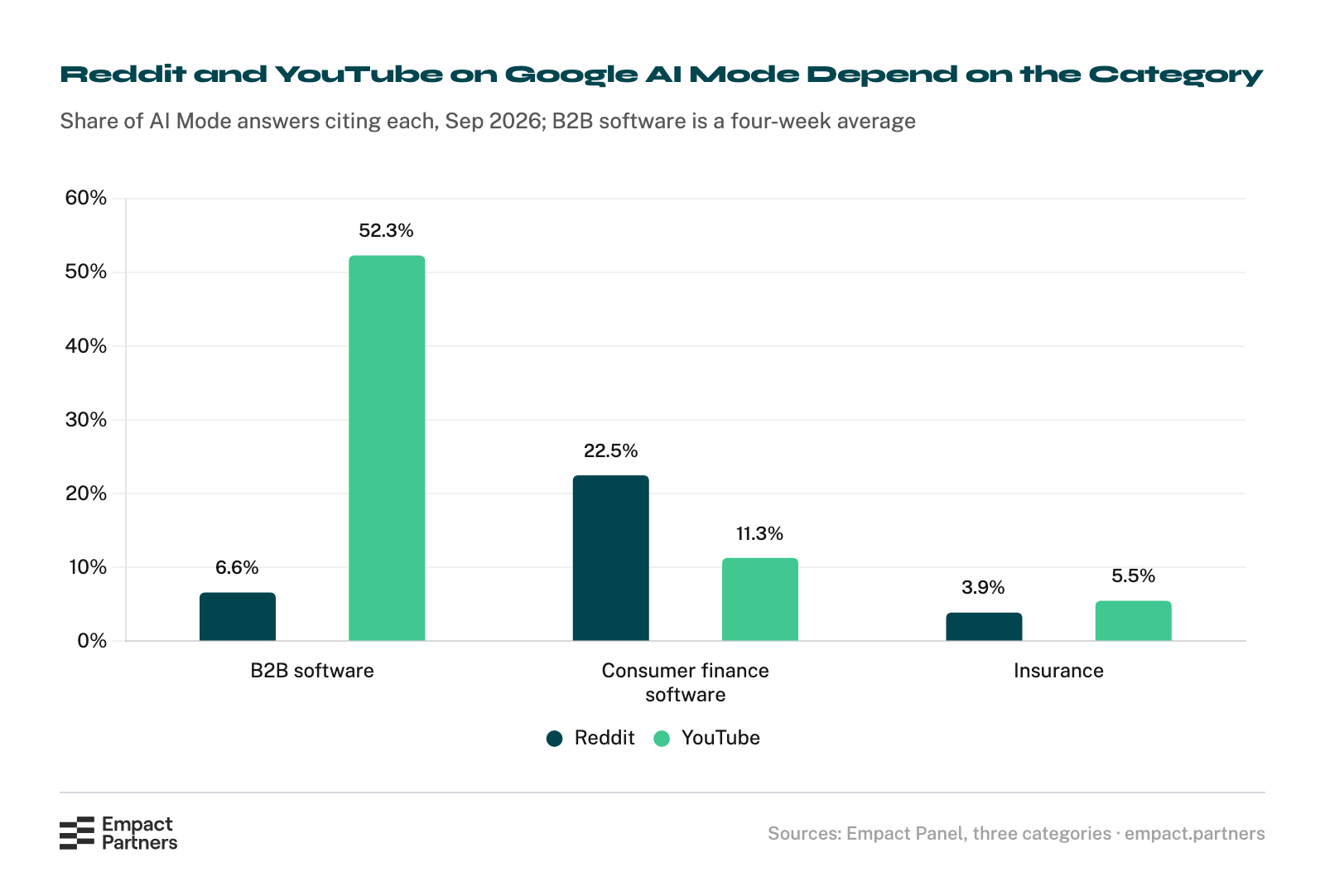
None of that matches the Reddit headlines, and the headlines are not wrong. Across all topics, Reddit tops ChatGPT’s most-cited list with 16.8% of the top-50 share.3 Software buying questions are a different diet. In three young SaaS categories, Qvery found Reddit in 43.2% of answers,18 which says as much about the category as about the engine.
The category moves it too. In a consumer finance software category we measure, Google AI Mode cited Reddit in 22.5% of answers and YouTube in 11.3%.19 In an insurance category it was 3.9% and 5.5%.20 ChatGPT stayed under 2% for both, in all three categories.
Community work is the UGC half of the formula we run GEO on, GEO = UGC + Mentions: what real users say about you in public, and where independent pages name you. We run it where a category’s answers cite it. For KKday, a Reddit program drew 3,208,973 views, 4,250 upvotes and more than 60 explicit mentions in three months.21
LinkedIn shows up in business answers on both engines
LinkedIn is the platform the two engines use most evenly in our run: 8% of ChatGPT’s answers and 8.8% of Google AI Mode’s cited it.1 Semrush found it in 14.3% of ChatGPT Search responses and 13.5% of AI Mode’s across a business-heavy prompt set.22
The Mix Moves Every Week, and No Two Engines Read the Same Web
The shares in our run average four weekly waves, and on Google AI Mode the average hides a lot. Between 2 and 23 September, the share of AI Mode answers citing YouTube went 61.3%, 65%, 62.7% and then 20.5%, while Reddit climbed from 2.9% to 12%. ChatGPT’s review-site line barely moved, from 18.4% to 19.2%.1
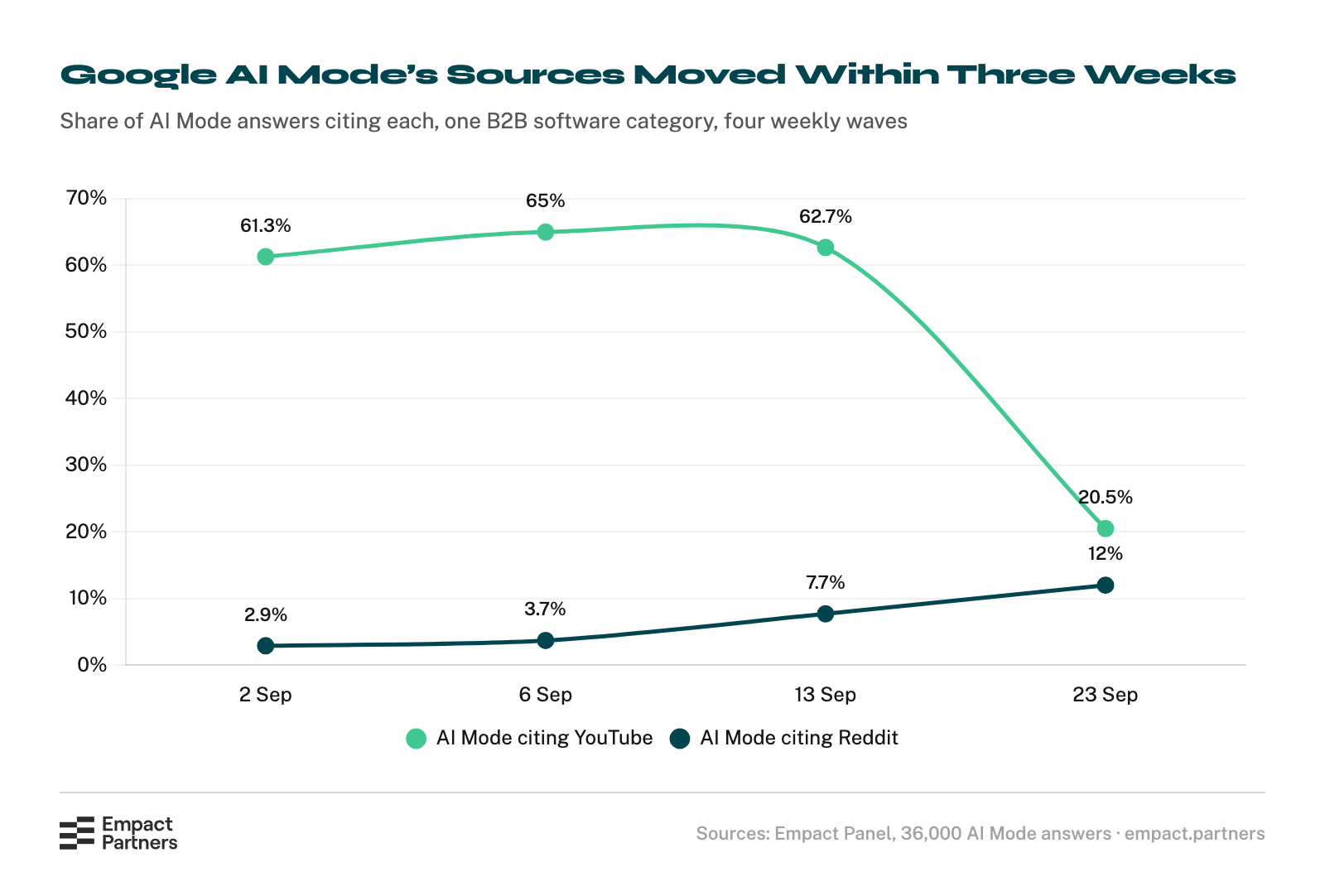
From our side there is no telling whether Google changed what it cites or how it displays it. Either way, one week’s reading would have given two opposite answers about YouTube. The published studies record the same instability over longer windows:
Two separate facts sit in that list. Each engine reads its own web, so being cited on one says little about the other, and each engine’s diet drifts, so last quarter’s map is a hypothesis.
Both matter more now that the engines look before they answer: ChatGPT came back with sources in 95.6% of runs in Qvery’s August SaaS set.18 Empact Partners measures a partner’s category every week and reads it monthly for that reason, and the roadmap changes when the cited pages do.
Being Named Tracks Presence on the Pages Engines Read, Not Links
A budget turns on what goes with being named, and our panel can test one answer directly. Among answers citing a roundup the panel had opened and checked, it compares how often a vendor is named when a cited roundup lists it with how often when the cited roundups leave it out.
A listed vendor was named in 52.6% of ChatGPT’s answers, a left-out one in 11.2%. Google AI Mode ran 46.9% against 13.2%, and Claude 46.6% against 10.7%.1
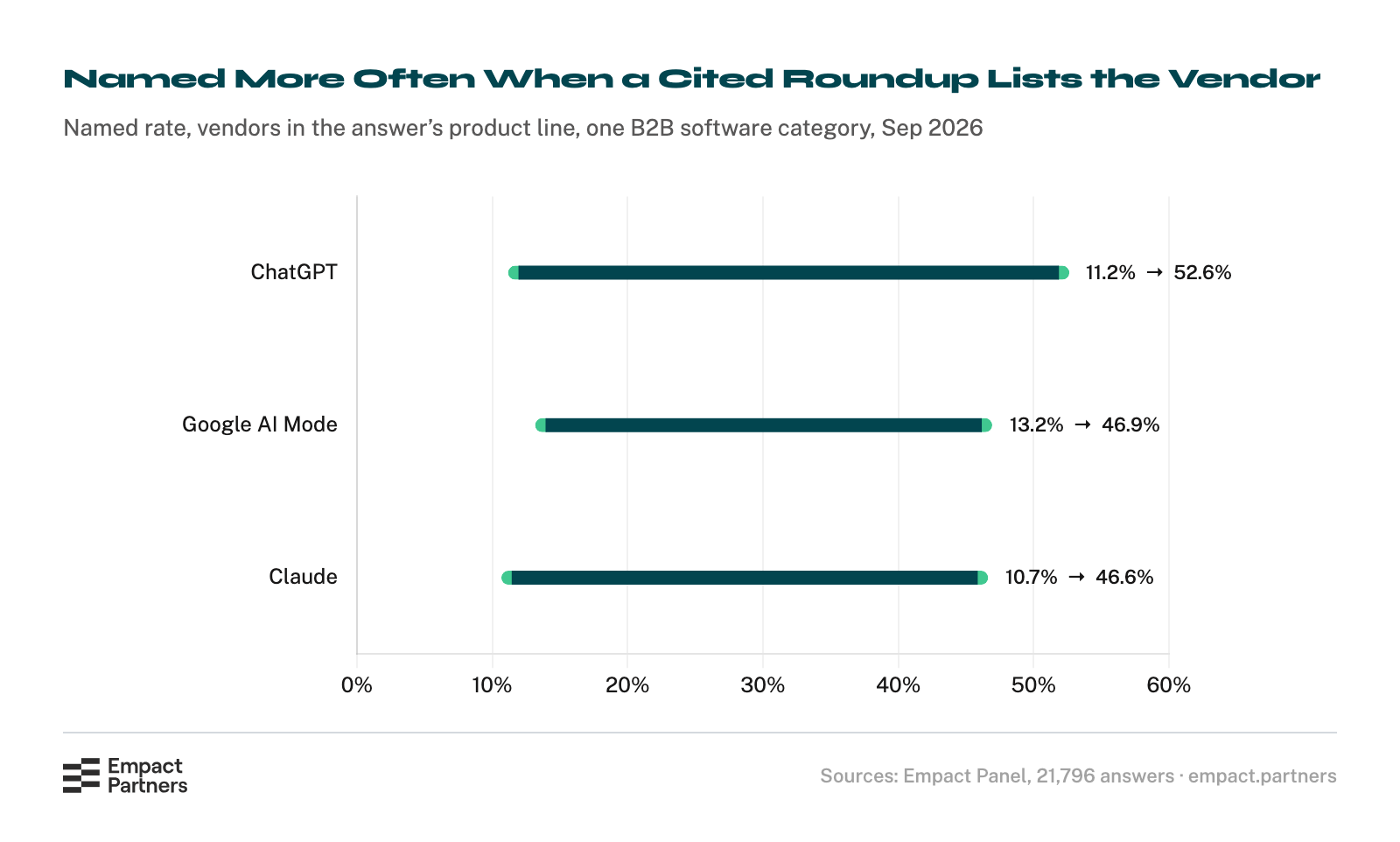
Every vendor we could test showed the same gap, all 46 on ChatGPT and all 44 on AI Mode.1 That rules out the easy explanation, that big vendors are both listed and named, though it stays an association: a roundup may list a vendor for the same reasons an engine names it.
.png)
The published studies that measured what goes with being named agree on the half a budget needs, which is that links and authority sit well behind:
| Study | Engine and population | Strongest factor measured | Links and authority |
|---|---|---|---|
| Qvery4 | ChatGPT, SaaS brands it named five or more times, September 2026 | Share of cited roundups listing the brand: 0.64 | Backlinks rank 0.35, US organic traffic 0.27 |
| Ahrefs27 | AI Overviews, 75,000 brands | Branded web mentions: 0.664 | Number of backlinks: 0.218 |
| Ahrefs28 | ChatGPT, AI Mode and AI Overviews, the same brands | YouTube mentions: about 0.737 | Domain Rating on ChatGPT: 0.266 |
| Profound15 | Eight engines, 50,000+ prompts in five industries | Not measured | 97.2% of citation variance not explained by backlinks |
| Seer Interactive29 | GPT-4o API, 10,000 finance and SaaS questions | Page-one Google rankings: about 0.65 | Backlinks weak or neutral |
Read the coefficients as ranking agreement. The strong ones mean the brands highest on that measure are mostly the brands named most. The weak ones, backlinks and authority among them, tell you little about who gets named.
Ranking on Google still helps, and less than it did
Ranking first gets you close to even odds of being cited, which is worth having. It is not the route most citations take: most cited domains are not in the top 10 for the buyer’s query. Our read is that the engine searches several phrasings of its own on the way to an answer, so the pages it cites rank for questions the buyer never typed.
Inside the page, specifics get quoted
In a lab test on a simulated engine, adding citations, quotations or statistics to a page raised its visibility inside the answer by 30% to 40%.33 Live data leans the same way: AI-cited B2B SaaS articles averaged 4.2 statistics against 1.2 for articles that were not cited.8 And the pages AI assistants cite are 25.7% younger than those in organic results.34
The name is the prize, because the answer is the page
In a small shopping study on ChatGPT, the brands people chose had about twice the share of voice (how often a brand is named against its rivals) of the ones they passed over, 24% against 11%, and 92.8% of tasks ended with no click to the open web.35 The categories were consumer ones, so read it as the direction for software rather than a measure of it.
Getting a partner named on the pages the engines read is the Mentions half of GEO and most of the work in it. We run mention building as outreach to the pages an engine already cites for the category, rather than as a hunt for links.
Fund the Pages Engines Already Read Before You Fund New Ones
The order we would put a GEO budget in:
- Map the cited pages in your own category, per engine, before spending anything. The mix differs by engine and by category and moves weekly, so a published average is a starting guess.
- Get listed on the roundups your category’s answers already cite, independent ones first. Being listed is the strongest thing we measured alongside being named.
- Fix the pages of yours an engine can quote: product, feature and comparison pages, and an honest roundup of your own with your rivals on it.
- Add the platforms your buyers’ engine reads: review profiles where recommendation questions cite them, YouTube where Google AI Mode leans on it, Reddit where the answers show it.
What our evidence cannot settle is cause. The roundup test is an association in one B2B software category over four weeks, and a vendor that earns a place on the lists may be the one an engine would have named anyway.
Two numbers are worth watching, per engine, and the second is the one you can change this quarter:
In practice a GEO engagement with us opens with that map, a roadmap that funds the weakest pillar first, and a consultant who re-reads the answers every month. Momentum takes a quarter or more to show.
If your category’s answers keep naming three competitors and not you, book a call with us, and we will see together whether we are the right people to change that.
Sources
- Empact Partners, Empact Panel: 36,000 ChatGPT, 36,000 Google AI Mode and 2,700 Claude answers to unbranded buying questions in one B2B software category, collected weekly 2 to 23 September 2026, every citation classed by the kind of site it sits on; read 28 September 2026.
- G2, “The Answer Economy: How AI Search is Rewiring B2B Software Buying”, 2026 AI Search Insight Report. learn.g2.com/g2-2026-ai-search-insight-report
- Ahrefs, “The 50 Most-Cited Websites in ChatGPT (September 2026)”, 2026. ahrefs.com/blog/most-cited-domains-in-chatgpt
- Qvery, “Does Domain Authority Decide Which SaaS Brands ChatGPT Names? Roundups Track It More Closely”, 2026. qvery.ai/blog/domain-authority-vs-ai-recommendations-saas
- Profound, “Where do AI citations come from?”, 2026. tryprofound.com/blog/where-do-ai-citations-come-from
- Qvery, “How Often AI Answers Cite G2 for SaaS: Mostly on Recommendation Questions”, 2026. qvery.ai/blog/g2-review-sites-ai-citations-saas
- Kevin Indig for G2, “Do Software Review Platforms Show Up More in the Bottom of the Funnel?”, 2026. learn.g2.com/do-software-review-platforms-show-up-more-in-the-bottom-of-the-funnel
- Citera, “An Analysis of 350,000 B2B SaaS Articles: What Predicts Google Ranking and AI Citation”, 2026. citerahq.com/research/b2b-saas-content-study
- Chen, Wang, Chen and Koudas, “Generative Engine Optimization: How to Dominate AI Search”, arXiv, 2025. arxiv.org/abs/2509.08919
- Muck Rack, “What Is AI Reading?”, May 2026 edition. muckrack.com/blog/what-is-ai-reading-may-2026
- Qvery, “The Landing Page Route: How SaaS Product Pages Become AI Engine Citations”, 2026. qvery.ai/blog/saas-landing-pages-ai-citations
- Ten Speed, “What AI Cites for B2B Evaluation-Stage Prompts”, 2026. tenspeed.io/blog/what-ai-cites-b2b-evaluation-stage
- Kyle Poyar and Nikolas Laskaris, Profound and Growth Unhinged, “What AI agents really think about your pricing”, 2026. tryprofound.com/blog/what-ai-agents-really-think-about-your-pricing
- Qvery, “The Self-Listicle Playbook for SaaS”, 2026. qvery.ai/blog/saas-self-listicle-playbook
- Josh Blyskal, Profound, “I analyzed 40 million search results, here’s what I found”, BrightonSEO San Diego, 2025. speakerdeck.com/joshbly/josh-blyskal-profound-i-analyzed-40-million-search-results-heres-what-i-found
- Kevin Indig for G2, “Do More G2 Reviews Mean More AI Visibility? Insights from 30k Citations”, 2025. learn.g2.com/do-more-g2-reviews-mean-more-ai-visibility
- AirOps, “Is Your Brand Missing Out on the Fastest-Growing Source in AI Search?”, 2026. airops.com/blog/fastest-growing-source-in-ai-search
- Qvery, “First AI Recommendations for a Brand-New SaaS: What the Answers Had in Common”, 2026. qvery.ai/blog/new-saas-first-ai-recommendations
- Empact Partners, Empact Panel: 1,000 ChatGPT and 1,000 Google AI Mode answers to unbranded buying questions in one consumer finance software category, collected 15 September 2026; read 28 September 2026.
- Empact Partners, Empact Panel: 4,000 ChatGPT and 4,000 Google AI Mode answers to unbranded buying questions in one insurance category, collected 8 September 2026; read 28 September 2026.
- Empact Partners, KKday case study: the Reddit program’s views, upvotes, comments and mentions over three months, as published. empact.partners/partners/kkday
- Semrush, “We Analyzed 89K LinkedIn URLs Cited in AI Search: Here’s What Drives Visibility”, 2026. semrush.com/blog/linkedin-ai-visibility-study
- Semrush, “The Most-Cited Domains in AI: A 3-Month Study”, 2025. semrush.com/blog/most-cited-domains-ai
- Profound, “AI Search Volatility: Why AI search results keep changing”, 2025. tryprofound.com/blog/ai-search-volatility
- Kevin Indig, “The Consensus Gap”, Growth Memo, 2026. growth-memo.com/p/the-consensus-gap
- BrightEdge, “ChatGPT vs Google AI: 62% Brand Recommendation Disagreement”, 2025. brightedge.com/resources/weekly-ai-search-insights/chatgpt-vs-google-ai-62-brand-recommendation-disagreement
- Ahrefs, “An Analysis of AI Overview Brand Visibility Factors (75K Brands Studied)”, 2025. ahrefs.com/blog/ai-overview-brand-correlation
- Ahrefs, “Top Brand Visibility Factors in ChatGPT, AI Mode, and AI Overviews (75k Brands Studied)”, 2025. ahrefs.com/blog/ai-brand-visibility-correlations
- Seer Interactive, “STUDY: What Drives Brand Mentions in AI Answers?”, 2025. seerinteractive.com/insights/what-drives-brand-mentions-in-ai-answers
- Qvery, “AI Engine Citations vs Google Organic SERPs: Only 13.9% Overlap”, 2026. qvery.ai/blog/ai-citations-vs-google-serp
- Ahrefs, “Update: 38% of AI Overview Citations Pull From The Top 10”, 2026. ahrefs.com/blog/ai-overview-citations-top-10
- BrightEdge, “AI Overviews at the One-Year Mark: Presence, Size, and What They’re Citing”, 2026. brightedge.com/resources/weekly-ai-search-insights/ai-overviews-one-year-presence-size-citing
- Aggarwal, Murahari, Rajpurohit, Kalyan, Narasimhan and Deshpande, “GEO: Generative Engine Optimization”, KDD 2024. arxiv.org/abs/2311.09735
- Ahrefs, “New Study: AI Assistants Prefer to Cite ‘Fresher’ Content (17 Million Citations Analyzed)”, 2025. ahrefs.com/blog/do-ai-assistants-prefer-to-cite-fresh-content
- Kevin Indig, Eric Van Buskirk and Jasman Singh, Profound with Clickstream Solutions, “The shortlist is the new shelf”, 2026. tryprofound.com/blog/the-shortlist-is-the-new-shelf


