


There is no such thing as your brand’s AI visibility. There is your visibility to a buyer in Munich asking ChatGPT in German, and to a buyer in São Paulo asking Google AI Mode in Portuguese, and the two can share almost nothing. Every AI answer is assembled for the person asking.
So a single visibility percentage with no country beside it is an average of the markets where engines recommend you and the markets where they have never heard of you. As a guide to where to work, it is worse than no number, because it hides the one market you should be working next.
When an engine searches the web to answer, it leans on what it trusts for that asker: pages in their language, sites from their country, the communities people there read, and whatever the assistant remembers about them. The brands it names follow those sources.
Empact Partners is an AI consultancy that works with the world’s best SaaS companies: we make them visible in AI search and build AI agents for their teams. Winning that visibility one market at a time is what our Generative Engine Optimization work does every week, and it is where this view comes from.
Every AI Answer Is Built for the Person Asking
Personalization is the design, and OpenAI’s help center says so plainly: ChatGPT can estimate where you are from your IP address, down to your country, state or city, and use it for local results.
With memory on, it can also use what it has saved about you to rewrite the search it runs. OpenAI’s own example: tell it you are vegan and live in San Francisco, ask for restaurants you might like, and it searches for “good vegan restaurants San Francisco.” Since June 2025, ChatGPT has referenced recent conversations for free users too.
Google goes further on its own turf. Its Search help pages say Personal Intelligence in AI Mode draws on your previous searches, and in January 2026 Google let paying US subscribers connect Gmail and Google Photos to AI Mode, opt-in. Put those together and three things shape your buyer’s answer, and they are not equally measurable.
| What shapes the answer | What it changes | Can anyone outside the account measure it? |
|---|---|---|
| Where the buyer is | Which local sites and local brands the search turns up | Yes: ask from that country |
| The language they ask in | Which pages exist to be found, and whose lists they come from | Yes: ask in that language |
| What the assistant remembers | How specific the search becomes: their city, their industry, their budget | No: it lives inside one person’s account |
Memory is the layer that makes people say AI visibility cannot be measured. I read it the other way. Memory makes the search more specific, but the pages it can find depend on the buyer’s country and language. So the market, a country and a language together, is the unit you can sample and act on, and every buyer there draws from the same pool of sources.


Change the Language and the Answer Changes, Even From the Same Country
In October we measured how AI answers differ by country, with twenty software questions asked in English from five countries. Held to English, location moved less than people expect: the engines named 88% to 93% of the American shortlist everywhere else.
Google AI Mode and Gemini even recommended TurboTax, a US tax product, to every German, Brazilian and Indian asker in that run, nine answers out of nine each. Location alone, in English, mostly hands back the American answer.
So in November we held the country still and changed only the language. On 9 November 2026 we asked ChatGPT and Google AI Mode ten software-buying questions from Germany, France, Brazil and Japan. Each went in twice in English and twice in the country’s own language: 320 answers, logged out, every one backed by a web search.
The sources are where it shows most. Asked in English, 10% of cited links pointed at sites on the country’s own domain, the .de, .fr, .br or .jp pages. Asked in the local language from the same address, that rose to 38%, and it rose in every one of the four countries.
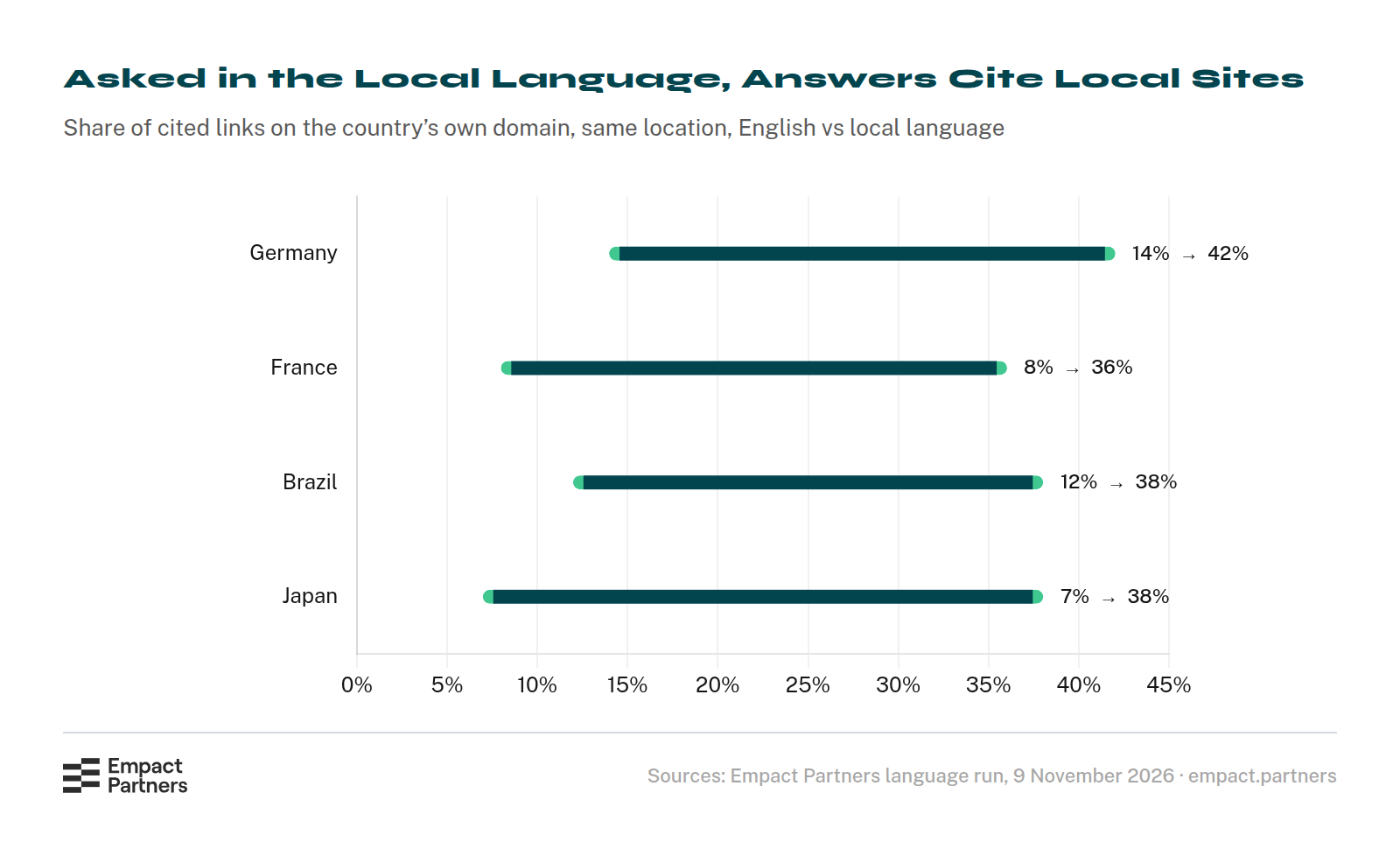
One Visibility Number Hides the Market You Should Be Working
The accounting question shows what that does to the brands. Same country, same day, same question, two languages:
| Country | QuickBooks, Xero and Zoho, asked in English | The same three, asked in the local language | Named in every local-language answer |
|---|---|---|---|
| Germany | Each named in 4 of 4 answers | 0 of 4 | Lexware, sevDesk, DATEV |
| France | Each named in 4 of 4 answers | 0 of 4 | Pennylane |
| Brazil | Each named in 4 of 4 answers | QuickBooks 1 of 4, the others 0 | Conta Azul |
| Japan | Each named in 4 of 4 answers | 0 of 4 | freee, Yayoi |
Now average it the way a single dashboard would. QuickBooks was named in 17 of the 32 accounting answers, a visibility of 53%. That figure is true of no market in the run: QuickBooks was in every English answer and in one local-language answer out of sixteen.
Pennylane comes out of the same arithmetic at 16%, five answers out of thirty-two (four in French, one in English from France), which reads as a minor player. In French, from France, it was named in every answer. One number made the brand every French answer named look marginal, and a brand those answers left out look half-present.

A team reading that dashboard would either relax or panic, and in both cases it would work on the wrong thing. The split tells it where to go: the market where buyers ask in their own language and a local competitor gets named every time.
“My Board Wants One Number, Not a Twelve-Country Matrix”
The one-number objection is the one I hear first, and it is mostly right. A board wants one figure that goes up. Most visibility dashboards ship one. And a grid of twelve countries, three engines and two languages is a report nobody reads past the first row.
Two parts of that are true:
What the headline cannot do is run the team. Every decision a marketing team makes from a visibility number is a decision about a market: which country gets budget this quarter, which language the next pages are written in, whose lists to get onto. An average answers none of those.
Keep the one number for the board, and run the work on the split. In practice the split is short: the markets that pay, in the language buyers there ask in.
Winning a Market Means Earning What That Market’s Answers Cite
If the market is the unit, the question the platforms leave you with is how to get named inside answers you will never see in full. The answer is less exotic than it sounds: you become the brand the local sources name.
That starts with asking each market’s questions from that country, in its language, on the engines buyers there use. Then read which sites the answers cite, because that list is where the work starts, and in our run it barely overlapped with the English one.
Most of those sites fall into three kinds, and each takes different work to earn.
An assistant that remembers a buyer’s city, industry or budget writes a more specific search than the buyer typed, which favors the page that answers their exact situation, in their language.
We have done the unglamorous version of this. When buycycle, the Munich bike marketplace, outgrew its German site, Empact Partners helped it move to buycycle.com and laid the groundwork for 32 languages, with hreflang tags telling search engines which version to serve in which country. It has since raised $3.2 million to keep expanding.
On a Generative Engine Optimization engagement for a partner selling abroad, the first weeks run in this order:
-
We split the measurement by country and language, before anything else.
-
We pick the market worth the most to the partner where engines rarely name it.
-
We read every site the answers cite there, in that market’s language.
-
Mention Building takes the local lists, Reddit Marketing the local threads, and Content Marketing the local-language pages, all from that one list.
A named consultant owns it. The Empact Panel, the measurement we built for our own work, checks every week what ChatGPT, Google AI Mode and Claude say about more than a dozen of our partners. Expect quarters, not weeks, before a new market’s answers move.
Ask for Your Visibility by Country and Language
The first move is a question. Ask whoever reports your AI visibility for the number by country and by language. If you sell in several markets and the report cannot split it, you have been reading an average, and an average cannot tell you where to work.
If it can, rank your markets by what they are worth to you and start with the most valuable one where engines rarely name you, in the language its buyers ask in.
If you sell in more than one country and your AI visibility still arrives as one number, book a call with me. We’ll work out together whether finding and winning your next market is a job for us.


