


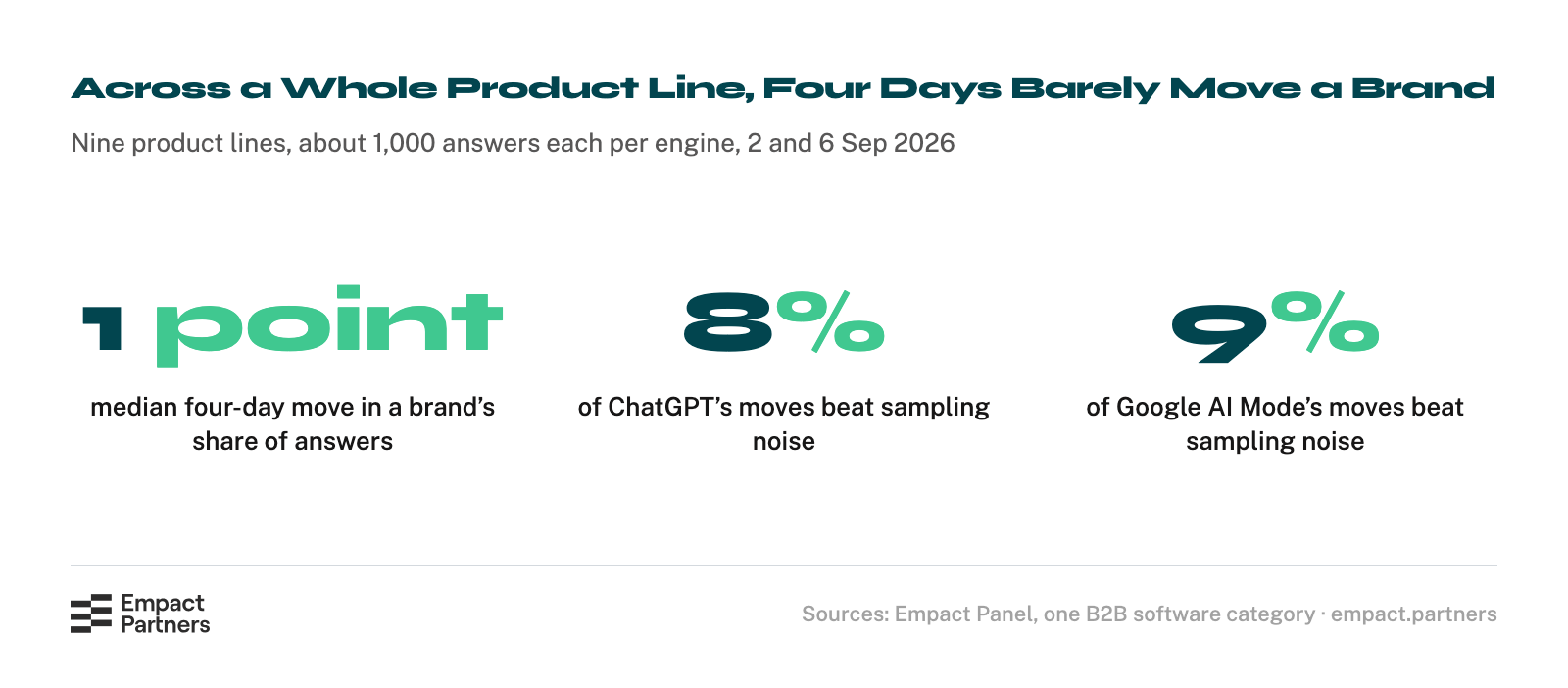
Ask Google AI Mode the same software-buying question ten days apart and it names about half the same brands: 48% of them, in the B2B software category we measure every week. ChatGPT names 58% of them again.1 Across the whole category, those same ten days moved the median brand’s share of answers by less than three points.
Most teams read an AI answer the way they read a ranking, as a position that moves now and then and can be checked with a screenshot. An answer is closer to a draw from a pool of candidates the engine refills every time it is asked, so it moves a lot from one answer to the next and far less across a whole category.
What follows are the numbers on how much AI answers move, why they move, and how fast buyers are moving to them: our own weekly panel across two software categories, research from Qvery, our sister company, and the published studies, each read at its origin.
Highlights
Any single AI answer is a draw, so one answer, or a small set of them, cannot tell a team where it stands. The picture the draws add up to is steadier. It still moves when a model or a product changes, and more of the buying is moving into the engines doing the drawing.
Ask Again and a Different Answer Comes Back
Our panel asked ChatGPT and Google AI Mode the same 9,000 unbranded software-buying questions on 13 and 23 September 2026, in one B2B software category, and Claude 900 of them. Matching each question to itself ten days later:
Google AI Mode moved most. Claude moved least, and it is the one engine we ask through its API rather than through the page a buyer sees, which says as much about the route as about the model. A consumer finance software category we also measure kept the same order over ten days: ChatGPT named again 66% of the brands, AI Mode 55%.6
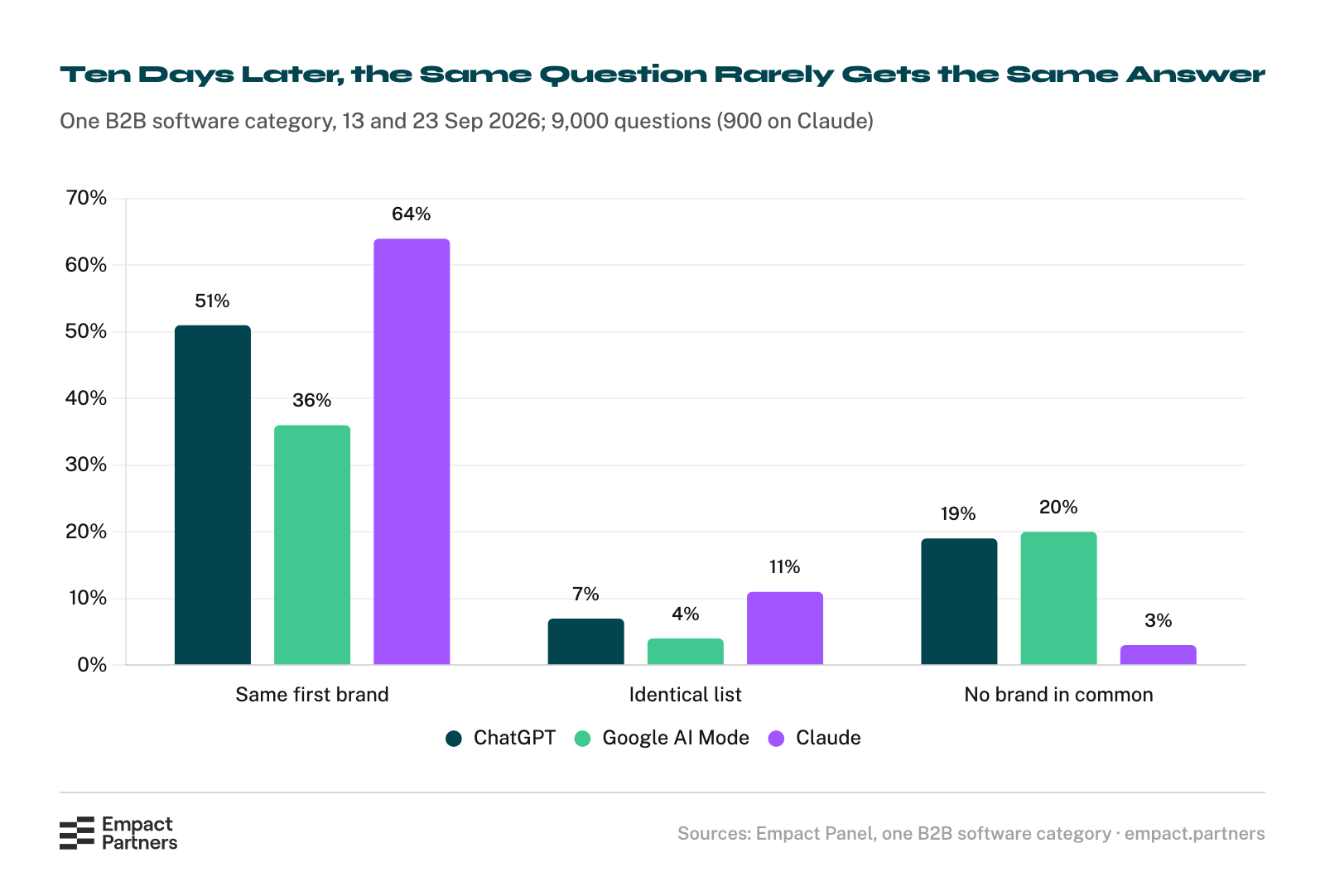
Every study that re-ran the same prompt found the same pattern at its own speed:
Read as a sample, the list is doing what a sample does. An engine holds a pool of candidates for a question, larger than any one answer shows, and each answer draws a handful from it. Ask a hundred times and you meet the pool. Ask once and you meet whatever came out this time.
Empact Partners runs this panel for the partners in its Generative Engine Optimization workstream, GEO for short: the work of becoming a brand AI engines name when a buyer asks their category question. The same unbranded questions go to three engines every week and every answer is kept, so a question can be matched to itself.

.png)
Most of the Movement Is the Engine Drawing Again
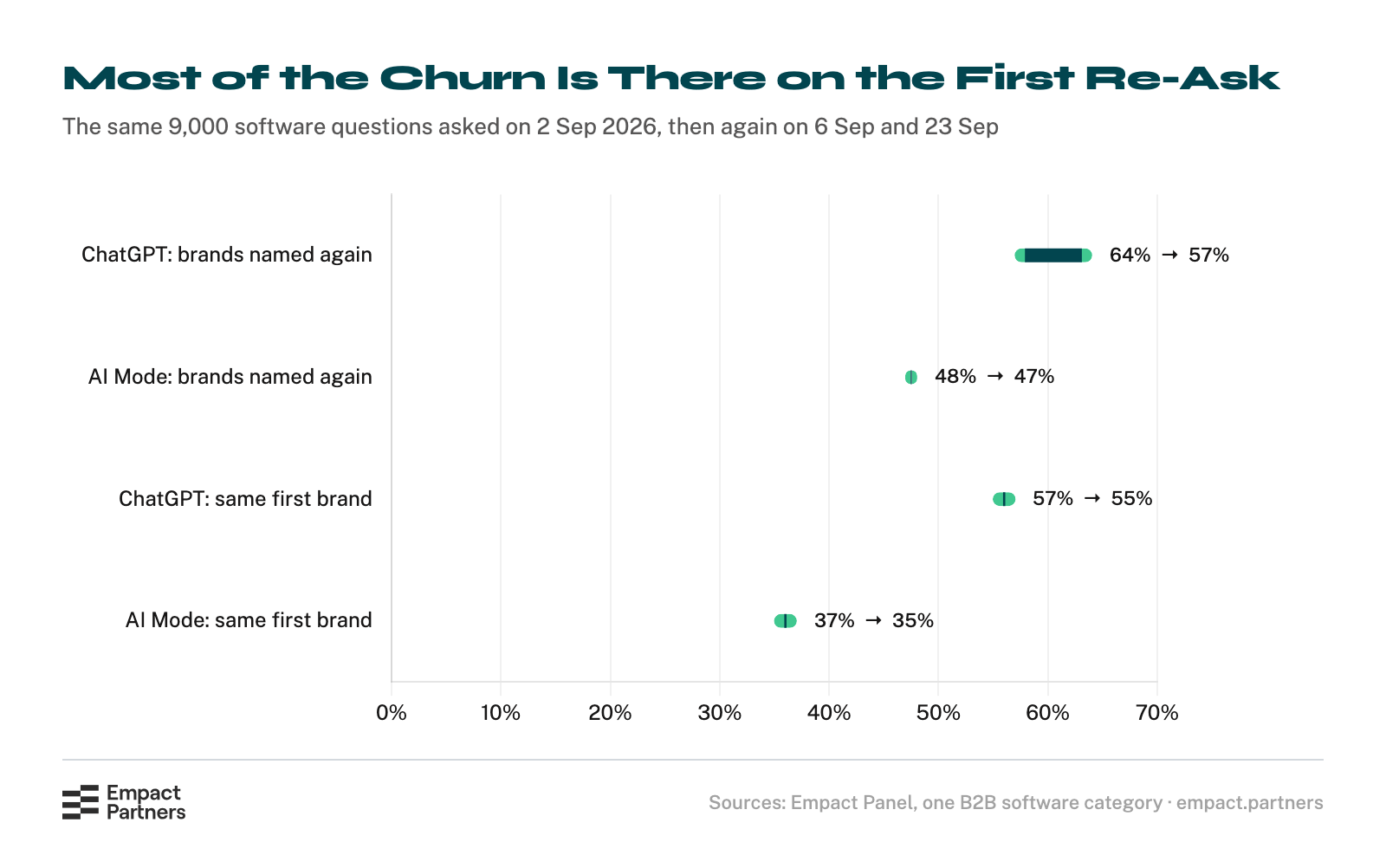
If the churn were the market moving, it would deepen with time: a question asked three weeks later would have lost more of its brands than one asked four days later. In our category it barely does. From the same 9,000 questions asked on 2 September:
So most of what changes between two answers is there on the first re-ask. On AI Mode, three weeks added almost nothing to it. On ChatGPT, time added a slow slide on top of the draw, from 64% to 57% over seventeen days.
Qvery, our sister company, sees the same thing in its own data. It tracks millions of citations a month across ChatGPT and Google AI Mode. It is ours, so give its findings less weight than an outsider’s, and open the studies linked here to check the working yourself.
In its share-of-voice test, ChatGPT answered the same shopping question again and again inside one collection window, and two thirds of the cited sources moved between any two runs.10
The draw comes from how an answer gets built. Three steps sit between the question and the answer, and each can land somewhere else on the next ask:
- Rewriting. ChatGPT turns a question into one or more search queries and may pass your general location to the search providers.11
- Fan-out. Google’s AI Overviews and AI Mode issue multiple related searches across subtopics for one response, and the two may use different models, so the links they show vary.12
- Sampling. The model then writes the answer word by word from probabilities. Even with that randomness switched off, one lab got 80 different completions from 1,000 runs of one prompt, because the server batches each request with other people’s and the batch changes the arithmetic.13
Place and person change the pool
The same question from a different place, or a different person, draws from a different pool:
A tracking setup that asks from one location, logged out, with no persona, measures one corner of that pool. That is fine as long as nobody reads the corner as the whole.
.png)
The Pages Behind an Answer Turn Over Faster Than the Brands in It
Brands are the steady layer. The pages an engine cites underneath them rotate much faster, and over the same ten days in our category:
The deeper the layer, the less of it survives: on both engines that search the live web, the brand list keeps about half, the domains a third or less, and the exact pages a fifth or less.
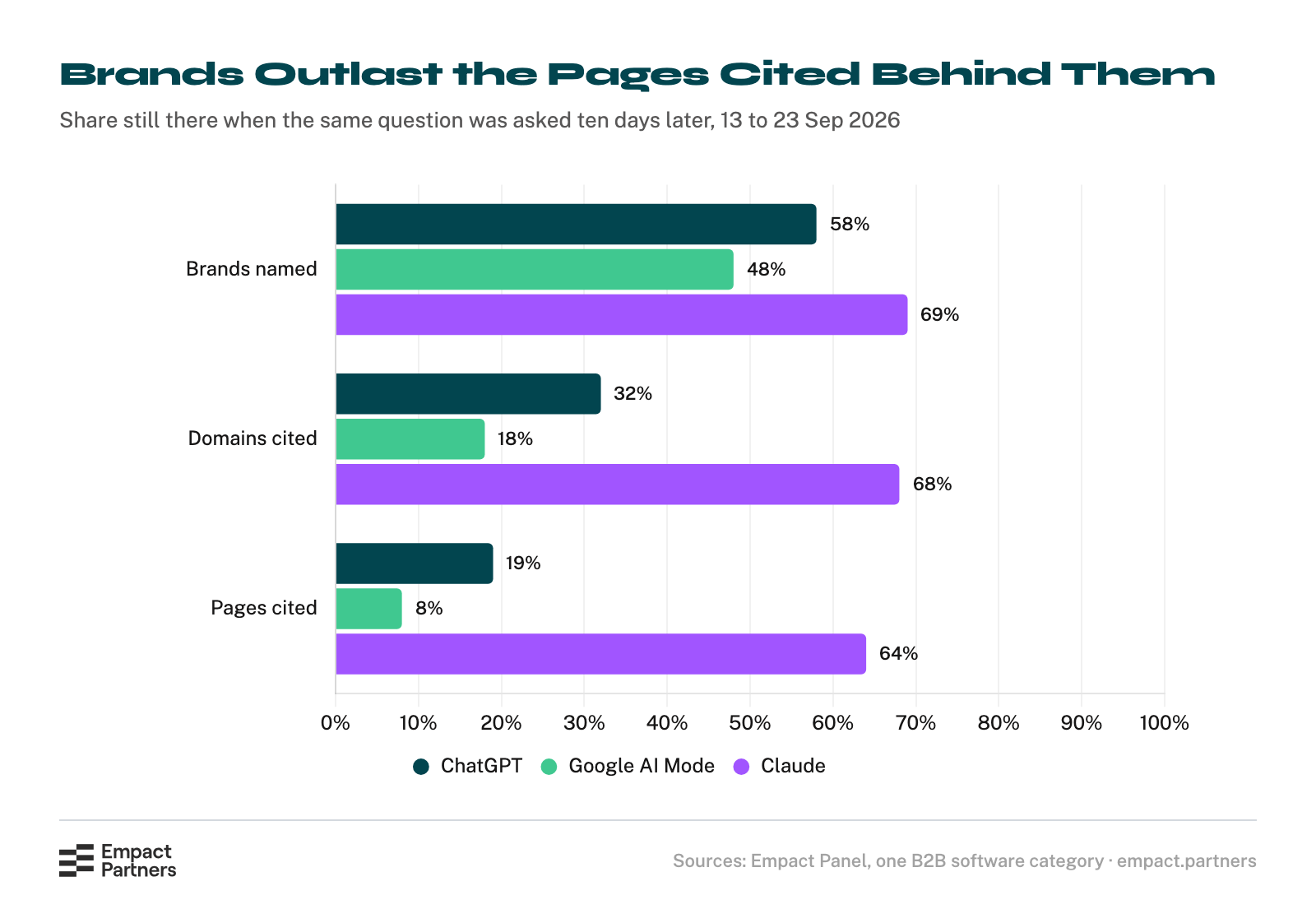
Every published measurement of the source layer finds the same speed, whatever its ruler:
Google’s own two surfaces barely agree either. AI Mode and AI Overviews shared 13.7% of cited pages for the same query while reaching answers 86% alike in meaning.22
A brand outlives the pages because several of them say its name, which is the logic behind the formula our GEO work runs on, GEO = UGC + Mentions: what real users say about a brand in public, plus where independent pages name it.
A brand named across dozens of the pages an engine rotates through keeps turning up whichever ones it draws this week. A brand that depends on one ranking page drops out the week that page rotates away.
Across a Whole Category, the Picture Holds for About a Week
Step back from the single question to the whole category, which is where a marketing team’s number lives, and most of the churn cancels out.
The median brand barely moves
Across nine product lines of about 1,000 answers each, between 2 and 6 September:
SparkToro found the same split inside a single prompt. ChatGPT named one West Coast cancer hospital in 69 of 71 answers and put it first in 25.2 Its visibility held while its place in the list changed from answer to answer.
Leaders hold, and the tail rotates
Qvery’s same-day shortlist test found the same shape in two SaaS categories: across five runs of the same questions, 4 brands in project management and 2 in CRM made every run’s top five, and some brands made one run’s top five and no other.23
A category has a core the engine keeps returning to and a carousel it spins around it. A leader’s visibility is sticky because it sits in the core. The fight for most brands is in the carousel, which is exactly the part a single screenshot catches at random.
When a move stops being noise
The category does move. It moves slowly enough that a week is about the shortest window in which it shows:
Small Question Sets and Changed Instruments Manufacture Moves
The size of the question set decides how much of that noise lands in the number. We took every brand at 5% visibility or more in our category and re-measured it on random subsets of its product line’s questions:
The error falls with the square root of the sample, so the first hundred questions buy most of the precision and every hundred after that buys less.
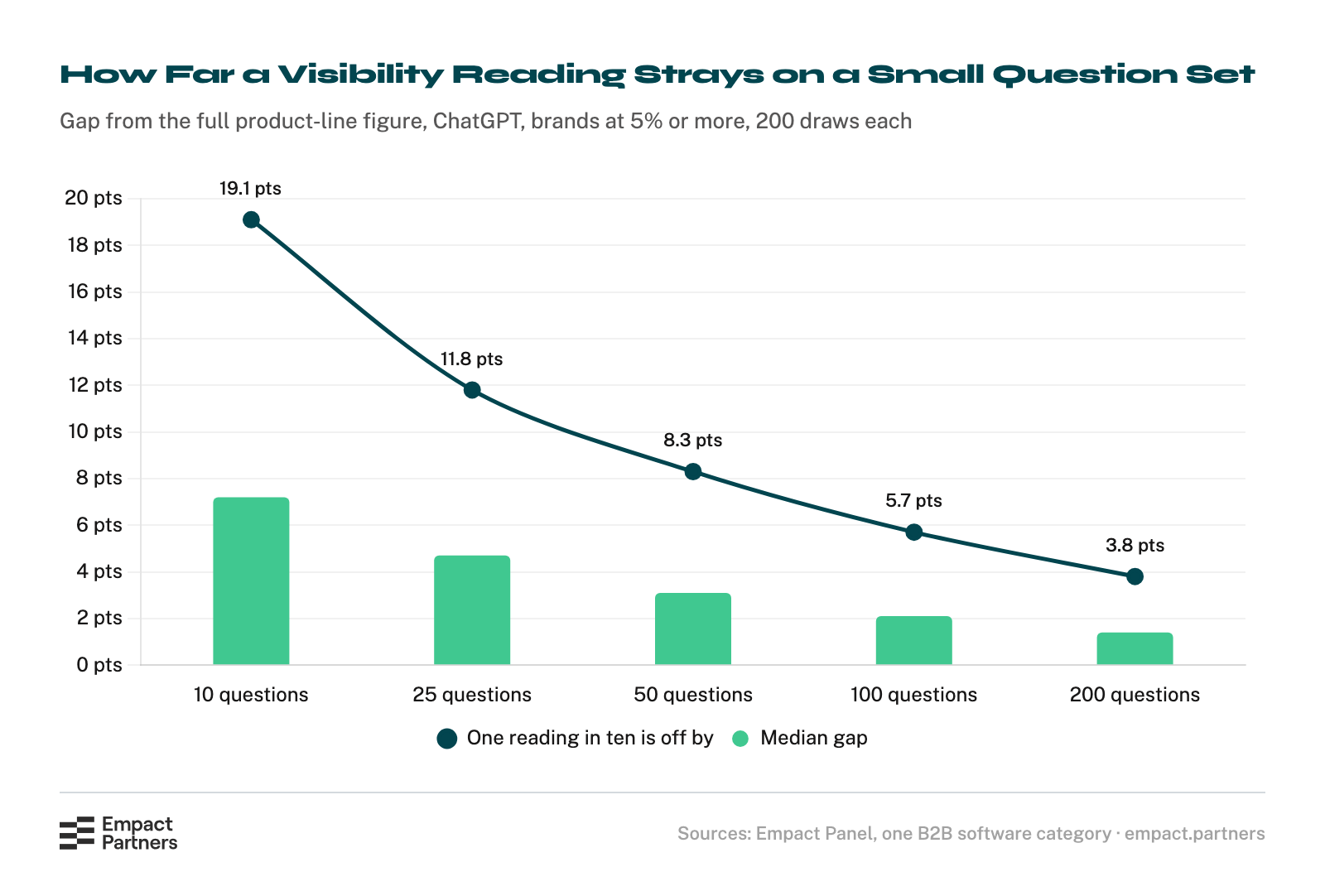
Otterly’s tracking gives the same shape on another ruler: 90% of brand-coverage readings fell between 39% and 71% on 10 prompts, and between 51% and 60% on 100.21
Claude shows it inside our own data. With about 100 answers per product line, a brand’s share of Claude’s answers moved a median 3 points in ten days, and 2.7% of those moves beat the noise.1 The moves looked bigger because the sample was smaller.
The instrument moves too
The largest move between two waves anywhere in our category’s data is not a market event:
Nothing on a dashboard labels a week like that. Everything simply moves at once, on one engine, in both directions.
An Empact report measures visibility on hundreds of questions per category as a rolling baseline, reads each move against the category’s normal weekly range, and logs changes to the collection beside the numbers. That is how we measure AI search visibility for partners, and why our own AI Mode break reads as the vendor’s change rather than anybody’s result.
What Moves the Picture for Real: Releases, Retrieval and Google’s Dial
Take the draw, the sample and the instrument out, and what remains are the slow moves, the ones that change the pool itself. Almost all of them come from the engines themselves.
ChatGPT changes how often it looks things up
Whether ChatGPT searches the web before it answers decides which pages can reach the answer at all, and in 2026 that switch moved sharply, even inside a single model version:
Qvery’s August question sets were narrower than its June ones, and narrower questions may trigger a search more often, so its new SaaS study reports the gap without explaining it: “Treat any trigger rate you measure as a reading taken on a date, not a fixed property of the engine.”
DataForSEO re-asks the same question set with every release, and its series shows the shift happening inside a single model version. A quarter-on-quarter comparison that crosses a change like this needs a note beside it.
And what it reads when it does
Qvery’s March 2026 citation trends caught ChatGPT changing how it builds answers inside a single month:
| Per response, in Qvery’s tracking | February 2026 | March 2026 |
|---|---|---|
| ChatGPT citations | 16.93 | 9.76 |
| Google AI Mode citations | 19.49 | 19.62 |
| ChatGPT unique domains | 21.2 | 11.7 |
| Google AI Mode unique domains | 13.2 | 13.3 |
| ChatGPT brand mentions | 7.22 | 6.32 |
The citations fell by about 42% while the brand mentions fell by an eighth.26 seoClarity measured the same event from outside: the share of US ChatGPT responses with no citation at all went from 28% to 48% in March, before citations rebounded in May.27 The mix of sources moved on its own schedule too:
Google turns its own dial
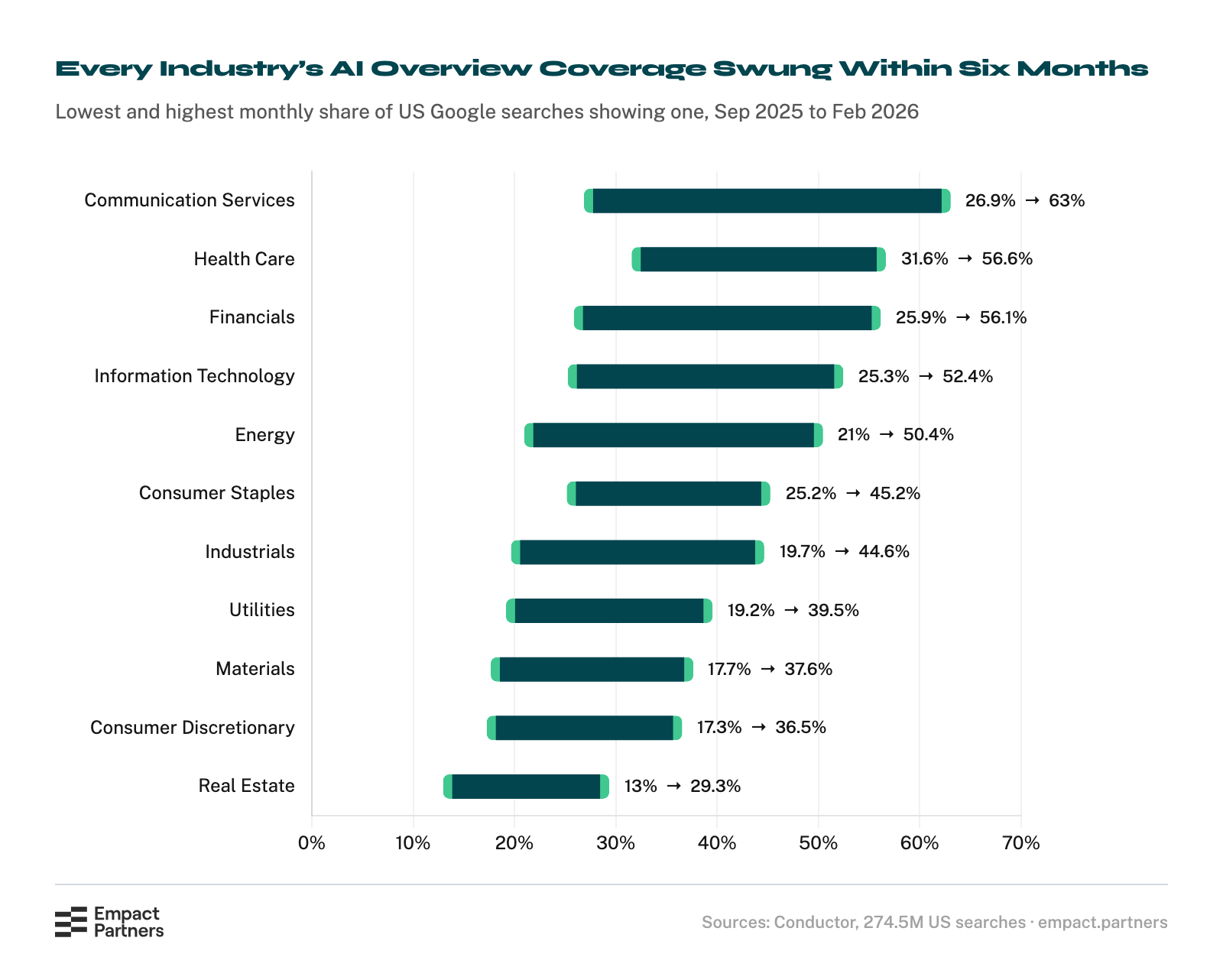
Google also moves the surfaces themselves, on a schedule no page owner sets. Our panel asks AI Mode directly and cannot see how often AI Overviews appear, so these readings come from outside it:
In Conductor’s data every one of the eleven industries swung between a low and a peak inside those six months, the narrowest from 13% to 29.3% of searches.36
More of the Buying Now Happens in the Engines That Move Most
None of this would matter much if the engines were a side channel. The searches are moving, less evenly than the headlines say, and fastest among the people a B2B software company sells to.
Where the searches are going
ChatGPT’s weekly audience grew about tenfold in under three years, by OpenAI’s own counts: more than 800 million a week by December 2025,37 more than 900 million by February 2026,38 and past a billion by August 2026.39
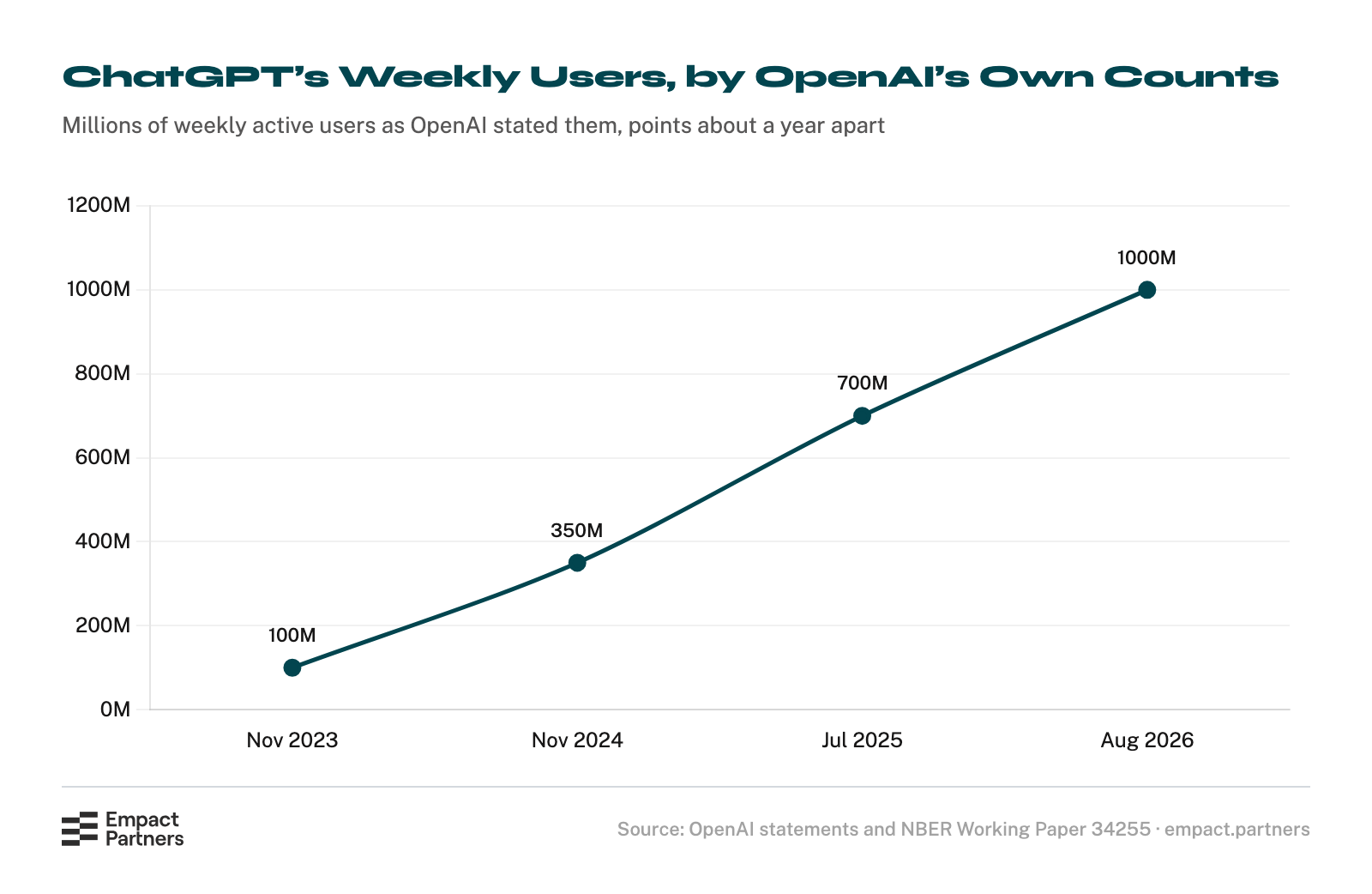
So most searches have not left Google, and the ones that did are not all going to one engine. What moved fastest is the question that used to start a search, and the engines taking it are the ones whose answers move most, trading audience with each other as they go.
Why buyers move, and what it costs the click
B2B software buyers moved fastest, and the move reaches their shortlists:
Consumers give the reason in plainer terms: 53% of users choose a chatbot over a search engine to untangle a complex topic, 47% for step-by-step instructions and 45% to brainstorm.46 The chatbot does the synthesis a results page leaves to the reader.
The click that used to carry a buyer to a vendor’s page is going with it. Google users clicked a traditional result on 8% of visits when an AI summary appeared, against 15% when none did.47 The top-ranking page gets a 58% lower click-through rate when an AI Overview sits above it.48
So the shortlist a buyer brings to a first sales call is increasingly drawn in one of these engines, from the pool this page has been measuring. A GEO partnership with us starts with an audit of that pool in the partner’s category: which brands the engines name, from which pages, and how steady each engine is, before any content or outreach is planned.
Read the Band Before Anyone Takes Credit
The line we read by: in a software category, a brand’s share of AI answers that moves by less than two points in a week, on a thousand questions, has not moved. A move that holds in the same direction for three weekly waves, on the same questions, with nothing in the change log that week, has. Everything in between is a reading to keep watching.
Reading moves this way is also why a GEO partnership with us is judged over quarters. Getting named across the pages the engines rotate through moves the pool slowly, and the engines move it faster, both ways, so a single month is weather and a quarter is climate. The standing report a partner gets from us shows the rolling baseline, never a screenshot.
If your AI visibility swings and nobody can tell you which week was the real one, book a call with us, and we will work out together whether this is work for us.
Sources
- Empact Partners, Empact Panel, category A: one B2B software category, nine product lines; the same 9,000 unbranded buying questions on ChatGPT and Google AI Mode (900 on Claude) on 2, 6, 13 and 23 September 2026, and a subset of them on 22 August; every answer, citation and named brand, each question matched to itself across waves; read 28 September 2026.
- SparkToro, “NEW Research: AIs are highly inconsistent when recommending brands or products; marketers should take care when tracking AI visibility”, 2026. sparktoro.com/blog/new-research-ais-are-highly-inconsistent-when-recommending-brands-or-products-marketers-should-take-care-when-tracking-ai-visibility
- SISTRIX, “AI Citation drift: How stable are sources in AI search results?”, 2026. sistrix.com/blog/ai-citation-drift-how-stable-are-sources-in-ai-search-results
- Qvery, “First AI Recommendations for a Brand-New SaaS: What the Answers Had in Common”, 2026. qvery.ai/blog/new-saas-first-ai-recommendations
- G2, “New G2 Research: Half of B2B Software Buyers Now Start Their Research With AI Chatbots”, release of the report “The Answer Economy”, 2026. prnewswire.com/news-releases/new-g2-research-half-of-b2b-software-buyers-now-start-their-research-with-ai-chatbots-302742807.html
- Empact Partners, Empact Panel, category B: one consumer finance software category, US; the same 1,000 unbranded buying questions on ChatGPT and Google AI Mode on 15 and 25 September 2026; read 28 September 2026.
- Detailed.com, “How Volatile Are AI Responses? (70K Answer, 28 Day Study)”, 2026. detailed.com/ai-volatility
- AirOps, “The 2026 State of AI Search: How Modern Brands Stay Visible”, 2025. airops.com/report/the-2026-state-of-ai-search
- Mike Sonders, “What repeated ChatGPT runs reveal about brand visibility”, Search Engine Land, 2026. searchengineland.com/repeated-chatgpt-runs-brand-visibility-468552
- Qvery, “How To Measure Ecommerce Share Of Voice”, 2026. qvery.ai/blog/measure-ecommerce-ai-share-of-voice
- OpenAI Help Center, “Searching the web with ChatGPT”, read 28 September 2026. help.openai.com/en/articles/9237897-searching-the-web-with-chatgpt
- Google Search Central, “AI features and your website”, documentation, 2025. developers.google.com/search/docs/appearance/ai-features
- Thinking Machines Lab, “Defeating Nondeterminism in LLM Inference”, 2025. thinkingmachines.ai/blog/defeating-nondeterminism-in-llm-inference
- SE Ranking, “How Volatile Are AI Mode Results? 2025 Local Search Test”, 2025. seranking.com/blog/ai-mode-volatility-test
- SE Ranking, “AI Mode Research: Sources, Volatility, & Differences between AIO and Organic Search”, 2025. seranking.com/blog/ai-mode-research
- Radyant, “Do personas change what AI recommends? Here is what 17,929 chats revealed”, 2026. radyant.io/research/persona-study
- Profound, “AI Search Volatility: Why AI search results keep changing”, 2025. tryprofound.com/blog/ai-search-volatility
- Ahrefs, “AI Overviews Change Every 2 Days (But Never Change Their Mind)”, 2025. ahrefs.com/blog/ai-overview-change
- Semrush, “Exploring URL Volatility in Google’s AI Overviews”, 2024. semrush.com/blog/url-volatility-ai-overviews
- Authoritas, “AI Overviews & SERP Volatility: Research into how Google’s Search Results Change”, 2025. authoritas.com/blog/serp-organic-and-ai-overview-volatility-research
- Otterly.AI, “AI Search Visibility: How Stable Are Brand Mentions and Citations?”, 2026. otterly.ai/blog/ai-search-visibility-stability
- Ahrefs, “Are AI Mode and AI Overviews Just Different Versions of the Same Answer? (730K Responses Studied)”, 2025. ahrefs.com/blog/ai-overviews-vs-ai-mode
- Qvery, “Have AI Engines Already Settled Your SaaS Category’s Top 5? Check Before You Try To Break In”, 2026. qvery.ai/blog/break-into-saas-category-ai-shortlist
- Surfer, “Why You Cannot Track AI Visibility Through an API: 2026 Data From ChatGPT, Perplexity, Gemini, AI Mode, and AI Overviews”, 2026. surferseo.com/blog/llm-scraped-ai-answers-vs-api-results
- Denis Pavlovsky (DataForSEO), LinkedIn post on ChatGPT citation rates across model versions, 9 September 2026. linkedin.com/posts/denis-pavlovsky-abb38926a_gpt-sitation-shift-2026-activity-7503418723240853505-qWX4
- Qvery, “AI Search Citation Trends: March 2026”, 2026. qvery.ai/blog/ai-search-citation-trends-march-2026
- seoClarity, “Tracking the Decline of ChatGPT’s Citations: A Global Trend Analysis”, 2026. seoclarity.net/chatgpt-citation-decline-analysis
- Qvery, “Social Media in AI Search: ChatGPT vs Google AI Mode”, 2026. qvery.ai/blog/social-media-ai-citations-statistics
- Tomek Rudzki (Peec AI), LinkedIn post on ChatGPT’s citations ten days into GPT-5.6, 18 August 2026. linkedin.com/posts/tomekrudzki_since-8th-august-the-default-model-for-chatgpt-activity-7495535968205201409-Cmsf
- Tomek Rudzki (Peec AI), LinkedIn post on ChatGPT’s sources before and after GPT-5.6, 20 August 2026. linkedin.com/posts/tomekrudzki_chatgpt-is-falling-out-of-love-with-listicles-activity-7496162756547670016-PUKC
- Profound, “AI Search Shift: ChatGPT’s growing alignment with Google’s index”, 2025. tryprofound.com/blog/ai-search-shift
- Josh Blyskal (Profound), LinkedIn post on ChatGPT referral traffic, 20 August 2025. linkedin.com/posts/joshua-blyskal_chatgpt-referral-traffic-is-down-52-since-activity-7364003556087005185-BaJ0
- SE Ranking, “Gemini 3 Replaces 42% of Previously Cited Domains in AI Overviews”, 2026. seranking.com/blog/gemini-3-impact-on-ai-overviews
- Alphabet, “Alphabet earnings, Q4 2025: CEO’s remarks”, 2026. blog.google/company-news/inside-google/message-ceo/alphabet-earnings-q4-2025
- Semrush, “Semrush Report: AI Overviews’ Impact on Search in 2025”, 2025. semrush.com/blog/semrush-ai-overviews-study
- Conductor, “Google AIO Volatility by Industry: What 2026 Data Reveals”, 2026. conductor.com/academy/ai-overviews-industry-volatility-analysis
- OpenAI, “The state of enterprise AI”, 2025. openai.com/index/the-state-of-enterprise-ai-2025-report
- OpenAI, “Scaling AI for everyone”, 2026. openai.com/index/scaling-ai-for-everyone
- OpenAI, “A milestone in expanding access to AI”, 2026. openai.com/index/expanding-access-to-ai-with-chatgpt-ads
- Chatterji, Cunningham, Deming, Hitzig, Ong, Shan and Wadman, “How People Use ChatGPT”, NBER Working Paper 34255, 2025. nber.org/papers/w34255
- Alphabet, “Alphabet earnings call Q2 2026: Sundar Pichai remarks”, 2026. blog.google/company-news/inside-google/message-ceo/alphabet-earnings-q2-2026
- Similarweb, “AI Search Stats in 2026”, 2026. aisearch.similarweb.com/blog/gen-ai-stats
- SparkToro, “New Research: Search Happens Everywhere; an Analysis of 41 Websites with Significant Search Activity”, 2026. sparktoro.com/blog/new-research-search-happens-everywhere-an-analysis-of-41-websites-with-significant-search-activity
- Wynter, “How B2B SaaS CMOs Buy Software in 2026”, 2026. wynter.com/post/how-b2b-saas-cmos-buy-software-in-2026
- 6sense, “The B2B Buyer Experience Report for 2025”, 2025. 6sense.com/science-of-b2b/buyer-experience-report-2025
- Bain & Company, “Why Consumers Choose an AI Chatbot over a Search Engine”, 2026. bain.com/insights/why-consumers-choose-an-ai-chatbot-over-a-search-engine-snap-chart
- Pew Research Center, “Google users are less likely to click on links when an AI summary appears in the results”, 2025. pewresearch.org/short-reads/2025/07/22/google-users-are-less-likely-to-click-on-links-when-an-ai-summary-appears-in-the-results
- Ahrefs, “Update: AI Overviews Reduce Clicks by 58%”, 2026. ahrefs.com/blog/ai-overviews-reduce-clicks-update


