The planning deck has a slide on it that nobody wants to present. Last year it said your AI share of voice was 18%. This year a different tool says 31%, against different competitors, and the pipeline line marked “AI search” has not moved. Now the board wants to know whether you are winning in the answers buyers read first.
Neither number can answer that, because visibility and share of voice measure different things and the market uses one name for three formulas. Our position, argued below: in 2026, lead with visibility, which holds still and shows most brands are not yet in the answer. Build share of voice now, because by 2027 it decides who gets picked.
Empact Partners is a consultancy that has built software companies’ go-to-market engines from inside their own marketing teams since 2020, and our Brand Marketing work now reads the engines the way it once read a competitor’s homepage. The method below is the one we run, written out so you can start it this quarter with the team you have, in this order:
- What each number measures, and the ceiling nobody prints.
- Why “share of voice” is three formulas, and which one to trust.
- How your positioning sets the denominator.
- What our panel shows about which number holds still.
- Why visibility leads in 2026, and share of voice by 2027.
- What the engine says about you, which neither number shows.
- The method, step by step, and the slide the board gets.
Visibility Asks Whether You Are Named. Share of Voice Asks Whether You Are Picked.
Ask ChatGPT or Google AI Mode which tools a company like yours should shortlist, and the answer is a list of seven or eight names with a sentence about each. Two things can be true of your brand in it. It is on the list or not. And if it is, it is first, with the longest sentence, or seventh, after “also worth a look”.
Brand visibility counts the first thing. Ask a fixed set of buyer questions, count the answers that name you, divide by the answers. It is absolute: it does not care who else is named, and it moves only when engines name you more or less often.
Share of voice counts the second thing, relative to everybody else in the answer. It takes the same answers and asks what share of the attention went to you rather than to your competitors, and the better versions weight that by where in the answer you sat. It is relative: it moves when a competitor moves, even if nothing about your brand changed.
| Brand visibility | Share of voice | |
|---|---|---|
| The question it answers | Are we in the answer at all? | When we are, are we the one picked? |
| What it divides by | The answers to your question set | Every brand mention in those answers |
| What moves it | Engines naming you more or less often | You, and every competitor in the denominator |
| What it hides | Whether you are first or an afterthought | Real progress from zero, and the size of the field |
| Its ceiling | 100% | Set by how many brands each answer names |
The two can disagree completely. Take a category where every answer names eight brands, and weight each position the way our sister company Qvery does: eight points for first place, down to one for eighth. Qvery is ours, so weigh what it publishes accordingly and check its method on its own site before relying on it.
Two brands each appear in 40 of 100 answers, so both have 40% visibility. One is always named first and the other always eighth. The first brand’s share of voice comes to 8.9% and the second’s to 1.1%: the same visibility, eight times the share.
That example also shows a ceiling nobody mentions on a dashboard. With eight brands per answer, a brand named first in every single answer tops out at 22.2% share of voice. A figure in the low teens can be a strong position, and a slide that prints it beside a revenue target invites the wrong conversation.
“Share of Voice” Is Three Formulas Wearing One Name
The 18% and the 31% on that planning slide may not be two readings of one number. They may be two different numbers that happen to share a label, because the industry has not agreed what AI share of voice is.
Three formulas are in common use, and a single vendor can use more than one of them:
| The formula | What it divides | What it really measures |
|---|---|---|
| Share of mentions | Your mentions by all brand mentions in the answers | Your slice of the attention; all brands sum to 100% |
| Share of answers | Answers naming you by all answers | Your visibility, under another name; shares can sum past 100% |
| Weighted share | Mentions weighted by position, or by a modeled search volume | Position, or a model’s guess at reach, depending on the weight |
Semrush shows how close these sit. Its published guide gives share of mentions as the formula: your AI mentions divided by all brands’ AI mentions in the category. Its own case study, published in May 2026, calls share of voice “the percentage of answers that mention us versus competitors”, which is the second row.
AuthorityTech put the line where it belongs: “A count of answers that merely mention the brand is a visibility rate, not a share.” Ahrefs is candid about the third row, calling the search-volume weighting in its Brand Radar “a modeling choice, not a measured relationship” and its metrics “modeled visibility signals, and not performance metrics.”

.png)
The same Semrush case study shows what the denominator does. Its share of voice “nearly tripled”, from 13% to 32%, in one month on 39 prompts. When the team widened the set to 726 prompts, it reset the baseline to roughly 15% and has since grown it to 25%. Nothing about Semrush’s brand changed when the baseline dropped. The set of questions did.
To its credit, the post says it “can’t fully isolate which tactic drove what”, the honest version of most share of voice stories. Qvery reports the third row, position-weighted, with the formula published, and that is the one we use for partners: position is what the second question asks about, and ignoring it answers the first question twice.
Your Positioning Sets the Denominator
Every share of voice figure divides by something: a set of competitors and a set of questions. Most teams let the tool choose both. A tool picks competitors by who appears next to you, and it picks questions by what is easy to generate, so the denominator drifts toward whatever the engine already thinks your category is.
Letting the tool choose is a brand decision made by default. Which category you claim, and who you are compared with, is positioning, the first job of our Brand Marketing workstream. We build it in order: purpose, category, differentiators, target market, statement. The category step has three answers: create one, modify one, or compete inside one.
Each answer produces a different question set. Competing inside a category, you are measured on the questions buyers already ask. Modifying one, you add the narrower questions your change creates. Creating one, you will read near zero on the old questions for a long time, and that is the strategy working.
The competitor list comes from the same work
Our brand marketing engagements open with time-boxed competitive research on about ten to twelve companies, including the indirect competitors a buyer weighs you against. That list, frozen for the reporting year, is the right denominator. A tool’s auto-detected competitor list is not, because it moves every time the engine’s answers move.
Two traps sit inside this, and both come from our own partnerships:
So the first deliverable of a measurement program is a decision on paper: the category questions, in the buyer’s words, and the competitor list, with the reasons. Everything downstream is arithmetic on those two choices.
Visibility Holds Still. Position Does Not.
A report needs a number that moves when the market moves and sits still when it does not. Our own panel shows which of the two numbers behaves that way.
Every week we ask ChatGPT, Google AI Mode and Claude the same unbranded buying questions in one B2B software category and keep every answer. Across 9,000 questions asked ten days apart in September 2026, ChatGPT named again 58% of the brands it had named the first time, and kept the same first-named brand on 51% of questions.
The gap is wider on the engine that moves most:
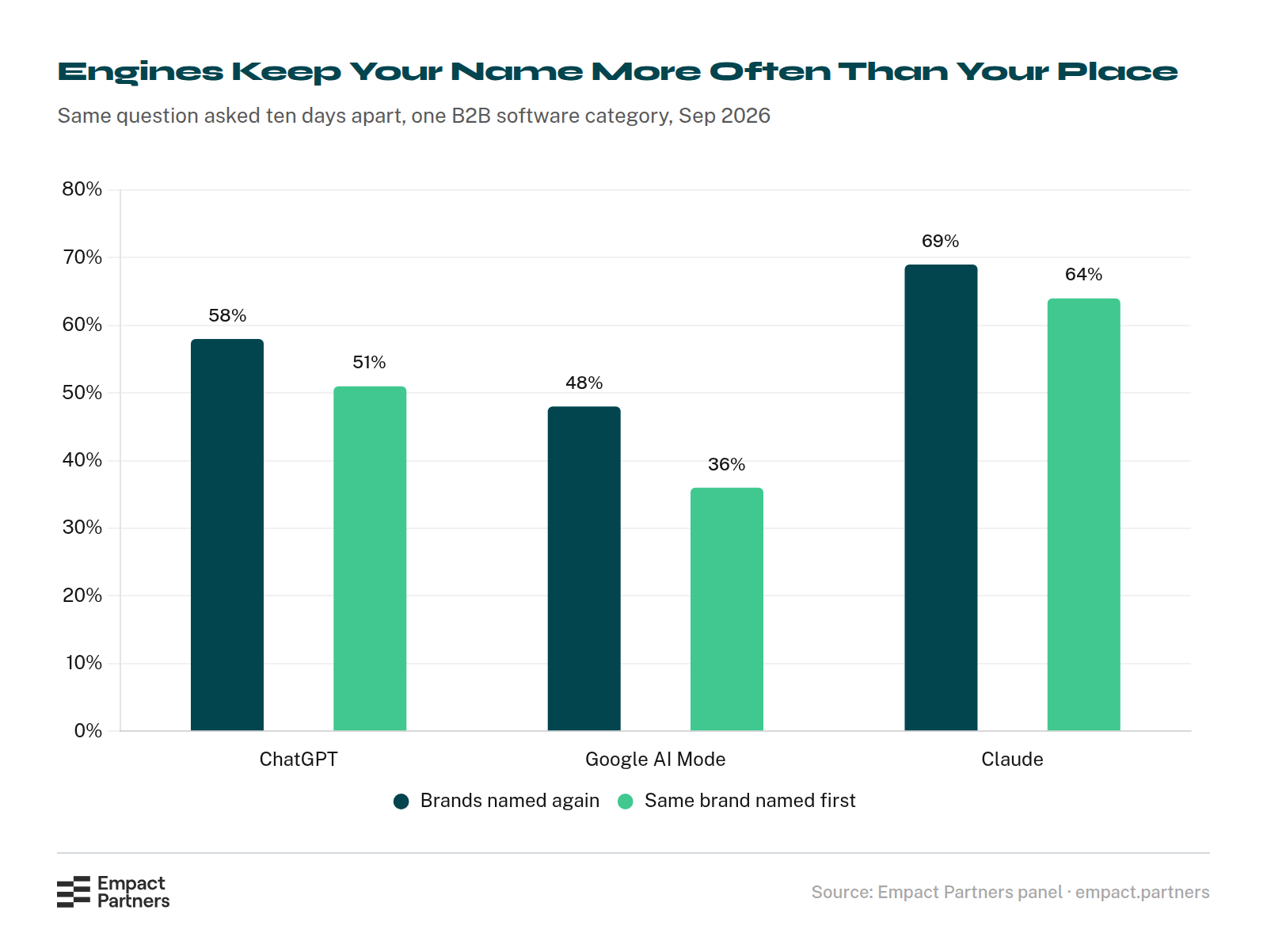
Read the chart as a warning about the ingredient share of voice is built from. Presence held better than first place on every engine, and on Google AI Mode the first-named brand changed on almost two thirds of questions in ten days. Any number built mostly on position inherits that churn.
Step back to the whole category, where a brand’s number lives, and visibility settles further. Measured across nine product lines in four days of September, the typical brand’s visibility shifted by about 1 point, and only 8% to 9% of shifts beat chance. Our AI search volatility statistics carry the full run.
SparkToro found the same split inside one prompt. In research with Gumshoe, which sells AI tracking and says so, a cancer hospital on the US West Coast turned up in 69 of 71 ChatGPT answers to one question, and was first in just 25. Its visibility was close to certain and its place was not. Fewer than 1 in 100 repeat runs returned the same brand list.
The sample decides how much noise reaches the number
The other half of a stable number is the sample. We re-measured every brand at 5% visibility or more on random subsets of its product line’s questions and recorded how far one reading in ten landed from the full figure:
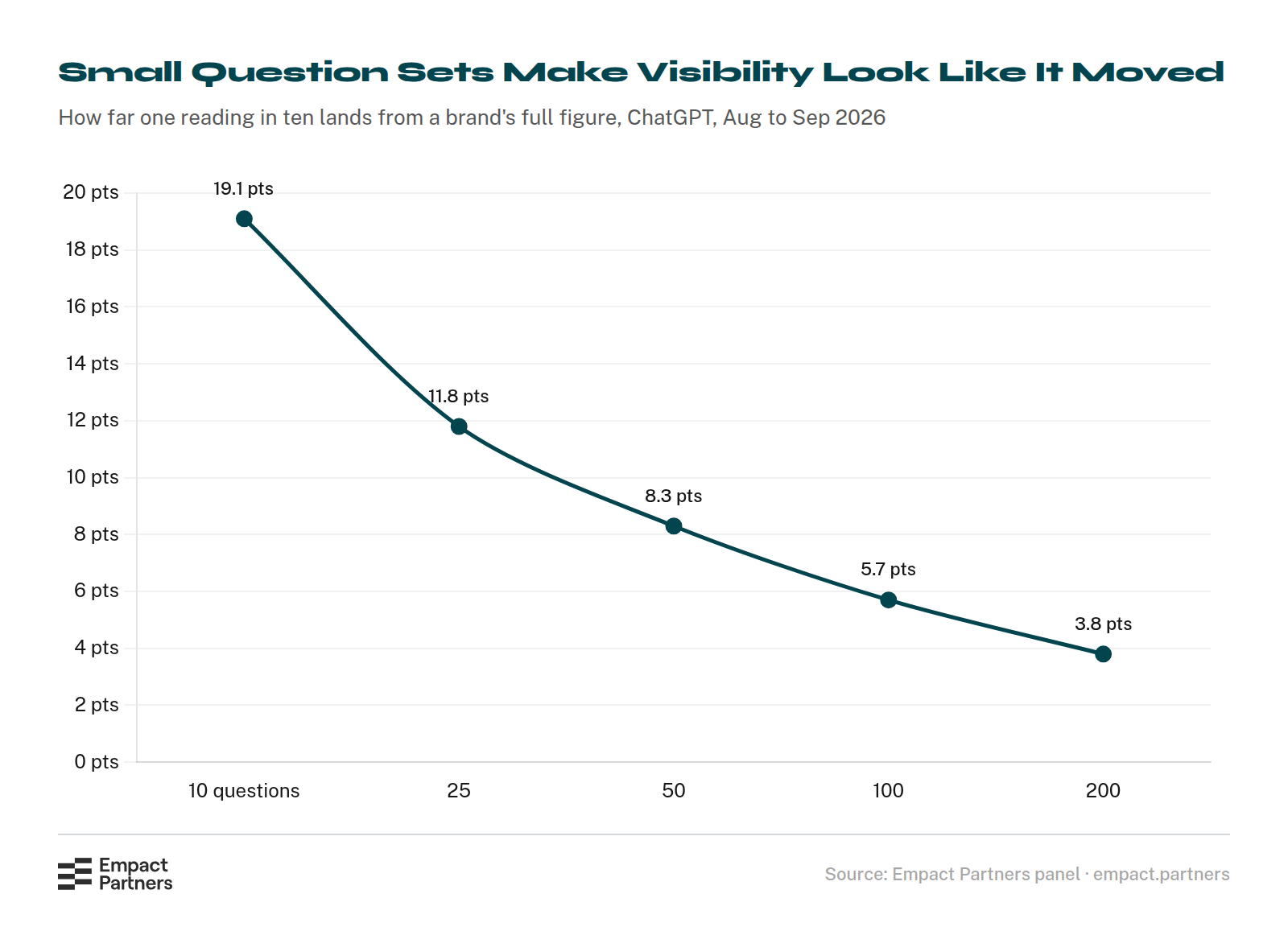
On 25 questions, one reading in ten was 11.8 points or more off. On 100 it was 5.7, and on 200 it was 3.8. Each doubling buys less than the last, so the first hundred questions do most of the work. Share of voice rests on position as well as presence, and in our experience it needs a bigger sample than visibility.
In 2026, Lead With Visibility
The stronger argument for visibility is where most brands stand: outside the answer. An arXiv study from January 2026 took 112 startups from Product Hunt’s 2025 leaderboard and asked a ChatGPT model, through the API, about each one. Asked by name, it recognized them 99.4% of the time. Asked a buyer’s discovery questions, it surfaced them 3.32% of the time.
That gap is where most of our new partners start. One partner in a crowded software category measured about 1% visibility after strong work on its own site and little elsewhere. Its share of voice was a rounding error that moved with every competitor, and a board shown it rising from 0.4% to 0.9% learns nothing.
Visibility starts at an honest zero
Visibility tells the truth at that stage. It starts at an honest zero, it moves only when engines start naming you, and a rise from 1% to 8% over two quarters is a result anyone in the room can read. For a niche category we track from an explicit baseline, zero included, and report relative growth and competitor movement rather than a day-one count.
Share of voice also hides progress. In the eight-brand category, take a challenger that climbs from nowhere to 15% visibility in two quarters, usually named fifth. Its share of voice goes from zero to about 1.7%, beside an incumbent at about 19%, and the line looks flat. On visibility the same two quarters read as 0% to 15%, the real story.
The working line we use comes from how we measure AI search visibility for partners: below one answer in five, the engines do not yet treat a brand as a relevant player in the category, and the job is to get named. Above it, and holding there across consecutive reporting windows, the job changes.
.png)
By 2027, Share of Voice Decides Who Gets Picked
Once a brand is named in most of the answers that matter, visibility stops discriminating. Everyone on the shortlist is visible. What separates them is whether the engine leads with them, how it describes them, and whether a buyer reading the answer carries their name to the next step.
That next step is narrower than the answer. In our partnerships the buying path runs from a question to an engine, to a shortlist of four or five names, to one name pasted into Google, to a direct visit. Answers name seven or eight brands and the buyer keeps about half. Position decides which half, and position is what a weighted share of voice measures.
Two forces narrow the answer further
We expect engines to keep getting more opinionated, more willing to say which tool fits which buyer rather than list options. Every step in that direction concentrates the outcome on the first name or two.
Assistants are also starting to act on what they recommend. Radial’s surveys of US consumers, which our agentic commerce statistics carry, found 58% open to ordering through an AI assistant and 6% who had done it. Agents buying on a person’s behalf are the tail of 2027, not its body, but in that tail only the first pick counts.
So the argument is not that visibility stops mattering. It is that for a brand already in the room, visibility saturates and share of voice keeps moving, and the brands that can read a year of clean, position-weighted share of voice will see the next shift before their competitors do.
Two things would prove that wrong. If engines began returning a stable order, position would become readable on small samples and could lead now. If answers stopped being lists and became a single recommendation, share of voice would collapse into a yes-or-no per answer, which is visibility again. Neither shows in our data today. Watch both.
What the Engine Says About You Is the Number Neither Metric Shows
Visibility and share of voice both count names. Neither reads the sentence attached to the name, and for a brand team that sentence is the point. An engine can name you in most answers, even first, and describe you as the thing you stopped being two years ago: the old category, the old buyer, the feature you no longer lead with.
A stale description is a positioning failure showing up in a new place, and it belongs to Brand Marketing more than to anyone. Engines assemble their description of you from what other people have published. If reviews, roundups and community threads still describe the company you were, the answer will too, however clean the new messaging on your site.
So alongside the two numbers, read the sentences. Take the answers that name you in a window and mark each description against your positioning on four things:
The last one has a practice behind it in our work: find out why a buyer would choose someone else, and answer it in public before a competitor does. An engine summarizing a category repeats whichever answer is easier to find. This reading is a diagnosis, so it stays off the board slide, but it usually explains a share of voice that will not move.
The same reading explains why citations are a third, separate number. An engine can cite your own page as a source in the same answer in which it recommends a competitor, so a citation count belongs in the content team’s report rather than the board’s.
In our panel the pages behind an answer rotate far faster than the brands in it. Across those ten days ChatGPT returned to only a third of the domains it had cited for a question, and Google AI Mode to fewer than one in five, while each still named half or more of the same brands. A brand outlives any one page because many pages carry it.
Run Both Numbers This Quarter
Everything above turns into a method a team of two can start this quarter. The order matters, because each step fixes something the next one depends on.
- Write the question set from your positioning. Take the category decision and turn it into the questions a buyer asks before they know your name, in their words, a hundred at least, across the use cases and buyer roles you serve. No brand names, no “versus”.
- Freeze the competitor list. Ten to twelve companies, indirect competitors included, chosen from the positioning work, written down with the reason each is on it. It changes once a year, on purpose, with a note.
- Pick the engines and the countries. ChatGPT and Google AI Mode at minimum, because they disagree. Every market you sell into is measured separately, in its language.
- Run the set repeatedly. The same questions, on the same schedule, every answer kept. One run is a draw. A month of weekly runs is a picture.
- Count visibility. Answers naming you divided by answers, per engine, per country, per window. Count every name the brand has gone by.
- Compute share of voice with the formula named. Position-weighted, against the frozen list, from the same answers. Write the formula on the slide.
- Read each move against the noise. A move earns a line in the report once it holds across windows on the same questions. Log every change to the questions, the engines or the collection beside the numbers.
Where the method goes wrong
The judgment calls sit in steps one, two and seven. A question set written in the marketing team’s own vocabulary measures how well engines repeat your messaging, which is a positioning test, not a visibility count. Keep that second set on purpose: it shows whether the message you rewrote in the spring has reached the engines.
The competitor list goes wrong by growing. Each time a new name turns up in the answers, somebody adds it, and share of voice drops with no change in the market. The Semrush reset is that problem at scale. Its own reporting guidance says the same thing in general form: expanding the prompt set mid-cycle inflates mentions without showing real improvement.
Step seven goes wrong by impatience. A one-point shift over a few days is usually the draw, so a weekly report that treats each one as news teaches the team to react to noise. A move is real when it holds.
Measure every market on its own
The per-country split is the step teams skip, and it reverses stories. Engines localize: the same question asked in another country leans on local-language pages and names different brands. Shanal Govender, a senior GTM consultant here, has seen partners at 40% share of voice in the US sitting under 5% in the market they were expanding into.
A global number averages a winning market and a losing one into a figure that describes neither. Our localization statistics show how differently engines source answers from one market to the next, which is why every country in the report gets both numbers of its own.
The Slide the Board Gets
The output of all of that is one slide. It carries both numbers because each alone misleads, and every number on it carries its date range and its source, which has been standing practice in our partner reporting since long before AI search.
| Line on the slide | What goes in | Why it is there |
|---|---|---|
| Visibility | Share of answers naming you, per engine, this window against the last | The 2026 headline: are we in the answer |
| Share of voice | Position-weighted share against the frozen competitor list | The 2027 headline: are we the one picked |
| Position when named | Average place in the answers that name you | Separates “named often” from “named first” |
| By country | Both numbers for each market you sell into | A global average hides a losing market |
| The sample | Questions, engines, runs, dates, and the formula used | Without it neither number can be checked |
| What changed | Edits to the questions, competitors or collection | So a method change is not read as a result |
| In plain words | One sentence a board member can repeat | The numbers above serve this sentence |
| Next step | The one piece of work this reading calls for | A report that ends on a number ends on nothing |
What stays off the slide matters as much. Keyword rankings and domain rating no longer answer this question, because an engine building an answer consults neither. They belong in an SEO report. A screenshot of one answer is one draw from a pool. An “AI ranking position” is a place in one answer dressed as a rank no engine keeps.
Below the board, each team reads a different cut of the same data, and handing everyone the board slide wastes most of it:
The plain-words line is the one boards remember. Write it as a buyer would hear it: “When a buyer asks ChatGPT which tools to shortlist in our category, we are now named in about one answer in four, up from one in ten in March, and named first in about a third of those.” That sentence carries both numbers without asking anyone to learn either.
An Afternoon Gets You the First Reading, Not the Series
Part of this you can do this afternoon, by hand. Write thirty of the questions from step one, put them to ChatGPT and Google AI Mode, and mark each answer for whether it names you and where. You will learn whether you are in the room at all, which competitors the engines put beside you, and whether the sentence about you matches your positioning.
An afternoon will not give you the series. Thirty questions asked once is a draw, and on a set that small our panel puts one reading in ten about a dozen points or more off. The number a board can steer by needs a hundred questions or more, asked every week, on at least two engines, in every market, with every answer kept so the same question can be compared with itself.
Most in-house programs stop there, usually around the third week. The spreadsheet that worked for thirty questions does not survive three hundred across two engines and four countries, and the person running it has another job. The program quietly becomes a quarterly spot check, and the board goes back to a single screenshot.
So be honest about which half you are buying. The series is a standing piece of measurement with somebody responsible for it, and it is the half our partners most often ask us to run.
The Report Is a Brand Decision Before It Is a Dashboard
At Empact Partners the work runs in a set order. The Brand Marketing workstream decides what a company says before deciding where it says it, and in 2026 that includes which category questions you want to be the answer to and which companies you are measured against. We settle that denominator before anyone reads a percentage.
Moving the numbers is the neighbouring workstream, Generative Engine Optimization, GEO for short: earning mentions on the pages engines read and in the communities they cite. The two run together in most of our partnerships, because a positioning nobody repeats in public never reaches the engines.
What working with us on it looks like:
Our position is narrower than the market’s. Neither number is the brand. Visibility says whether the engines know you belong in the conversation, and share of voice says whether they think you are the answer, and both are downstream of a positioning that was clear before anyone measured it.
If your category message has stopped landing and you need to know where you really stand in the answers your buyers read, book a call with us, and we can see whether we are the right team to work on it with you.