It’s week eleven of a mention-building retainer, and the status call opens on a slide. It says “47 outreach emails sent,” shows a screenshot of a podcast recording that won’t air until November, and promises “strong relationship momentum.”
Then, the founder shares their screen. They’ve asked ChatGPT their category question again, the way they have every morning since the contract was signed, and it still recommends three competitors. Nobody on that call is lying, and the founder still hangs up with nothing to tell the CFO, who wants a renewal decision by Friday.
A quarter of mention building realistically produces a baseline, a working outreach pipeline, a few mentions on the pages AI engines already read, and early, noisy signals in AI visibility. It rarely produces a new position in ChatGPT, and anyone promising you one in 90 days is selling a spreadsheet. Here’s what a quarter can deliver:
I work as a Senior GTM Consultant at Empact Partners, which runs go-to-market work for B2B software companies from inside their own marketing teams. Mention building is half of the Generative Engine Optimization (GEO) workstream we run: becoming the brand an AI engine names when a buyer asks their category question.
We work to a formula, GEO = UGC + Mentions, meaning what real users say about you in public plus what other sites say about you. Before any of that work starts, we tell a partner what a quarter can and can’t move, and why a count of mentions is the worst way to find out.
Mention Building, Defined Before Someone Sells It To You
Mention building is the work of getting your brand named on pages you don’t own, such as roundups, reviews, articles, podcasts, and community threads, so that search engines and AI answer engines connect your name with your category. A mention counts with a link or without one.
That second sentence is where it parts ways with link building. An “unlinked brand mention” is your name on someone else’s page with no hyperlink attached, and a link builder treats it as a lead: email the site, ask for the link, move on. We treat the mention as the asset, because an engine reads whether a trusted page names you, link or no link.
The whole category is selling one study’s headline, so it deserves a fair reading. Ahrefs, which sells an AI-visibility tracker called “Brand Radar,” studied 75,000 brands with a Domain Rating above 40 and compared each brand’s footprint on the web with how often Google’s AI Overviews mention it:
That’s a correlation across established brands at one point in time, and Ahrefs says so on the page. It shows mentions and AI visibility travel together. It can’t tell you what thirty new mentions in a quarter will do to your AI visibility, and I haven’t found a published study that can.

.png)
Why ChatGPT Doesn’t Read Your Press Release On Tuesday
AI answers run on “two clocks.” A live search can pick up a new page soon after it’s crawled and indexed, while what a model knows without searching only changes when a new model ships with a later knowledge cutoff.
The providers say so in their own documentation:
The second clock is the knowledge cutoff, and every model has one. OpenAI lists February 16, 2026, for GPT-5.6. Anthropic lists June 2026 for its newest Claude models and warns that a model “may not be aware of events or information that occurred after” that date. Here’s how the two clocks compare:
| Live retrieval | The “trained layer” | |
|---|---|---|
| What it reads | Pages in a search index, fetched when the question is asked | Whatever was in the training data before the cutoff |
| How a new mention gets in | Crawled, indexed, then retrieved for the question | Included in a later model’s training run |
| How fast | Days to weeks after publishing, once crawled (Google says recrawling can take “several days to several months”) | On the provider’s release schedule, months at the earliest |
| Where you see it | Cited links under the answer | A brand named with no link at all |
| Who you can call about it | Whoever owns the pages the engine retrieves | Nobody |
We’ve watched both clocks run. In a January 2025 test, Copilot surfaced a partner’s new software-directory listing about a day after it went live. In the same round of tests, a partner that had renamed itself appeared in AI answers only under its old name, kept alive by old forum threads and by what the models had learned before the rebrand.
Britney Muller, an SEO and AI educator who used to work at Moz, put the split plainly on LinkedIn: “Getting mentioned by an LLM (no URL) = Being in training data.” A cited link is the “fast clock.” A brand named from memory is the “slow clock.”
Ask ChatGPT The Same Question Eight Times And Watch The Shortlist Move
AI visibility moves even when nobody does anything. Ask ChatGPT the same buyer question eight times and the top of the shortlist holds while its edge changes from run to run, so any “movement” at the edge has to beat that churn, which I call the “noise floor,” before it counts as a result.
On October 2, 2026, we asked ChatGPT four buyer questions, about CRM, help desk, project management, and SOC 2 compliance software, eight times each with web search on, and recorded every brand named and every page cited. That’s 32 answers from one engine on one day, enough to see the churn and nowhere near enough to rank anyone. Here’s who appeared, and how often:
| Category | Named in all 8 answers | Named in some of them |
|---|---|---|
| CRM | HubSpot, Pipedrive | Attio 7, Close 7, Salesforce 4, Zoho CRM 1 |
| Help desk | Intercom, Help Scout, Zendesk | Freshdesk 7, HubSpot Service Hub 3, Front 2, Crisp 1 |
| Project management | Linear, Jira, ClickUp | GitHub Projects 7, Asana 6, monday.com 1 |
| SOC 2 compliance | Vanta, Drata, Secureframe | Sprinto 7, Thoropass 2 |
What the 32 answers show:
The ages of the cited pages show the fast clock in our own data. Of the 29 third-party pages with a publication date, 11 of the 29 were less than three months old, so pages published inside one quarter were already shaping the next quarter’s answers.
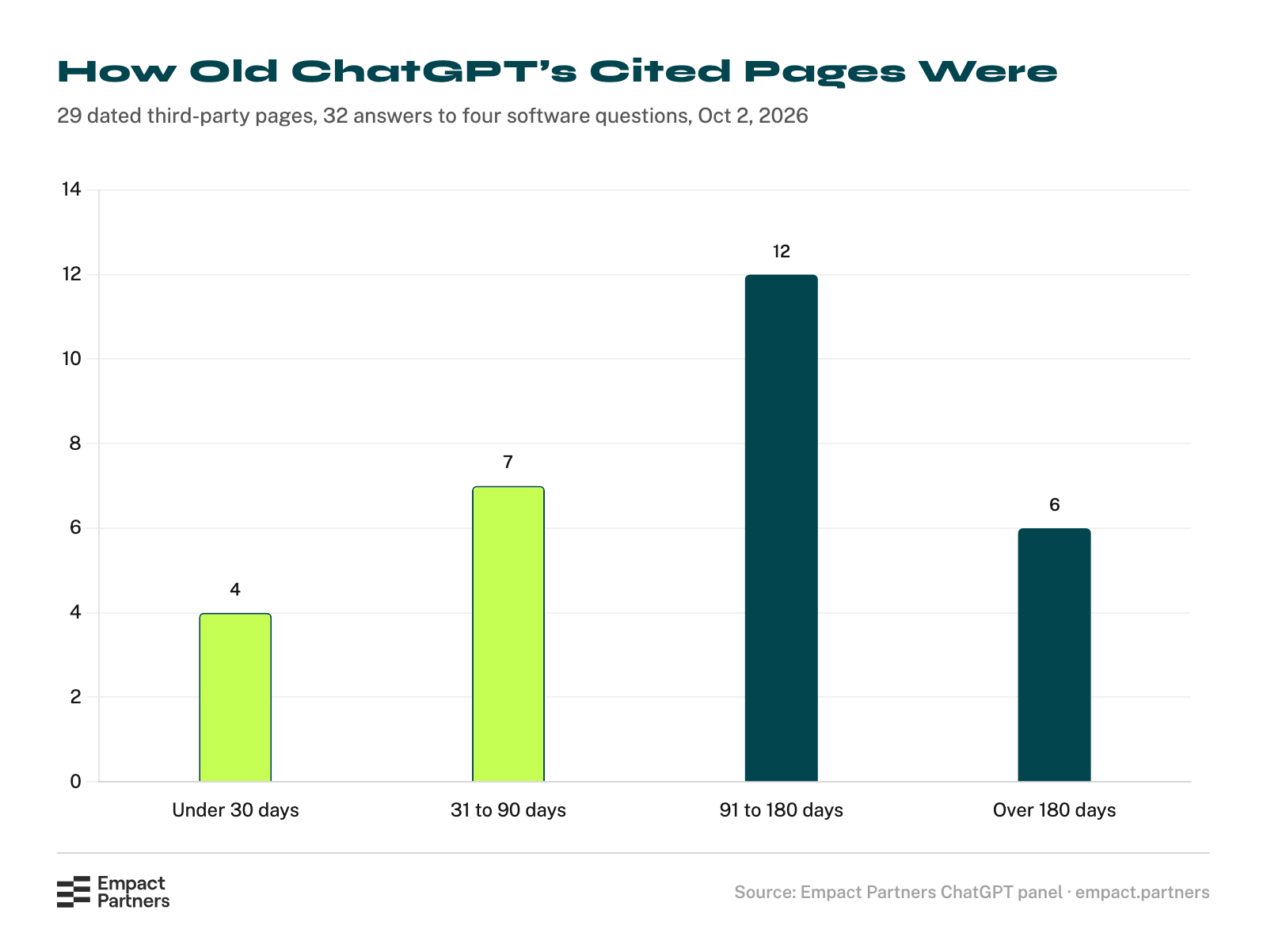
The slow clock showed up too. With web search off, OpenAI’s gpt-5.6-sol named brands the live answers never named: Freshsales for CRM, Gorgias and Dixa for help desk, Trello and Azure DevOps Boards for project management, and Scytale and Scrut Automation for SOC 2. Three runs per question is a small sample, so read it as a small picture of the trained layer.
That’s why “AI share of voice” has to mean your share of the brand mentions across many runs of many category questions, never one answer. Our sister company, Qvery, runs that measurement daily, at that scale, so discount the recommendation accordingly.
You don’t need it to start: ask your category question eight times in a clean session, write down who appears, and ask any vendor who reports a change smaller than your own eight-run spread to show you their raw answers.
The Quarter, Week By Week
Most of a quarter’s visible results arrive in its last five weeks. The first half goes on the baseline, the target list, and outreach that mostly gets no reply. Placements publish weeks after they’re agreed, and engines read them only after they’re crawled.
Nobody has published primary data on how long a podcast takes from recording to release, or how far ahead journalists plan a story, so I won’t pretend otherwise. Here’s how a realistic quarter runs, with each lag sourced where a source exists and marked as our experience where none does:
| Weeks | What’s happening | What you see | The lag, and where it comes from |
|---|---|---|---|
| 1–2 | The baseline: your category questions, asked repeatedly across engines, and an audit of where you’re already mentioned and which pages get cited | A baseline report and no new mentions | Our practice |
| 2–3 | The target list: the cited roundups, the reviewers, and the writers and hosts who cover your category, each with a reason to say “yes” | A list | Our practice |
| 3–5 | Outreach, by hand, with one follow-up | Mostly silence | 54% of journalists seldom or never respond to pitches, and most want one follow-up 3 to 7 days later (Muck Rack, “State of Journalism 2026”) |
| 4–6 | Review requests to real users | A few new reviews | G2 moderates in “up to 3 full working business days”; TrustRadius in 2 to 3 days |
| 5–8 | Replies turn into “yeses”: a list owner agrees, a writer wants a quote, a host books a recording | Agreements and recordings, nothing public | Pitch to press runs “2-3 months (and longer),” per a PR practitioner on Reddit; podcast release gaps are our experience |
| 7–10 | The first placements publish | The first live mentions | Our experience, and a practitioner’s “towards the end of month two” |
| 9–13 | Published pages get crawled, indexed, and retrieved | The first cited answers, if the pages are ones engines read | Google’s recrawl window; our directory listing in about a day |
| 13 | The same questions, run the same way, against the baseline | A reading, and next quarter’s plan | Our practice |
The middle of that table is where retainers go to die. Weeks five to eight are the busiest and the least visible: the “yeses” are coming back, and none of them has a URL yet. The founder checks ChatGPT, sees the same three competitors, and the report fills with whatever can be counted. Emails sent. Calls booked. “Conversations ongoing.”
“Usually, towards the end of month two, I start seeing the fruits of my labor, and then by month three, we are in a good spot.” – u/Myabyssalwhip, r/PublicRelations, May 2026
That drift is understandable, and it’s still the wrong instinct. Muck Rack, a PR Software Company, surveyed 897 journalists for its “State of Journalism 2026” and found that 54% seldom or never respond to PR pitches, and Propel, which sells PR software, saw 3.56% of pitches draw any reply in late 2025. A slide that leads with the email count reports the step most likely to fail, in the language of progress.
.png)
The honest middle-of-quarter report is shorter and less flattering. It names the pages you’re trying to land on, says which owners replied and what they asked for, and gives a date for each placement that’s been agreed. If the vendor can’t write that report in week seven, a count won’t rescue week thirteen.
Not Every Mention Buys The Same Quarter
Mentions differ in how fast they land, how long they last, and how often AI answers read the kind of page they sit on. A quarter should spend most of its effort where all three line up for your category. Here’s how the main channels compare:
| Channel | First mention | Shelf life | AI pickup | Main risk |
|---|---|---|---|---|
| Earned “best X” roundups | Weeks | Until the next refresh | High: 43.8% of ChatGPT’s cited page types (Ahrefs) | Offers to pay for a spot |
| Journalist outreach | 1–3 months | Years | High on trend questions (Muck Rack) | Paywalls, blocked crawlers |
| Expert quote platforms | Weeks | Months | Low unless the outlet ranks (my view) | Bylines nobody reads |
| Review sites | Days per review | Years | Often, on comparison questions (my view) | FTC rules on incentives |
| Podcast guesting | 1–2 months | Years | Low unless transcribed or on YouTube (my view) | Release delays |
| Original research | 1–3 months | Years | High once journalists cite it (my view) | A study nobody needed |
| Reddit threads | Days | Years | Gemini’s most-cited domain (Muck Rack) | Removal by moderators |
| Partner co-marketing | Weeks | Months | Medium (my view) | Reads as an ad |
Ahrefs’ study of 750 “best X” prompts found those roundup lists made up 43.8% of the page types ChatGPT cited, and that 79.1% of the lists it pulled from had been updated in 2025, the year of the study. That’s why roundups sit at the top of most of our target lists, and why the first job of a quarter is finding which ones your engines already read.
Getting into them is a method we call Existing Article Outreach (EAO): asking the owners of lists that already rank, and already get cited, to add you, instead of pitching new articles that start from zero. Tell the owner you don’t mind which position you get, and you’ve removed the one detail they’d otherwise negotiate.
Across our outreach for partners, two things decide the reply rate more than volume does:
And the category decides how far any of this goes. In one credential-sensitive clinical category, several hundred quote requests drew almost no replies, and we stopped taking that kind of outreach work. If your buyers live in a field like that, a mention-building retainer is the wrong first purchase, and I’d tell you so on the first call.
Promises That Should End A Sales Call
Any promise about what an AI engine will say, or a fixed count of placements by a date, is a promise about decisions nobody selling it controls. The useful question is what the vendor will do, on which pages, and how they’ll show you it worked.
Guaranteed-link packages are sold by the bundle on the open market, and the promises around them take a few recurring shapes. Here they are, paraphrased, with nobody named:
| The promise | What the evidence says | Ask this instead |
|---|---|---|
| “Guaranteed ChatGPT mentions” | OpenAI’s own help page says “Placement is not guaranteed,” and the same brand list repeats less than once in 100 runs (SparkToro and Gumshoe) | Which questions, how many runs, and what counts as a mention? |
| “100 mentions in 90 days” | ChatGPT cites about five sources per answer (Muck Rack), so a hundred mentions on pages it never retrieves move nothing | How many of these pages does an engine cite for my question today? |
| “We’ll get you into every AI Overview” | Google says “Indexing and serving isn’t guaranteed,” and 45.5% of AI Overview citations change between observations (Ahrefs) | Which questions will you track, and what’s their noise floor? |
| “Placements on DA 70+ sites” | Backlinks correlate 0.218 with AI Overview mentions, web mentions 0.664 (Ahrefs) | Which of these sites already gets cited for my category? |
| “Guaranteed placements in top-tier outlets” | 54% of journalists seldom or never answer a pitch (Muck Rack), so a guaranteed placement is usually a paid one | Is any of this paid, and how will it be labeled? |
| “You’ll rank first in ChatGPT” | The same brand order repeats about once in 1,000 runs (SparkToro and Gumshoe) | What’s my share of answers across many runs? |
| “Results in 30 days” | Pitch to press runs months, and Google says recrawling can take “several days to several months” | What will I see in weeks one to six? |
Rand Fishkin, the Co-Founder of SparkToro, ran that consistency research with Gumshoe, which sells AI-visibility tracking. Their volunteers ran 12 prompts 2,961 times, the study isn’t peer-reviewed (they say so), and his verdict on the ranking promise is one line: “Any tool that gives a ‘ranking position in AI’ is full of baloney.”
“Anyone promising or guaranteeing placements is ‘pay-to-playing’ for them, whether they’re being transparent with you about that or not.” – u/Juniper338, r/PublicRelations, Dec 2024
The rules on paying for a mention
A paid spot in someone’s ranked list is an ad, and the FTC says a disclosure doesn’t fix a bought ranking. Here’s what the FTC’s own documents say, in plain terms (none of this is legal advice, so get a lawyer’s read before you pay anyone for a placement):
So, a vendor offering a guaranteed spot in a “best X” list for a fee is offering you an ad with no label, and the FTC’s own example puts part of the liability on the brand that paid. Inclusion the list owner decides on, because you belong there, is mention building.
Judge The Quarter On What A Quarter Can Move
Judge a first quarter on leading indicators: the baseline, the target list, the replies, and placements on pages engines cite. Judge AI share of voice, cited answers, branded search, and pipeline from the second quarter on, and always against the churn you measured in week one.
Here’s the scorecard I’d paste into the doc you review every quarter (where a row says “my view,” it’s our experience across partnerships, and it’s marked so you can argue with it):
| Metric | Quarter one | Quarter four | Basis |
|---|---|---|---|
| Baseline (leading) | Done by week two, with the raw answers kept | Re-run monthly on the same questions | Our practice |
| Target list (leading) | Every target is a page or person engines already cite for your questions | Refreshed as citations shift | My view |
| Replies (leading) | Well above the 3.56% pitch reply rate, because targets were chosen | Steady, from a known set of owners | Propel; my view |
| Placements on cited pages (leading) | One or two live by week thirteen | Most placements land on cited pages | My view |
| Cited answers naming you (lagging) | First appearances, outside the noise floor | Present in most runs of your core questions | My view |
| AI share of voice (lagging) | Measured, not judged | Up by more than the week-one churn | My view |
| AI referral traffic (lagging) | Tracked through the source tag ChatGPT adds to its links | Growing | OpenAI; my view |
| Branded search (lagging) | Flat is normal | Rising | My view |
| Pipeline influenced (lagging) | Not yet | Self-reported “found you in ChatGPT” leads | My view |
Notice how many lagging rows say “my view.” Nobody has a validated benchmark for AI share of voice yet, which is exactly why a single tracked number shouldn’t decide a renewal.
Greg Gifford, Chief Strategy Officer at SearchLabs, makes that case in a fifteen-minute interview with Mordy Oberstein, Head of Brand at SE Ranking, on SE Ranking’s YouTube channel, and since SE Ranking sells an AI-visibility tracker, it’s worth hearing its own guest call tracking a directional signal rather than a KPI.
The week-eleven check
If you’re in the middle of a retainer now, you can run this before your next status call, with nothing but a spreadsheet and a fresh browser session:
That last line is also the fair way to end an engagement. A first quarter that lands nothing on a cited page, and can’t name its targets, should end. A first quarter with a clean baseline, a target list built from real citations, and two placements live in week twelve is on schedule, even if ChatGPT hasn’t noticed yet.
Four questions for any proposal, ours included
Ask these before you sign anything, including with us:
Here’s how we answer them at Empact Partners: a GEO engagement starts with an audit and a baseline across the engines your buyers use, kept as raw answers you can read yourself. The target list comes from the pages those answers cite, and we ask you for whatever moves a “yes,” usually access, a reviewer, and someone worth quoting.
We report on citations and share of voice against the week-one churn, never on emails sent. And we say up front that the horizon is quarters: GEO takes months before momentum shows, and an engagement earns far more in its third year than its first.
When One Quarter Does Produce The Spike
A single quarter can outrun everything above when you hand it something newsworthy: a launch with a real hook, original research journalists want to cite, or an audience that already talks about you.
The public cases say so, with the usual warning that every one is published by a company selling the work. Position Digital, which sells digital PR, says a data report it ran for the B2B software company Resource Guru earned 50+ backlinks in three months, one of them from Forbes.
Smarty Marketing, the digital PR business whose Co-Founder is Ann Smarty, says an original-data study for an unnamed brand drew about 30 links in its first wave and about 200 after a year. The second number is the more useful one: the first wave was roughly a seventh of what the same asset earned.
Neither case published an AI-visibility figure, and that’s the honest state of the evidence. The public cases with dated AI-visibility numbers, like incident.io’s rise from 38% to 64% in four months, published by Discovered Labs, came from owned content. I haven’t found a public “before-and-after” for earned mentions alone, and the first one I see will have to show its runs.
The quiet first quarter still compounds, for a reason that’s easy to miss. Marketers now draft their own roundups with AI help, and those lists start from the brands the AI already names, so every mention that reaches a cited page raises the odds of the next one.
The compounding runs in reverse if you stop: Muck Rack’s “What is AI Reading?” study found that 57% of the journalism AI engines cited, where the date was known, was under a year old. And it’s slow. Here’s a former B2B SaaS PR practitioner, answering a founder who had counted 12 to 18 placements in thirteen months:
“12–18 placements over the course of a year for a bootstrapped company, in all honesty, seems about right from my days working in B2B SaaS PR.” – u/fortuitousavocado, r/PublicRelations, May 2025
That’s how we run mention building at Empact Partners: a baseline first, targets from the pages engines already cite, a reason to say “yes” in every ask, and a report that would embarrass us if the work wasn’t happening. A quarter of that buys you a foundation and mentions that count, and a vendor who promises you more is quoting a number nobody controls.
If you’re about to sign a mention-building retainer, or you’re in week eleven of one and can’t tell what it’s doing, book a call with us, and we’ll work out together what your next quarter can realistically move.