The slide says 60%. Sixty percent of last quarter’s trials turned into paying users, and the founder lets the number sit. Then a board member asks two questions: how many people started a trial in the first place, and did the 60% mean to be charged?
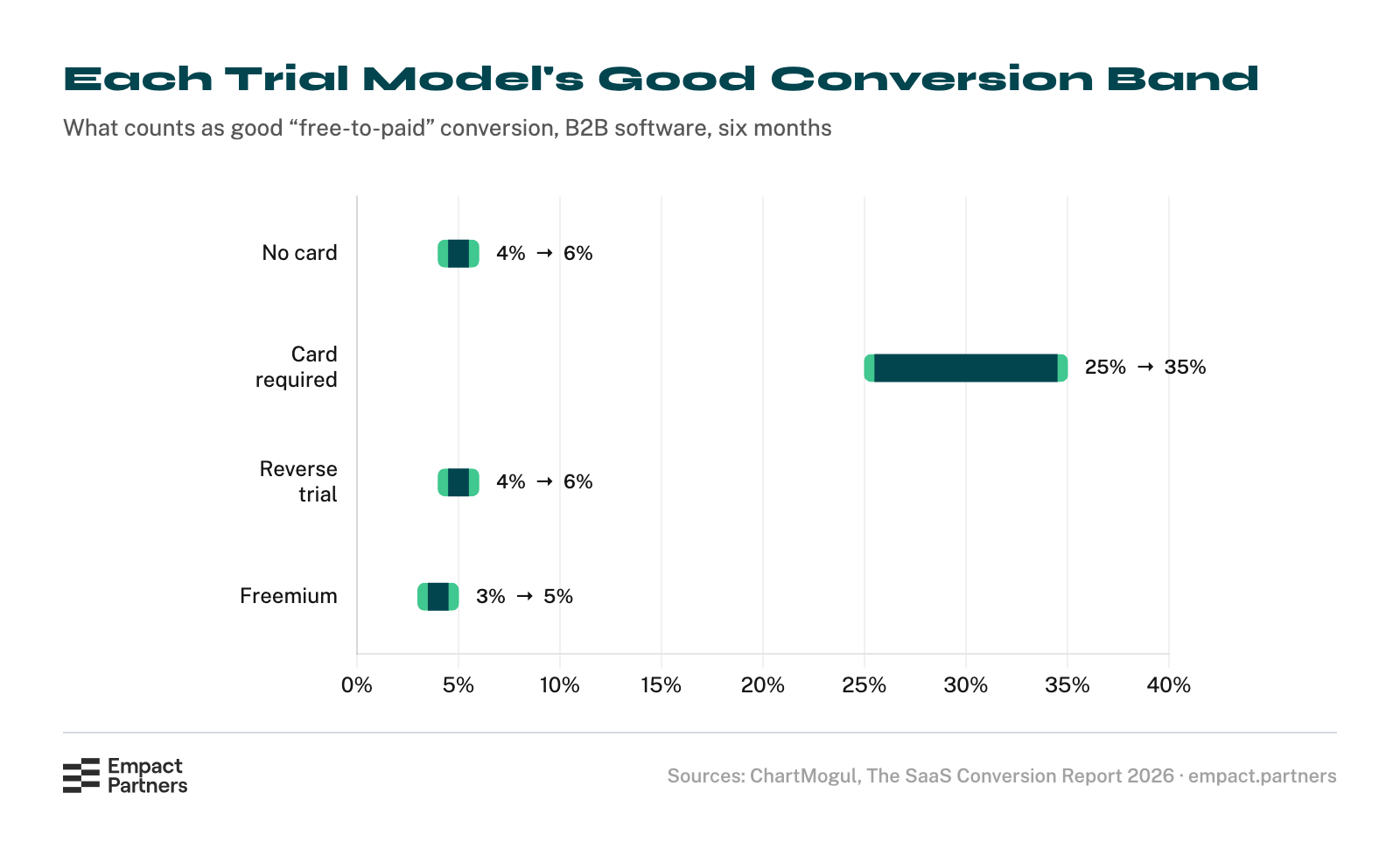
Most free trial conversion statistics can’t answer either one. B2B trials that ask for no card convert 4% to 6% at what counts as “good,” and trials that take a card up front convert 25% to 35%, in the same survey of 200 software products1. Same products, same survey, a sixfold gap, and the gap is the trial’s design.
Here is my view, stated plainly: most “good” trial conversion rates are a product of trial design more than product quality, and some of the highest rates in the industry rest partly on people who forgot to cancel. Everything below is the evidence, sorted by the seven dials a team controls, then a table that matches your setup to the one benchmark built the way your trial is.
Highlights
Read together, the card, the app store, and the salesperson each lift the rate, and each also changes who gets counted. An automatic charge keeps the people who meant to stay and some who forgot, and no benchmark page tells you the split.
Trial Length: Seven Days Beat Thirty In Software, And Long Trials Win In Apps
In a randomized test of 337,724 new users at a software company, a 7-day free trial converted 15.36% of trial users, against 14.67% for a 30-day trial4. Consumer apps run the other way, and the reason is who picks a long trial.
Hema Yoganarasimhan, Professor of Marketing at the University of Washington’s Foster School of Business, ran that experiment with Ebrahim Barzegary, now Assistant Professor of Marketing at ESSEC Business School, and Abhishek Pani, then at Adobe. They published it in Management Science in 2023. What the usage logs showed:
A longer trial mostly bought a longer silence. Ling Zhang and Jiang Duan, of the School of Computing and Artificial Intelligence at Southwestern University of Finance and Economics in Chengdu, found the other half in 2025, randomizing 680,588 new users of a freemium image-editing product between a 3-day and a 7-day trial that required a card:
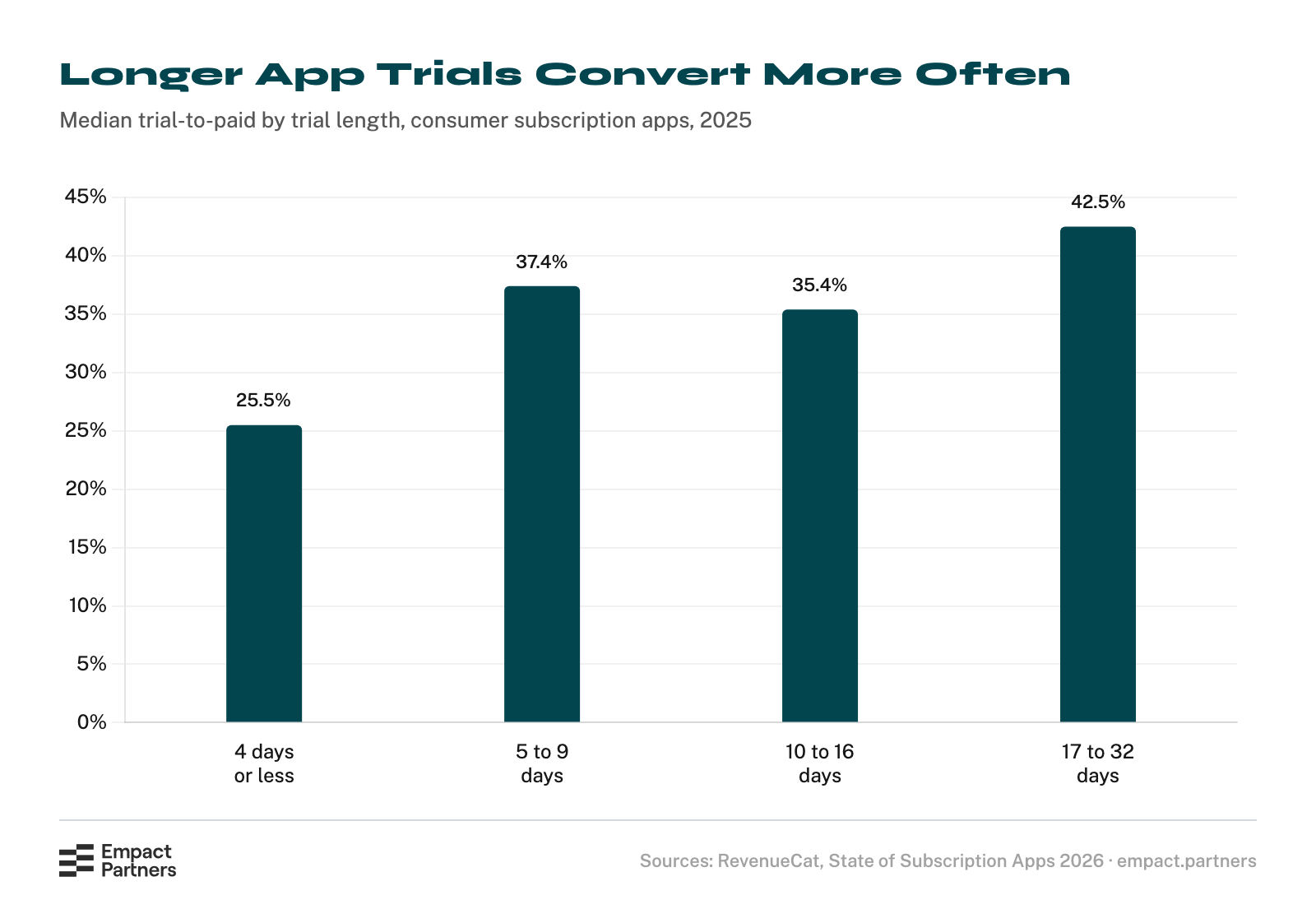
So the randomized evidence points to about a week: 7 days beat 30 in one test and beat 3 in the other. RevenueCat’s 2026 report, built on 115,000+ subscription apps, shows the opposite slope, and it is worth reading carefully:
Apps confident enough to give away a month may simply be the ones people already meant to buy. David Barnard, Growth Advocate at RevenueCat and Host of its podcast “Sub Club,” said as much on a “Sub Club Live” stream on March 19, 2026: the longer-trial advantage is partly correlation, not causation10.
| Source | Lengths compared | Result | Trial and base |
|---|---|---|---|
| Yoganarasimhan et al., 2023 | 7, 14, 30 days | 15.36%, 14.96%, 14.67%4 | Software; trial starts |
| Zhang and Duan, 2025 | 3 vs 7 days | 0.368% vs 0.445%9 | Card; all new users |
| Miller et al., 2026 | 2 vs 4 weeks | No significant difference5 | Newspaper; all readers |
| Recurly, 2022 | 7 days or less vs 61+ | 40.4% vs 30.6%3 | Mostly card; trial starts |
Plan type moves the answer too. On monthly app plans, a “5- to 9-day” trial converts 45.9%, against 46.6% at 10 to 16 days and 43.7% at 17 to 32 days, across 17,000+ apps between August 2025 and July 202611. And B2B software mostly ignores the debate: 62% of products run a 14-day trial, per ChartMogul’s 2026 survey of 200 products1.
Anmol Tiwari, Director of Product Management at Duolingo, told “Sub Club” in March 2026 that cutting Duolingo’s trial from 14 to 7 days brought more conversions overall12, and RevenueCat’s 2026 report records that the cut doubled experimentation velocity2. He walks through the cut in this episode of “Sub Club,” published on RevenueCat’s YouTube channel.

.png)
The Card Question: Asking For A Card Wins More Payers, And Some Of Them Forgot
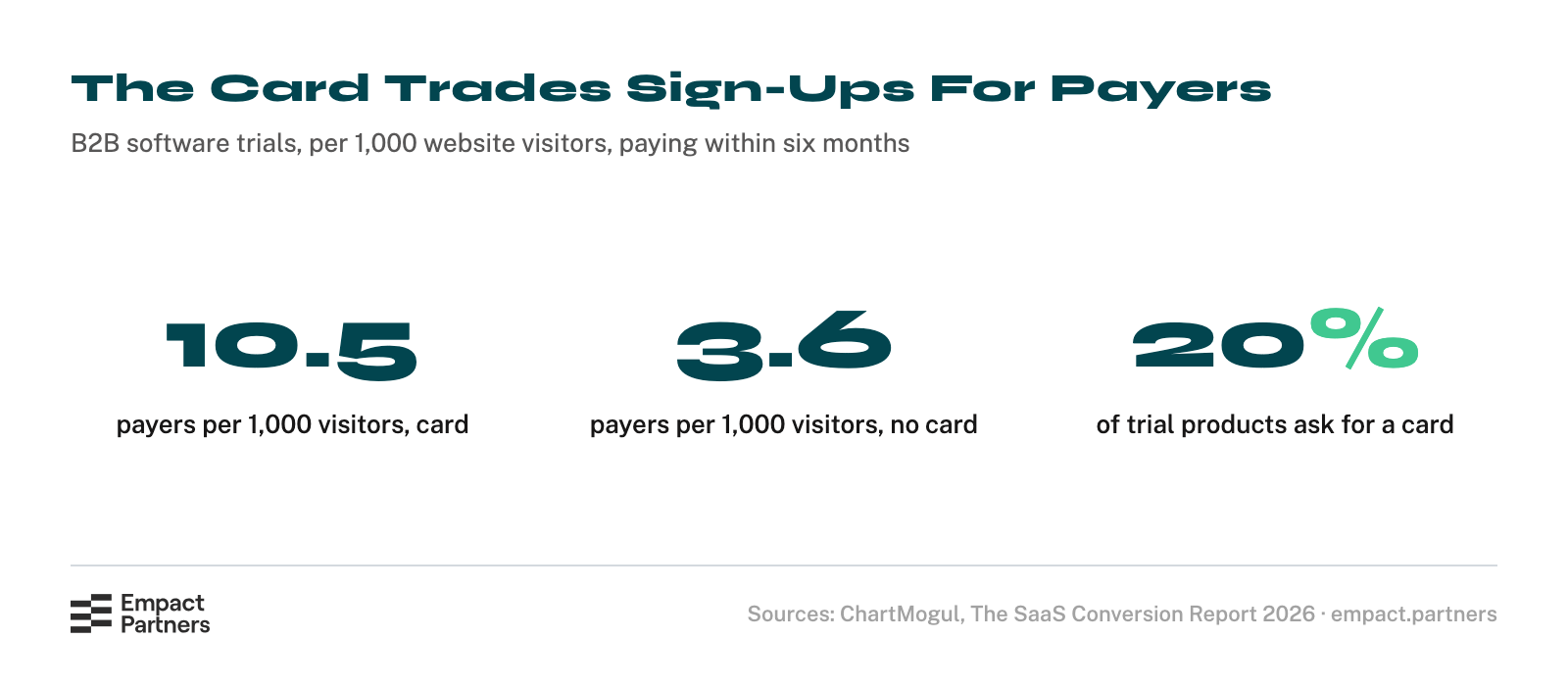
B2B trials that require a card convert 30% “free-to-paid,” more than five times trials that don’t, per ChartMogul’s 2026 survey of 200 software products, measured over six months from sign-up1. The card also cuts sign-ups, so the fair comparison is paying users per visitor.
ChartMogul’s report, written by Kyle Poyar, Founder of the newsletter “Growth Unhinged,” with ProductLed, counts the whole funnel per 1,000 website visitors:
On that arithmetic, the card wins, and most teams stop reading there. The trouble is what an opt-out trial counts as a conversion: anyone who failed to cancel. Here is every source that reports both rates.
| Source | Opt-in (no card) | Opt-out (card) | Divided by |
|---|---|---|---|
| ChartMogul, 2026 | 4% to 6% “good”1 | 25% to 35% “good”1 | Free sign-ups, six months |
| Recurly, 2022 | 12.0%3 | 39.0%3 | Trial starts |
| Elena Verna, 2022 | 15%13 | 70% to 80%13 | Trial starts, an estimate |
Elena Verna, Head of Growth at Amplitude when she wrote it, put the other side of the trade in a 2022 post on Amplitude’s blog: as many as 80% of people drop off at the card screen, by her estimate13.
So the gap mixes three things. Some of it is intent, since a person who types in a card has decided something. Some is friction, the browsers the card screen turns away before a good first week.
The rest is forgetfulness, and the academic work measures it. Klaus Miller, Assistant Professor of Marketing at HEC Paris, Navdeep Sahni, Professor of Marketing at Stanford Graduate School of Business, and Avner Strulov-Shlain, Associate Professor of Marketing at Chicago Booth, randomized offers across 1,389,869 readers of a large European newspaper, some set to auto-renew and some to lapse5. What 20 months showed:
Liran Einav, the Charles R. Schwab Professor in Economics at Stanford University, Ben Klopack, Assistant Professor of Economics at Texas A&M University, and Neale Mahoney, the TG Wijaya Professor of Economics at Stanford, put a price on that inattention in the American Economic Review in 2025, across ten US subscription services. In their model, inertia raises seller revenue 87% on average14.
Monthly retention drops four times faster when a card expires and forces an active choice14. When subscribers have to decide, many decide to leave.
Trial Type: The Paywall You Choose Sets The Ceiling
In consumer apps, a hard paywall turned a median 10.7% of installs into payers within 35 days, against 2.1% for freemium apps, per RevenueCat’s 2026 report2. In B2B software, the free trial is still the default door: 61% of SaaS products lead with one1.
The same ChartMogul survey sets a “good” band for each model, which is the clearest picture of how far apart the doors sit:
Charging a little for the trial costs take-up while the promotion runs. In the same newspaper experiment, raising the trial’s price from free to €0.99 cut subscriptions 9% during the promotion, with no significant effect afterward5.
Freemium has its own way of hurting. Baremetrics, the subscription analytics company, added a free plan with no card in 2015. Over 11 weeks, 53 of 461 eligible free users upgraded, 11.5%15, and the company lost nearly 60 paying users in the same period before going back to a 14-day full-access trial, its Founder, Josh Pigford, wrote in 201715.
Albert Cheng, Chief Growth Officer at Chess.com, who previously led growth and monetization at Duolingo and Grammarly, gave the rule of thumb in October 2025 on “Lenny’s Podcast,” hosted by Lenny Rachitsky, Author of Lenny’s Newsletter: reverse trials suit B2B products where a team builds lock-in during the trial, and consumer products do better with a normal one16.
.png)
Activation And Onboarding: The First Session Decides Most Trials
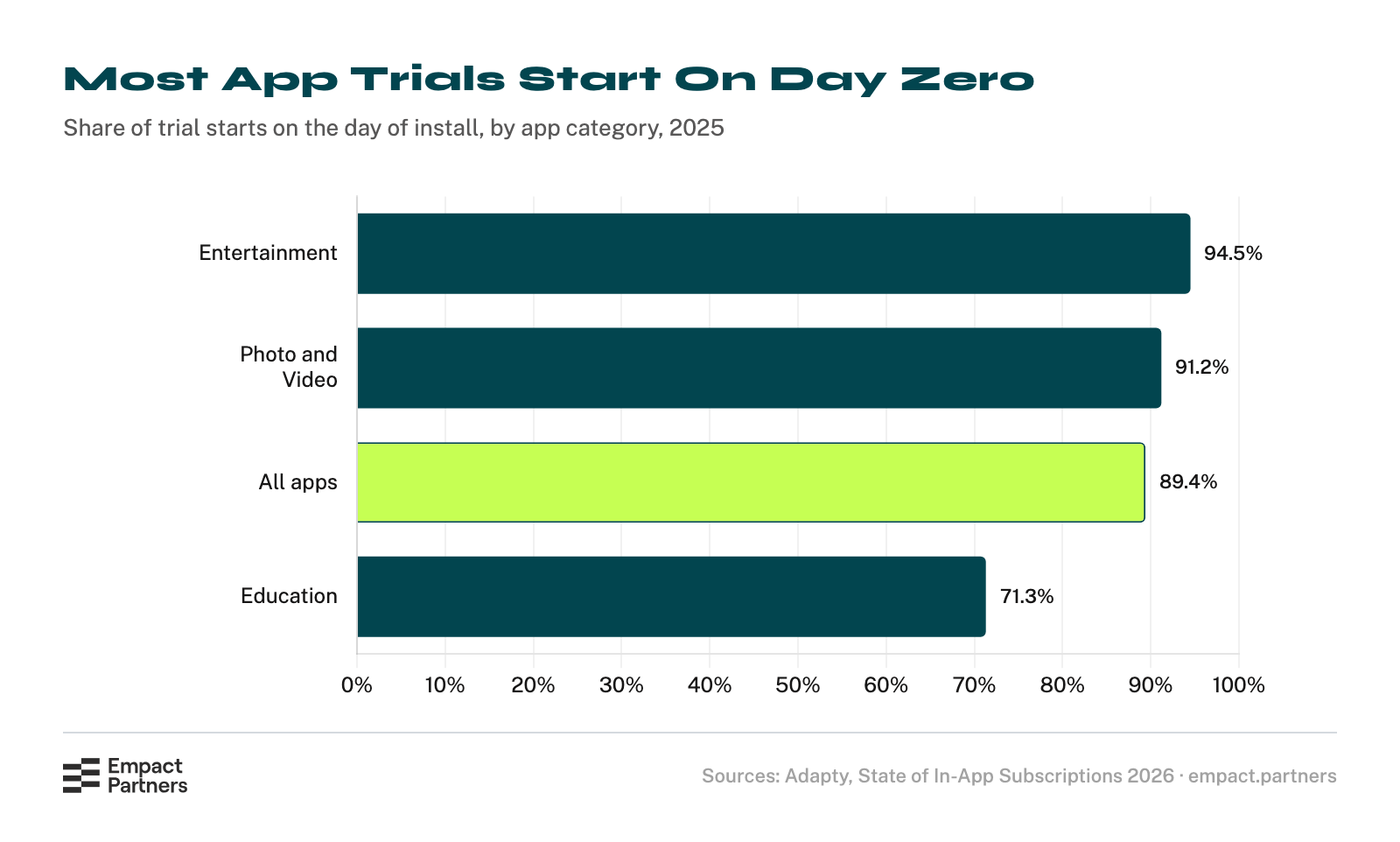
Between 78% and 89.9% of app trials start on the day of download, depending on the category, per RevenueCat’s 2026 report2, and Adapty puts the figure across all apps at 89.4% on day 017. Whatever happens in the first session is most of the trial.
Adapty’s 2026 report, drawn from 16,000+ apps, breaks the day 0 share down by category:
B2B products show the same cliff in slower motion. Amplitude’s 2025 benchmark, built on behavioral data from 2,600+ companies, found that a 7% return rate on day 7 puts a product in the top quarter for activation18, and that for half of all products over 98% of new users are gone by week two18.
Userpilot’s 2024 benchmark of SaaS companies puts the average activation rate at 37.5%19 and onboarding checklist completion at 19.2%20.
If 98% of new users are gone by week two, the trial’s length was never the constraint. What happens before the first log-out is, and two published “before-and-afters” say the same thing:
Activation is the part of a trial we work on most at Empact Partners, a go-to-market consultancy for B2B software companies that has worked from inside its partners’ own marketing teams since 2020.
For PDF Reader Pro, one of our partners, we wrote step-by-step product guides that showed prospects the product doing their job before they ever opened it. Sales grew 85% from June 2023, with 15% to 20% of monthly sales credited to those guides23.
The Sales Touch: Self-Serve Trials Stop Being Self-Serve Around $100
Most B2B companies running a product-led motion start adding salespeople once the average selling price reaches about $100, per ChartMogul’s 2025 analysis of billing data from 2,500 SaaS companies24. Below that line, the trial has to close itself.
That analysis also clocks how long the trial takes to close on its own. Nearly half of companies with an average selling price under $25 turn a lead into a paying user within 7 days, and at $250 to $500 the cycle stretches to 30 days and beyond24. Who joins the trial, when someone does:
ICONIQ’s 2026 survey reports roughly 50% of free trials and proofs of concept converting to paid, up from about 36% a year earlier28, from a sample that was 62% sales-led and only 7% product-led29. That number belongs on a sales-led slide, never beside a self-serve trial rate.
Our Product-Led Growth workstream starts from the same line. Self-serve suits small, mid-market, and prosumer buyers, and a $500K deal wants a salesperson.
A partnership opens with an audit of where the trial loses people and a roadmap, and a named senior consultant owns it, usually alongside Content Marketing, because the product guides that move activation sit in that workstream.
Pricing And Packaging: The Plan On The Paywall Moves Trial Starts More Than The Price
At upper-mid prices, weekly app plans turned 9.8% of installs into trial starts, against 1.8% for annual plans and 0.3% for monthly ones, per Adapty’s 2026 report17. The plan shown first does more to trial starts than the number beside it.
RevenueCat’s data says the same about price tiers and renewals:
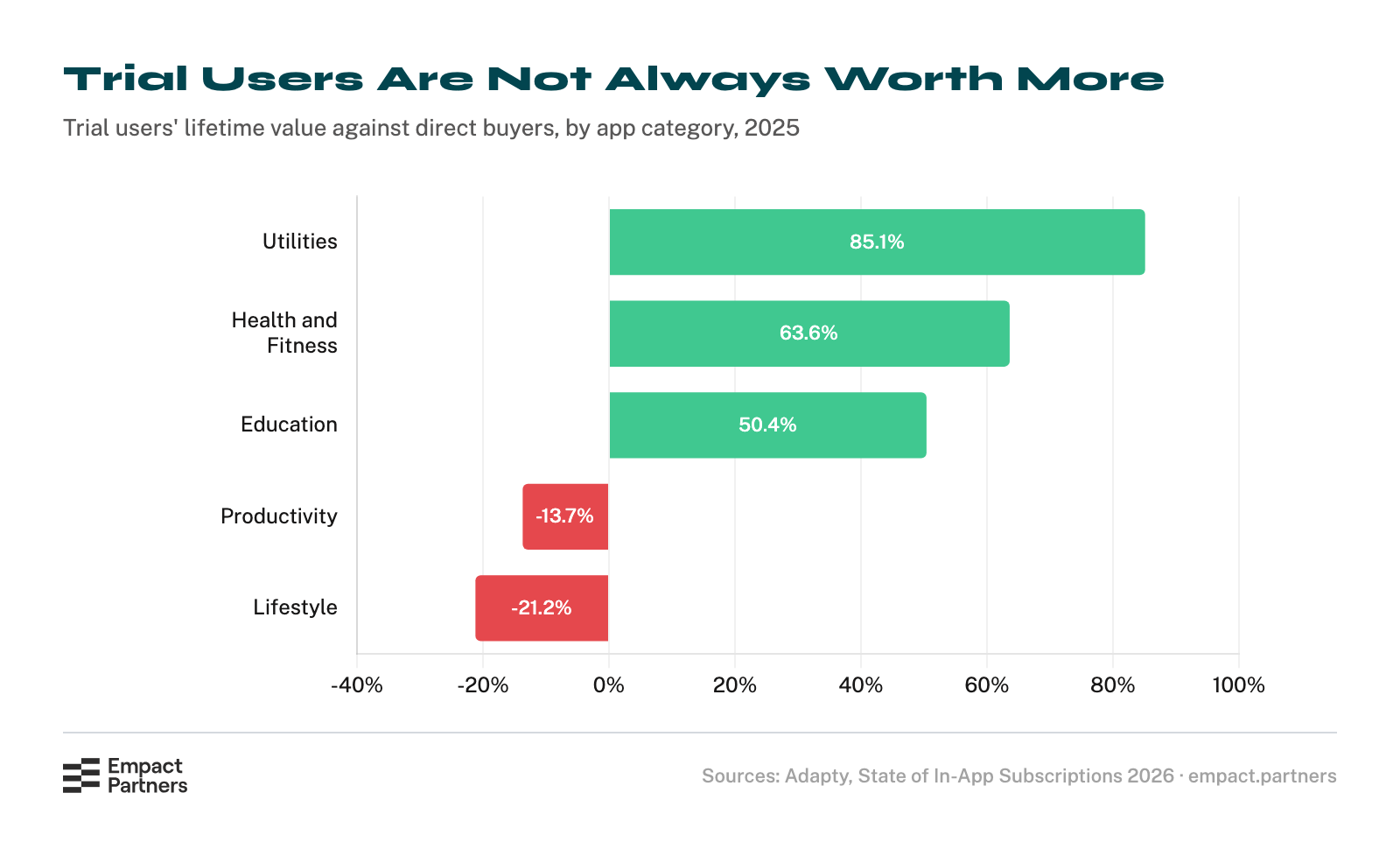
Trial users renew better, and they are not always worth more. Adapty’s 2026 data shows 59.2% of weekly-plan trial users renewing the first time, against 37.0% of direct buyers17. The value split runs by category:
In B2B, one ChartMogul survey respondent reported 26% more premium trials after replacing a single “Get started for free” button with a choice between freemium and a 14-day card-required trial26. It is one company’s result, and it agrees with the app data: show a choice of plans and more people pick the paid one.
Timing And Reminders: Conversions Bunch At Day Zero And The Final Day
In B2B SaaS, the median daily trial conversion rate stays close to zero until the final day of the trial, per ChartMogul’s 2025 analysis of 2,500 companies24. In apps, 50.6% of all paid conversions happen on the day of download, per RevenueCat2.
Cancellations bunch even harder, and RevenueCat’s 2026 report measures it by trial length:
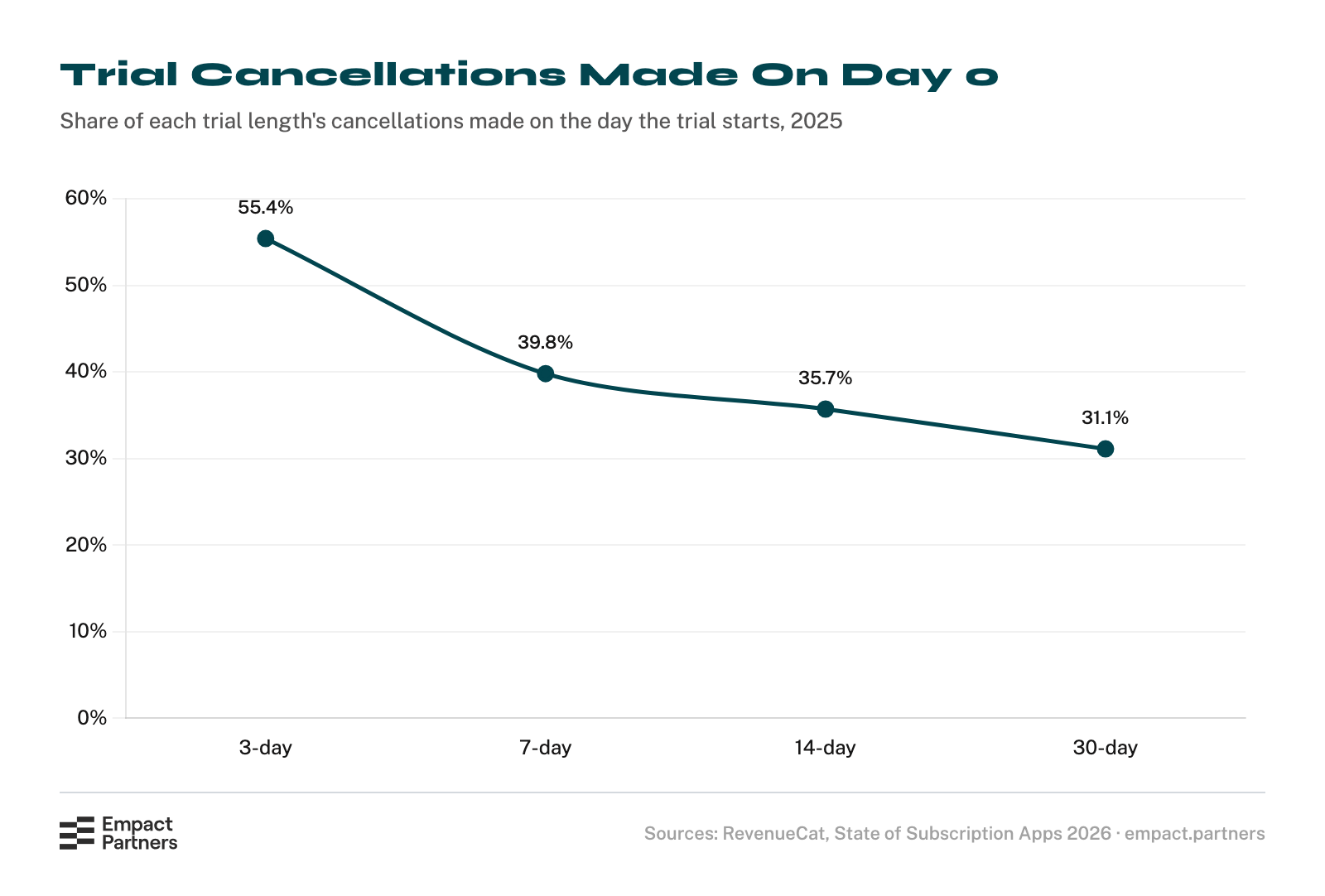
RevenueCat’s day 0 figures are shares of cancellations, not of trial starts, a difference its own summary blurs. They describe people who switched off renewal the day they started.
Thomas Petit, an App Growth Consultant, was asked about the 55.4% figure on the same “Sub Club Live” stream and said: “It’s frustrating and the truth is there’s very little you can do about it.”10
The end of a trial looks like this:
A reminder email is the cheapest test of how much of a conversion rate is consent. The card-expiry finding says a lot of it isn’t: when people have to choose, retention falls four times as fast. A rate that survives a reminder is the one to show a board.
The Cancellation Click Count: How Many Steps It Takes To Leave Ten Trials
We read ten well-known trials on the companies’ own pages on October 2, 2026. Seven convert to paid automatically, and only 3 of those 7 say they send a reminder before the first charge. The counts below are the steps and clicks each help center documents, a floor rather than a timed session.
| Product | Trial and card | Reminder stated | Steps, clicks |
|---|---|---|---|
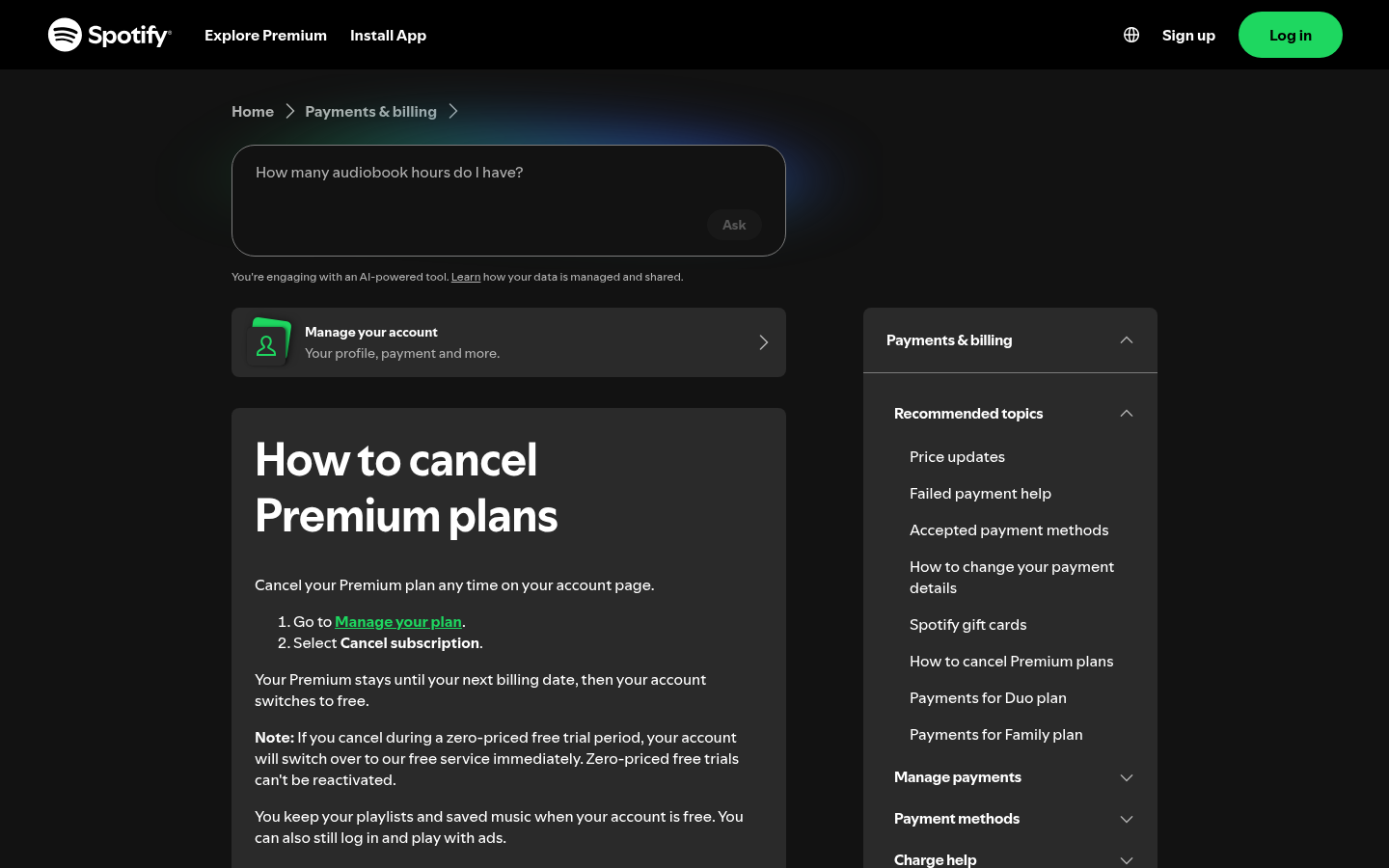
| Spotify Premium | 1 month, card | Not stated | 2 steps, 1 click30 |
| YouTube Premium | 1 month, card | 7 days before | 6 steps, 6 clicks6 |
| LinkedIn Premium | 1 month, card | Desktop sign-ups | 7 steps, 7 clicks7 |
| Amazon Prime | 30 days, card | Not stated | “Follow the prompts”31 |
| Semrush | 7 days, card | Not stated | 4 stages, 3 clicks32 |
| Canva Pro | Length not stated | Timing not stated | 9 steps, 8 clicks8 |
| Adobe Creative Cloud | 7 days | Not stated | 7 steps, 6 clicks33 |
| Shopify | 3 days, no card | Not stated | 9 steps, 8 clicks34 |
| Squarespace | 14 days, no card | Day before it ends | 7 steps, 6 clicks35 |
| HubSpot | 14 days, no card | Not stated | Nothing to cancel36 |
The clean split is not card vs no card. It is whether the trial converts on its own: every trial here that needs no cancellation also needs no card, and the three that don’t convert by themselves, Shopify, Squarespace, and HubSpot, simply end.
Semrush is the only flow that leaves the product: a cancellation form, then a confirmation link by email that expires in 24 hours. Canva and Shopify write a pause or downgrade step into the cancellation instructions themselves.
The Cancellation Pages, Screen By Screen
Here are nine of the ten companies’ own pages, as they read on October 2, 2026, each with the one detail that sets its exit apart:
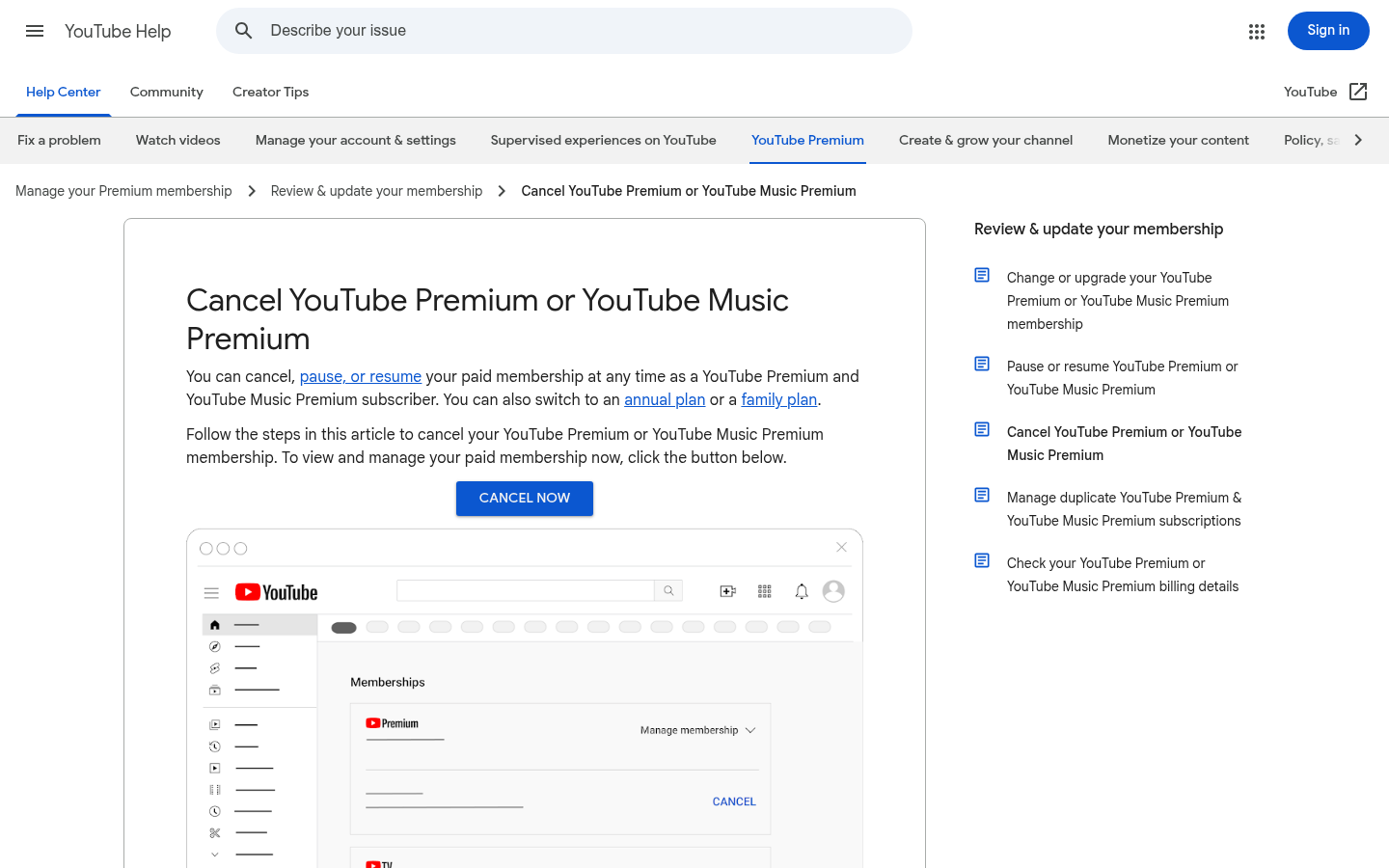
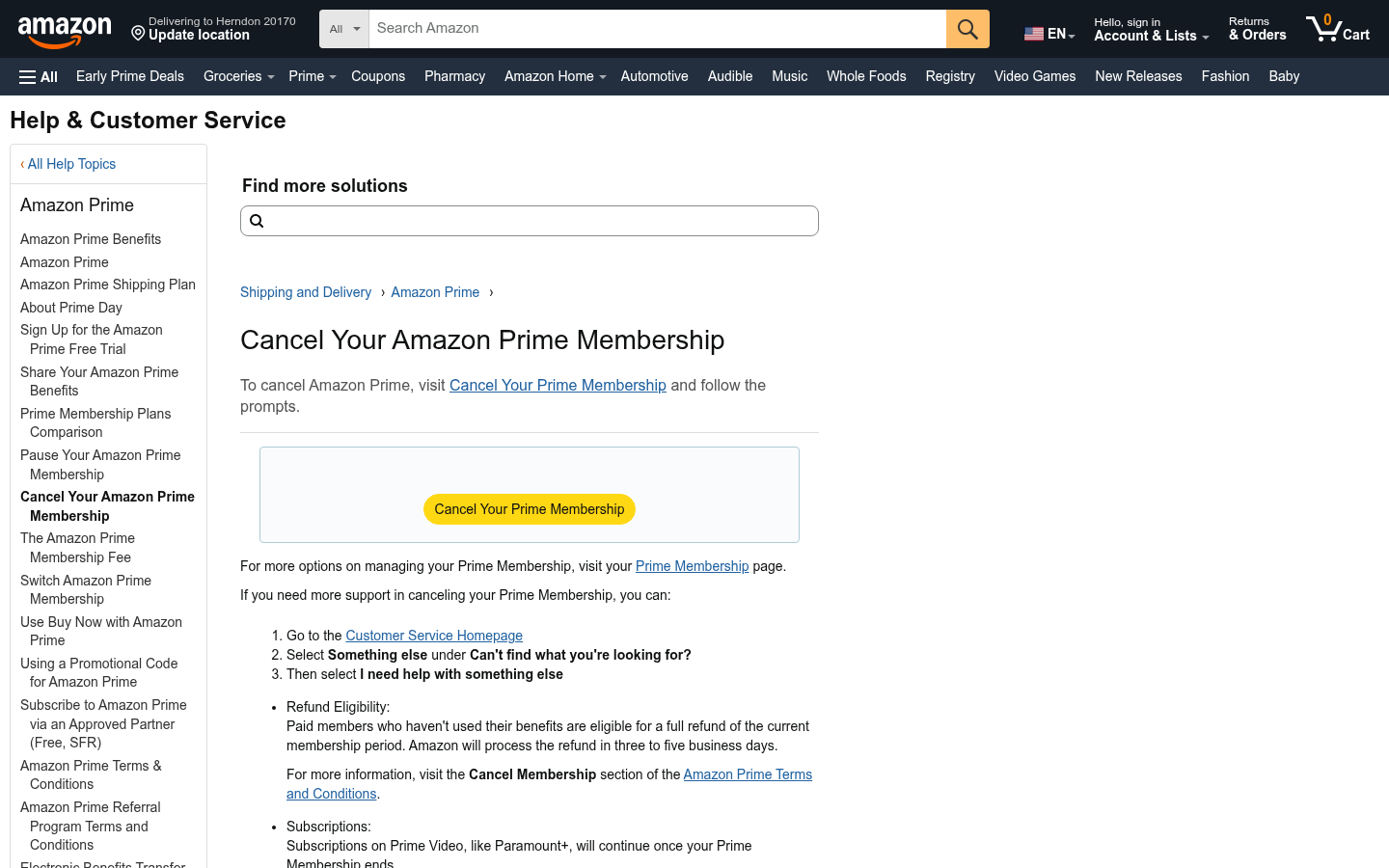
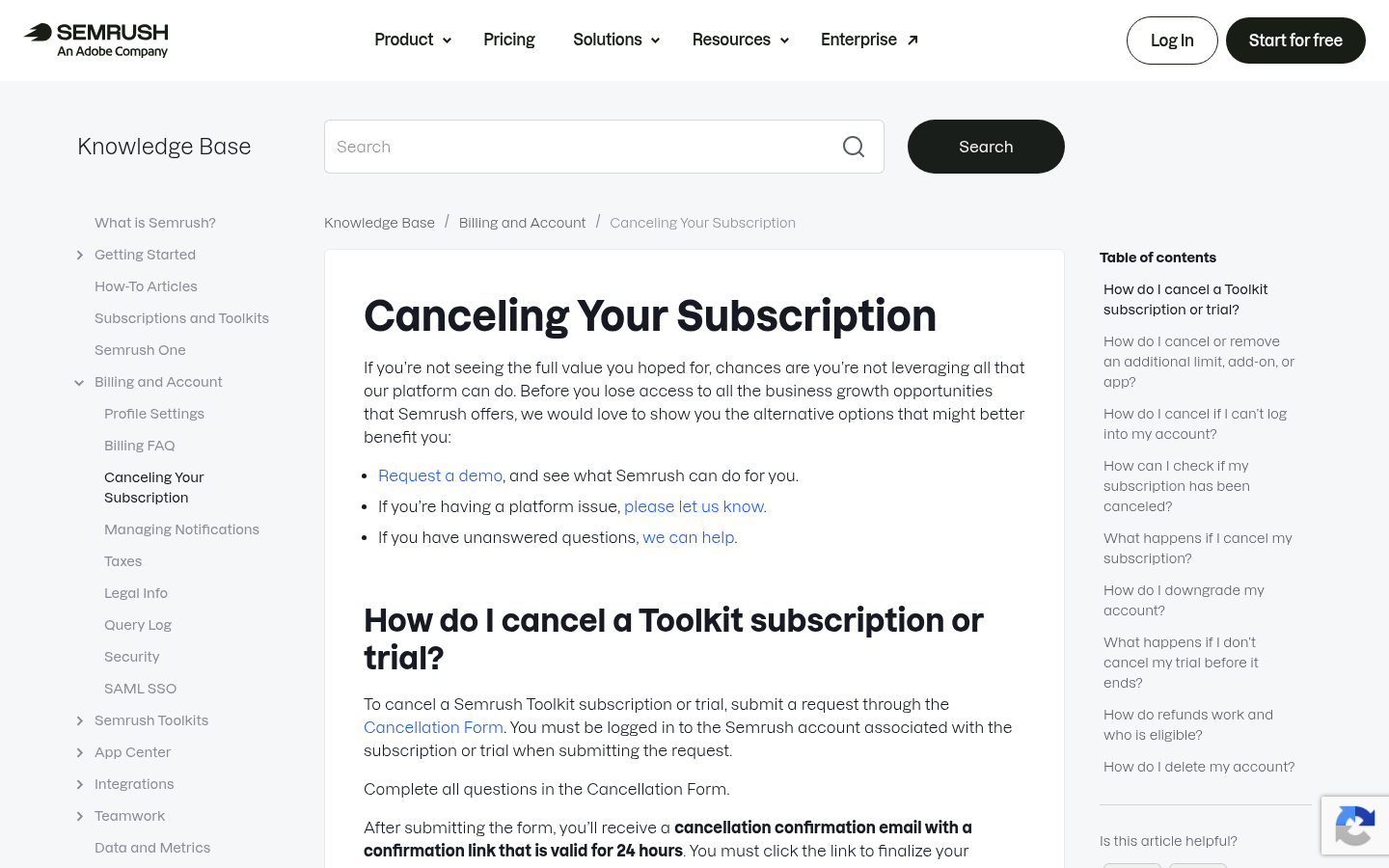
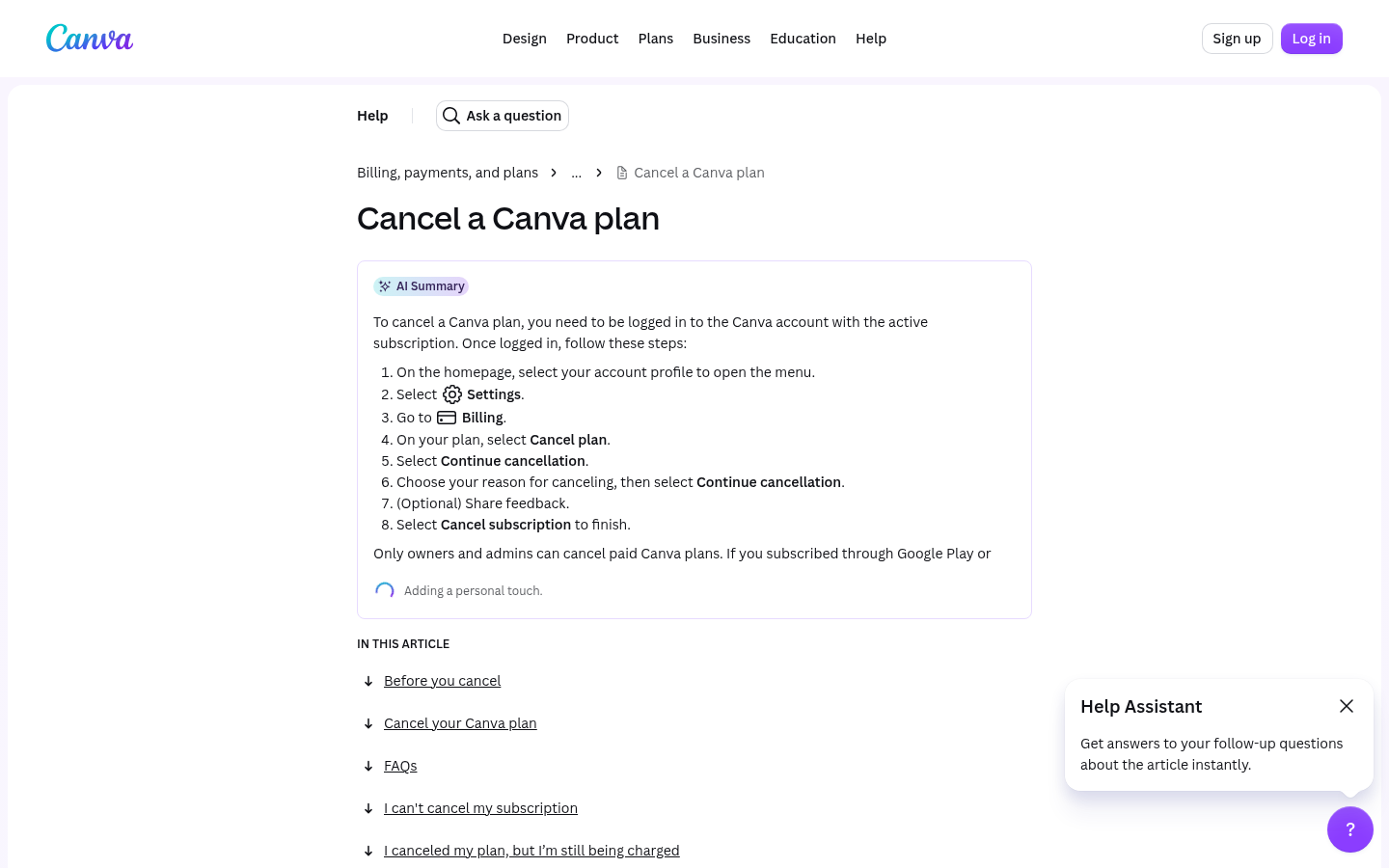
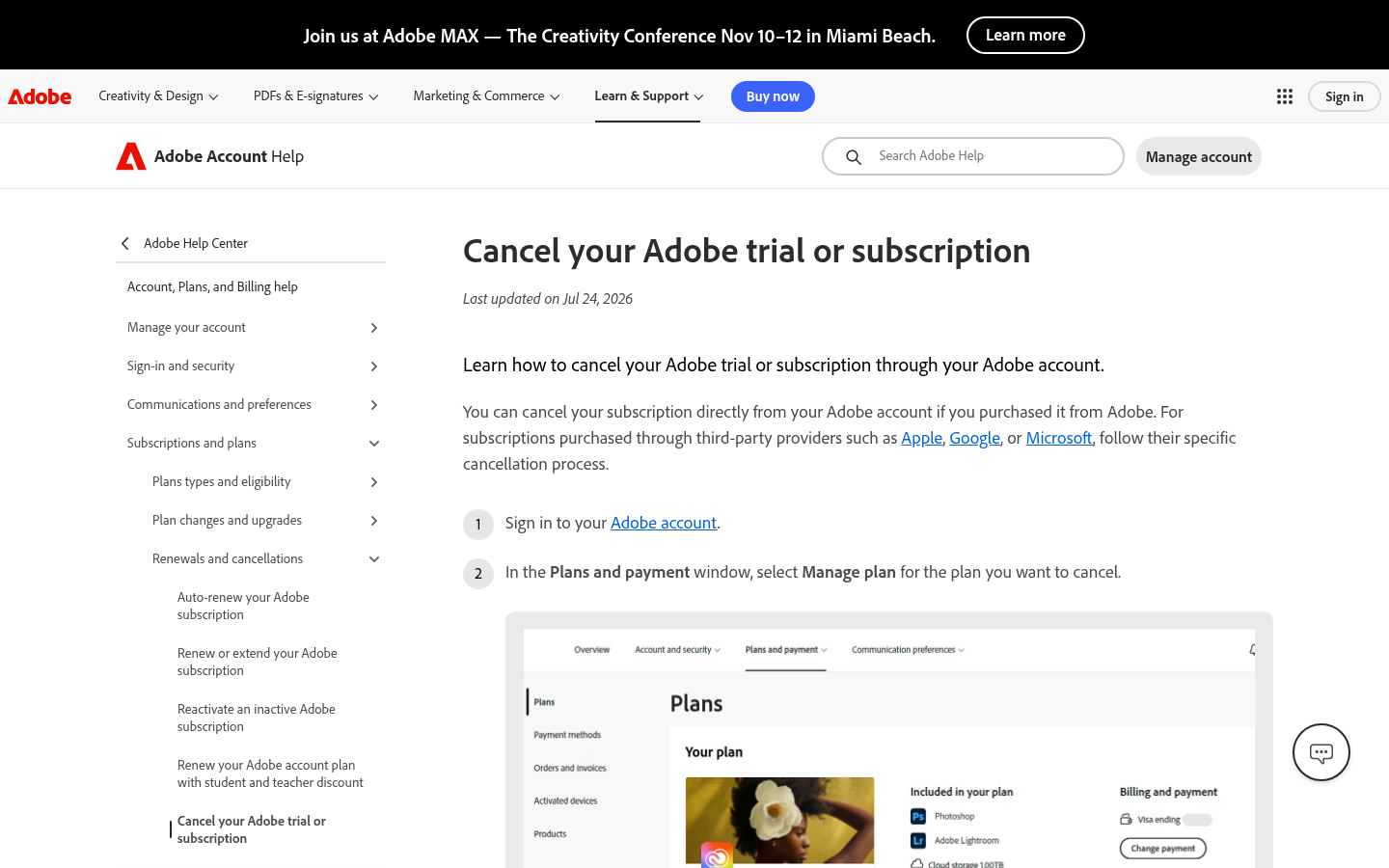
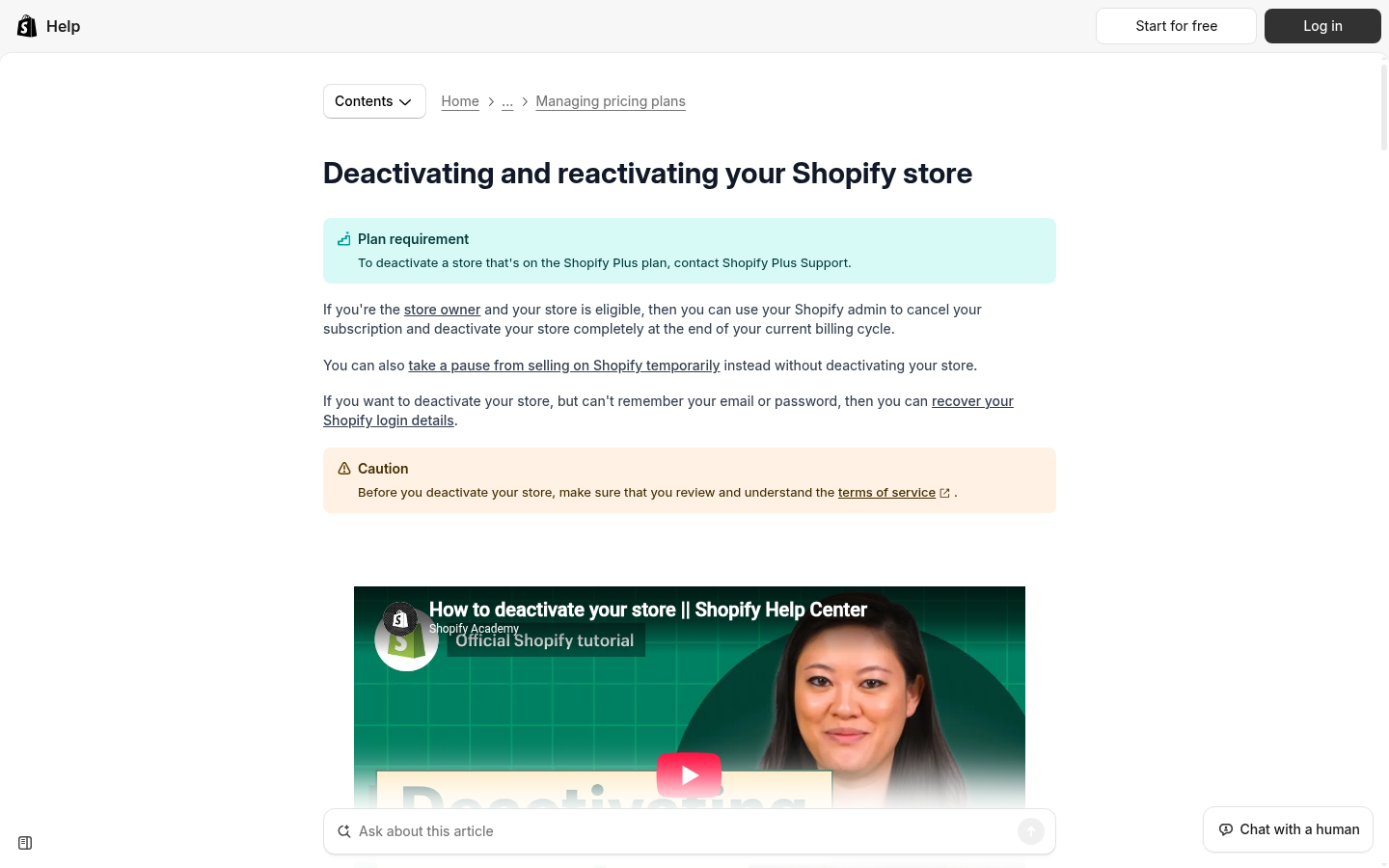
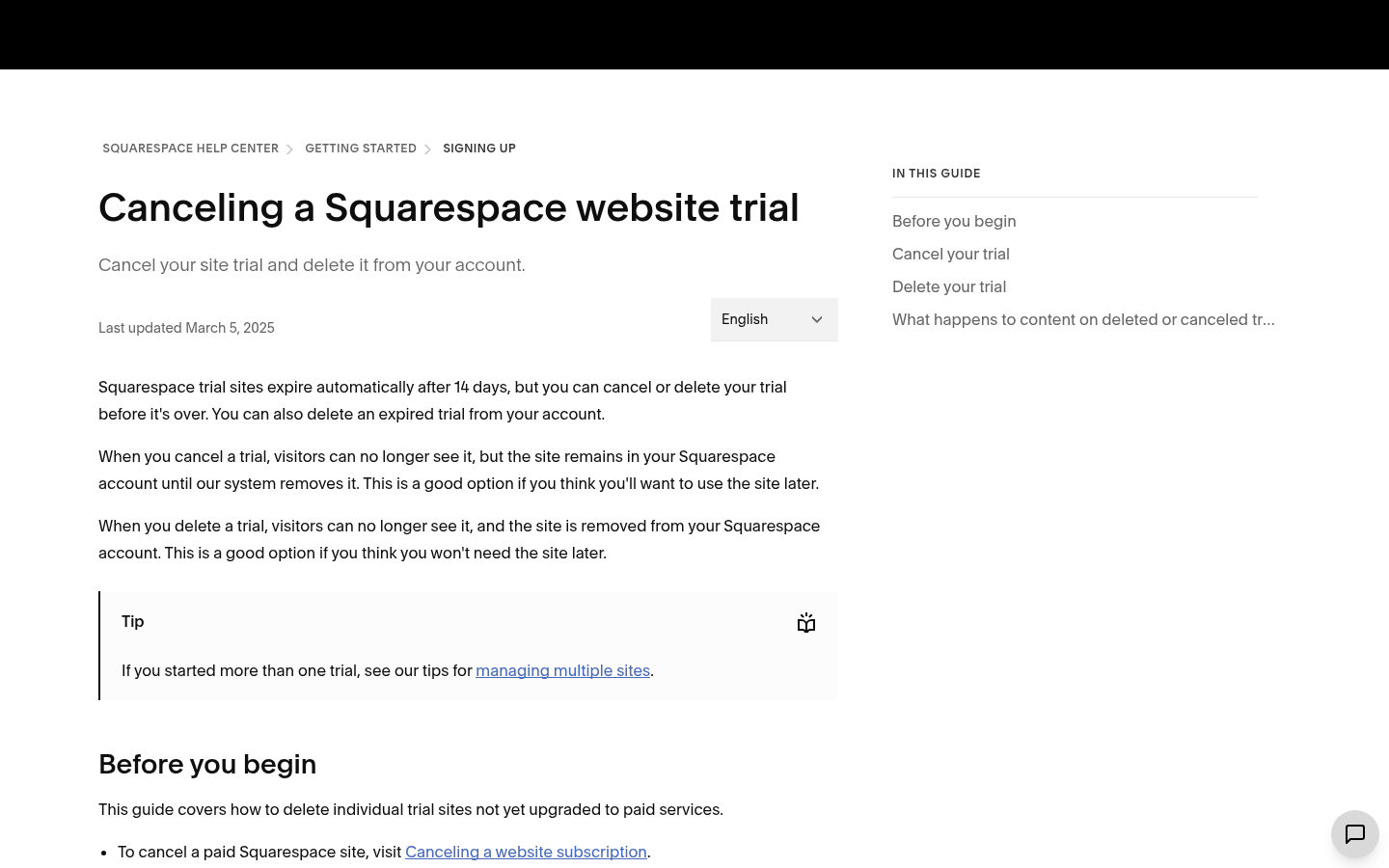

What The Law Requires, As Of October 2, 2026
The rules on all this moved twice in a year, so here are the facts as of October 2, 2026, and they are not legal advice.
The Eighth Circuit vacated the FTC’s 2024 “click-to-cancel” amendments to the “Negative Option Rule” on July 8, 2025, and the FTC restored the rule’s 1973 text on February 12, 202637 38. A US online trial that converts to paid now answers to the “Restore Online Shoppers’ Confidence Act” and to state law, and the FTC opened a new rulemaking on March 13, 2026, with no proposed rule since39.
Enforcement carries on case by case. Amazon settled the FTC’s Prime allegations in September 2025 for $2.5 billion, including a $1 billion civil penalty40, and Adobe settled the Justice Department’s allegations for $150 million under an order requiring a reminder before any trial longer than seven days converts into a plan with an early termination fee41. State rules on trial reminders:
Germany has required a cancellation button on online consumer contracts since July 1, 202246, and the UK’s subscription rules are due in January 202747. A 7- or 14-day trial falls below every US reminder trigger above. I’d send the reminder anyway, because the rate it leaves you with is the one you can defend.
Self-Reported By Founders: What Builders Say Their Trials Convert At
Founders’ self-reported rates are anecdotes, not benchmarks: numbers they posted about their own products on Reddit and Hacker News, with small samples, different bases, and no audit.
| Product | Trial setup | Reported | Where |
|---|---|---|---|
| B2B AI agents | 7 days; card to use | 71.43% of 42 trials48 | r/SaaS, 2026 |
| B2C subscription software | 2 weeks, card; then 4 weeks, none | 38%, then 16%49 | r/startups, 2022 |
| B2B proposal software | Card at sign-up, then none | 40%, then 4%50 | Hacker News, 2015 |
| Small-business CRM | No card | About 25%51 | Hacker News, 2018 |
| B2B feedback tool | Not stated | Closer to 8%52 | Hacker News, 2018 |
| B2B video screening | Not stated | 8.30% in a month53 | Hacker News, 2025 |
| Student study app | 7 days, no card | 5 of 59 trials54 | r/startups, 2026 |
| Fitness photo app | 7 days, App Store | 20.7%, then 44%55 | r/iosapps, 2026 |
| Alarm clock app | 3 days, hard paywall | About 1 in 1056 | r/AppStoreOptimization, 2026 |
The highest numbers come with a card, a salesperson, or a hand-picked audience: the 71.43% came from trials sourced entirely by cold outbound email.
The two founders who removed a card both watched the rate collapse, and one of them, the B2C company, says the change cost about $170,000 in annual recurring revenue before the card went back. The small self-serve products cluster near 8%, beside ChartMogul’s 8% median across all products1.
Which Benchmark Fits You
Pick the row that matches your trial type, audience, and motion, and use only that row’s number. Mixing rows is how a 60% gets onto a board slide.
| Your setup | Use this | Misleading if |
|---|---|---|
| No card, B2B, self-serve | 4% to 6% “good” (ChartMogul, 2026)1 | You count only activated users |
| Card, B2B, self-serve | 25% to 35% “good” (ChartMogul, 2026)1 | You skip payers per visitor |
| Card, B2C, app | 32.6% median (RevenueCat, 2026)2 | Your trial is 4 days or less |
| Card, B2C, web | 39.0% (Recurly, 2022)3 | You sell B2B; it is 2022 data |
| No card, B2C, web | 12.0% (Recurly, 2022)3 | Your trial is far from 39 days |
| B2B, sales-assisted | 30% to 39% of qualified leads (ProductLed)27 | Sales touches every trial |
| B2B, sales-led pilot | Roughly 50% (ICONIQ, 2026)28 | You run a self-serve trial |
The benchmark table is the one we use when a partner asks whether their trial is broken. In a Product-Led Growth audit, the first question is which row the trial sits in, because the number a founder brings us is usually the right number for a different product.
The Number To Watch Is The One After The Reminder
Design the trial for a buyer who would pay on purpose. Start near a week, the length that won both randomized tests, and stretch it only when buyers need approvals. Take a card only when the product earns it, and judge the card by paying users per 1,000 visitors rather than by the rate it inflates.
Then watch one number: the conversion rate after every trial user has had a reminder before the charge. If it falls when people are reminded, the trial was never converting them. It was billing them.
If your trial converts at a number you can’t explain to your board, book a call with us, and we’ll walk you through how we’d read your funnel and which benchmark it should be held to.
Sources
- ChartMogul, with Kyle Poyar and ProductLed, “The SaaS Conversion Report: Benchmarks for trials, freemium, and conversion in 2026”, 2026. Survey of 200 B2B software products, January 2026; conversion counted over six months from sign-up. Read 2 October 2026.
- RevenueCat, “State of Subscription Apps 2026”, 2026. 2025 data from more than 115,000 subscription apps on the App Store and Google Play. Read 2 October 2026.
- Recurly, “State of Subscriptions: The acquisition chapter”, 2023. Subscription sites on Recurly, January to August 2022; conversion is a site-level average of trial starts. Read 2 October 2026.
- Hema Yoganarasimhan, Ebrahim Barzegary, and Abhishek Pani, “Design and Evaluation of Optimal Free Trials”, 2023. Management Science 69(6); randomized field experiment with 337,724 new users of a software suite. Read 2 October 2026.
- Klaus M. Miller, Navdeep S. Sahni, and Avner Strulov-Shlain, “Sophisticated Consumers with Inertia: Long-Term Implications from a Large-Scale Field Experiment”, 2026. Working paper, version of January 22, 2026; 1,389,869 readers of a European newspaper, offers from May to August 2018, follow-up to April 2020. Read 2 October 2026.
- YouTube Help, “Cancel YouTube Premium or YouTube Music Premium”, 2026. Trial terms and cancellation steps, counted for this article. Read 2 October 2026.
- LinkedIn Help, “Premium free trial and cancellation”, 2026. Trial terms and cancellation steps, counted for this article. Read 2 October 2026.
- Canva Help Center, “Cancel a Canva plan”, 2026. Trial terms and cancellation steps, counted for this article. Read 2 October 2026.
- Ling Zhang and Jiang Duan, “Longer or shorter? A large-scale randomized field experiment on the impact of free trial duration on sustainable user conversion in the Freemium model”, 2025. Frontiers in Psychology; 680,588 new users randomized between 3-day and 7-day trials. Read 2 October 2026.
- Sub Club by RevenueCat, “What 115,000+ Apps Reveal about Growth in 2026, Sub Club Live with Thomas Petit”, 2026. Live stream, March 19, 2026; David Barnard at 26:57, Thomas Petit at 16:38. Read 2 October 2026.
- RevenueCat, “How long should your free trial be? Data from 17,000+ apps”, 2026. App Store and Google Play trials, August 2025 to July 2026, split by weekly, monthly, and annual plans. Read 2 October 2026.
- Sub Club by RevenueCat, “The Counterintuitive Way To Nudge Users Into Free Trials, with Anmol Tiwari of Duolingo”, 2026. Podcast episode, March 2, 2026; the trial-length cut at 6:18. Read 2 October 2026.
- Amplitude, Elena Verna, “Trial or Freemium? Get the Best of Both with a Reverse Trial”, 2022. Practitioner estimates, no dataset stated. Read 2 October 2026.
- Liran Einav, Ben Klopack, and Neale Mahoney, “Selling Subscriptions”, 2025. American Economic Review 115(5); ten large US subscription services. Read 2 October 2026.
- Josh Pigford, Baremetrics, “How freemium nearly caused our business to implode”, 2017. The company’s own before-and-after, 2015. Read 2 October 2026.
- Lenny’s Podcast, “Finding hidden growth opportunities in your product, with Albert Cheng”, 2025. Podcast episode, October 5, 2025; reverse trials at 27:26. Read 2 October 2026.
- Adapty, “State of in-app subscriptions 2026: Key findings on app monetization”, 2026. 2025 data from more than 16,000 apps. Read 2 October 2026.
- Amplitude, “The 7% retention rule explained”, 2025. From Amplitude’s 2025 Product Benchmark Report; behavioral data from more than 2,600 companies. Read 2 October 2026.
- Userpilot, “6 Key Activation Metrics for SaaS Companies”, 2024. First-party data from Userpilot’s 2024 benchmark; activation measured across 62 SaaS companies. Read 2 October 2026.
- Userpilot, “Product Metrics Benchmark Report 2024: 6 Key Insights for PMs”, 2024. First-party data from 547 B2B SaaS companies. Read 2 October 2026.
- Baremetrics, Kaegan Donnelly, “How we doubled our trial conversion rate with in-app messaging”, 2017. The company’s own before-and-after on a 14-day trial. Read 2 October 2026.
- Plausible Analytics, Marko Saric, “How simplifying our homepage helped increase trial signups by 84%”, 2026. The company’s own before-and-after, January to April 2026, on a 30-day trial with no card. Read 2 October 2026.
- Empact Partners, “PDF Reader Pro case study”, 2026. One partnership, from June 2023; sales growth and the share of monthly sales attributed to product guides. Read 2 October 2026.
- ChartMogul, “The SaaS Go-To-Market Report: How 2,500 SaaS companies acquire and convert customers”, 2025. Billing data from 2,500 SaaS companies, Q1 2024 to Q1 2025. Read 2 October 2026.
- Lenny Rachitsky and Kyle Poyar, “What is a good free-to-paid conversion rate”, 2023. Survey of more than 1,000 products, mostly B2B, with OpenView and Pendo. Read 2 October 2026.
- ChartMogul, with Kyle Poyar and ProductLed, “The SaaS Conversion Report: What’s working to improve free-to-paid conversion”, 2026. Part two of the survey of 200 B2B software products. Read 2 October 2026.
- ProductLed, “Product-Led Growth Benchmarks: Key SaaS Findings and Trends”, 2022. Survey of more than 600 SaaS businesses. Read 2 October 2026.
- ICONIQ, “The State of Go-to-Market in 2026”, 2026. Survey of go-to-market leaders at more than 150 B2B software companies, January 2026. Read 2 October 2026.
- ICONIQ, “The State of Go-to-Market in 2026, report PDF (firmographics)”, 2026. The sample’s motion: 62% sales-led, 31% hybrid, 7% product-led. Read 2 October 2026.
- Spotify, “How to cancel Premium plans”, 2026. Trial terms and cancellation steps, counted for this article. Read 2 October 2026.
- Amazon, “Cancel Your Amazon Prime Membership”, 2026. Trial terms and cancellation steps, counted for this article. Read 2 October 2026.
- Semrush, “Canceling Your Subscription”, 2026. Trial terms and cancellation steps, counted for this article. Read 2 October 2026.
- Adobe, “Cancel your Adobe trial or subscription”, 2026. Trial terms and cancellation steps, counted for this article. Read 2 October 2026.
- Shopify Help Center, “Deactivating and reactivating your Shopify store”, 2026. Trial terms and cancellation steps, counted for this article. Read 2 October 2026.
- Squarespace Help Center, “Canceling a Squarespace website trial”, 2026. Trial terms and cancellation steps, counted for this article. Read 2 October 2026.
- HubSpot, “Free 14-Day HubSpot Trial”, 2026. Trial terms, counted for this article. Read 2 October 2026.
- U.S. Court of Appeals for the Eighth Circuit, “Custom Communications, Inc. v. FTC, No. 24-3137”, 2025. Opinion filed July 8, 2025. Read 2 October 2026.
- Federal Trade Commission, “Revision of the Negative Option Rule, Withdrawal of the CARS Rule, Removal of the Non-Compete Rule To Conform These Rules to Federal Court Decisions”, 2026. Federal Register, February 12, 2026. Read 2 October 2026.
- Federal Trade Commission, “Rule Concerning the Use of Prenotification Negative Option Plans: Advance Notice of Proposed Rulemaking”, 2026. Federal Register, March 13, 2026. Read 2 October 2026.
- Federal Trade Commission, “FTC Secures Historic $2.5 Billion Settlement Against Amazon”, 2025. Press release, September 25, 2025. Read 2 October 2026.
- U.S. Department of Justice, “Adobe Agrees to $150 Million Settlement and Injunction to Resolve Alleged Violations of the Restore Online Shoppers’ Confidence Act”, 2026. Press release, March 13, 2026. Read 2 October 2026.
- California Legislature, “Business and Professions Code §17602, as amended by AB 2863”, 2024. Chapter 515, Statutes of 2024. Read 2 October 2026.
- New York State Senate, “General Business Law §527-a”, 2025. Current text. Read 2 October 2026.
- Minnesota Revisor of Statutes, “Minnesota Statutes §325G.57”, 2025. Current text. Read 2 October 2026.
- Massachusetts Office of the Attorney General, “940 CMR 38.00: Unfair and Deceptive Fees”, 2025. Regulations in force from September 2, 2025. Read 2 October 2026.
- Federal Ministry of Justice, Germany, “German Civil Code (BGB) §312k”, 2022. In force since July 1, 2022. Read 2 October 2026.
- Prime Minister’s Office, UK Government, “PM starts roll out of ‘everyday fixes’ on the cost of living, ending rip-off discounts and subscription traps”, 2026. Press release, August 9, 2026. Read 2 October 2026.
- Reddit, r/SaaS, “We just hit 71.43% trial-to-paid conversion rate - here’s how”, 2026. A founder’s own post, May 26, 2026. Read 2 October 2026.
- Reddit, r/startups, “Should I require credit card details even for accessing free trial?”, 2022. A founder’s comment, November 6, 2022. Read 2 October 2026.
- Hacker News, “Comment on SaaS Pricing: Our Big Free Plan Mistake”, 2015. A founder’s comment, June 29, 2015. Read 2 October 2026.
- Hacker News, “Comment on The Business of SaaS”, 2018. A co-founder’s comment, February 20, 2018. Read 2 October 2026.
- Hacker News, “Comment on The Business of SaaS”, 2018. A co-founder’s comment, February 20, 2018. Read 2 October 2026.
- Hacker News, “Comment in Ask HN: What are you working on? (October 2025)”, 2025. A founder’s comment, October 13, 2025. Read 2 October 2026.
- Reddit, r/startups, “Update: 3,080 users / 2 trials, 5,561 users / 59 trials”, 2026. A founder’s own post, August 9, 2026. Read 2 October 2026.
- Reddit, r/iosapps, “Fixed my trial conversion (21% to 44%) and just passed $900 MRR”, 2026. A founder’s own post, July 7, 2026. Read 2 October 2026.
- Reddit, r/AppStoreOptimization, “I am unable to understand this much trial cancellation”, 2026. A developer’s own post, September 24, 2026. Read 2 October 2026.