You typed your category’s question into ChatGPT this morning, worded the way a buyer would word it, and it named three competitors. Google’s AI Mode named the same three in a different order. The reflex is to fix the website: rewrite the product pages, add the comparison page, publish the post that should have gone out last spring.
The website is the part you can change this week, which is why everyone starts there and why starting there rarely changes the answer. An AI engine runs a handful of searches, reads what comes back, and names the brands those pages agree on. Most of what it reads was written by somebody else.
Empact Partners, a go-to-market consultancy working from inside software companies’ marketing teams since 2020, runs Generative Engine Optimization (GEO) as one of its six workstreams: getting a partner named when a buyer asks an engine their category question. Every GEO engagement we open starts with three checks, in an order most teams reverse.
An AI Engine Names You From Pages You Did Not Write
Ask ChatGPT which project tool suits a ten-person agency that bills by the hour, and it does not answer from memory. It rewrites the question into several searches, fetches the pages they return, keeps the passages that answer a part of the question, and names the products those passages agree on.
ChatGPT looks almost every time. In Qvery’s August runs, ChatGPT came back with sources in 95.6% of software answers and in every answer to a set of money questions. Qvery is our sister company, so weigh its numbers as you would any interested party’s. Each study it publishes carries its method, which is the place to check them.
So the useful question is whose pages those are. Our panel, the weekly read we run on a partner’s category, collected 37,800 answers from three engines on 30 September and 7 October, all in one B2B software category. For each vendor an answer named, we split the pages it cited into three piles: the vendor’s own, other software companies’, and everyone else’s.
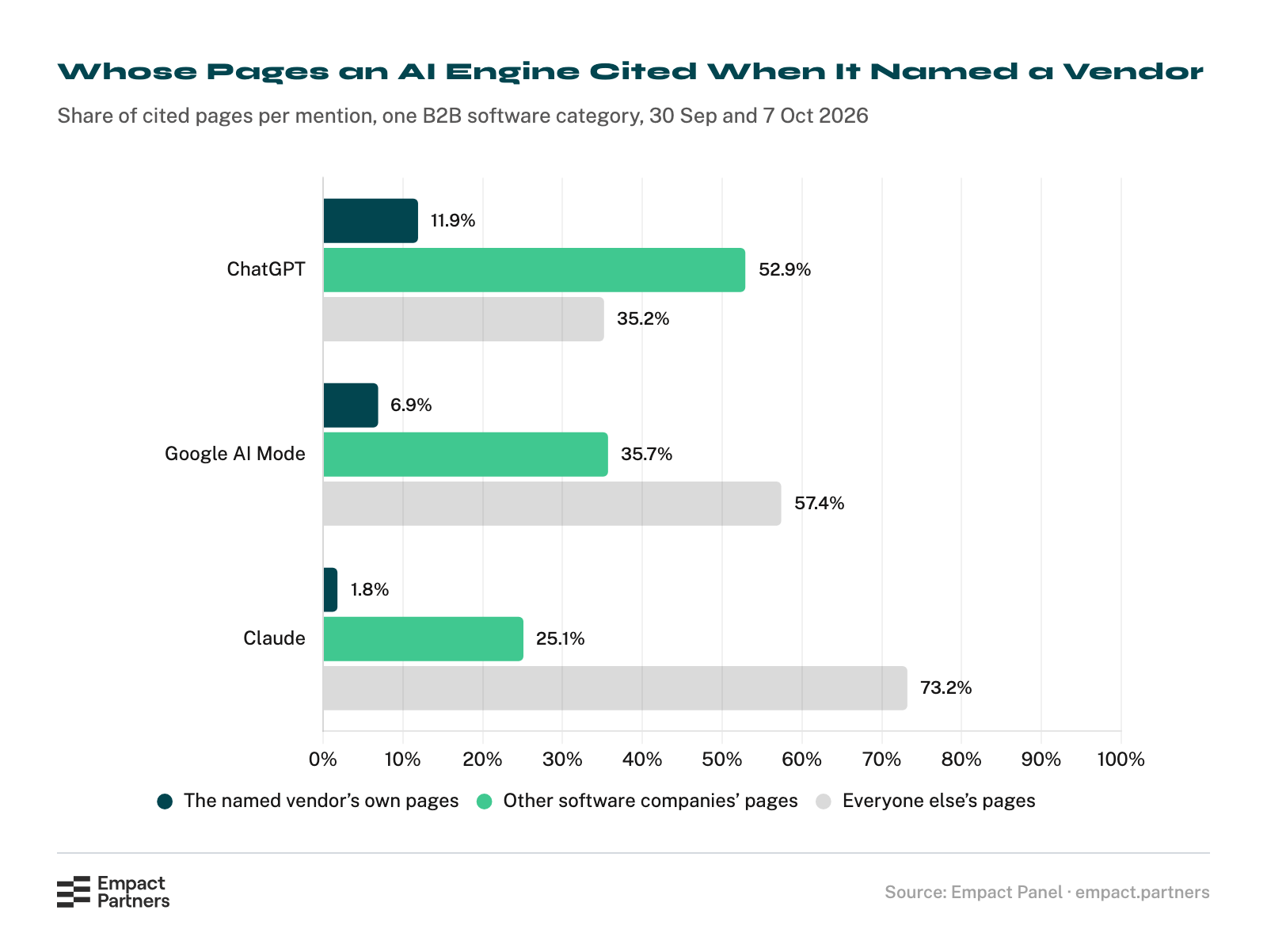
When ChatGPT named a vendor, 11.9% of the pages it cited were that vendor’s own. Google AI Mode came in at 6.9% and Claude at 1.8%. In about half of ChatGPT’s mentions, and four in five of AI Mode’s, the vendor’s site was not among the sources at all, so the name rested entirely on other people’s pages.
.png)
That does not make the website worthless. It makes the website one of three jobs, and the smallest of them for the question you typed this morning.
Three Layers Decide Whether You Are Named, and They Run in a Fixed Order
The stack of pages behind an answer splits the work into three layers. Each one controls something different, costs something different, and belongs to a different person:
| Layer | What it decides | When it starts, and how long it takes | Who owns it |
|---|---|---|---|
| Reach | Whether an engine can fetch and quote your own pages | Week one; about a week, then a monthly check | The site owner, with a developer |
| Presence | Whether the pages an engine already reads name you | The map in month one, the program from month two; quarters, and it never finishes | One named person whose job it is |
| Match | Whether your own pages answer the sentence a buyer types | Month two, written from the map; a few weeks per batch | The content team |
Teams start at the bottom of that table. Match is the only layer that lives inside their own CMS, so it is the work they can finish and report on. In crowded categories we have seen partners publish good posts steadily and stay close to invisible, because nobody else named them.
The order that works costs nothing extra. Check reach first because it breaks silently, map presence before writing a page, then write the pages the map asks for.
The three layers do not stand in for each other. A strong site cannot make up for missing from the roundups, and a place on every roundup will not fix a page the engine cannot fetch. The order is the order of finding out what each layer is costing you, before you spend on any of them.

.png)
Reach Takes a Week, and It Breaks Without Telling You
Reach is whether an engine can fetch your pages at all. It is the cheapest layer to fix and the easiest to miss, because nothing alerts you when it fails.
Your own pages still decide how an engine describes you. ChatGPT had the named vendor’s own site among its sources in 46.2% of the mentions we counted, AI Mode in 18.6%. A page the engine cannot fetch is a page it describes from somebody else’s notes.
The reach check runs in this order, because each step assumes the one before it:
Ranking on Google is part of reach, and only part. In Qvery’s comparison of 922 queries, 13.9% of the domains ChatGPT and AI Mode cited sat in Google’s organic top ten, and a domain in position one was cited 48.8% of the time. The top spot gets your page into the pile about half the time. It does not decide what the engine makes of the pile.
Domain rating belongs to this layer and to no other. A strong domain helps its pages rank, so they reach the pile more often, and that is all it does.
MarketSplash, the marketing publication we run, has a domain rating of 77 and a page on each of twenty questions we put to Google AI Mode on 14 October, all published in the previous six weeks. None of the twenty answers cited it. The same answers cited 56 other domains, and 12 rated below 50.

So reach decides whether your pages can be read. Which pages the engine reads for your category, yours or anyone’s, you answer by looking, and the look comes before anybody writes a word.
Map What the Engines Already Read Before You Write a Page
The map is the cheapest research in GEO and the step most teams skip. Write down the questions your buyers type, as sentences with a role, a company size and a constraint in them. Run each on the engines your buyers use, more than once, and list every page the answers cite.
A few dozen questions show you the shape. A number you intend to report needs far more, because the same question returns different sources from one run to the next. Sort what comes back by who owns each page, and the map answers two questions at once: which third-party pages you need to be on, and which buyer questions your own pages fail to answer.
In the B2B software category we measure, the October map looked like this:
Reddit earns its own line because it works on two engines at once. A thread titled the way a buyer searches can rank on Google on the strength of Reddit’s domain, and when an engine cited Reddit in Qvery’s study, Reddit was also on Google’s first page 78.5% of the time. Whether it carries your category is on your map.
Where it does carry the category, Reddit is a program, never a post. The program we ran for KKday drew 3,208,973 views and more than 60 explicit mentions of the brand in three months.
Volume from one source is not presence. When a startup that had twenty Reddit posts written for it asked r/AskMarketing in July why ChatGPT still did not cite it, the top answer named the difference:
“ChatGPT is more likely to surface companies that have strong, independent mentions across multiple trusted websites, rank well in search, and have an overall established online presence, rather than repeated mentions from a single source.” r/AskMarketing, Jul 2026
Community work like that is half of how we define GEO: GEO = UGC + Mentions, the public conversation among people who use a product plus the independent pages that name it.
Match Means Answering the Sentence a Buyer Types
Match is the layer most teams start with, and the map is what makes it pay. A buyer does not type a category name. They type the tool for a ten-person agency that bills by the hour and lives in Slack, and the engine splits that into searches about each part.
A generic feature page answers none of those parts well. A page built for the role, the industry or the constraint answers one of them exactly, and that is the page an engine quotes.
From a vendor’s own site, engines mostly cite product and feature pages: in Qvery’s August read they appeared in 74.4% of the answers that cited a vendor’s domain, documentation and integration pages in 56.8%, pricing pages in 30.4%. Price, reputation and comparison get answered from other people’s pages.
So write the pages the map asked for, in the buyer’s own sentences: one for each role, industry or integration the questions kept naming, each saying plainly who the product suits and who it does not. A page that matches the question that closely can reach answers without a strong backlink profile, and we have seen it happen on our own projects.
Practitioners report the same split. In the SEO threads we read this autumn, the people who said on-site work had helped almost always credited a comparison or “alternative to” page answering one buying question, while the most common report on llms.txt files and schema alone was that nothing moved.
Schema rebuilds and llms.txt files can wait until reach and match are done. Qvery set out to compare cited and uncited product pages on markup, specifications and rendering, needed 30 matched pairs in each group, and found two and one, so nobody can yet say which of those fields an engine rewards.
Presence Is What Changes the Name, and It Takes Quarters
Back to the roundups on your map, because they are the strongest thing we measure next to being named. Among the October answers that cited a roundup our panel had checked, ChatGPT named a vendor in 55.8% of answers when a cited roundup listed it, and in 11.7% when the cited roundups left it out.
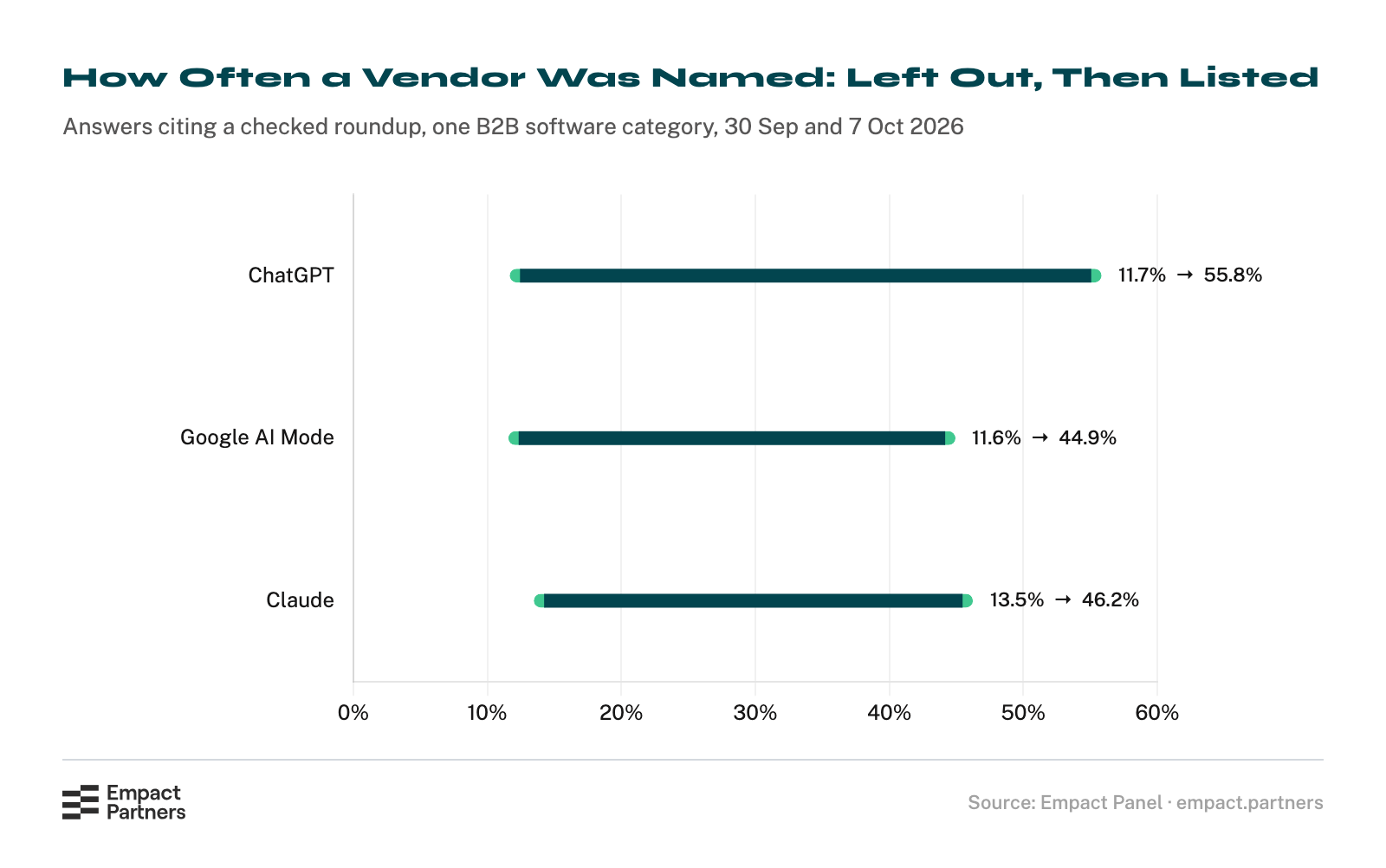
The obvious objection is that strong vendors get listed because they are strong. The vendor-by-vendor test narrows it: the same vendor, with the same site and the same reputation, was named far more often in answers whose roundups listed it.
That held for all 47 vendors we could test on ChatGPT, 45 of 46 on AI Mode and 35 of 38 on Claude. It is still an association, and whatever persuades an editor to add a vendor may be what persuades an engine to name it.
Qvery found the same direction across SaaS brands ChatGPT named in September: how often a brand sat on the cited roundups tracked how often ChatGPT named it almost twice as closely as its backlinks score did. A roundup also lists several products, so a rival’s place on it does not take yours. The gap is the cost of being absent.
Most GEO programs stall at this layer, and the arithmetic says why. The first moves fit in a week:
What a week cannot do is the rest. Editors answer in a month, lists get refreshed twice a year, community threads need somebody who belongs in the community, and the map moves under you. That is a quarter before anything shows and a person whose job it is.
Existing Article Outreach (EAO) is our method for the roundup half: we find the lists engines already cite in a partner’s category and make the partner’s case to their editors, one list at a time. It is the Mentions half of the formula, and we run it beside the community work because the same map feeds both.
The First Quarter Runs Reach, the Map, Then the Pages
Empact Partners runs those three in that order with every GEO partner, and the sequence fills the first quarter:
A named senior consultant owns the work and is on the calls. We measure the category every week through our panel and Qvery, read it with the partner every month, and change the roadmap when the cited pages change. Momentum takes a quarter or more to show, and we say so before anyone signs.
What our own evidence cannot settle is cause. Everything above is an association in one category over two weeks, and a vendor that earns its place on the lists may be one an engine would have named anyway. We bet that listings move first and naming follows, and we measure both monthly so the bet can be checked.
If the answers in your category keep naming your competitors and the website is the only thing your team has tried, book a call with us, and we can see together whether the other two layers are work we should run for you.