Bynder asked 1,002 marketers how long a rebrand takes, and the average answer was seven months.1 The old name takes longer to leave. In AI answers we collected on 13 October 2026 about 21 renamed companies and products, 21.7% of the answers naming the brand still used its retired name, nearly always as “formerly” beside the new one.2
Whether a rebrand is worth doing has numbers too, and they say more about reasons than taste. Here are the ones a founder or CMO needs before signing off on a new name, from the decision to what AI engines say afterwards. Planning that whole arc is what Brand Marketing at Empact Partners does, and I’ll point out where we come in.
Highlights
Read together, they say a rebrand earns its keep when it carries a change buyers can see, and that the new name needs years of help after launch before it stands on its own in the places buyers now ask.
Most Marketers Have Run a Rebrand, and Most Started With a New Look
Bynder, which sells software for managing brand assets, surveyed 1,002 marketers in 2023. Here’s what they said about the decision:
The answers were multi-select, so most rebrands carry more than one reason, and the most popular is also the vaguest. “Update the identity” can mean the strategy changed and the look has to catch up. It can also mean the logo feels tired.

Rebranding isn’t a rare decision. UpCity surveyed more than 600 business owners and marketers in the US and Canada in 2022 and found 51% had changed their branding strategy since the pandemic began. 48% handled branding in-house.7
The trigger the marketing surveys skip is the acquisition. Landor’s 2017 study of more than 2,300 acquisitions by S&P Global 100 companies found 74% rebranded the acquired company within seven years.8
Size decided a lot of it: 78% of deals under $99 million were rebranded, against 46% of deals over $5 billion, and 38% of mergers of equals ended in a brand transition.8 It’s 2017 data, so read it as how big acquirers behaved for a decade, not as this year’s rate.

.png)
A Rebrand Takes Seven Months and Touches 215 Assets
The same survey puts the average rebrand at seven months from first talks to rollout, and 8% of marketers have worked on one that ran for one to two years.1 The average one updates 215 marketing assets.1

Asked what was hardest, marketers named the work around the design more often than the design:
I’d add one nobody listed, which is deciding how you’ll know it worked. Hanover Research found 94% of organizations measure their brand in some form,9 but we couldn’t find anyone who publishes how many measure a rebrand against a baseline set before launch. Without one, every result after launch is a story somebody tells.
The words and the coordination are where we spend most of our time on a rebrand. When SystemOne started its rebrand at the end of 2024, a design studio built the new identity and Empact Partners wrote everything around it.
We cut a long feature list into a dozen product and solution pages and ran a review-site campaign beside the launch, so the pages other people publish about the company would carry the new name too.
Investors Reward a Rename That Arrives With a Real Change
Whether a rebrand worked depends on what you measure, and the longest record belongs to the stock market, because a listed company’s new name comes with a date and a share price. The studies that looked at ordinary renames found this:
The pattern is a rename as news about the business. Two studies measured what a name can do with nothing behind it, and both read as warnings.
In 1998 and 1999, 95 companies that added a dotcom to their names earned abnormal returns of about 74 percent in the ten days around the announcement, while ordinary renames in the same study earned an insignificant two percent.12
Between 1994 and 2001, funds renamed toward a fashionable style drew 28% more money than comparable funds the next year. Performance didn’t improve, and the money came whether or not the holdings matched the name.3 By the authors’ account, the investors who bought in lost money afterwards.
.png)
The psychology runs the same way. A familiar name is a shortcut buyers use without thinking. Round and Roper’s interviews found people build their own associations for a brand name, good and bad, which the company never put there and loses when it renames.13 A rename asks buyers to give that shortcut up, and they’ll do it for a reason they can see.
Committed Customers Push Back on a Redesign
The clearest experiment on this is about a logo. Walsh, Winterich and Mittal showed 632 people redesigned logos for two shoe brands. The more the logo changed, the worse strongly committed customers rated the brand, while weakly committed customers liked it better.14
That split explains the famous design reversals better than taste does. Each of these changed something loyal customers used every day:
Consistency is the everyday version of the same problem. In Lucidpress’s 2021 survey, 77% of companies said they deal with off-brand content, and respondents estimated a consistent brand would lift revenue by 10–20%, which is their guess rather than a measurement.18
A New Name Doesn’t Wash a Bad Reputation
Harris Poll found in 2023 that 79% of Americans think companies will need to rebrand to stay relevant, and 75% think companies rebrand their products when they should be rebranding their ethics and values.19 The reputation scores back the second half.
Meta and X Stayed in the Poor Band
Facebook renamed its parent company Meta in October 2021. Its Harris reputation score was 60.0 the year before5 and 59.6 in 2024,6 both inside the band Harris labels Poor. Harris’s 2026 list still prints the company as Meta (Facebook).20
Twitter fell from 63.4 to 58.8 over the same years, a slide that showed up in the spring 2022 survey, before the takeover closed and well before the July 2023 rename to X.5 Wells Fargo, a company in the same band that kept its name, went from 63.0 to 63.4.5

Brand Finance puts X’s brand value at $498 million in 2025, 91% below its 2022 peak, and awareness of the brand at 78%, down from 94%.21 Both measures span the takeover and the rename, so nobody can pull the two apart.
Investors read scandal renames the same way. In Unsal’s study of US financial firms with records of misconduct, the market reacted badly when those firms changed their names.22
ValuJet’s Recovery Came With a New Airline, Not Just a New Name
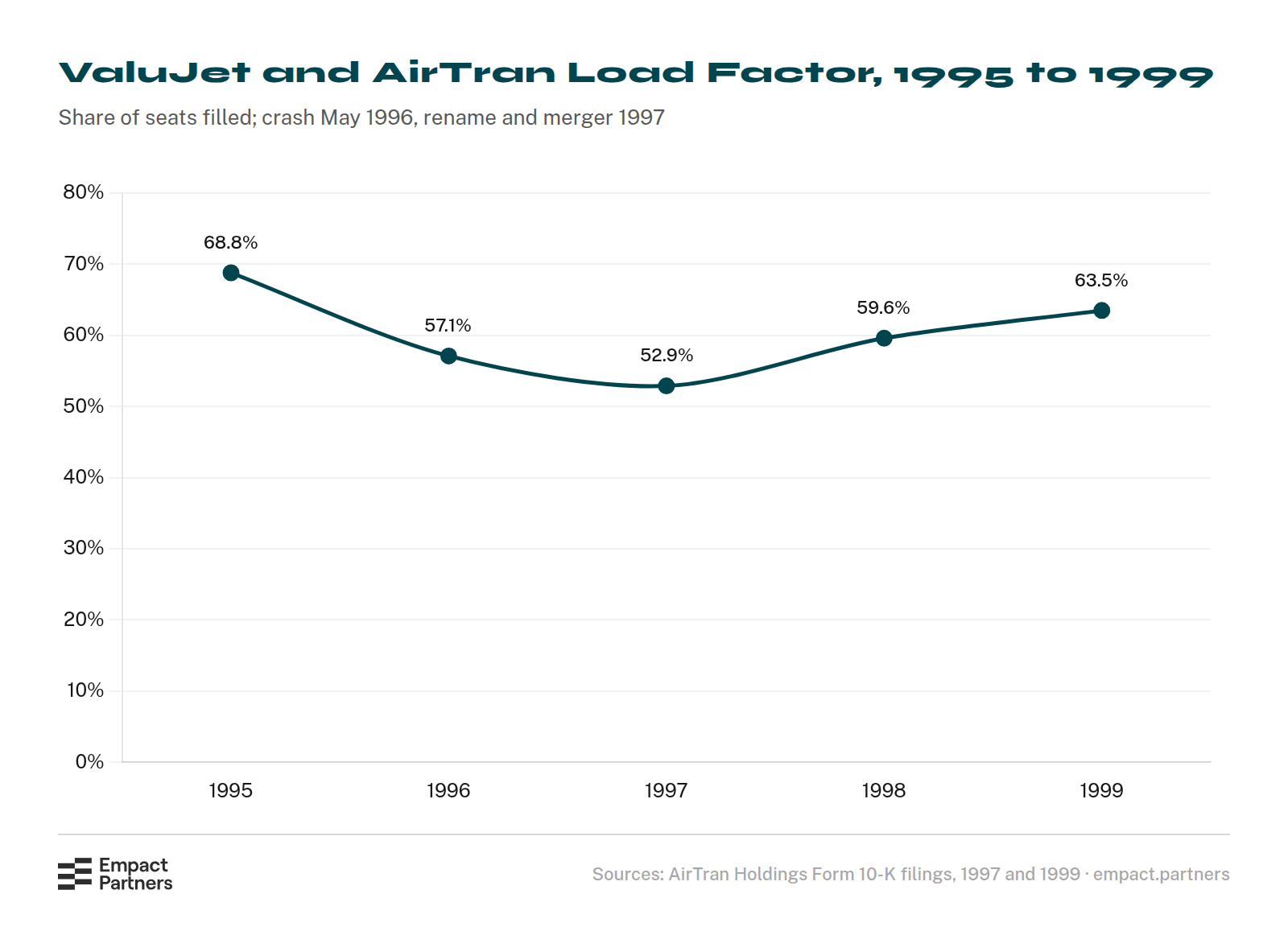
The rename usually held up as one that worked is ValuJet’s. After the May 1996 crash, revenue fell from $367.8 million in 1995 to $211.5 million in 1997,23 the year the company spent $5.2 million renaming itself AirTran.24
By 1999 revenue was $523.5 million, but that includes AirTran Airways, the airline it merged with, and the same years brought business class and new routes.23
Load factor, the share of seats filled, tells the cleaner story: 68.8% before the crash, 52.9% in the rename year and 63.5% in 1999, recovering but still short of where it started.23
AI Answers Still Carry the Old Name, Mostly as “Formerly”
None of those studies can see where many buyers meet a brand first today, which is an AI answer. Nobody publishes what happens to the old name there, so we measured it.
On 13 October 2026 we asked ChatGPT and Google AI Mode 42 buyer questions, two for each of 21 companies and products renamed between 2013 and 2024, three times each, and counted the answers that named the brand and still used the old name.2
The engines differ by a long way. Google AI Mode used the old name in 36.5% of answers naming the brand and ChatGPT in 6.3%, and on renames three to six years old Google AI Mode did it 71.4% of the time.2

One day of answers across 21 different brands isn’t a timeline for any single name, and it isn’t a market rate. What it shows is that the old name doesn’t leave when the new site goes live, and that the engines mostly carry it as context rather than as a mistake. Your new name gets introduced with your old one attached.
The reason sits in what the engines read. Qvery is our sister company: it runs buyers’ questions through ChatGPT and Google AI Mode every day and records what they cite, 716,821 answers as of 19 September 2026.25 We own it, so weigh its findings accordingly, and each one below links to the research behind it:
Our own run caught it at the page level: 13 of 126 Google AI Mode answers cited a page whose title or snippet still carried the old name, and two of those pages were the company’s own, Google’s documentation saying Data Studio and a Salesforce page saying “formerly Pardot”.2
This part is my reading, not a measurement. An engine introduces you the way the pages it fetched introduce you. A roundup written in 2021 says Integromat, so the answer says Make (formerly Integromat), and the bridge lasts as long as those pages do.
Being named on the pages engines read is the core of generative engine optimization, GEO for short, and a rebrand is the moment those pages all go out of date at once.
Put the Afterlife in the Launch Plan
Empact Partners is a go-to-market consultancy for B2B software companies, and Brand Marketing is the workstream that settles what a company says before anyone decides where it says it. We plan a rebrand with the afterlife in it, which adds four steps to the usual launch:
My verdict, which could turn out wrong, is to judge a rebrand at month twelve rather than at launch, and on two things. Did the reason you rebranded show up in the business? And do the AI answers about your category name you without the “formerly”? If the first is no, the name won’t rescue it. If the second is no, the rename isn’t finished yet.
If you’re weighing a rebrand and want the reason and the afterlife planned before anyone opens a design file, book a call with me, and let’s see whether we could work together.
Sources
- Bynder, “Study reveals that marketing teams transform 251 assets over 7 months in the average rebrand”, press release, 2023. The headline says 251 assets; the release’s body and its spokesperson say 215.
- Empact Partners, retired names in AI answers: 252 answers from ChatGPT (DataForSEO LLM scraper, web search on) and Google AI Mode (DataForSEO AI Mode results) to 42 buyer questions about 21 public companies and products renamed between 2013 and 2024, three runs each, US English, collected and read 13 October 2026.
- Cooper, Gulen and Rau, “Changing Names with Style: Mutual Fund Name Changes and Their Effects on Fund Flows”, Journal of Finance, 2005.
- Advertising Age (Natalie Zmuda), “Tropicana Line’s Sales Plunge 20% Post-Rebranding”, article, 2009.
- The Harris Poll and Axios, “2022 Axios Harris Poll 100”, report, 2022.
- Axios and The Harris Poll, “The 2024 Axios Harris Poll 100 reputation rankings”, article, 2024.
- UpCity, “UpCity Survey Results: 51% Of Businesses Have Changed Their Branding Strategy Since COVID-19”, press release, 2022.
- Landor, “First quantitative M&A brand study of S&P Global 100 shows 74 percent rebrand post-acquisition”, press release, 2017.
- Hanover Research, “The State of Brand Measurement”, report, 2020.
- Horsky and Swyngedouw, “Does It Pay to Change Your Company’s Name? A Stock Market Perspective”, Marketing Science, 1987.
- Kot, “Corporate name changes: Price reactions and long-run performance”, Pacific-Basin Finance Journal, 2011.
- Cooper, Dimitrov and Rau, “A Rose.com by Any Other Name”, Journal of Finance, 2001.
- Round and Roper, “Exploring consumer brand name equity: Gaining insight through the investigation of response to name change”, European Journal of Marketing, 2012.
- Walsh, Winterich and Mittal, “Do logo redesigns help or hurt your brand? The role of brand commitment”, Journal of Product & Brand Management, 2010.
- Lee, Gao and Brown, “A study of the impact of package changes on orange juice demand”, Journal of Retailing and Consumer Services, 2010.
- Gap Inc., “Gap Listens to Customers and Will Keep Classic Blue Box Logo”, press release, 2010.
- The Guardian, “Consignia consigned to the bin”, article, 2002.
- Lucidpress (now Marq), “The state of brand consistency”, report summary, 2021.
- Stagwell and The Harris Poll, “Special Report: The 2023 Axios Harris Poll 100 Corporate Reputation Findings”, report, 2023.
- The Harris Poll, “The 2026 Axios Harris Poll 100”, article, 2026.
- Brand Finance, “X: Navigating decline and the fight to reclaim brand trust”, article, 2025.
- Unsal, “Reputational damage and name changes: Impact of financial crimes”, Corporate Governance: An International Review, 2022.
- AirTran Holdings, “Form 10-K for the fiscal year ended December 31, 1999”, SEC filing, 2000.
- AirTran Holdings, “Form 10-K for the fiscal year ended December 31, 1997”, SEC filing, 1998.
- Qvery, production database of AI answers captured from ChatGPT (since 28 October 2025) and Google AI Mode (since 18 December 2025), read 19 September 2026.
- Qvery, “First AI Recommendations for a Brand-New SaaS: What the Answers Had in Common”, article, 2026.
- Qvery, “Listicles Are the Most Cited Content Type in AI Search”, article, 2026.
- Qvery, “How To Get Your SaaS Into The Tech Media Roundups AI Engines Cite”, article, 2026.