The renewal is in your inbox: another twelve months of link building, twelve links a month from sites rated DR 50 and up, on the same terms you have signed three times. The first two years show on the traffic graph as a line that kept climbing. The third year is flat, and nobody on the last call could say why.
A second proposal arrived the same week, for mention building, at roughly the same monthly figure. It promises visibility in ChatGPT and Google AI Mode. Read side by side, the two documents share most of their nouns, and you suspect you are being sold the same invoice under a newer name.
Sometimes you are. So skip whether mention building is link building renamed, and ask which unit of work a proposal is buying. Empact Partners sold the first unit for years and moved to the second when it stopped paying on schedule, and the two units put different names on the list, ask them for different things, and promise different results.
Link Building Paid Off Because the Unit Could Be Counted
A backlink is another site vouching for yours in the one form a ranking algorithm can count. Empact Partners, the consultancy behind this page, has run go-to-market work from inside B2B software teams since 2020, and for years the rules held still: pick sources with authority and real readers, earn links at a steady cadence, let the rankings compound.
flair is the clean record of it. From 2021 we built flair over 150 articles and landing pages and, within two years, 500+ links from sites rated DR 40 or higher. Monthly organic traffic rose 1600% within three years. The content and the links ran as one program, and the case study does not split the growth between them, so neither will we.
What went after 2022 was the predictability. The same cadence stopped producing the same curve on the partnerships we ran it for, and traceable link patterns began ending in a cliff. Links still do their old job in classic results. What they stopped doing is compound on schedule, which was the reason anyone bought them by the month.
A Mention Is a Sentence an Engine Reads, With or Without the Link
Ask ChatGPT which tools to shortlist in your category and watch what it does. It retrieves a handful of pages, most of them written by somebody other than you, reads what they say about the products in play, and names the ones those pages name. At no point does it look up anyone’s domain rating.
A mention does that job. It is your brand named on a page an engine trusts, with or without a link on the name. Every link that names you is also a mention, and the engine only reads the sentence around it. If a link is a vote an algorithm counts, a mention is a reference letter: nobody tallies the letters, they read what each one says and who wrote it.
Our own panel of AI answers tested this directly. In September 2026 we asked ChatGPT and Google AI Mode 72,000 buying questions about one kind of B2B software, none of them naming a brand, plus a smaller set on Claude, and compared how often a vendor was named when a roundup the answer cited listed it with when none did.
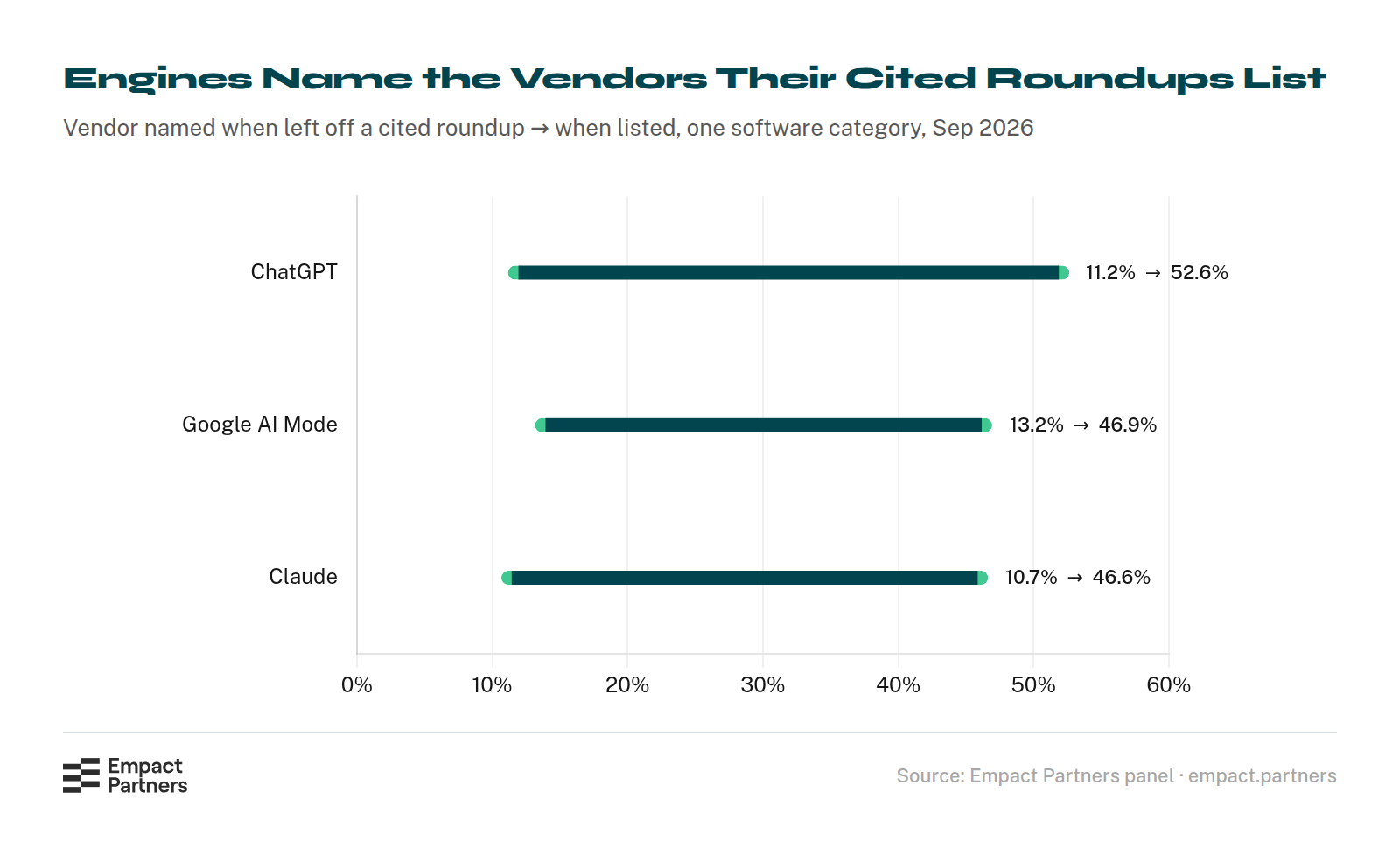
Read what follows as an association, because whatever got a vendor onto a roundup may also be what gets it named. On ChatGPT a listed vendor was named in 52.6% of answers and a left-out one in 11.2%, about five times as often. All 46 vendors we could test on ChatGPT showed the gap, and all 44 on Google AI Mode.
Qvery, our sister company, found the same order from the other side. Among SaaS brands ChatGPT named five or more times in September, the brands most listed on cited roundups were mostly the ones it named most (a rank correlation of 0.64), against 0.35 for backlinks. Qvery is ours, so weigh that and read its method first.
.png)
Mention building sits inside Generative Engine Optimization (GEO) for that reason, the workstream about becoming the brand AI engines name when a buyer asks. We run it on one formula, GEO = UGC + Mentions: the reviews and threads your users write in public, plus every page someone else publishes that names you. Mention building works the second half.
The Unit Decides Three Lines on Your Brief
So the unit moved from a link on a page with authority to a name on a page an engine reads. Three lines on your brief follow it, and each one changes what the money is spent on.
The list is what the engines cite, not a DR floor
A link-building list starts from a DR floor, because authority was what you were buying. A mention list starts from the pages the engines cite when your buyers ask about your category, weighted by how often each one is pulled. We call that citation weight: how much a page shapes the answer, where domain rating measures how strong the site is.
Which pages make it depends on the category and the buyer. Review sites weigh more in one vertical and independent blogs in another, so we build the list per category and never from a universal source list. Every page it surfaces still needs a person to open it, because engines also cite sources for minor claims that have nothing to do with your product.
The list also has a half you cannot work. In our panel, 74.8% of the roundups the engines cited were posts on a software company’s own blog, usually a competitor’s. Those pages answer questions about you whether they list you or not, so they stay on the list as pages to watch, and the independent roundups are where the asks go.
The ask is a place on a page that is already read
A link program asks for a new page, judged by whether a followed link survives on it. A mention program asks to be named on a page that already ranks and is already cited. Existing Article Outreach (EAO) is our method for it: we pick out the roundups already doing that job for a category and ask each editor, one at a time, to add the partner.
The ask is a trade rather than a favor, so it carries something for the page owner. It also drops what a link program fought for. Telling a roundup’s owner that the position does not matter removes a round of negotiation, and an unlinked mention stops being a failed link to chase, because for an engine it is already doing its job.
The promise is benchmarks and answers, never a count
Outreach has a hit rate and some trades fail, so a proposal that guarantees a monthly count is guaranteeing the one thing nobody controls. An honest mention program sets benchmarks instead: the reply rate and the placement rate its outreach usually reaches at that volume, reviewed by quarter.
What it reports on is the answers. They change from run to run, so a single screenshot proves nothing in either direction. Hold a fixed set of the questions your buyers ask, run it repeatedly across the engines, and read the share of answers that name you.
One limit belongs inside that promise. Nobody has a rate that converts mentions earned into visibility gained, us included, and the evidence above is association. So the brief carries a review point: if none of your tracked questions has moved after two quarters, the list was wrong, and that is the conversation to have before any renewal.
The brief, rewritten line by line
Put together, the three lines rewrite the brief. Here it is beside the version most link programs were bought on:
| Line | Link-building brief | Mention-building brief |
|---|---|---|
| Goal | Raise domain authority and rankings for target pages | Be named in the answers your buyers get to a fixed set of questions |
| The list | Sites above a DR floor, with real traffic | Pages the engines cite in your category, weighted by how often they are pulled; competitors’ roundups kept as pages to watch |
| The ask | A new guest post, placement or paid slot with a followed link | Inclusion on a page that already ranks and is already cited; position, anchor and link optional |
| A win | A live link on a qualifying domain | Your name on a page the engines read |
| The report | Links live this month, their DR, their anchor text | Share of tracked answers naming you, by engine, and where each placement sits |
| The promise | A monthly count | Reply and placement benchmarks, reviewed by quarter |
| Review point | The renewal date | Two quarters: if no tracked question has moved, rebuild the list |

.png)
Four Lines in a Proposal Tell You Which Unit It Sells
The same test works on somebody else’s document. A relabelled link program keeps its old sentences, because its delivery process never changed, and four of them give it away.
A proposal for the new unit reads differently. It names the page types your category’s answers are built from, says which pages it plans to ask first, prices its effort in benchmarks rather than a count, and reports the answers. Mention building is part of what we sell, so put the same four questions to us, and hold us to the answers.
Renew the Budget, Not the Unit
Most of the first step fits in an afternoon. Rewrite the list line of your brief, put five questions your buyers ask to ChatGPT and Google AI Mode, and write down which pages come back as sources. By the end of the day you will know whether your current program has ever placed you on one of them.
What an afternoon cannot cover is everything after the list: asking the dozen owners of the pages that decide your category’s answer, one trade at a time, over a quarter, then watching whether the answers move. That is the part partners most often give us to run inside GEO, and how the outreach runs is our work rather than something we publish.
A partnership on it starts by auditing where your answers stand and setting a roadmap from that, and one named senior consultant owns it and joins your calls. You supply product access and someone to review what gets said about it. What lands is your name on pages the engines already read, with Qvery tracking the answers, over quarters rather than weeks.
So renew the budget and not the unit. The money that bought twelve links a month off a DR floor buys a shorter list chosen from what the engines cite, fewer asks that are each worth more, and a standing read of the answers. Keep link work where a page ranking in classic results is what you need, such as a product page that has to be retrieved at all.
We still build links where rankings pay, and we stopped selling them by the month once they stopped compounding on schedule. What replaced the count is a list of the pages that write your category’s answers, and a quarterly read of whether those answers now say your name.
If that renewal is sitting on your desk and you want to know which unit the next proposal is really selling, book a call with us, and we will see whether we are the right people to run it.