


A brand name in an AI answer can mean several different things, and most AI visibility reports count them as one win. The answer may have chosen you, linked you while choosing somebody else, listed you and asked for more details, or told the buyer to doubt you. This page shows a founder or CMO how to tell those apart in an afternoon, and who owns what they find.
We ran it on ourselves first. Empact Partners is a consultancy that sits inside B2B software teams and runs their go-to-market, and deciding what a company says about itself is our Brand Marketing work. Our Empact Panel puts 500 open questions about our own category to AI engines every week. From 4 to 23 October it collected 4,200 answers, and our name appeared in one.
In that answer ChatGPT listed us among the names worth investigating, linked our case study, told the buyer to check our numbers before believing them, and recommended two other companies. Our panel’s sentiment judge marked the mention negative. The engine’s advice is sound, which is the annoying part.
A Question With Your Name In It Tests Nothing
Ask an engine about your company by name and it will describe your company, because you handed it the subject. Amit Prakash Sharma measured the distance in a January 2026 arXiv paper: a ChatGPT model recognized 112 Product Hunt startups by name 99.4% of the time and surfaced them on discovery questions 3.32% of the time.
So our panel asks only what a stranger would ask: who should we hire, which option fits a team like ours, with nobody’s name in the question. The panel’s numbers on this page all come from those open answers. Taking your name out gets you a fair test. It still does not tell you what a name in the answer is worth.
Mention, Citation And Recommendation Are Three Separate Questions
Here is what ChatGPT said about us on 23 October, to a buyer asking who to hire for Reddit work that brings leads rather than upvotes:
“Published a March 2026 case study reporting nearly 40 qualified leads in one month for an insurance brokerage … Ask for the attribution data and references before relying on the claim.” — ChatGPT on Empact Partners, 23 October 2026
A few lines later it chose: “My recommendation: Start by evaluating” one Reddit specialist for organic work and another for paid. We were on the list and off the pick, and it takes three separate questions to see that.


The three questions come apart in every direction. Five real answers from the same panel, with every name but ours masked:
| What the answer did | Chosen | Named | Own site linked |
|---|---|---|---|
| Ours: listed us, linked our case study, recommended two others | No | Yes | Yes |
| Used a consultancy’s own ranked list of its field as a source, named others, left the author out | No | No | Yes |
| “I’d shortlist” it “first” for getting cited in AI Overviews, with no link to its site | Yes | Yes | No |
| “Start with” it “if you sell software”, with its site linked | Yes | Yes | Yes |
| Google AI Mode: one line on what it is “best for”, then questions for the buyer | No | Yes | No |
Add those rows into one number and you get a report that calls all five the same thing. Visibility and share of voice tell you whether you appear and how much of the answer you got. Neither tells you whether the answer chose you, so record that separately.
Google AI Mode Names You And Almost Never Chooses
Being chosen does not mean the same thing on every engine. Across 2,000 answers each, ChatGPT and Google AI Mode named a brand we track about as often and linked sources about as often. They differ on the third thing, choosing.
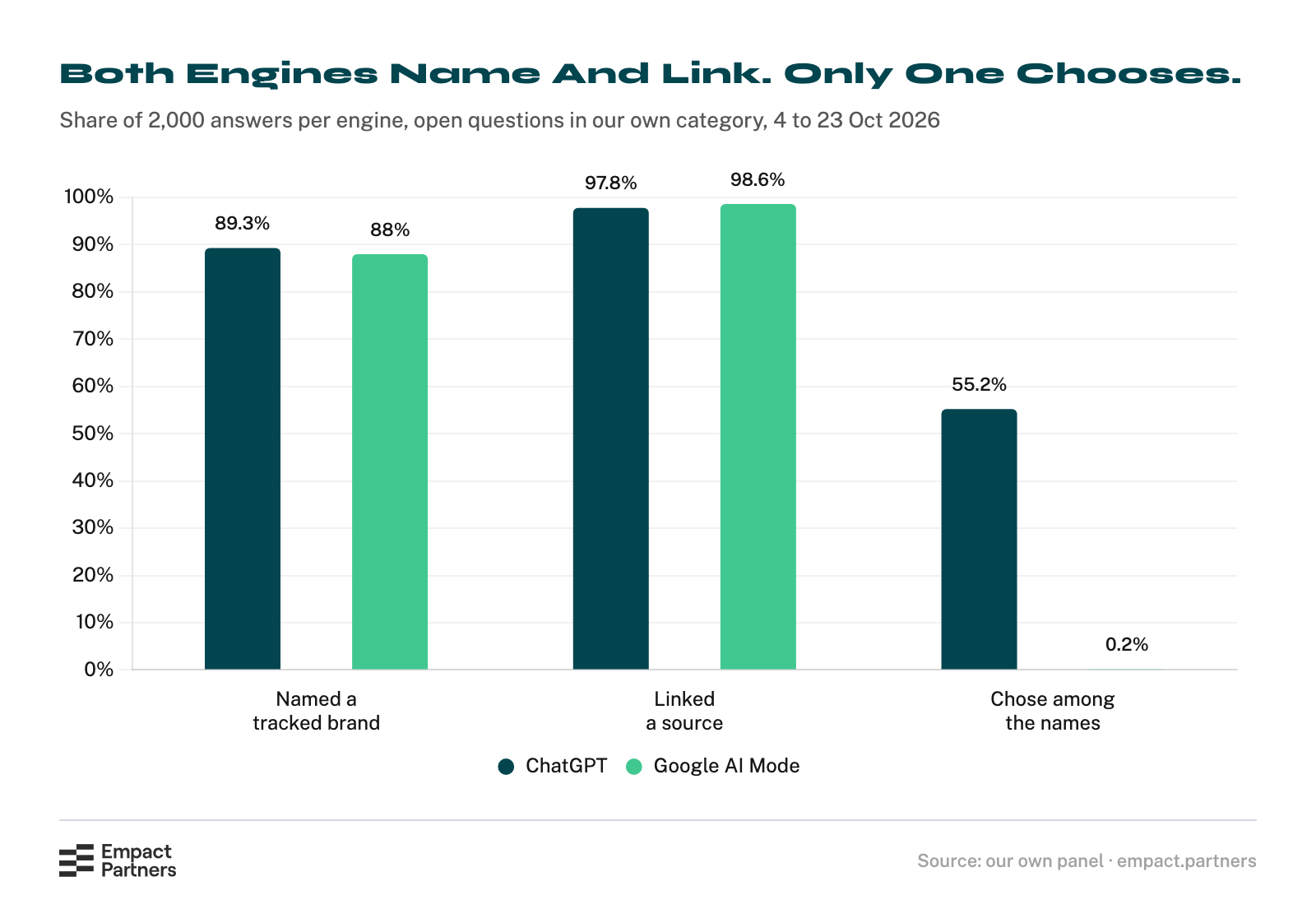
ChatGPT chose among the names it gave in 55.2% of its answers. Google AI Mode did it in 4 of 2,000, and those four were list lines reading “top pick for”. Softer wording such as “highly recommended for” sat beside a brand in 171 of its answers, so the count stays small however you draw the line.
The usual Google AI Mode answer lists names with a line each and then asks for more: 1,917 of the 2,000 ended by asking the buyer about stage, budget or goal.
So a first Google AI Mode answer rarely recommends anyone by the test above. What you can win there is the line beside your name, so read that line as what the buyer takes away, and read each engine on its own. What it chooses after the buyer replies we cannot tell you, because our panel reads first answers only.
A link is evidence, and the choice is made elsewhere
A link does not settle it on the engine that does choose. ChatGPT linked the brand’s own site in 83% of mentions, and about half of those brands were left out of its pick: 2,684 of 5,437. Linked brands were picked more often than unlinked ones, 51% against 42%, so the link helps. It does not decide.
A Recommendation Can Carry The Reason Not To Buy
ChatGPT does choose, then, about half the time. A count of those picks cannot tell you what the answer said about the brand it chose.

Choosing and describing are separate jobs. The engine was asked to name someone, so it chooses by fit to the question. It describes each name from whatever it could find and check. So a brand can be the best fit available with proof the engine could not verify, and the answer will recommend it and warn you in the same entry.
Each of these answers chose the brand it describes:
Read those the way a buyer does. The first three are references that recommend the candidate and suggest you check whether the degree is real.
The sentiment score will not catch most of them
Our panel’s sentiment judge reads the words around each name. Across 14,599 brand mentions it marked 125 as negative, and the median brand in our category scored 91 out of 100.
Then we counted ChatGPT’s picks with a caution in the entry about the brand: a push to verify, a warning on price or size, a flagged risk. There were 341, and the judge labeled 276 of them positive and 12 negative.
These answers are polite. “Ask for the full case study and how attribution was measured” sits two lines under “Strong SaaS fit”, so a model reading tone hears a compliment. Use the label as a smoke alarm and read the sentence yourself. A positive label can hide a caution, and the advice behind our own negative label is fair.
Why a caution can cost more than absence
A caution under a pick costs something absence does not. If an engine leaves you out, a buyer who never heard of you stays that way. If it names you with “ask for the attribution data”, you meet a buyer who has been told what to doubt before your first call.
So report a brand as recommended only when the answer chooses it for a stated need, and put every caution beside that number. A pick with a caution about your proof is worth less than it looks, and you fix the proof before you buy more mentions.
What would prove us wrong is a buyer who reads the caution and books at the same rate as one who did not. We cannot measure that yet, and we have not seen anybody do it.
The Harsh Words Come Out When The Question Carries A Worry
Those cautions do not arrive evenly. We split the panel’s 500 questions into plain category questions and the 138 that state a budget, a stage, a size or a fear. Negative labels ran about three times higher on the second group on ChatGPT, and about twelve times higher on Google AI Mode.

We tried the same thing outside our category on 30 October, with ten open software questions to ChatGPT, one answer each. Ten answers show that it happens and say nothing about how often.
The plain “best X” question is the one most teams track, and it is the kindest question there is. A test set needs a second half built from the objections your sales team already hears, and that list is where Brand Marketing starts anyway.
The Reason In The Answer Decides Who Fixes It
Once you have the sentences, each one has an owner, and often it is not the person running your AI visibility program. Some belong to Generative Engine Optimization, or GEO, the work of getting a brand into the threads and list articles engines read. Most of these start earlier, with what the company says and can prove.
| What the answer says | What it means and the first move | Who owns it |
|---|---|---|
| “Ask for the attribution data and references” | It found your claim and cannot check it. Put the method inside the case study, then get someone else to repeat the result | Brand Marketing, then GEO |
| “treat its rankings as vendor-authored” | Your own list reads as an ad. Stop leaning on it and earn places on other people’s lists | GEO |
| “aged, high-karma accounts” | Something you do, or say you do, is the objection. Change the practice or the page before any more visibility work | The founder |
| “Likely overkill for a pre-PMF startup” | Your size puts you outside that buyer. Decide whether you want that buyer. If not, the sentence is qualifying for you | Brand Marketing |
| “Pricing increases as your subscriber count increases” | A product fact, read against the buyer’s fear. Check it is still true, then answer it on your pricing page | Product, Brand Marketing |
| “Reddit lead generation” | The engine’s version of your positioning. Compare it with what you sell, then change what your pages and others’ pages say | Brand Marketing |
The “Reddit lead generation” row is ours. Empact Partners runs six workstreams for B2B software companies, and that answer had one case study on one channel to go on.
63% of ChatGPT’s picks came with a condition: if your priority is this, start with that. The condition is your positioning as the engine understood it, written by something that never sat in your messaging workshop.
A few things travel with a pick in our category, which shows association and says nothing of cause. The last row counts what the entry says, and we cannot see what the engine read.
| What ChatGPT’s entry carried | Picked with it | Picked without it |
|---|---|---|
| A plain “best for” line | 59% | 46% |
| A published price | 60% | 51% |
| A case study | 57% | 52% |
| Reviews or threads mentioned | 53% | 53% |
The pattern fits the mechanism: the engine picks what it can state plainly and match to the question. Empact Partners publishes no price list, by choice, and on a budget question that costs us.
What we cannot show you is a brand we moved from named to chosen with one clean change. We have no result that isolates it. Anyone who offers you one should show the question, the engine, the weeks, and the sentence before and after.
Read Ten Questions This Afternoon
You need a private browser window and no budget.
Each cell holds something a single visibility number hides:
One week tells you little. Across four weeks ChatGPT gave us 4,035 combinations of a question and a brand, and 2,495 appeared only once. Of the 284 that appeared every week, 89 were picked every week, 16 were never picked, and 179 switched between picked and not. One row is an anecdote, ours included.
What Reddit says about repeat runs
A practitioner replying to an audit walkthrough on r/SaaS put a working number on it:
“For step 4 I usually go 5 runs minimum, 3 isn’t enough when the answers shift around like that. If you see the same gap in 4 out of 5 you can pretty much bank on it being real” — r/SaaS, Oct 2026
What An Afternoon Cannot Do
Everything above fits in an afternoon because reading is cheap. An afternoon cannot rewrite a case study so its method survives a skeptical reader, get an independent page to repeat the result, or move the label an engine gave you. That takes quarters and somebody whose job it is. We have not changed the sentence about us yet, and we sell the fix, so weigh that accordingly.
Empact Partners opens a partnership with an audit, and in Brand Marketing this read is part of it. You bring the objections from your lost deals and the real numbers behind your claims. The roadmap puts the messaging and the proof first, a named senior consultant is on the calls, and standing reports show whether the sentence changed. Momentum takes months.
Watch one number next quarter: of the answers that choose you, how many carry a sentence you would not read aloud to a buyer. If AI engines are naming you and you cannot tell whether they are selling for you or against you, book a meeting with me. We will find out together whether there is a fit.


