Somebody on your team asked ChatGPT about your category this morning, and it named three competitors and not you. The screenshot is in a Slack thread by now, on its way to the CEO.
Look at what it measured before it gets there. On 2 October we asked ChatGPT “Who should I hire to get my brand mentioned by AI chatbots?” from two places on the same afternoon, logged out both times.
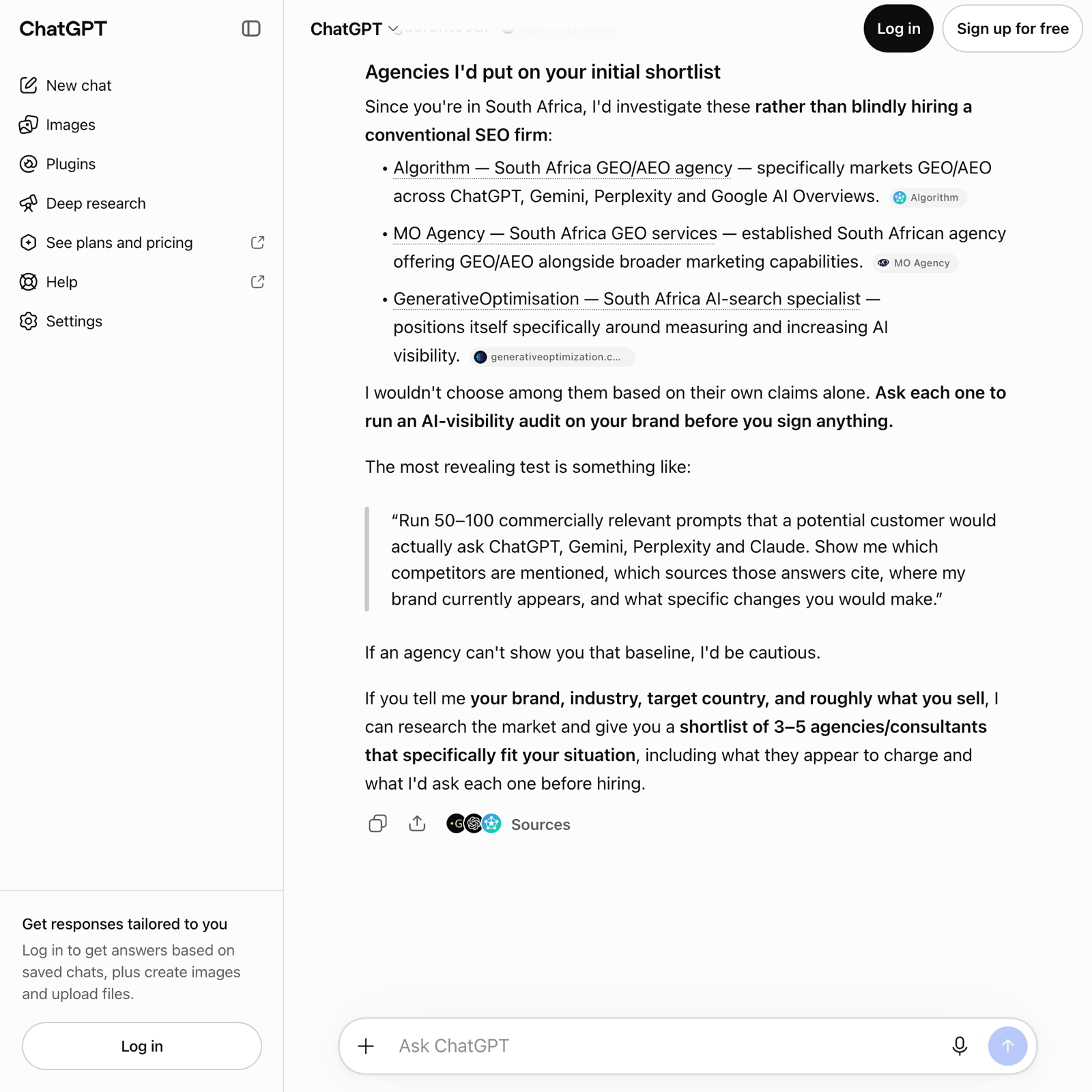
From a US connection it named six companies. From South Africa it named two South African companies and nobody else, and the next time we asked, it opened the shortlist with its reason: “Since you’re in South Africa.”
One answer is one draw, and the person asking is part of what gets drawn. That would be trivia if buyers still started on Google. When G2 surveyed 1,076 B2B software buyers in March 2026, 51% said they start with a chatbot more often than with Google, up from 29% in G2’s 2025 report, and 69% had switched to a vendor they had not planned on because a chatbot recommended it.
Most teams answer the screenshot with another screenshot, or with a tracker bought before anyone decided what it should track. Empact Partners runs Generative Engine Optimization (GEO), the workstream that makes a SaaS brand the name AI engines give when a buyer asks about its category, and every GEO engagement we run opens with this baseline:
Build the first one by hand. A tracker earns its place in month two, once the questions have earned theirs. Before that, the two calls that decide a baseline, which questions count and what counts as being named, are calls a tool makes for you without showing its work, and a baseline whose calls you cannot see is a number you cannot defend.
We ran it on our own category on 2 October 2026: consultancies that help B2B SaaS companies get recommended by AI engines, which is the work we sell. What came back from the hundred answers asked from the US:
Before the first run, you need the following, and one decision:
This shows who the engines name for your buyers’ questions and which pages they read to do it. Why they chose those names, and what to change on your own site, is the audit that comes after it.
Write the Questions a Stranger Would Ask
Step 1: Ask Claude for thirty candidate questions
Open a new chat in Claude and paste the prompt below. Change the lines that start “My category” and “My buyer” to your own and leave the six rules alone. Our consultants hold every question set to them, and each closes a way a set goes wrong: a question that draws a definition, a brand that tilts the answer, a price question that comes back with a price.
I want to find out which companies AI assistants recommend when someone shops my category. Write the questions to test.

My category: consultancies that help B2B SaaS companies get recommended by AI assistants like ChatGPT and Google AI Mode, usually alongside SEO and content
My buyer: a head of marketing at a B2B SaaS company with 50 to 500 employees

Write 30 questions this buyer would type into ChatGPT or Google AI Mode when they want names to choose from.

Rules:
1. A good answer to every question is a list of companies or products. Never ask what something is, how something works, or how to do it yourself.
2. Never name a company, product, or brand, including mine. Never use the words alternative, vs, versus, or compared to.
3. If a question is about price, ask for affordable options, never for what something costs.
4. Make about half the questions broad and plain. Give each of the rest exactly one detail a real buyer adds: company stage, team size, region, budget, a tool they already use, or a deadline.
5. Write the way a person types into a chat box: one sentence, plain words, under 25 words.
6. Vary how the questions start. No more than three may open with the same two words.

Return a numbered list, one question per line, nothing else.
Claude returns thirty questions in a numbered list. Ours came back in under a minute, and twenty failed the cut in the next step, more than half for doing a job another question already did. Sales-call transcripts make the list better: Cris S. Cubero, a B2B SaaS content strategist at Kalungi, posted in August that thirty calls gave her about fifty questions in buyers’ own words.
Step 2: Cut the thirty to ten
Ten is the number because of the arithmetic downstream. Ten questions, two engines and five runs make a hundred answers, and a hundred is what one person can log in a day. Read the thirty against these rules, in this order:
Our thirty lost twenty to those rules. Five of the cuts, with the fault in each:
| Cut | The fault |
|---|---|
| “We use HubSpot already, who integrates AI visibility tracking with it?” | Names a brand, and asks about tracking tools |
| “Recommend vendors for tracking share of voice in generative AI results.” | The tools category, not ours |
| “List providers that help brands get surfaced in AI shopping recommendations.” | A retailer’s question, not our buyer’s |
| “Who are the leading players in AI assistant brand recommendation strategy?” | Vague enough to draw an overview |
| “Can you list specialists in making SaaS brands show up in AI search?” | The same job as Q02, in other words |
Write the keepers in a buyer’s words rather than your category’s. Meghan Houston of Go Fish Digital posted in August that Go Fish showed up in 23.6% of answers to prompts using terms like GEO and AEO (answer engine optimization), and in 3.6% when a buyer described their situation. Two of our ten carry the jargon, Q05 and Q10, and Q05 drew the org chart Step 7 comes back to.
| ID | Question | The detail it adds |
|---|---|---|
| Q01 | Who should I hire to get my brand mentioned by AI chatbots? | none |
| Q02 | What companies help B2B SaaS get recommended in ChatGPT answers? | none |
| Q03 | What teams combine SEO and AI visibility work for SaaS marketers? | none |
| Q04 | Who are known experts in getting cited by Google AI Mode? | none |
| Q05 | Who handles AI answer engine optimization for a Series B startup? | company stage |
| Q06 | Who specializes in AI visibility for companies under 100 employees? | team size |
| Q07 | Need a consultancy in Europe for AI search optimization, who fits? | region |
| Q08 | Looking for affordable options to improve AI search visibility, who’s good? | budget |
| Q09 | Who can help us rank better in AI assistant answers within a quarter? | deadline |
| Q10 | Which consultants help with answer engine optimization before a product launch? | use context |
This cut is where a GEO engagement spends its first judgment. The questions that make the set are the ones a partner’s buyers would type, never the ones its sales deck answers, and every number after this step inherits the choice.
Step 3: Set up the sheet
Create a Google Sheet with three tabs named Questions, Runs and Baseline. Paste your ten into Questions with their IDs in column A. On Runs, click cell A1 and paste this header row:
Date Market Engine Question Run Brands named, in order We were named (Y/N) Our position Pages cited NotesEvery answer you collect becomes one row on Runs. Baseline stays empty until the runs are in, because its only job is arithmetic, and Step 9 gives it the formulas.
Ask Every Question Five Times, Logged Out
Step 4: Open a private window in your buyers’ country
Open a new private window (Incognito, in Chrome) and sign in to nothing. That keeps your memory, search history and settings out of the answer: for the next hour you are a stranger. Irina Maltseva, who runs Seen, posted in August about a CMO who believed, from their own ChatGPT account, that they were at 80% visibility. A clean run through the tracker Scrunch put them at 20%.
If your buyers are in another country, connect a VPN to that country first. OpenAI’s help pages say ChatGPT may use an approximate location from your IP address to give local results, and our run shows what that does to a shortlist: all five South Africa runs of Q01 named only South African companies, eight of them, and none of the fifteen our US runs named.
One country per baseline. Comparing markets month on month is where a sheet stops scaling, and it is what Qvery, our sister company, was built for: daily runs on ChatGPT and Google AI Mode in more than 200 countries, with every cited page kept. It is ours, so discount what we say about it, and ask to see the raw answers behind any number it shows you.
What Reddit says
“I would do it, but my ChatGpt just knows a lot about my comings and goings, I fear it would have bias in what it tells me. I should ask someone else to check on me :)”
r/SEO, July 2026
“Along with most of the comments here about tools showing an estimate I would like to add there are some geographic & context/memory variance too. Tools are mostly tracking US while your customer might be in another geography.”
r/seogrowth, September 2026
Step 5: Ask ChatGPT
Go to ChatGPT in the private window. Paste Q01 into the box and press Enter. Wait until the answer stops growing and the Sources button appears under it, which took 15 to 21 seconds in our South Africa runs. Close the window when you have logged the answer, and open a new one for the next question.
Here is a finished logged-out answer to Q02, asked from South Africa. The bold names are the shortlist, and the grey chip at the end of each line is the page the answer leaned on for that line.
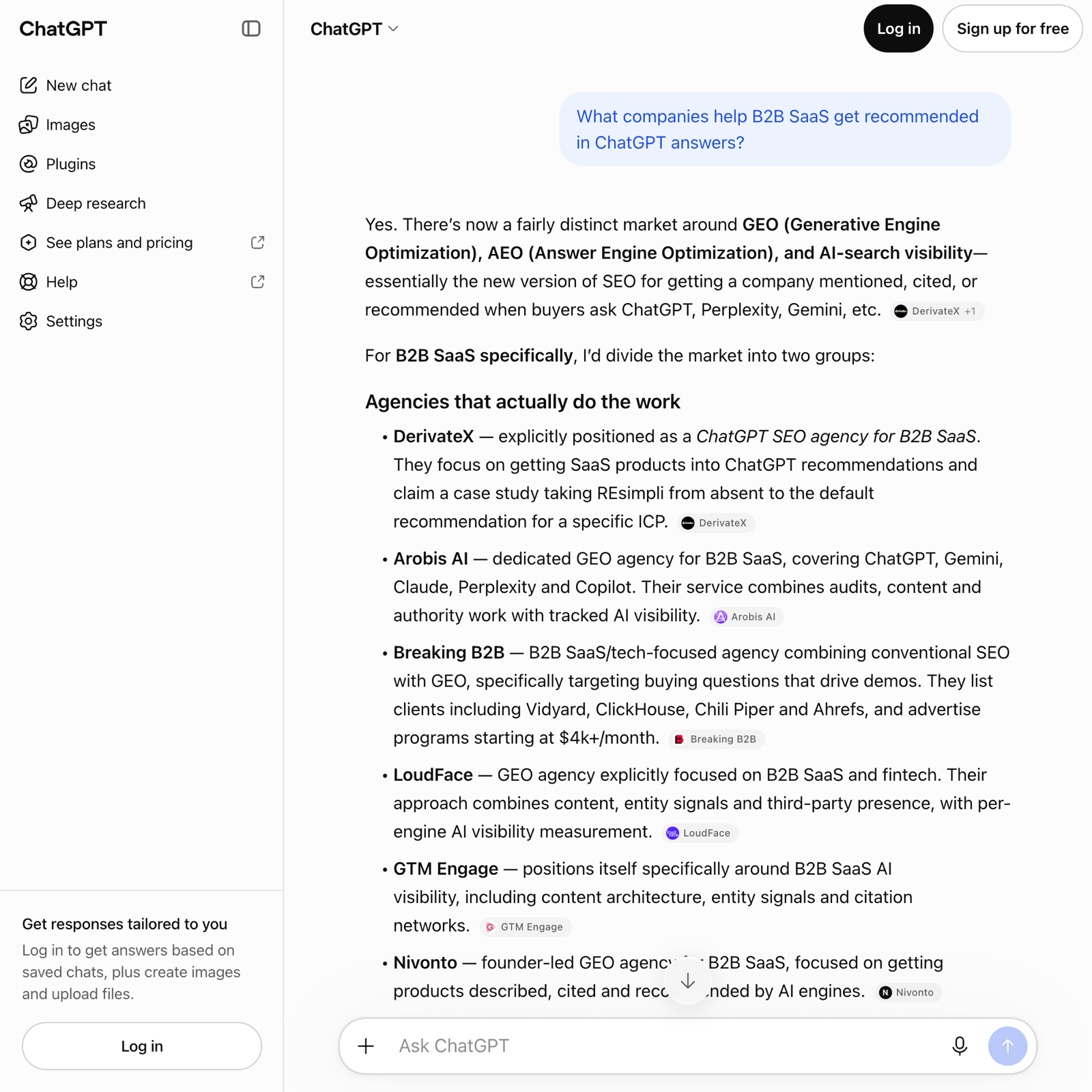
Three things you will meet, and what each one means:
Step 6: Ask Google AI Mode
Go to Google AI Mode in a fresh private window, still signed out. Paste the same question and press Enter. The answer streams through “Searching” and “Thinking a little longer” and is finished when the line “AI can make mistakes, so double-check responses” appears under it, 7 to 16 seconds in our South Africa runs.
AI Mode ends by asking you something back: your industry, your budget, whether you want a tool or a service. Leave it unanswered, for the same reason. Here is AI Mode’s answer to Q02 from a US connection, signed out:
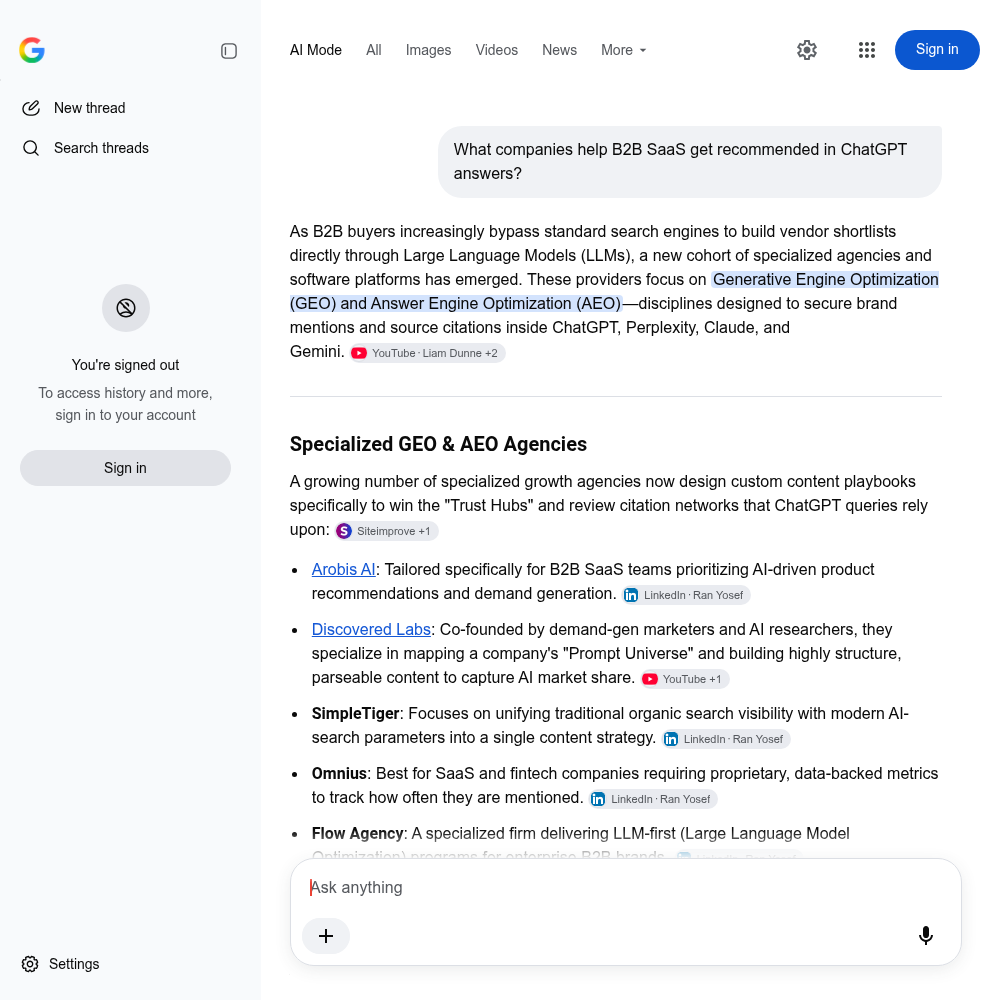
The chip at the end of each line names the page AI Mode leaned on, and the full list of pages sits under the answer, behind Show all.
Step 7: Log what the answer named and cited
Add one row to Runs per answer: the date, the market, the engine, the question’s ID and the run number. In F, type every company the answer offers as an option, in order, separated by commas. Type Y in G if your brand is one of them and its position in H, and paste the cited links into I, separated by spaces. We logged ours under these rules:
The note matters more than it looks. Seven of our fifty ChatGPT answers named nobody, and none of them was an empty seat. Four were Q05 drawing an org chart: ChatGPT read “who handles” as a question about which of your own people owns the work, which is the question’s fault rather than an opening in the market.
The other three ran no search and replied with a sentence or an offer to find names. Log answers like that as they came, because a stranger got them too.
Step 8: Repeat until every question has five runs
Run all ten questions on both engines, a fresh private window each time, then go again later the same day until every question has five runs on each engine. We spaced our five rounds twenty minutes apart through one afternoon, in fresh automated browser sessions because our buyers are in the US and we were not, and read every answer whole before logging it.
Five is where a baseline starts telling regulars from passers-by. Two in three of the names ChatGPT offered for a question appeared in one run of five and never again, and so did nearly half of AI Mode’s. Only eight names held a question on ChatGPT for four runs or more, against 35 on AI Mode, the first sign that the two engines answer from different places.
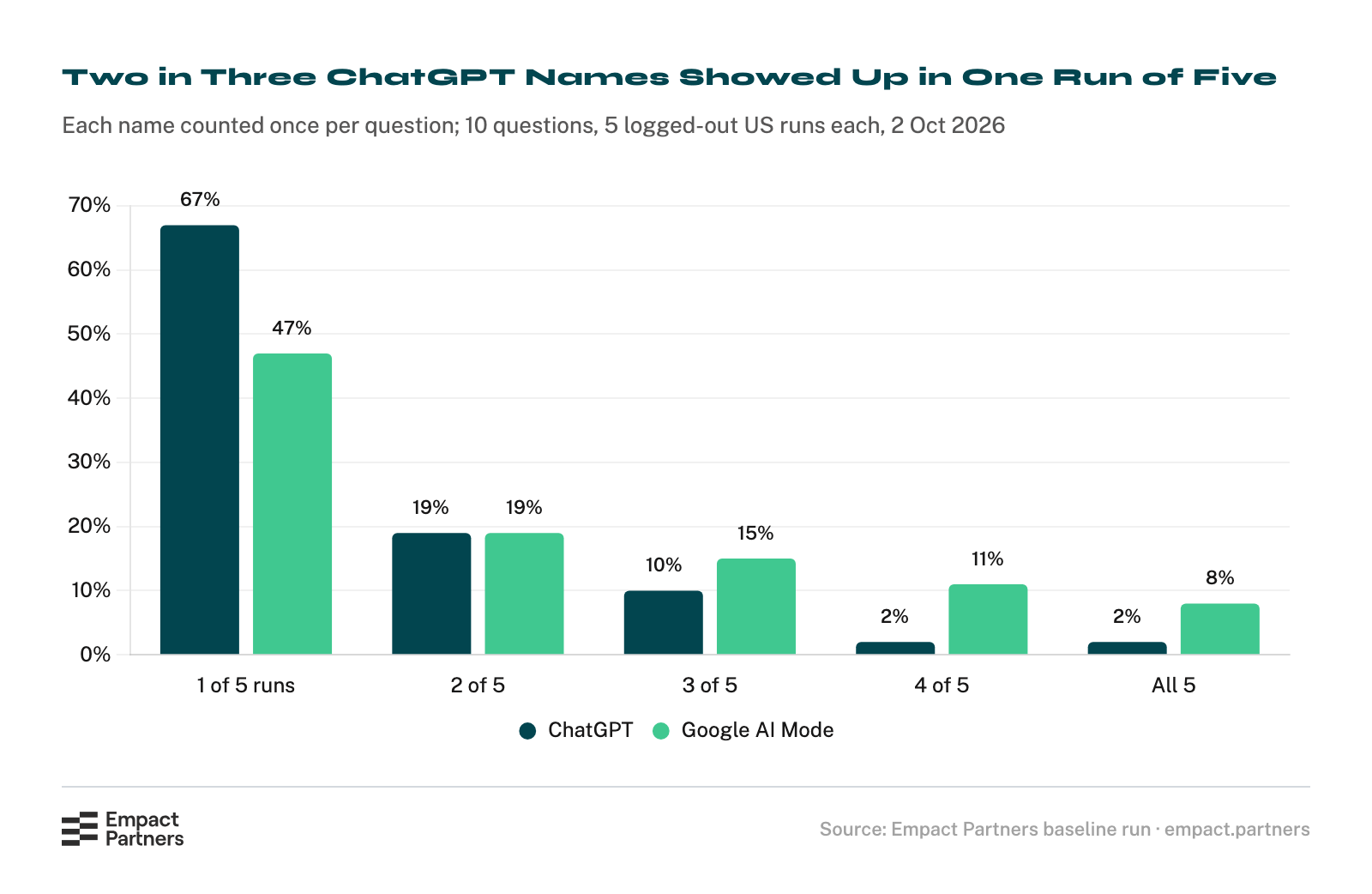
Stopping at three would have misread both engines. On ChatGPT, three runs showed a name in every answer on three questions, and five runs found an owner on six. On AI Mode, Kevin Indig appeared in all three of the first answers to the experts question and in neither of the last two, and Exposure Ninja did the same on Europe. Runs four and five also brought 54 new names on ChatGPT.
How many runs is enough is the most argued line in this work. The newest posts and studies on it disagree on the number and agree that one is not it:
| Who | Published | Runs per question | What they found |
|---|---|---|---|
| RankJojo, on LinkedIn | September 2026 | 10 for a first baseline | The same question asked 20 times drew 11 different answers |
| Senthil Kumar Hariram, FTA Global, on LinkedIn | September 2026 | 5 | The same brand stayed first in only 35% of identical reruns |
| Brain Buddy AI, on LinkedIn | August 2026 | A check a week for four months | 44% of citation wins looked permanent after 3 checks, 26% after 5, 17% after 8 |
| Julius Schulte, Malte Bleeker and Philipp Kaufmann, preprint | April 2026 | At least 7 a day, to track a rate | A single run is “essentially uninformative” |
| Rand Fishkin, SparkToro | January 2026 | 60 to 100, to know an engine’s set of recommendations | Under 1 in 100 chance of the same list of brands twice |

.png)
Read Who Owns Each Question
Five runs will not give you a share of your market to the point, and the preprint’s seven a day is the floor for a rate a dashboard can carry. A baseline asks something smaller and more useful first: for each question on each engine, is there a company the engine names nearly every time, several that take turns, or nobody at all?
Step 9: Give the Baseline tab its formulas
On Baseline, type your brand’s name in B1. Click A3 and paste the header row below, then list each question ID twice from A4 down, once for each engine, with the engine written in B exactly as you wrote it on Runs.
Question Engine Runs Answers naming anyone Times we were named Our share Most-named company Its share SeatClick C4, paste this row of formulas, and fill it down to the last question:
=COUNTIFS(Runs!D:D,A4,Runs!C:C,B4) =COUNTIFS(Runs!D:D,A4,Runs!C:C,B4,Runs!F:F,"?*") =COUNTIFS(Runs!D:D,A4,Runs!C:C,B4,Runs!G:G,"Y") =IF(C4=0,"",E4/C4) =IFERROR(LET(t,QUERY(ARRAYFORMULA(TRIM(FLATTEN(SPLIT(FILTER(Runs!F:F,Runs!D:D=A4,Runs!C:C=B4,Runs!F:F<>""),",")))),"select Col1, count(Col1) where Col1 <> '' group by Col1 order by count(Col1) desc",0),TEXTJOIN(", ",TRUE,FILTER(INDEX(t,0,1),INDEX(t,0,2)=INDEX(t,2,2)))),"") =IFERROR(INDEX(QUERY(ARRAYFORMULA(TRIM(FLATTEN(SPLIT(FILTER(Runs!F:F,Runs!D:D=A4,Runs!C:C=B4,Runs!F:F<>""),",")))),"select count(Col1) where Col1 <> '' group by Col1 order by count(Col1) desc",0),2,1)/C4,"") =IF(C4=0,"",IF(D4=0,"Empty",IF(F4>=0.8,"Ours",IF(H4>=0.8,"Owned","Contested"))))The Seat column carries four labels:
Here is our Baseline tab once the hundred US answers were in:
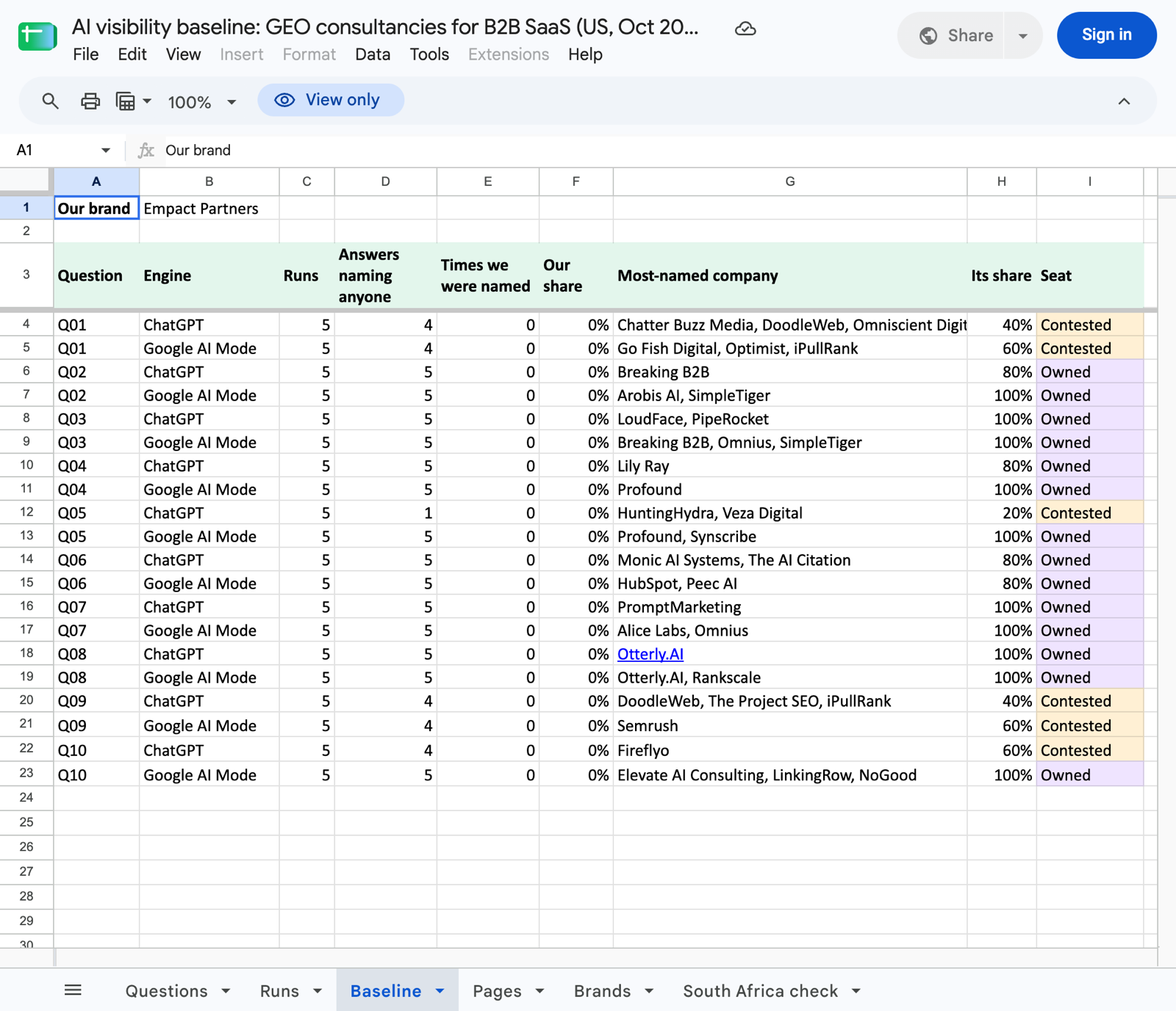
And the same seats side by side, one row per question, which is how they read best:
| Question | ChatGPT | Google AI Mode |
|---|---|---|
| Q01, who to hire | Contested | Contested |
| Q02, companies for B2B SaaS | Owned by Breaking B2B, 4 of 5 | Owned by Arobis AI and SimpleTiger, 5 of 5 |
| Q03, SEO and AI visibility teams | Owned by LoudFace and PipeRocket, 5 of 5 | Owned by Breaking B2B, Omnius and SimpleTiger, 5 of 5 |
| Q04, experts on AI Mode | Owned by Lily Ray, 4 of 5 | Owned by Profound, 5 of 5 |
| Q05, a Series B startup | Contested, four answers were org charts | Owned by Profound and Synscribe, 5 of 5 |
| Q06, under 100 employees | Owned by Monic AI Systems and The AI Citation, 4 of 5 | Owned by HubSpot and Peec AI, 4 of 5 |
| Q07, Europe | Owned by PromptMarketing, 5 of 5 | Owned by Alice Labs and Omnius, 5 of 5 |
| Q08, affordable options | Owned by Otterly.AI, 5 of 5 | Owned by Otterly.AI and Rankscale, 5 of 5 |
| Q09, within a quarter | Contested | Contested |
| Q10, before a launch | Contested | Owned by Elevate AI Consulting, LinkingRow and NoGood, 5 of 5 |
Our own row reads zero: Empact Partners was named in none of the hundred answers, and Qvery in none either. We ran the baseline on our own category because it is the one we can publish without breaking a partner’s confidence, and a baseline is measured from where you stand, not from where a screenshot says you stand.
Step 10: Compare the two engines
Read each question’s two rows side by side and never add them together. Both engines matter on their own: OpenAI puts ChatGPT past a billion weekly users, and Google says AI Mode passed a billion monthly users within a year. Kevin Indig posted Semrush data in August showing the two shared 69% of their most-mentioned brands and only 57% of their cited sources.
| In our run | ChatGPT | Google AI Mode |
|---|---|---|
| Answers that named nobody | 7 of 50 | 2 of 50 |
| Names per answer, on average | 6.4 | 8 |
| Different names across 50 answers | 168 | 125 |
| Names that appeared in one run of five | 67% | 47% |
| Questions with an owner | 6 of 10 | 8 of 10 |
| Links cited per answer, on average | 7.3 | 12.3 |
| Links to a named company’s own site | 61% | 27% |
| Seconds to a finished answer, from South Africa | 15 to 21 | 7 to 16 |
.png)
The pages explain the split. The four pages ChatGPT cited most were PipeRocket’s, Breaking B2B’s, LoudFace’s and PromptMarketing’s own pages about their services, and every one of those four companies owns a question on ChatGPT. What a company says about itself is most of what ChatGPT reads.
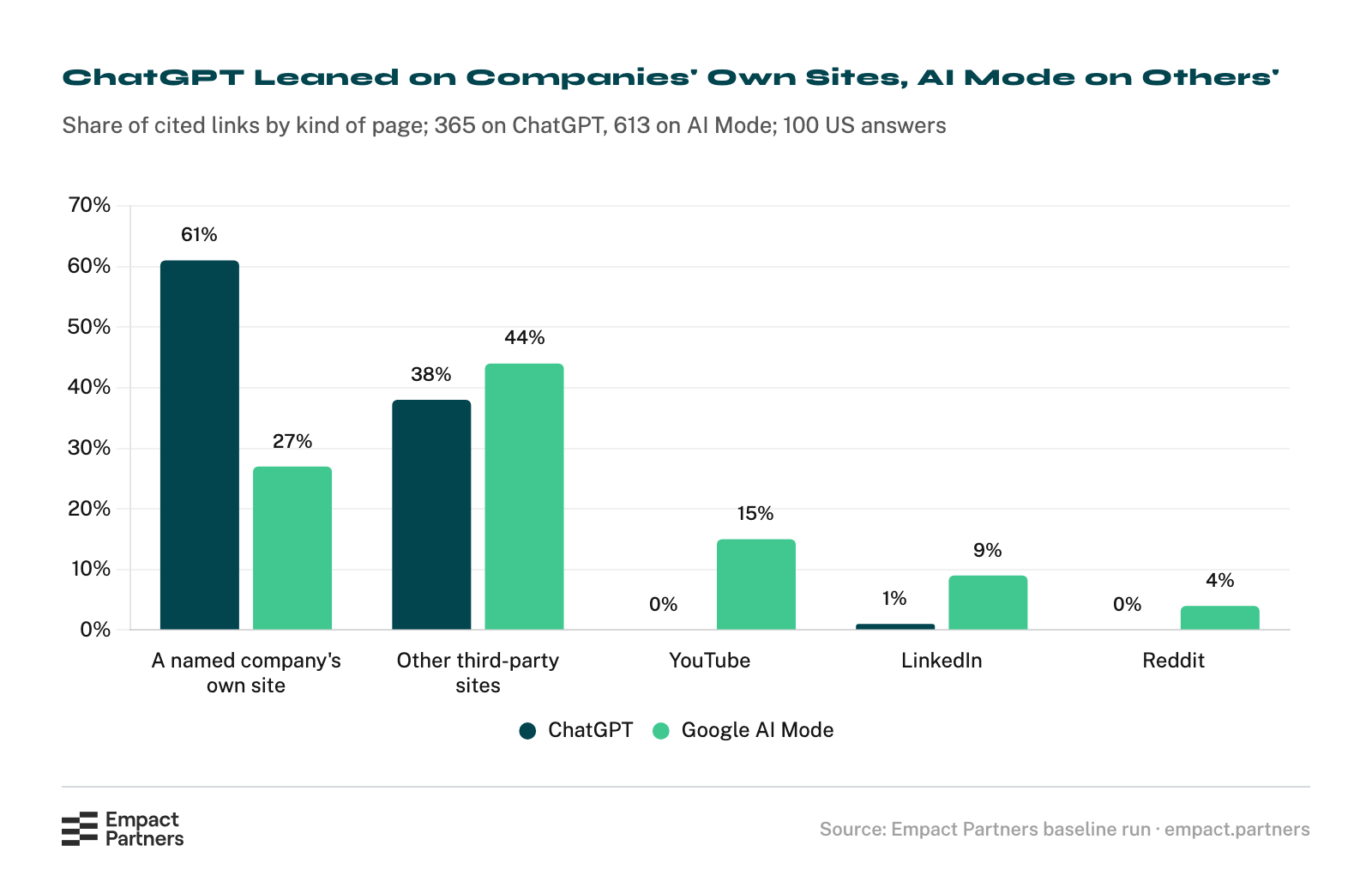
AI Mode reads what other pages say about you, and many of those pages are lists. All five of its answers to Q02 cited one LinkedIn article, a list of ten agencies published on 2 September by the founder of Arobis AI, and AI Mode’s two names in every run, Arobis AI and SimpleTiger, are that list’s first two. Its most-cited page overall was Optimist’s own list of the best GEO agencies, in nine answers.
Getting a partner into the lists an engine already cites is Existing Article Outreach, the method we built for this half of GEO. On ChatGPT the first move is usually the partner’s own pages, and on AI Mode it is the pages other people publish about the category.
Step 11: Turn the seats into the first month’s list
Sort Baseline by Seat. The Empty and Contested rows on questions your buyers really ask are the first month’s list, because an empty seat has no incumbent and a contested one has an incumbent the engine only half trusts. Owned rows go last: winning one means displacing a company the engine names every time.
To see which pages sit behind those seats, add a tab called Pages and paste this into A1. It counts every page the answers cited, per engine, most-cited first:
=QUERY(ARRAYFORMULA(IFERROR(SPLIT(FLATTEN(IF(Runs!I2:I="",,Runs!C2:C&"|"&TRIM(SPLIT(Runs!I2:I," ")))),"|"))),"select Col1, Col2, count(Col2) where Col2 <> '' group by Col1, Col2 order by count(Col2) desc label Col1 'Engine', Col2 'Page', count(Col2) 'Answers citing it'",0)The pages that name your competitors and not you are where mention building starts. Our category had no empty seats, which is what a crowded category looks like, so our own list starts with Q01 and Q09, contested on both engines, then Q10 on ChatGPT, where 22 names took turns. Q05 stays off it: four of its five ChatGPT answers were org charts, so the fix there is a better question.
On a partnership this sheet is the first page of the audit, and the roadmap that follows decides which seats get the first month of mention work. A named senior consultant owns that call, the standing report reruns the same questions so the movement shows, and it shows over quarters rather than weeks. If you want the list built and worked for your category, book a call with us.
What the Sheet Cannot Tell You
Rerun the sheet once a month with the same ten questions, market and five runs, and read the Seat column first. A contested question that turns into one of yours is the first evidence the work landed. A wobble of one run is the engine drawing again: in our own panel, only 58% of the brands ChatGPT gave for a software question came back ten days later, and 48% on AI Mode.
The sheet is the right first instrument, and it is not the only one you will need. What each way of checking can and cannot tell you:
| The check | What it can tell you | What it cannot |
|---|---|---|
| One screenshot | What one person saw, once | Anything about your buyers, because it measures the asker |
| One run per question | Which names an engine reaches for | Whether a name is a regular or passing through |
| The five-run sheet | Who owns, contests or leaves empty each question, per engine, and which pages it read | Your share to the point, other markets, why the engine chose |
| A daily tracker, per country | Movement over time in every market you sell in | Which questions matter, unless someone chose them first |
Start with the sheet and automate the recheck once the questions have earned their place. Some trackers read the engines through their APIs, and Surfer’s September 2026 test of 1,000 prompts found the brands named through an API overlapped with those on the screen users see by only 15.5% to 23.8%. A sheet built by hand reads your buyers’ screen, which makes it the check for any tool.
If your buyers are asking AI engines who to hire and your name is not in the answers, book a call with us, and we will work out together whether we could help.