Product-led growth got its name at OpenView in 2016.6 The idea is older than the name: let people find the product, use it free, and pay once it earns the money. By 2022 OpenView counted 61% of the Cloud 100 as product-led.5
Its poster companies were priced like it: Airtable at $11 billion pre-money in December 2021,1 Miro at $17.5 billion a month later.2 OpenView stopped investing in December 2023,7 and in August and September 2026 Bending Spoons agreed to buy Airtable for an enterprise value of $1.285 billion3 and Miro for $1.355 billion.4
So is this the end of product-led growth (PLG)? The two prices say yes. Everything else I can measure says the motion became the default, still compounds where the product is new, and lost the one thing it was built on: the search box that sent people to the free plan.
Highlights
Read together, product-led growth lost its 2021 price and kept its users. The free signup is still the front door. What changed is who walks the buyer to it: a chatbot now answers the question a search page used to, and on ChatGPT it reads the vendor’s product pages, help center included, more often than its blog.
Airtable and Miro Sold for a Fifth and a Tenth of Their Peak Prices
Bending Spoons buys software companies to run them for profit, and its two releases in August and September are the cleanest data the product-led world has had in years, because each puts a price next to the revenue. Luca Ferrari, CEO and Co-Founder of Bending Spoons, announced both deals. What the releases disclose:
Set the equity values against the last private rounds. Airtable’s $2.25 billion is about a fifth of $11 billion, a fall of about 80%, slightly flattered because $11 billion was the pre-money figure. Miro’s $1.79 billion is about a tenth of $17.5 billion. Divide enterprise value by recurring revenue and Airtable sold at 2.7 times revenue, Miro at 2.3 times.
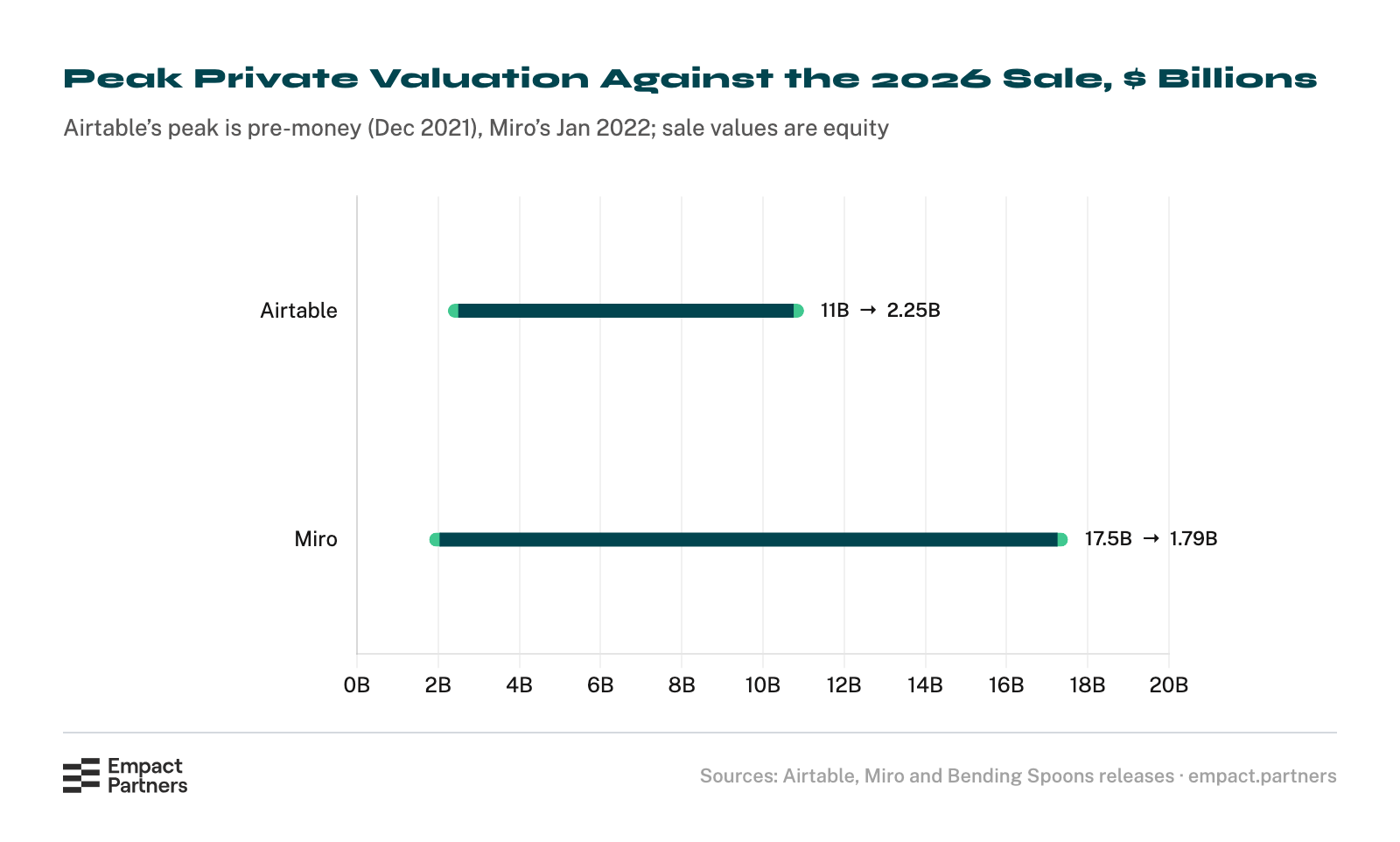
The revenue did not collapse with the price. A company growing more than 20% a year at nearly half a billion dollars in revenue is a healthy software business. What collapsed is what a buyer will pay for each dollar of it, and the 2021 rounds had priced product-led growth as a machine that would keep compounding without a sales team.

.png)
How the term spread before the price fell
Blake Bartlett, then a Partner at OpenView, says the firm coined product-led growth in 2016.6 OpenView measured it every year after that. Its third benchmark report, released in June 2022 from a survey of more than 450 product-led founders and CEOs, carried the numbers that sold the idea:
Eighteen months later OpenView suspended new investments and laid off half its staff after two of its three leaders left.7 The trigger was a leadership departure, and nothing in the reporting ties it to the idea. It still means the firm that named the motion was gone before anyone had to defend its price.
Miro Was a Sales-Assisted Business With a Free Front Door, and So Is Most PLG
Nearly 90% of Miro’s recurring revenue came from business and enterprise customers, by its own release.4 Miro is the company most founders picture when they picture a free product spreading through a team. By the time it sold, the revenue sat with customers who sign contracts.
Airtable said the same of itself in its 2021 round, crediting a “blend of product-led and sales-assisted growth”.1 ChartMogul’s data says this is the norm rather than the exception.
Its June 2025 report read 2,500 SaaS companies’ billing between early 2024 and early 2025 and flagged which websites carried a Contact Sales form. Kyle Poyar, Analyst-in-Residence at ChartMogul, then surveyed 200 B2B products with ProductLed in January 2026. Together:
Pure product-led growth wins where the price is low enough that a salesperson costs more than they add. From about $100 a month per customer, most B2B product-led companies start layering sales on top,8 and the product’s job shifts from closing the sale to starting it.
That hybrid is what Airtable and Miro were, and it is a fine business. The 2021 rounds priced it as something else: a free plan that would keep compounding without the salespeople.
Empact Partners works on this half. We have been a go-to-market consultancy inside software companies’ marketing teams since 2020, and Product-Led Growth is one of our six workstreams: making the product the acquisition channel, from the pages users find to the public talk that brings the next one. Our RevOps work picks which signups get a call.
The Free Front Door Is Now the Default, and It Converts the Way It Always Did
If product-led growth were dying, fewer products would start customers for free. The January 2026 survey of 200 B2B products says the opposite:
OpenView’s 2022 respondents converted only 5% of freemium signups to paid.5 The two surveys asked different companies three and a half years apart, so the pair is no trend line.
The two surveys agree on the shape. Most free users never pay, a median hides a tenfold spread, and the design of the trial explains much of where a product lands in it, which our free-to-paid conversion benchmarks lay out trial by trial.
Growth is harder for everyone. In ChartMogul’s billing data, new-business ARR growth for the top performers under $1M in ARR fell from 116% to 59% between early 2022 and early 2025.8 That covers every motion, product-led or not, and it is the weather two 2021 valuations were repriced in.
Where Product-Led Growth Still Compounds, the Product Is the New Behavior
Three companies show the motion still compounding at speed, and they share one property: using the product is the thing people talk about.
Figma’s free editor put a designer’s file in front of everybody it was shared with, and the enterprise contracts followed. Lovable and Cursor run the same mechanic in AI form: the output gets shared, it names the tool, and the next user arrives already convinced.
Each of the three created a behavior people did not have before. Airtable and Miro, by 2026, were selling a better spreadsheet and a better whiteboard to buyers who already had several.
The Channel Product-Led Growth Was Built On Moved Into the Answer
OpenView’s 2022 report carries one figure that matters more now than the day it was published: top freemium businesses got 53% of their users from organic search, and 13% from product-driven referrals.5 The free plan was the front door, and Google was the street that led to it.
That street is emptying. G2 sells software review data and has its own stake in the finding, so weigh its March 2026 survey of 1,076 software buyers accordingly: 51% of them now go to a chatbot first more often than to Google, against 29% eleven months earlier.14
The answer also changes the choice, and that is the part a product-led company feels in its signups. G2’s same survey counted how far the chatbot moves a buyer once they are in it.

Josh Grant, VP of Growth at Webflow, a product-led company if there is one, told Kyle Poyar in November 2025 that 10% of Webflow’s signups already came from AI discovery, growing four times a year. ChatGPT traffic converted at 24%, six times Google’s rate.15
.png)
The front door still works. Fewer people reach it from a results page, and the ones who arrive from an answer come further along.
ChatGPT Answers Software Questions From the Vendor’s Own Pages
What the answer reads can be measured, and we measured it with Qvery, our sister company, which puts buyers’ questions to ChatGPT and Google AI Mode daily and logs every source the answers cite. Qvery is ours, so weigh what follows accordingly. Check it instead of trusting it: the Qvery studies below are public, and the method is one sentence.
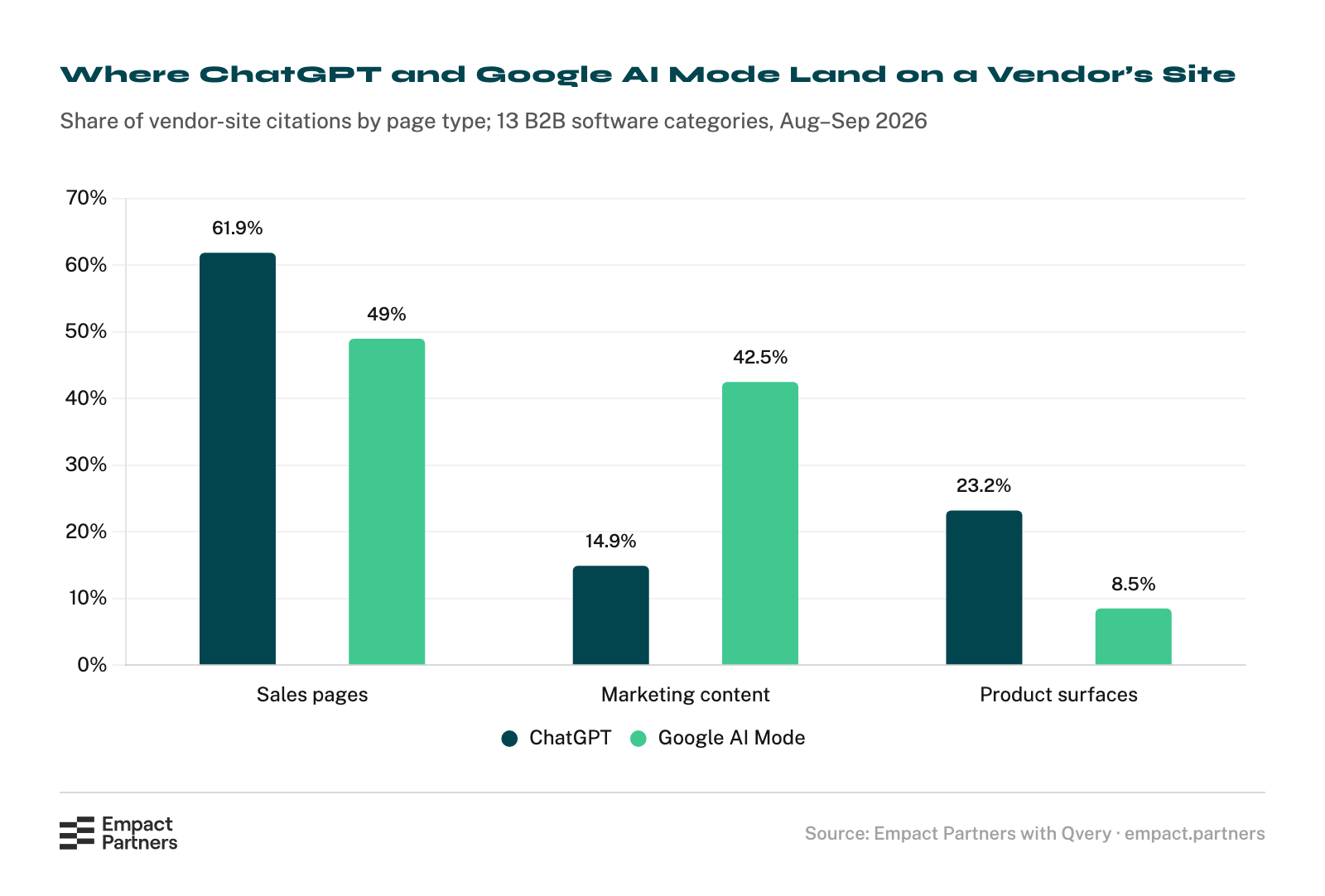
Together with Qvery, we classed every citation in 50,220 software-buying answers from 13 B2B software categories, collected 24 August to 15 September 2026. Vendor pages went three ways: product surfaces (help, docs, integrations, templates, community), marketing content (blogs, guides, comparisons) and sales pages (home, features, pricing). What it found:
The two engines read the same vendors differently. ChatGPT goes to the vendor and reads the product. Google AI Mode reads less of the vendor and more of its blog. A product-led team that writes only blog posts is writing for one engine.
Qvery’s own August 2026 study of SaaS buying questions shows the mechanism. It asked the same questions under two constraints, price and integration, and the constraint decided who answered:17
Third-party directories, the other place a self-serve product lists itself, carried 1.19% of all citations in Qvery’s collection this year, and G2’s share of citations fell 78% between January and March.18
Help Docs First, Integration Pages Second, Templates Last
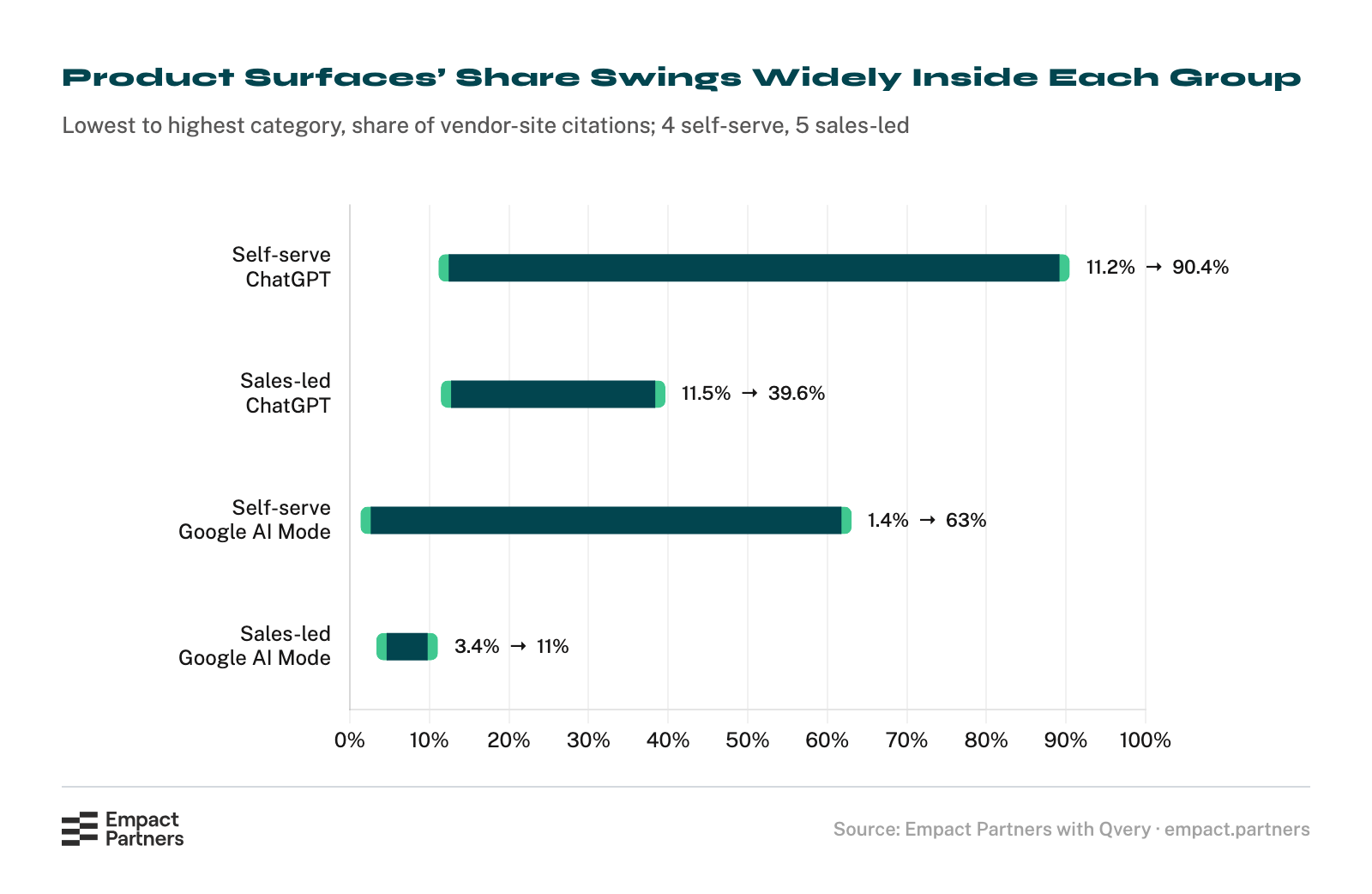
Split the 13 categories by how their products are bought and the pattern holds, with a wide spread inside it. In the four categories where buyers sign up on their own and the five where they book a demo:
Four and five categories make a direction, and the category decides more than the motion does: buyers who ask how something works get product pages, and self-serve products are bought by exactly those buyers.
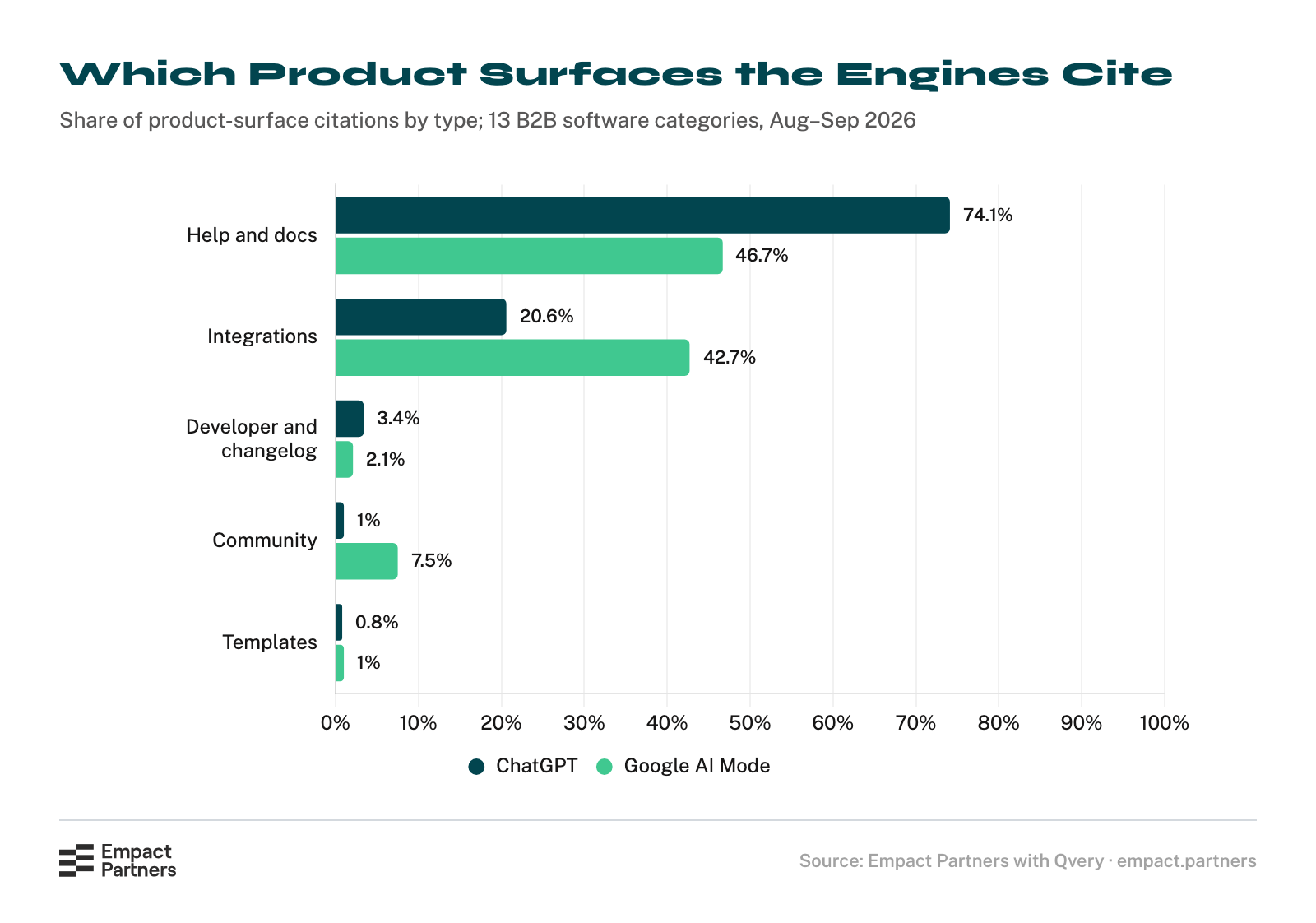
Inside the product-surface citations, one type dominates:
That ranking is the order of work, set by the engines rather than by taste: help docs first, integration pages second, everything else after.
The template line is the one that should change a roadmap, because our own partnerships proved every one of these surfaces in Google before the engines arrived:
All four won in search. In the answers we cut, help and guide pages carry the product-surface citation and template pages barely register. Community is the odd one: the discussion that feeds adoption lives on Reddit, outside the vendor’s site, which is why vendor-hosted community pages show up at only 1%.
The same order is how the Product-Led Growth workstream runs at Empact Partners. A partnership opens with an audit of which product surfaces an engine can read: public, current, written as answers, and cited or not in the partner’s category, which we read in Qvery. Then the rewrite runs in this order:
- Help docs, rewritten so each page answers one question a buyer asks before signing up.
- Integration pages, one per tool the buyer already runs, saying plainly what syncs and what does not.
- The public discussion: Reddit threads where buyers compare tools, run the way our KKday work ran.
- Templates and directory listings last, because the engines read them least.
A senior consultant owns the work inside the partner’s own channels, with our Generative Engine Optimization workstream beside it, which earns the third-party mentions a vendor cannot write about itself. It moves in quarters.
Call It Agent-Led Growth
Here is where this goes, as my reading rather than a measurement. The future of product growth is AI search. A buyer, and more often an agent working for one, asks which product fits, and the answer picks the product the company tries. ChartMogul’s 2026 report already describes signups shifting “from people to a combination of people and agents”.9
Call it agent-led growth. The free plan is still the front door, and the visitor at the door has changed. A product an agent cannot read, compare and recommend does not get tried, however good its onboarding is, which makes being visible in AI engines the first job of product-led growth.
What our evidence cannot settle yet is how much buying agents already do alone. No figure we found counts it. The nearest is G2’s: more than two-thirds of buyers let a chatbot change their vendor. Watch one number this quarter, the share of your signups arriving from an AI answer. Webflow’s was 10% and growing four times a year.
Empact Partners specializes in exactly this. If you need your product recommended more often when your buyers ask ChatGPT and Google AI Mode, book a call with me, and we’ll see whether we could work together.
Sources
- Airtable, “Airtable secures $735M to invest in its connected apps platform”, 2021. Series F announcement, 13 December 2021; $11 billion pre-money valuation. Read 5 October 2026.
- Miro, “Our story”, 2026. Company timeline; Series C entry, 2022. Read 5 October 2026.
- Bending Spoons, “Bending Spoons has entered into a definitive agreement to acquire Airtable for $1.285 billion”, 2026. Press release, 4 August 2026. Read 5 October 2026.
- Bending Spoons, “Bending Spoons enters into a definitive agreement to acquire Miro for $1.355 billion”, 2026. Press release, 10 September 2026. Read 5 October 2026.
- OpenView, “OpenView’s Third Annual Product Benchmarks Report Reveals PLG Companies 2x More Likely to Grow Quickly”, 2022. PR Newswire, 7 June 2022; survey of more than 450 product-led founders and CEOs. Read 5 October 2026.
- Sacra, “Blake Bartlett, partner at OpenView, on the future of product-led growth”, 2023. Interview. Read 5 October 2026.
- Kenrick Cai, Forbes, “VC Firm OpenView Collapsed Because Two Senior Leaders Quit, Sources Say”, 2023. 6 December 2023. Read 5 October 2026.
- ChartMogul, Sofia Faustino, “The SaaS Go-To-Market Report: How 2,500 SaaS companies acquire and convert customers”, 2025. ChartMogul billing data, Q1 2024 to Q1 2025; growth series from Q1 2022. Read 5 October 2026.
- ChartMogul, with Kyle Poyar and ProductLed, “The Conversion Report: Benchmarks for trials, freemium, and conversion in 2026”, 2026. Survey of 200 B2B software products, January 2026; conversion counted over six months from sign-up. Read 5 October 2026.
- ChartMogul, with Kyle Poyar and ProductLed, “The Conversion Report: What’s working to improve free-to-paid conversion”, 2026. The same January 2026 survey, second part, 18 March 2026. Read 5 October 2026.
- Figma, “Figma Announces Fourth Quarter and Fiscal Year 2025 Financial Results”, 2026. Results release, 18 February 2026. Read 5 October 2026.
- Lovable, “$100M ARR & Lovable Agent”, 2025. Company announcement, 23 July 2025. Read 5 October 2026.
- Cursor, “Series D announcement”, 2025. Company announcement, 13 November 2025. Read 5 October 2026.
- G2, “New G2 Research: Half of B2B Software Buyers Now Start Their Research With AI Chatbots”, 2026. PR Newswire, 15 April 2026; 1,076 buyers and decision makers surveyed online in March 2026. Read 5 October 2026.
- Kyle Poyar, Growth Unhinged, “Traffic is no longer a reliable growth metric”, 2025. Interview with Josh Grant, VP of Growth at Webflow, 2 November 2025. Read 5 October 2026.
- Empact Partners with Qvery, our own cut of Qvery’s collection: every citation in 50,220 software-buying answers on ChatGPT (25,924) and Google AI Mode (24,296) across 13 B2B software categories, 24 August to 15 September 2026, classed by the kind of page cited; pages on software vendors’ own sites split into product surfaces, marketing content and sales pages. Read 5 October 2026.
- Qvery, “The Landing Page Route: How SaaS Product Pages Become AI Engine Citations”, 2026. Constrained SaaS buying questions on ChatGPT and Google AI Mode, August 2026. Read 5 October 2026.
- Qvery, “Software Directories Still Feed AI Citations, Even as G2 Slides”, 2026. Qvery’s collection on ChatGPT and Google AI Mode since January 2026. Read 5 October 2026.
- Empact Partners, KKday case study, 2026. Three-month Reddit campaign, as published. Read 5 October 2026.
- Empact Partners, PDF Reader Pro case study, 2026. Partnership from June 2023, as published. Read 5 October 2026.
- Empact Partners, FAIR VC case study, 2026. Linearity section; partnership since 2019, as published. Read 5 October 2026.