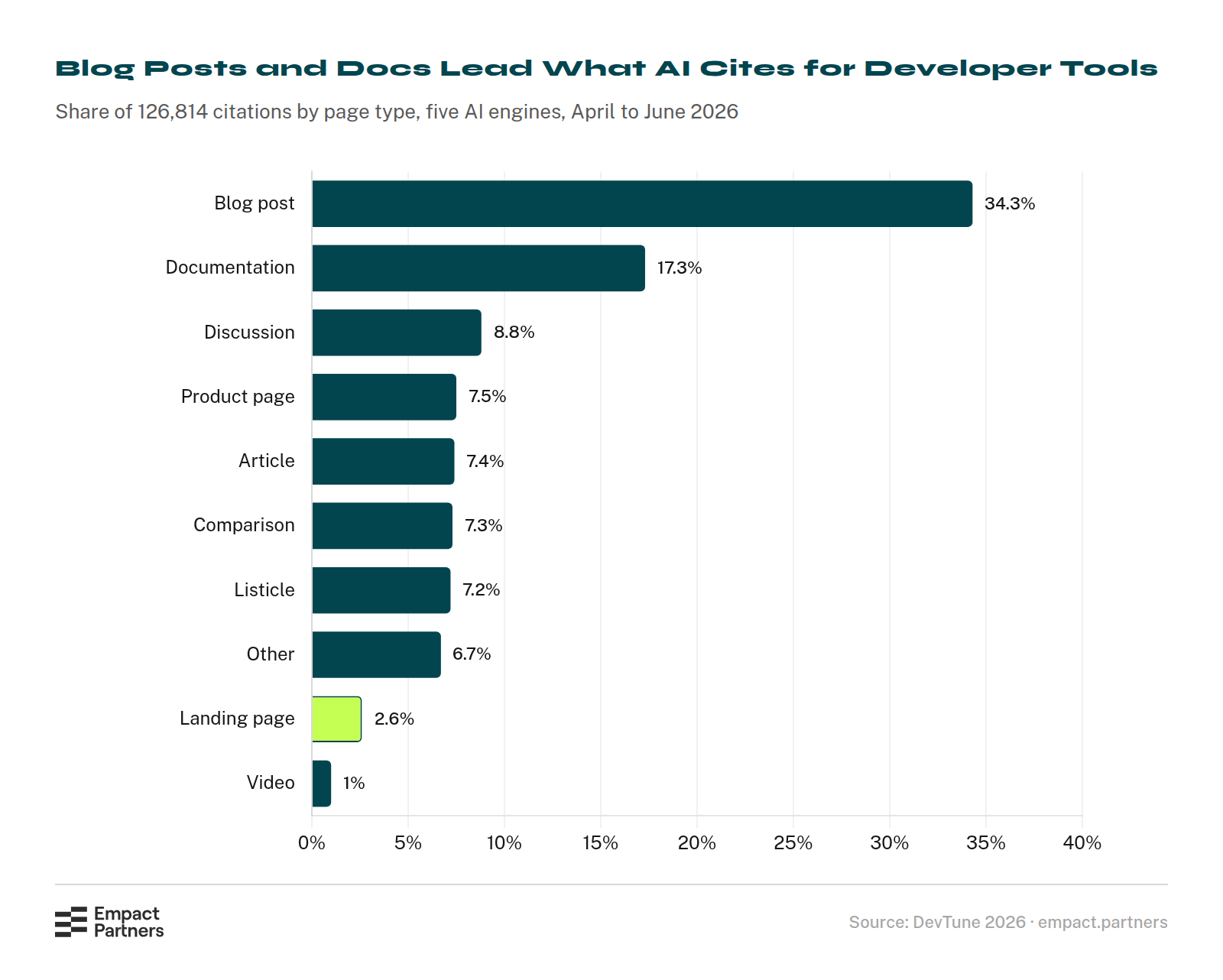
Landing pages are 2.6% of the pages AI engines cite when the question is about a developer tool.1 Blog posts are 34.3% and documentation is 17.3%.1 Most launch plans still put the landing page first, because that is the page a marketing team owns outright.
Empact Partners is a consultancy that works on go-to-market from inside B2B software companies. Generative Engine Optimization (GEO), getting a brand named when a buyer asks an AI engine about its category, is one of our six workstreams, and for a developer-facing partner it starts with one question: which pages are the engines reading?
Highlights
Read together, the figures say an engine cites pages. For a developer tool most of those pages belong to somebody else, the ones a vendor does own are its blog and its documentation, and inside each kind the pages cited more are the current, specific, checkable ones.
Blog Posts and Documentation Carry Half of Developer-Tool Citations
DevTune asked five AI engines 1,075 tool-evaluation questions across 43 developer-tool categories, every week from April to June 2026, and sorted each of the 126,814 citations by the kind of page it landed on.1 The shares:
Blog posts and documentation together are 51.6% of the citations, and both are pages somebody wrote to explain how a thing works. The page built to sell, the landing page, is cited about a thirteenth as often as the blog.
The same count split the citations by who owns the site. Vendors’ own domains, 781 of them, took 24.02% of citations. The other 75.98% went to 11,754 sites the vendors do not control: publications, communities, competitors, and reference pages.1
That split is why we describe Generative Engine Optimization with a formula, GEO = UGC + Mentions: what users say about a product in public, plus where independent pages name it. In a developer category three quarters of the cited surface is off the vendor’s own site, so a plan that only improves the site is working on the smaller part.

.png)
Developers Check an AI Answer Before They Use It
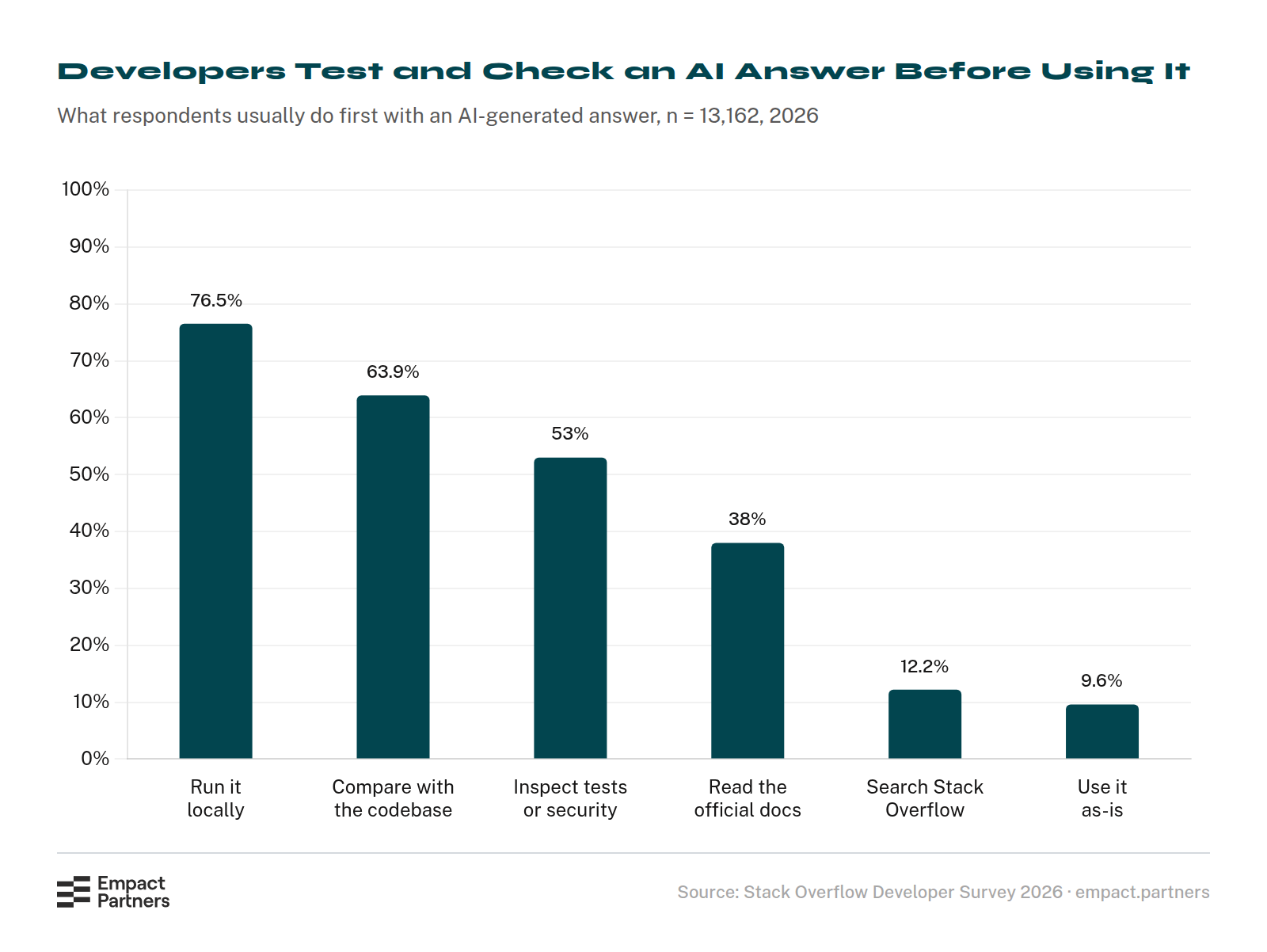
Stack Overflow’s 2026 Developer Survey, 30,903 responses collected from June to August, asked where developers go first for an answer and what they do with one from an AI tool.2 What it found:
No survey we could find asks developers how they choose a tool, so the step from these answers to tool choice is our reading, and we own it. A developer who checks before using opens the pages the engine cited. For a question about a tool, those pages are where the tool gets judged.
The Mix of Cited Pages Changes With the Engine
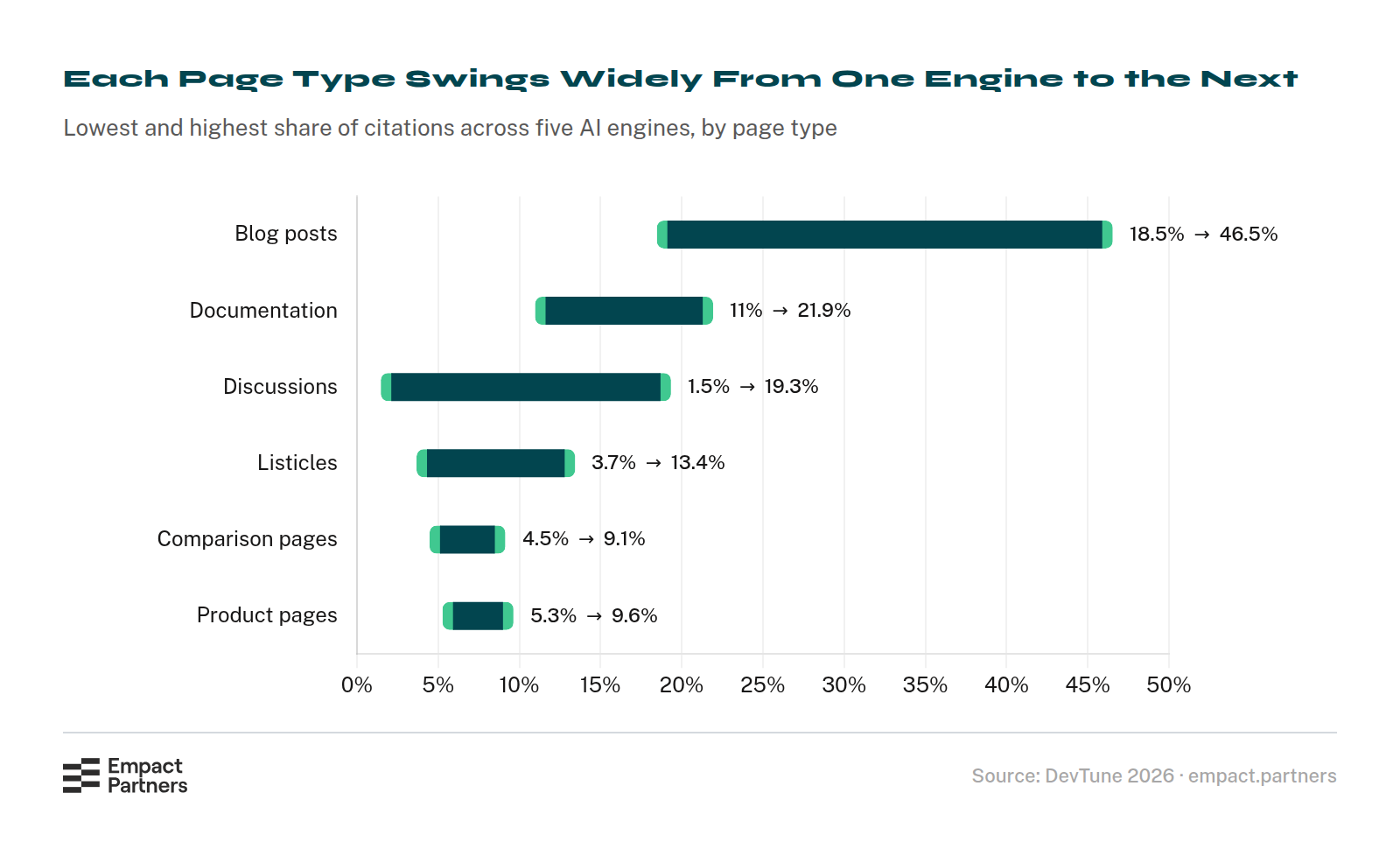
DevTune kept its five engines apart, and the page types do not hold still across them.1 For the same questions:
ChatGPT Search spreads its citations across documentation, discussions, and product pages. Perplexity and the two Google engines lean on blog posts and roundups, and Google AI Mode puts most of its weight on three sources. A team that knows which engine its buyers use can stop building for an average no engine matches.
Qvery, our sister company, measures what ChatGPT and Google AI Mode answer every day. Its all-category count through March 2026, which sorted hundreds of thousands of citations by title pattern, has listicles at 8.62% of ChatGPT’s citations and 2.50% of Google AI Mode’s.3 DevTune’s developer-tool count puts ChatGPT Search lowest.
The two counts cover different categories, use different classifiers, and ran in different months, so they cannot be laid side by side. The engine mix moves with the category and the quarter, so the count that matters is your own. Qvery is ours, so treat it as our instrument and read its published pages before taking our word.
.png)
On a Vendor’s Own Site, Documentation Is Cited Most
DevTune publishes the brands it tracks and the page type cited most on each one’s domain. By our count of that table, documentation leads for 36.8% of vendors, 155 of 421 domains, ahead of blog posts at 29.0%. Another 6.9% had no page of their own cited at all.1 Other counts point the same way:
Documentation is where a claim on the marketing site becomes something a reader can check, which is why engines reach for it when the question is technical. It is also the page a marketing team rarely owns.
What vendor documentation serves to a machine
On 13 October 2026 we requested the site of every vendor in DevTune’s benchmark, 421 domains, with a plain HTTP client and no JavaScript. 411 answered. The count describes what each site served that day. It cannot show what an engine read, and DevTune counted its citations months earlier.
Then we set the quarter of vendors DevTune saw cited most beside the quarter it saw cited least, 102 sites each. The most-cited vendors publish an llms.txt more often, 88.2% against 65.7%, and serve their documentation as Markdown more often, 57.6% against 33.7%.4

Being cited and publishing these files may both come from being a larger, longer-established company, so read the gap as a description. Two published counts found no payoff from the file itself. Ahrefs found 28% of domains publishing an llms.txt and 97% of those files never requested in a month.7 SE Ranking found 10.13% adoption and no relation to citations.8
Documentation and product tutorials are Content Marketing work at Empact Partners, because for a developer audience they are the content. On two large documentation platforms AI agents now outnumber human readers, which makes the format a page is served in part of the writing job.
Cited Articles Are Recent, Long, and Dense With Figures
The evidence on blog posts comes from the general web and from ChatGPT, and it compares pages cited more with pages cited less. SE Ranking modeled ChatGPT citations for 216,524 pages across 20 niches.9 Its average citations per page:
Ahrefs measured age another way, across 16.975 million cited URLs. The pages AI assistants cited were 1,064 days old on average, against 1,432 for the pages ranking in Google.10 Developers ask for the same thing: in the Stack Overflow survey, 72.6% named recency among the signals that make work information trustworthy.2
How much of the citing a blog carries depends on the category. In testing and QA, blog posts took 46.1% of citations, the highest of the categories DevTune tracked.1
Our own record points at the how-to end of the blog. For PDF Reader Pro we wrote product guides, pages that walk a user through one job in the product, and the case study attributes 15 to 20% of monthly sales to them.11 That is one partnership and a PDF product, so read it as what guides did there.
Roundups and Comparisons Are One Citation in Seven
Comparison pages took 7.3% of DevTune’s citations and roundups 7.2%, 14.5% together.1 DevTune then took 668 ranked pages that vendors had published on their own sites and looked at who was named in the answers that cited them.1
A vendor’s own comparison page earns the citation and usually the mention. About one time in six the answer names another brand and leaves the publisher out, and that happens more often with a best-tools list than with a head-to-head.

Other counts describe which roundups get cited:
Qvery also tested what goes with being named. Among SaaS brands ChatGPT named at least five times, a brand’s presence on the cited roundups tracked how often it was named more closely than its backlinks did.
On a scale where 1 means the two move in step, roundup presence scored 0.6374 against 0.3458 for backlinks rank.13 That is an association among brands already being named, on one engine.
Getting a partner’s product into the roundups that already get cited is the method we call Existing Article Outreach. It belongs to the SEO workstream, which we run as Search Everywhere Optimization: every surface a buyer searches, the AI engines included.
Reddit Took the Community Citation and Stack Overflow Lost It
Discussions were 8.8% of DevTune’s citations. Reddit was the most-cited independent domain in the count, with 10,831 citations across 5,109 URLs, ahead of Medium and dev.to.1 The other counts:
Developers still gather on GitHub and Stack Overflow in about equal numbers. Stack Overflow has all but left the citations, and GitHub holds a small share of everything ChatGPT cites.
Qvery’s count covers every category it tracks, so it describes AI answers at large. Our read is that a thread gets cited when the question is which tool to pick, and that conversation moved to Reddit.
Reddit threads are the UGC half of the formula. For our partners that means Reddit work done as a participant, in the threads buyers already read, with the product named where it answers the question.
What the First Audit of a Developer-Facing Partner Checks
A partnership with Empact Partners opens with an audit and a roadmap, before any new page is written. For a developer-facing partner the GEO part of that audit reads the cited surface by page type:
The roadmap that follows sets two or three workstreams moving together: content for the docs and how-tos, GEO and outreach for the roundups and threads. A named senior consultant owns it and joins the calls, the work runs in the partner’s own channels, reports ship on a standing schedule, and the first movement shows in quarters.
What these counts cannot settle is cause. Each comparison sets pages cited more beside pages cited less, or cited pages beside ranked ones. Nobody has yet set cited developer-tool pages beside uncited ones, us included. The number we would watch is the share of your category’s citations that lands on pages you can change.
If AI engines answer your category’s questions with other people’s pages and you want that changed, book a call with me. We will work out together whether it is something we should take on.
Sources
- DevTune, “The State of AI Search for Dev Tools: 2026,” 1 July 2026. 43 developer-tool categories, 1,075 questions re-run weekly on five AI engines, 126,814 citations, 2 April to 30 June 2026. The vendor-level shares are our arithmetic on its published brand table. Read 12 October 2026.
- Stack Overflow, “2026 Developer Survey,” 2026. 30,903 responses from 169 countries, 23 June to 5 August 2026. Read 12 October 2026.
- Qvery, “Listicles Are the Most Cited Content Type in AI Search,” by Vlad Shvets, 29 March 2026. ChatGPT and Google AI Mode, all tracked categories, page type read from title patterns. Read 12 October 2026.
- Empact Partners, vendor-site count. The 421 domains of the brands in DevTune’s 2026 benchmark, each requested once with a plain HTTP client and no JavaScript on 13 October 2026. 411 answered. Most-cited and least-cited quarters by DevTune’s citation records, 102 sites each.
- Ahrefs, “Do Self-Promotional ‘Best’ Lists Boost ChatGPT Visibility? Study of 26,283 Source URLs,” by Glen Allsopp, 4 December 2025. 750 ChatGPT prompts across software, products, and agencies. Read 12 October 2026.
- Qvery, “The Landing Page Route: How SaaS Product Pages Become AI Engine Citations,” by Vlad Shvets, 1 September 2026. Constrained SaaS buying questions on ChatGPT and Google AI Mode, August 2026. Read 12 October 2026.
- Ahrefs, “We Analyzed 137K Sites: 97% of llms.txt Files Never Get Read,” 15 June 2026. 137,210 domains, May 2026. Read 12 October 2026.
- SE Ranking, “Does LLMs.txt impact your AI visibility and citations? No, according to research,” 7 November 2025. Nearly 300,000 domains. Read 12 October 2026.
- SE Ranking, “How to optimize for ChatGPT: LLMs.txt doesn’t matter but brand mentions on Quora and Reddit do,” 24 November 2025. 129,000 domains and 216,524 pages across 20 niches. Read 12 October 2026.
- Ahrefs, “New Study: AI Assistants Prefer to Cite ‘Fresher’ Content (17 Million Citations Analyzed),” 28 July 2025. Read 12 October 2026.
- Empact Partners, PDF Reader Pro case study. One partnership, from June 2023. The sales figures are the ones its public page prints. Read 13 October 2026.
- Qvery, “The Self-Listicle Playbook for SaaS: How to Build a Best-Tools Roundup Like the Ones AI Engines Cite,” by Vlad Shvets, 22 September 2026. SaaS buying questions on ChatGPT and Google AI Mode, September 2026. Read 12 October 2026.
- Qvery, “Does Domain Authority Decide Which SaaS Brands ChatGPT Names? Roundups Track It More Closely,” by Vlad Shvets, 22 September 2026. SaaS brands ChatGPT named at least five times, September 2026. Read 12 October 2026.
- Qvery, “Stack Overflow Is Almost Invisible in AI Search,” by Vlad Shvets, 8 May 2026. All tracked categories on ChatGPT and Google AI Mode. The count behind the share, 772 of 5,681,370 citation links, is from Qvery’s own dataset notes. Read 12 October 2026.
- Similarweb, “The Most Cited Domains by LLMs and the Signals That Get You Cited,” by Maayan Zohar Basteker, 14 April 2026. Nearly 600,000 citation events, United States, January to February 2026. Read 12 October 2026.