On ChatGPT, 17.2% of the citations that reach a software vendor’s own website land on its help center and product documentation. The blog, the guides, and the comparison pages take 14.9% between them.1
Documentation gets budgeted as a support cost that nobody outside the product reads. On this engine it is cited about as often as everything the content team publishes. On Google AI Mode the same pages take 4%, so the answer depends on where your buyers ask.1
Whether an engine can read those pages is another matter. When we asked the public help centers of the Forbes Cloud 100 for a page with a plain request, no browser behind it, 35 of 83 answered with a bot challenge.2
Highlights
Together they make documentation a budget question. It is a real slice of what ChatGPT cites from a vendor’s own site and a thin slice of what Google AI Mode cites, and it earns that slice while buyers compare products. At four in ten of the Cloud 100 companies that have a help center, it met a machine’s plain request with a challenge.
ChatGPT Cites Help and Docs Pages About as Often as the Blog
Empact Partners ran this cut with Qvery, our sister company, which records the answers AI engines give and the pages they cite. It covers every citation in 50,220 answers to software-buying questions, across 13 B2B software categories on ChatGPT and Google AI Mode, from 24 August to 15 September 2026.1
Qvery is ours, so discount the measurement the way you would any seller’s, and hold it against the four outside studies in the next section. The same cut fed our product-led growth statistics. Here it is re-read for documentation, with each cited page classed by its kind.
Drawn as two bars, the engines stop looking like versions of each other.
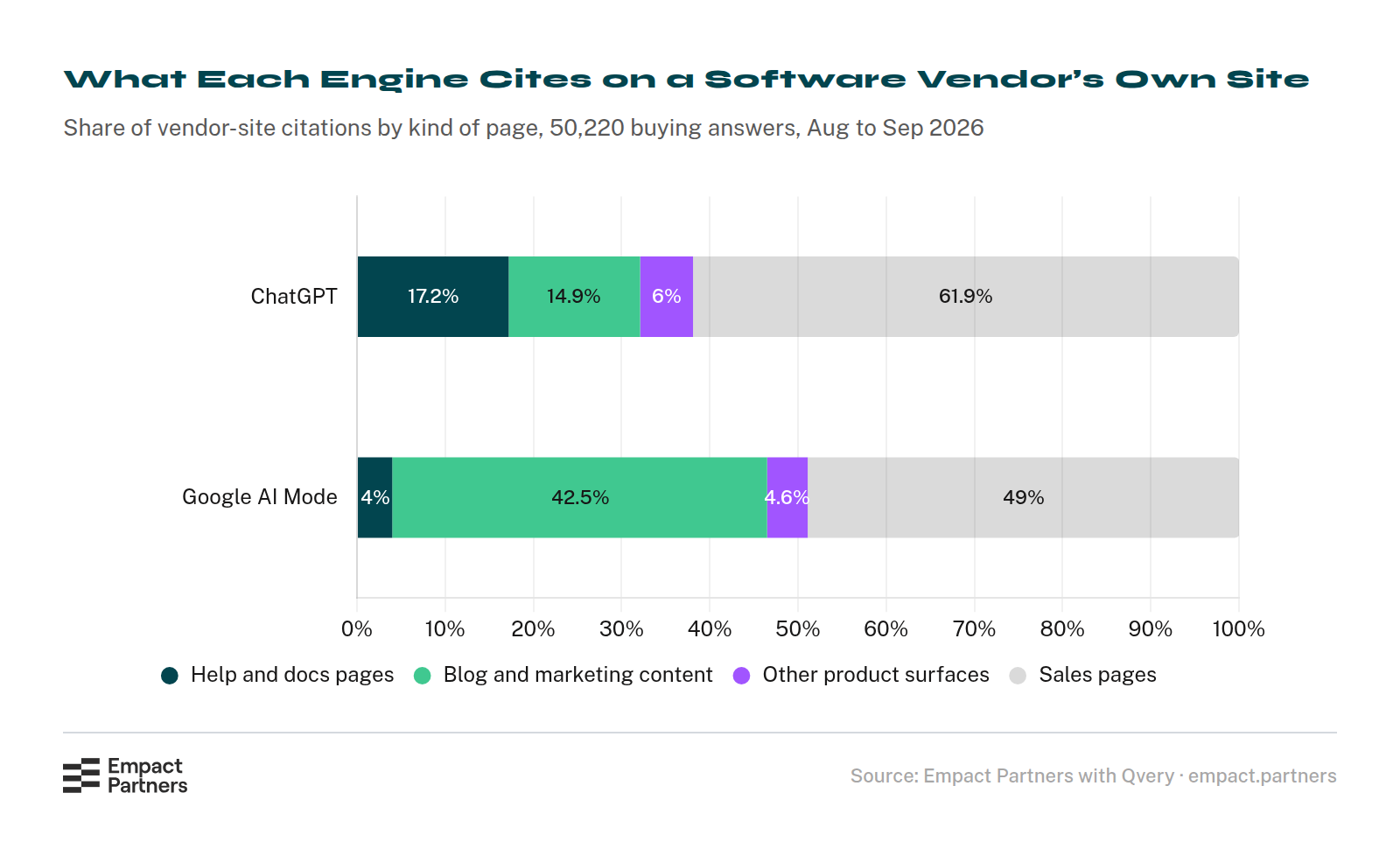
Sales pages lead on both engines, which keeps the documentation claim its true size. On ChatGPT, help and docs pages are the second thing cited from a vendor’s site, level with the whole blog shelf. On Google AI Mode the blog shelf outweighs them roughly ten to one.
Held against everything the engines cited, a vendor’s help or docs page was 13.2% of ChatGPT’s citations and 1.4% of Google AI Mode’s. Reach points the same way. 47.1% of ChatGPT’s answers cited at least one product surface, a wider class that adds integration, developer, community, and template pages, against 9.1% on Google AI Mode.1
Inside that wider class, the kinds of documentation are far from equal. On ChatGPT its citations divide like this.
Reading which of a partner’s own pages the engines already cite is where our Generative Engine Optimization work begins. GEO is the workstream that gets a software company named and cited in AI answers. It works on the company’s own website, on mentions elsewhere, and on user-generated content, and documentation belongs to the first.

.png)
Four Outside Studies Put Documentation in the Same Range
One cut from a seller’s sister company is a reason to look and no reason to move budget. Four studies by other people have measured documentation’s share on ChatGPT. Each asked different questions and divided by something different, which is why they sit in a table and not on one axis.
| Study | Documentation’s share on ChatGPT, and of what |
|---|---|
| Evocia | 17% of 2,259 citations in 800 answers to French-language B2B software buying questions, September 2026, with documentation counted by host name3 |
| Position Digital | 12.5% of 3,508 citations across 278 buyer questions in six B2B SaaS niches, July 20267 |
| DevTune | 21.9% of ChatGPT Search’s citation records, in a set of 126,814 across 43 developer-tool categories and five engines, April to June 20268 |
| Aleyda Solis | 19.7% to 26.6% of the citation weight on the owned pages of 15 large US SaaS brands, July 20269 |
Evocia and Position Digital divide by every citation in the answer, DevTune by every citation record in its dataset, and Solis by the weight on a brand’s own pages only. Ours divides by citations to vendor sites. They cannot be averaged, and they agree on the order of size: between an eighth and a quarter of whatever each one counted.
Evocia’s figure is also a floor. It counts documentation by host name, so a help center that lives under the main domain is filed as vendor site. Divide the share back into answers and it is at least one documentation citation in 266 of the 800, a third of them.3
The engine split repeats in the two studies that measured more than one engine, and in Qvery’s older data on titles.
Solis’s ranges show the swap most plainly.
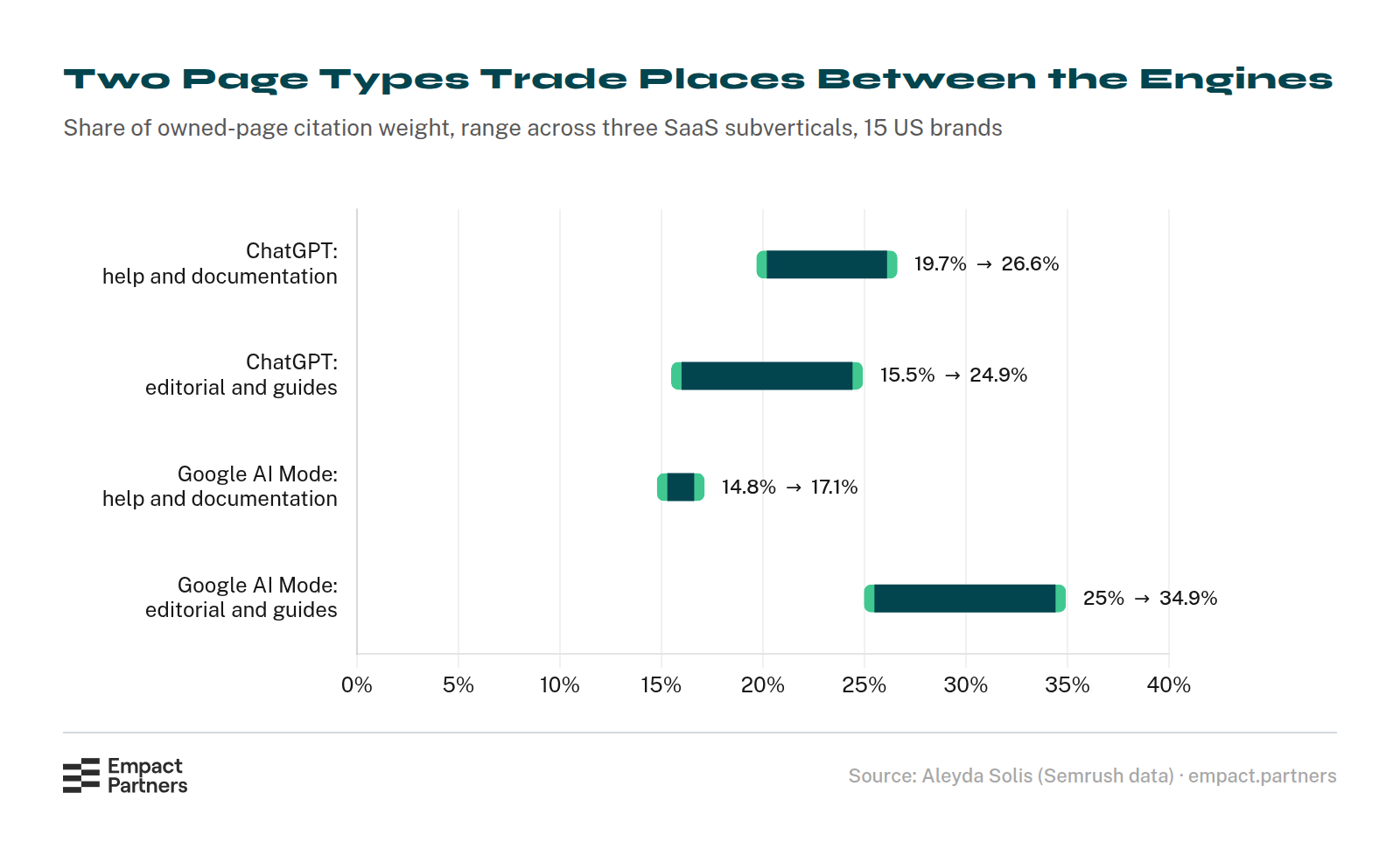
So the split in our cut is not an accident of one dataset. ChatGPT leans on a vendor’s documentation, Google AI Mode leans on its publishing, and two outside datasets say the same.
How big is the slice once everything else is counted?
Vendor sites as a group take most of what ChatGPT cites on software questions, but any one brand’s own pages are a small part of the answers about that brand, and documentation is a slice of that part. One documentation host collects a third of that slice, and ten collect most of it.
A documentation project replaces none of the mentions a brand earns elsewhere. It decides what gets quoted when the engine does come to your site.
Documentation Gets Cited When the Buyer Is Choosing
The natural guess is that documentation gets cited after the sale, on how-to questions from people who already own the product. Evocia sorted its 200 questions by buying stage, and the share of each stage’s citations that went to documentation hosts runs the other way.
Laid out stage by stage, the low point is the very first one.
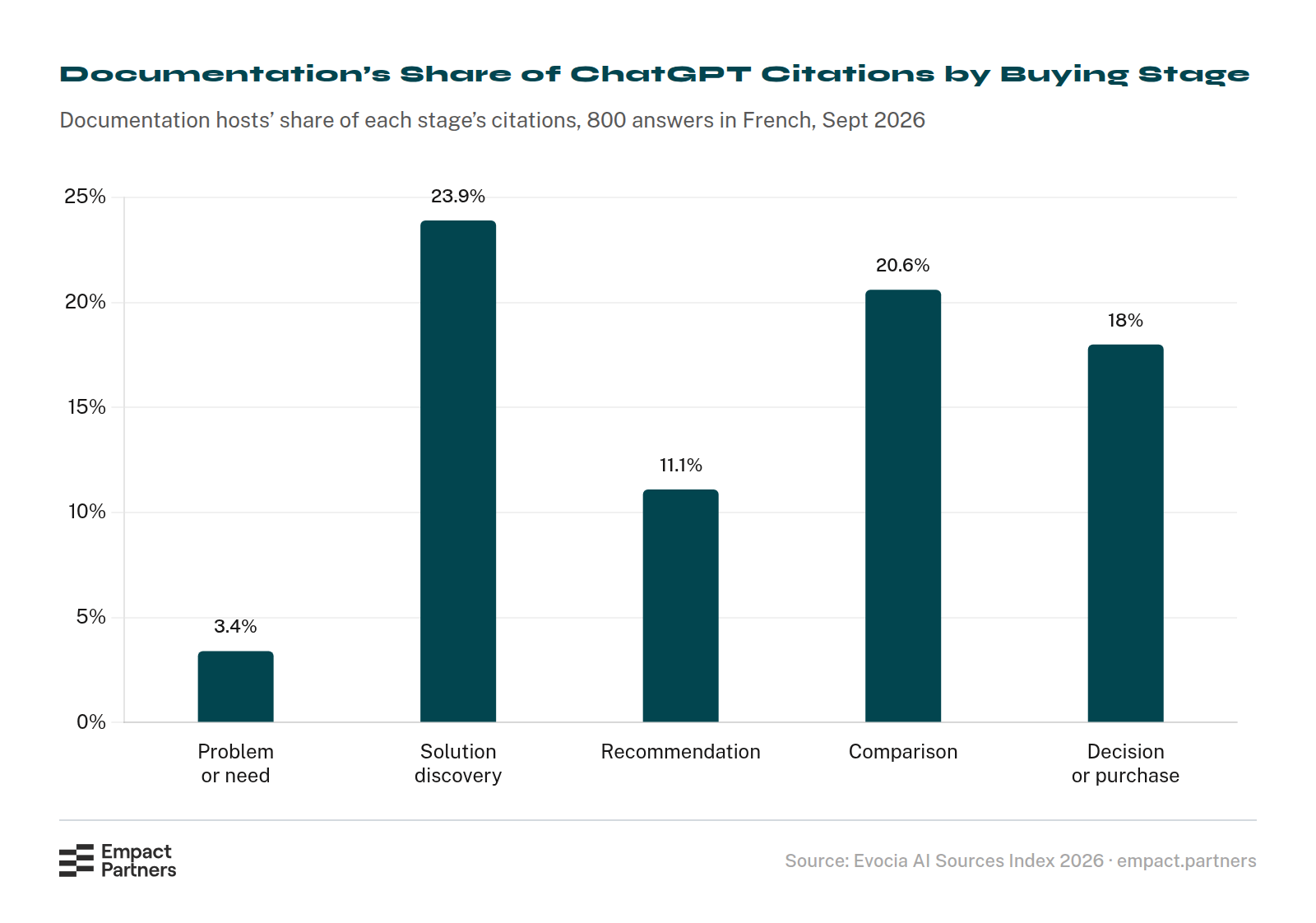
Documentation is nearly absent while a buyer is describing the problem and heaviest once they are asking what the products do. Evocia says it does not measure why. Our reading is that questions at those stages have checkable answers, such as whether a product supports single sign-on or connects to a given CRM, and the checkable answer lives in documentation.
Qvery’s published studies point the same way. They are small, targeted question sets with no counts printed, so take them as direction.
Outside measurements mark the edges of the pattern.
Open “best X” prompts are where documentation goes missing, which matches Evocia’s low share on recommendation questions. Once the question carries a constraint, a price or an integration, the page that states the fact can be cited more often than the page built to sell it. Plaid’s billing documentation was cited more often than its own pricing page.
Technical Categories Lean on Documentation Far More Than Back-Office Ones
What the buyer is choosing between matters as much as when. The same study asked 20 questions in each of ten B2B software sectors, 80 answers per sector, which is enough to rank the sectors and too little to treat any one figure as a rate. Here is documentation’s share of each sector’s citations.
Ranked, the top sector’s share is nearly eight times the bottom one’s.
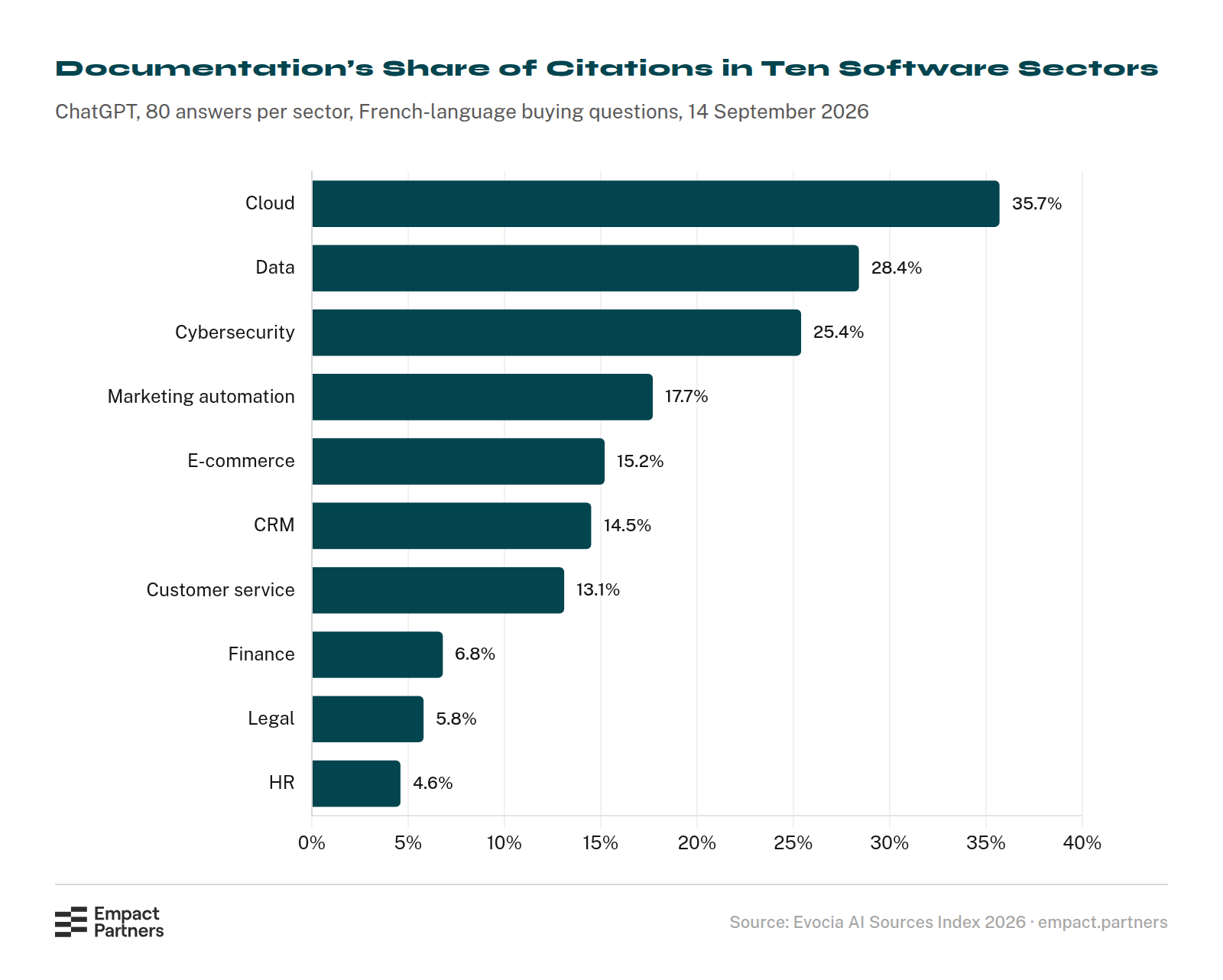
The order looks like a ranking by how technical the purchase is. In cloud, data, and security software the buyer asks what the product does and what it connects to, and reference pages answer that. DevTune’s developer-tools dataset sits at the same end, with documentation at 21.9% of ChatGPT Search’s citations.8
In finance, legal, and HR software the share falls into single digits. If you sell at the technical end, documentation is likely one of the main things ChatGPT cites from your site. If you sell at the other end, this data says it is a small one, and a documentation project there needs a better reason than citations.
The Top of the Page Gets Quoted Most
Which pages get cited is half of what a writer can use. The other half is where on the page the cited passage sits, and the studies that looked agree on the shape.
A well-made help article already looks like this. Its title is the question, its answer sits in the opening lines, and its steps run under headings in order. A blog post that opens on a story and reaches its answer in the fourth section is built the other way around.
Length, schema markup, and the llms.txt file, a plain-text map of a site written for machines, have each been tested as ways to earn citations. So has a page’s age.
On Two Documentation Platforms, AI Agents Now Outnumber Human Readers
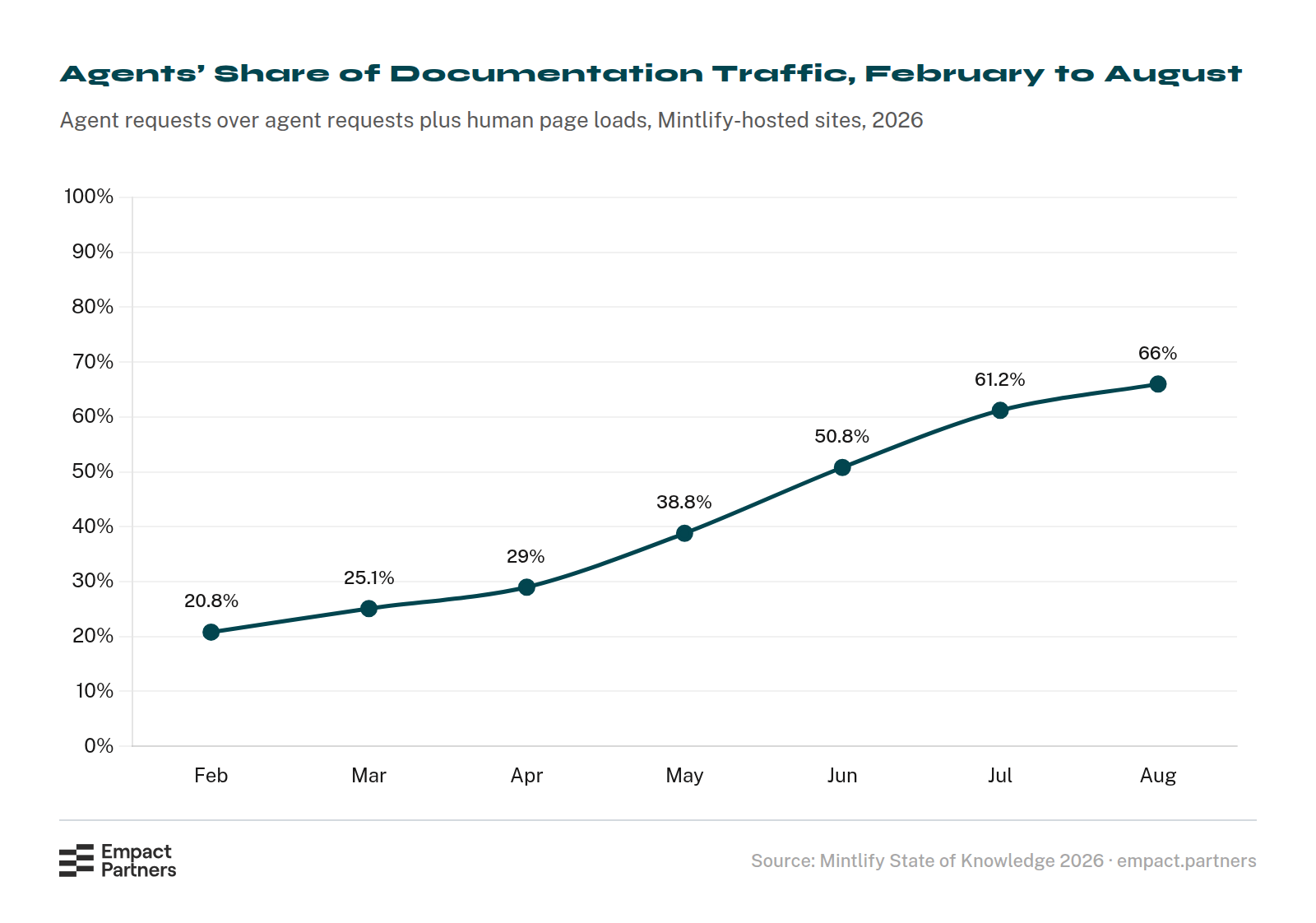
The llms.txt result deserves a second reading. The file does nothing measurable for citations, and that fits what it is for: it serves agents that do work, coding assistants above all. On two platforms that host documentation, those agents are now most of the audience. Mintlify, one of those platforms, published seven months of its own traffic.
Month by month, the share climbs without a break.
A second platform and a survey land close by.
Mintlify counts agents and people by different methods and calls the comparison an estimate, so hold the trend more firmly than the level.
None of it is citation, either. An agent fetching a Markdown page to finish a coding task is a different event from an answer engine quoting a help article to a buyer, and Google says its AI features use neither llms.txt nor Markdown copies.24
What the traffic does show is that documentation teams already publish for machines on purpose. That makes what we found at the help center harder to explain as a decision.
Four in Ten Help Centers Refused a Plain Request
On 12 October 2026 we requested the public documentation and help-center pages of the 100 companies on Forbes’ 2025 Cloud 100 with a plain HTTP client, no JavaScript, and recorded what each address sent back. That came to 89 documentation addresses and 83 help centers, and the help centers are where the requests failed.2
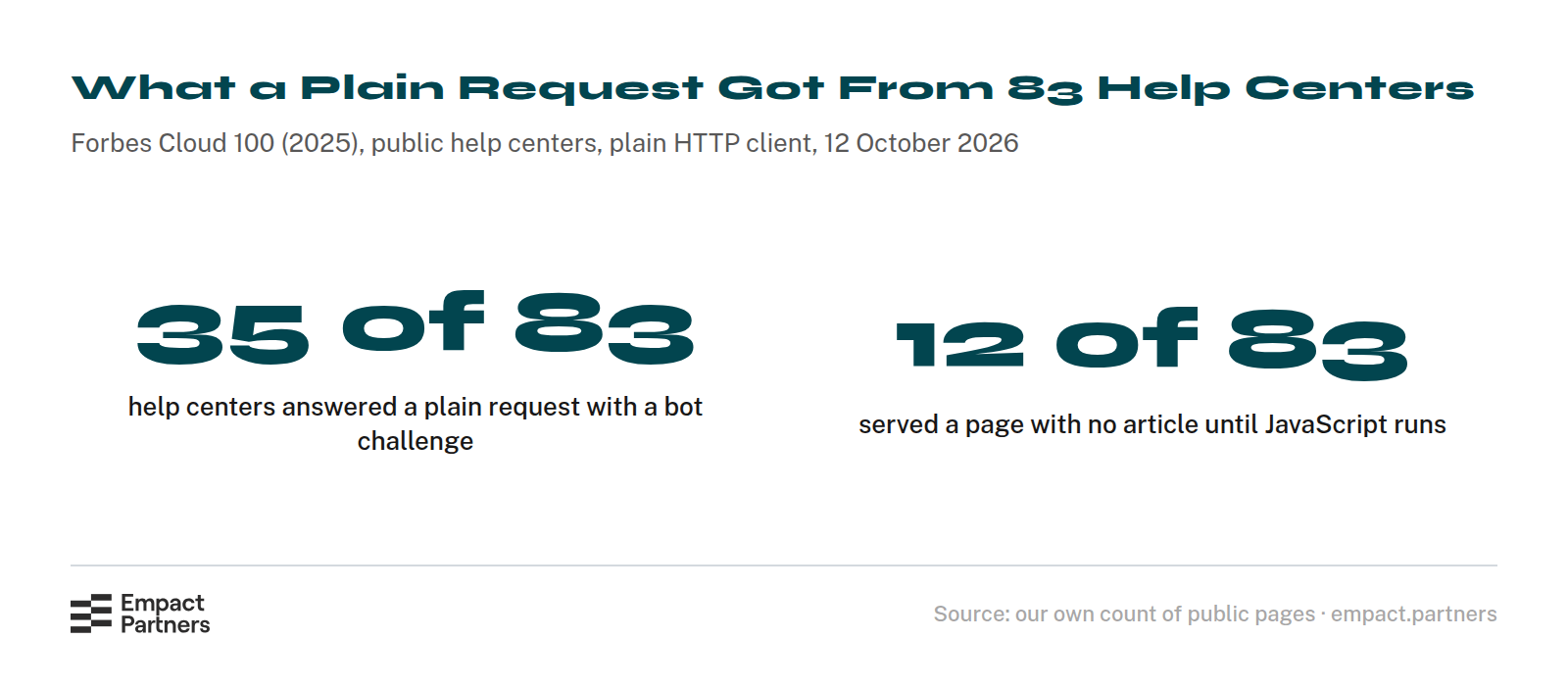
The 35 help centers that answered with a challenge did so on both passes, about fifteen minutes apart. Asked again the same day through an AI assistant’s own page-fetch tool, from its provider’s network, 35 of 35 refused once more.2 It is still what unrecognized software received on one day: the default a help center presents to a client it does not know.
A crawler the bot protection recognizes may be let through. Nothing here measures what OAI-SearchBot receives, the crawler OpenAI says decides whether a site can appear in ChatGPT’s search answers.25
The script shell is a quieter refusal. When Vercel and MERJ studied crawler traffic in December 2024, OpenAI’s and Anthropic’s crawlers fetched script files and did not run them, so a page that needs JavaScript to show its article would show them none.26
Documentation hosts publish copies for machines
Product and developer documentation on the same list goes the other way.
Side by side, the two kinds of host do not overlap on any measure.
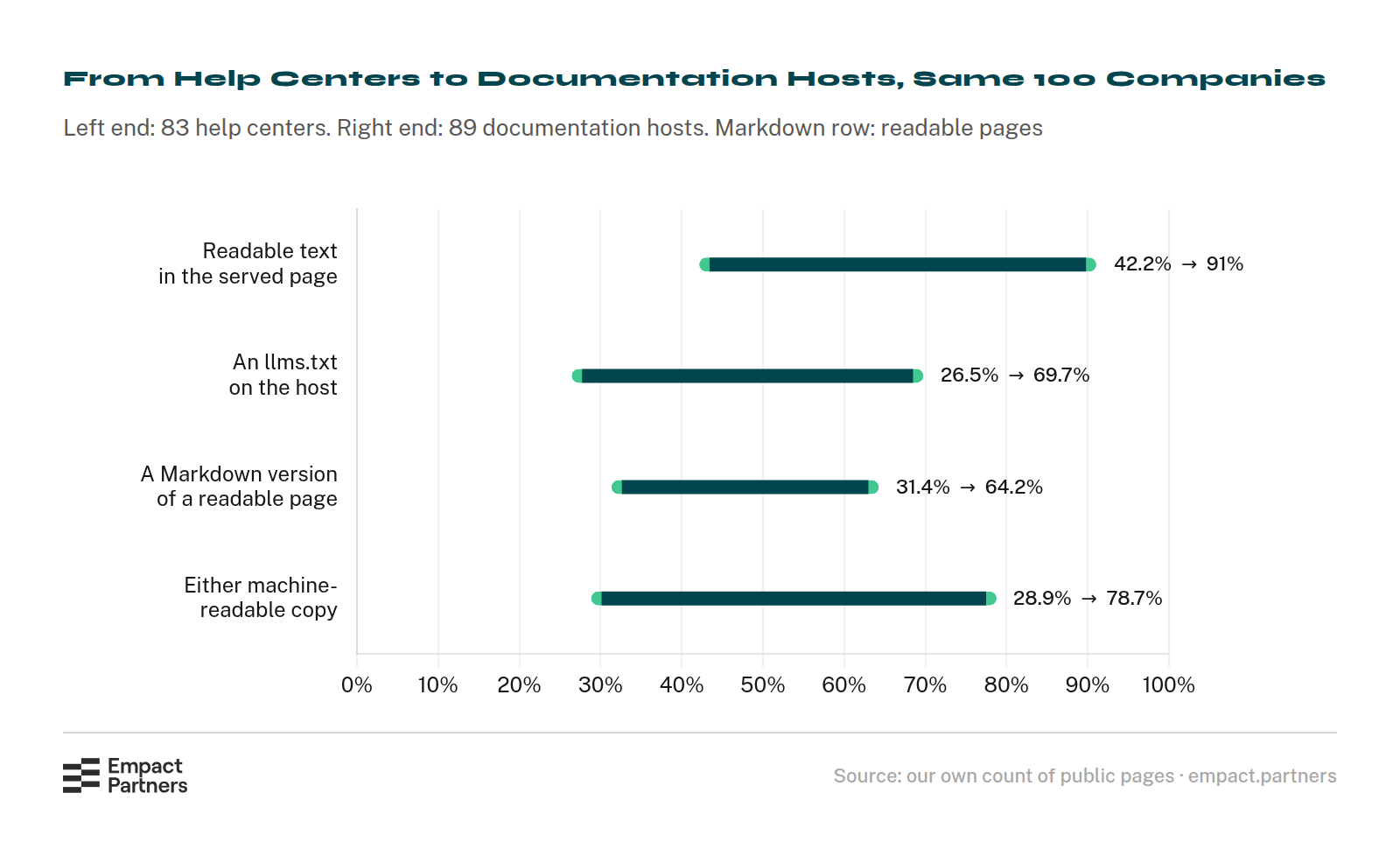
The web at large is nowhere near this. HTTP Archive found an llms.txt on 2.13% of sites across 16.2 million in July 2025,27 and Cloudflare found that 3.9% of sites among the most visited domains answer a request for Markdown with Markdown.28 The Cloud 100 is courting machines on every host but one.
The refusals follow the help-desk platform
Three help-desk platforms could be told apart by their own signatures, and the help centers on each behave alike.
Nothing a marketing team controls produced this, and the marketing side of the same companies is open.
Twenty-one companies publish a map for machines on one host and challenge them on another. That reads as a setting left where the help-desk platform put it, and very little like a policy on AI.
.png)
The hosts explain how it stays unnoticed. 66 of 89 documentation addresses sit on a subdomain of the company’s site and 7 on a different domain altogether, and help centers are the same: 65 of 83 on a subdomain, 9 on another domain.2 These are separate systems, usually with their own administrators, and the marketing team’s CMS reaches neither.
Empact Partners is a consultancy that B2B software companies bring into their own marketing teams to run go-to-market work. A GEO partnership opens with a website audit for AI citability, and whether a machine can fetch a page comes before anything the page says. For a help center, that means finding the help-desk platform’s administrator.
What Nobody Has Measured Yet
The evidence stops short of what a budget owner most wants to know.
What our own record does show is narrower. PDF Reader Pro has been a partner since June 2023, and its case study records 85% sales growth, with the product guides we wrote bringing in 15–20% of monthly sales.6 That is one partnership, and it says a documentation-type page is a commercial surface whether or not an engine is quoting it.
In a GEO partnership a named senior consultant owns the work. We run the audit and the standing reports on what the engines cite, and the partner supplies access to the people who own the pages. Rewriting them is our Content Marketing workstream, whose staple is the product tutorial. Expect three to six months before citations move.
If your documentation is turning up in AI answers you never planned for, or your help center cannot be read by a machine at all, book a meeting with me. We can find out together whether it is work for us.
Sources
- Empact Partners with Qvery, our own cut of Qvery’s collection, first published in 49 Product-Led Growth Statistics: every citation in 50,220 software-buying answers on ChatGPT (25,924) and Google AI Mode (24,296) across 13 B2B software categories, 24 August to 15 September 2026, each cited page classed by its kind. Pulled 5 October 2026, re-read 12 October 2026.
- Empact Partners, our own count of public pages: the documentation and help-center addresses of the 100 companies on the Forbes Cloud 100, 2025 edition (89 documentation addresses, 83 help centers), requested with a plain HTTP client and no JavaScript in two passes on 12 October 2026, the 35 refusals asked again through an AI assistant’s page-fetch tool. It records what an unrecognized client received, never what an engine cited.
- Evocia, “La documentation produit pèse 17 % des citations de ChatGPT, et jusqu’à 36 % en cloud”, AI Sources Index 2026, 17 September 2026, updated 10 October 2026. 2,259 citations in 800 ChatGPT answers to 200 French-language B2B software buying questions across ten sectors, one run on 14 September 2026, documentation counted by host name. Read 12 October 2026.
- Kevin Indig, “The Science Of How AI Pays Attention”, Search Engine Journal, 17 February 2026. 18,012 ChatGPT citations, each matched to the passage it draws on. Read 12 October 2026.
- Mintlify, “The 2026 State of Knowledge Report”, 2026. Traffic to the documentation sites Mintlify hosts, 1 February to 31 August 2026, and 2,400 controlled tests of coding agents across 20 documentation sites. Read 12 October 2026.
- Empact Partners, the PDF Reader Pro case study. Partnership from June 2023; the sales growth and the product-guide share are the figures the case study itself publishes. Read 12 October 2026.
- Position Digital, “Top ChatGPT Ranking Factors in B2B SaaS Niches”, updated 12 August 2026. 3,508 ChatGPT citations across 278 buyer questions in six B2B SaaS niches, one snapshot in July 2026. Read 12 October 2026.
- DevTune, “The State of AI Search for Dev Tools: 2026”, 1 July 2026. 126,814 citation records across 43 developer-tool categories and five engines, 2 April to 30 June 2026. Read 12 October 2026.
- Aleyda Solis, “What It Takes for SaaS Brands to Win in AI Search: 5 Data-Backed Findings and Actions”, 16 July 2026. Citation weight for 15 US SaaS brands in three subverticals on ChatGPT and Google AI Mode, from Semrush data; ranges only, and citation weight is not defined on the page. Read 12 October 2026 in the Internet Archive capture of 21 September 2026.
- Qvery, “Listicles Are the Most Cited Content Type in AI Search”, Vlad Shvets, 29 March 2026. Content type classed by title pattern, which matches about 12% of citations. Our sister company. Read 12 October 2026.
- Qvery, “How To Run A Content Gap Analysis For AI Search”, Vlad Shvets, 4 September 2026. One software category in one month, shopping questions against learning questions, with no counts printed. Our sister company. Read 12 October 2026.
- Qvery, “The Landing Page Route: How SaaS Product Pages Become AI Engine Citations”, Vlad Shvets, 1 September 2026. A targeted set of SaaS buying questions constrained by price or by integration, on ChatGPT and Google AI Mode, August 2026, with no counts printed. Our sister company. Read 12 October 2026.
- Ahrefs, “Do Self-Promotional ‘Best’ Lists Boost ChatGPT Visibility? Study of 26,283 Source URLs”, Glen Allsopp, 4 December 2025. 750 top-of-funnel prompts across software, products, and agencies on ChatGPT. Read 12 October 2026.
- Profound and Growth Unhinged, “What AI agents really think about your pricing”, Kyle Poyar and Nikolas Laskaris, 3 September 2026. The Forbes Cloud 100’s pricing pages and six engines’ answers about them, 29 July to 10 August 2026. Read 12 October 2026.
- AirOps, “The Influence of Retrieval, Fan-out, and Google SERPs on ChatGPT Citations”, Oshen Davidson, 12 March 2026. 15,000 queries and 548,534 retrieved pages on ChatGPT. Read 12 October 2026.
- CXL, “Where Google AI Overviews Cite From: A 100-Page Study”, Tarek Reslan, 6 March 2026, updated 26 August 2026. 100 Google AI Overview citations. Read 12 October 2026 in the Internet Archive capture of 16 September 2026.
- AirOps, “Why Ranking on Page One Isn’t Enough”, Oshen Davidson, 18 July 2025. 900 queries across 15 industries and more than 12,000 URLs. Read 12 October 2026.
- Ahrefs, “Short vs. Long Content in AI Overviews: The Data Says Both Work”, Despina Gavoyannis, 3 December 2025. 174,048 pages cited in Google AI Overviews. Read 12 October 2026.
- Ahrefs, “We Tracked 1,885 Pages Adding Schema. AI Citations Barely Moved.”, Louise Linehan, 11 May 2026. Pages that added JSON-LD schema between August 2025 and March 2026, against matched controls. Read 12 October 2026.
- Ahrefs, “We Analyzed 137K Sites: 97% of llms.txt Files Never Get Read”, Louise Linehan, 15 June 2026. 137,210 sites using Ahrefs’ analytics, May 2026. Read 12 October 2026.
- SE Ranking, “LLMs.txt: Why Brands Rely On It and Why It Doesn’t Work”, Yulia Deda, 7 November 2025. Nearly 300,000 domains. Read 12 October 2026.
- GitBook, “Research: AI agents are now the majority reader of your docs”, Rémi Gonnu, 13 May 2026. Page views on GitBook-hosted documentation, 27 April to 3 May 2026, crawlers excluded. Read 12 October 2026.
- GitBook, “The State of Docs Report 2026”, 2026. A survey of 1,131 documentation professionals. Read 12 October 2026.
- Google Search Central, “Optimizing your website for generative AI features on Google Search”, last updated 10 July 2026. Read 12 October 2026.
- OpenAI, “Overview of OpenAI Crawlers”. Read 12 October 2026.
- Vercel, “The rise of the AI crawler”, Giacomo Zecchini, Alice Alexandra Moore, Malte Ubl, and Ryan Siddle, 17 December 2024. Crawler requests across Vercel’s network, studied with MERJ. Read 12 October 2026.
- HTTP Archive, Web Almanac 2025, SEO chapter, 15 January 2026. 16.2 million websites in the July 2025 crawl. Read 12 October 2026.
- Cloudflare, “Introducing the Agent Readiness score. Is your site agent-ready?”, André Jesus and Vance Morrison, 17 April 2026. The 200,000 most visited domains, filtered to businesses, publishers, and platforms. Read 12 October 2026.
- Cloudflare, “The Internet has a second audience”, Matthew Conroy, 30 September 2026. Sites on Cloudflare’s network. Read 12 October 2026.