


Asked five times for the best SOC 2 compliance software, ChatGPT named the same five tools in the same order every time: Vanta, Drata, Secureframe, Sprinto and Thoropass. On visibility, the share of answers naming a brand at all, each scores 100%. Weighted toward whoever is named first, Vanta holds 32.4% of the voice to Thoropass’s 7.2%.1
Both of those numbers get sold as AI share of voice. The figures below are for the marketing team that has been handed one: what the term counts, how each tool calculates it, how far the readings disagree on the same answers, and how to calculate one you could defend to a board.
We are Empact Partners, a consultancy B2B software companies hire for go-to-market work, and this measurement starts our Generative Engine Optimization (GEO) work: getting brands into the answers buyers read. Qvery, our sister company with the same founder, supplied the category figures, so weigh them accordingly. The Sources carry each method.
Highlights
Read together, they say that whether a brand was named barely separates brands at the top of a category. What separates them is position, and position moves between asks, between engines and between formulas. A share of voice worth reporting is a series measured on a fixed question set, with its formula stated, one engine at a time.
The Same Answers Give Four Different Shares of Voice
On 29 October we asked ChatGPT, Google AI Mode and Gemini 30 B2B software-buying questions from the United States, five times each, and read all 450 answers four ways. For the option each set of five answers ranked highest, the medians were:
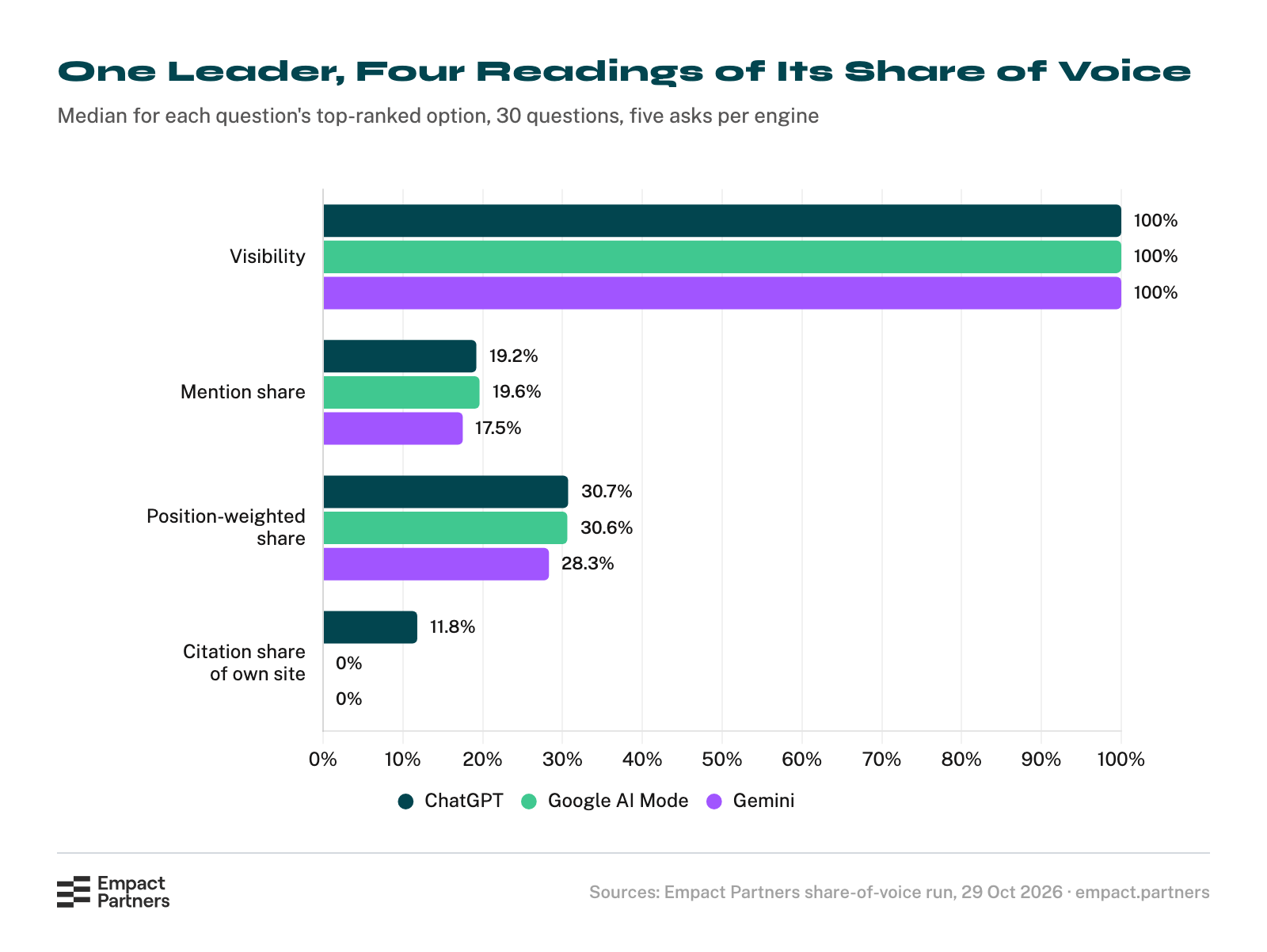
None of the four readings is wrong. Each answers a different question, and the one a tool picks sets your number before your work does.
Where the name came from
Share of voice began as an advertising number, and it meant money. Nielsen still defines it as a brand’s media spending as a percentage of all media spending in its category, market and channel.4 You could count it from invoices.
That number earned its place by predicting something. Working from IPA effectiveness cases, Les Binet and Peter Field found that 10 points of share of voice above share of market grew a B2B brand’s share by 0.7 of a point a year, against 0.6 for consumer brands.5 They built the B2B half on fewer than 50 cases and called the finding tentative.
We know of no study that has done the same for AI answers. An AI share of voice has no invoice behind it and no measured link to growth yet, so it is only as good as the answers sampled and the formula applied to them.
What each tool divides by
The tools that sell an AI share of voice agree on the name and not on the arithmetic:
| Tool | What it counts as your share |
|---|---|
| Peec AI | Your brand’s mentions over all brand mentions in the answers, with visibility kept as a separate number6 |
| LLM Pulse | Mentions over all tracked brands’ mentions, with mention rate and a position-weighted score reported separately7 |
| Ahrefs Brand Radar | Estimated impressions: each prompt weighted by its Google search volume times a traffic ratio for each engine8 |
| Qvery | Each answer split among the companies it names, more to the ones named first, so visibility times prominence; our run uses this formula9 |
Point two of these at the same answers and they print different numbers, each one correct. Ahrefs weights ChatGPT at 0.115 and Gemini at 0.011, so ChatGPT’s answers count about ten times as much in a combined score.8 A mention count treats fifth place like first. Our run’s four readings are that disagreement, measured.


Empact Partners opens a GEO partnership with an audit, and its first reading is where the brand is named, and in what position, on the questions its buyers ask. Every report after that is read against the same baseline.
One Ask of One Engine Is Not a Number
SparkToro and Gumshoe, which sells AI tracking, had 600 volunteers run 12 prompts through ChatGPT, Claude and Google’s AI a combined 2,961 times. Their finding, in one line:
Our run was gentler on the engines, since it asked through an API with web search on rather than through people’s own accounts. It still churned:
Measured against five asks, one answer’s position-weighted share sat a median 2.3 to 3.6 points off, and one time in ten as much as 7 to 11 points.1
One answer still put the five-answer leader on top 85% of the time on ChatGPT and 81% on the other two,1 because where the leader did not come first every time, it usually came first most times. One ask finds the leader. It cannot tell you how far behind the leader you are.
Asking more often is the fix, and it can be measured. In Qvery’s records, a question list asked once and then again put a company’s visibility 8.00 points apart or more one time in ten on ChatGPT. Asked every day for a month, the gap at that same one-in-ten mark was 2.02.9
Most companies are spending before they are measuring. McKinsey counts 16% of brands systematically tracking AI search performance.3
Conductor, which sells that tracking, surveyed more than 250 enterprise executives: 94% plan to raise answer engine and GEO spending in 2026, after putting an average 12% of digital budgets into it in 2025.11 They named the trustworthiness of AI visibility data as their top technology challenge.11
Our own answer to that gap is the Empact Panel, the measurement we built for our partners. Every week it tracks where more than twelve of them stand in the answers from ChatGPT, Google AI Mode and Claude.
Named in Every Answer, Weighted Several Times Apart
The SOC 2 answers were not unusual. Across the 90 sets of five answers in our run:

Visibility saturates at the top of a category. The engine knows the usual names and lists them every time, and what it changes is the order, which is the part a buyer reads first.

A single list’s order is close to random, as SparkToro showed, but the average position across many answers settles. In Qvery’s August records on ChatGPT, a company named in 20% or more of answers saw its average rank move a median 0.05 of a position between the month’s two halves, against 0.30 below 5%.9
Averaging is why a position-weighted share can be measured while a single ranking stays an anecdote.
Each Engine Keeps Its Own Leaderboard
The three engines agreed on the familiar names and disagreed about who leads:
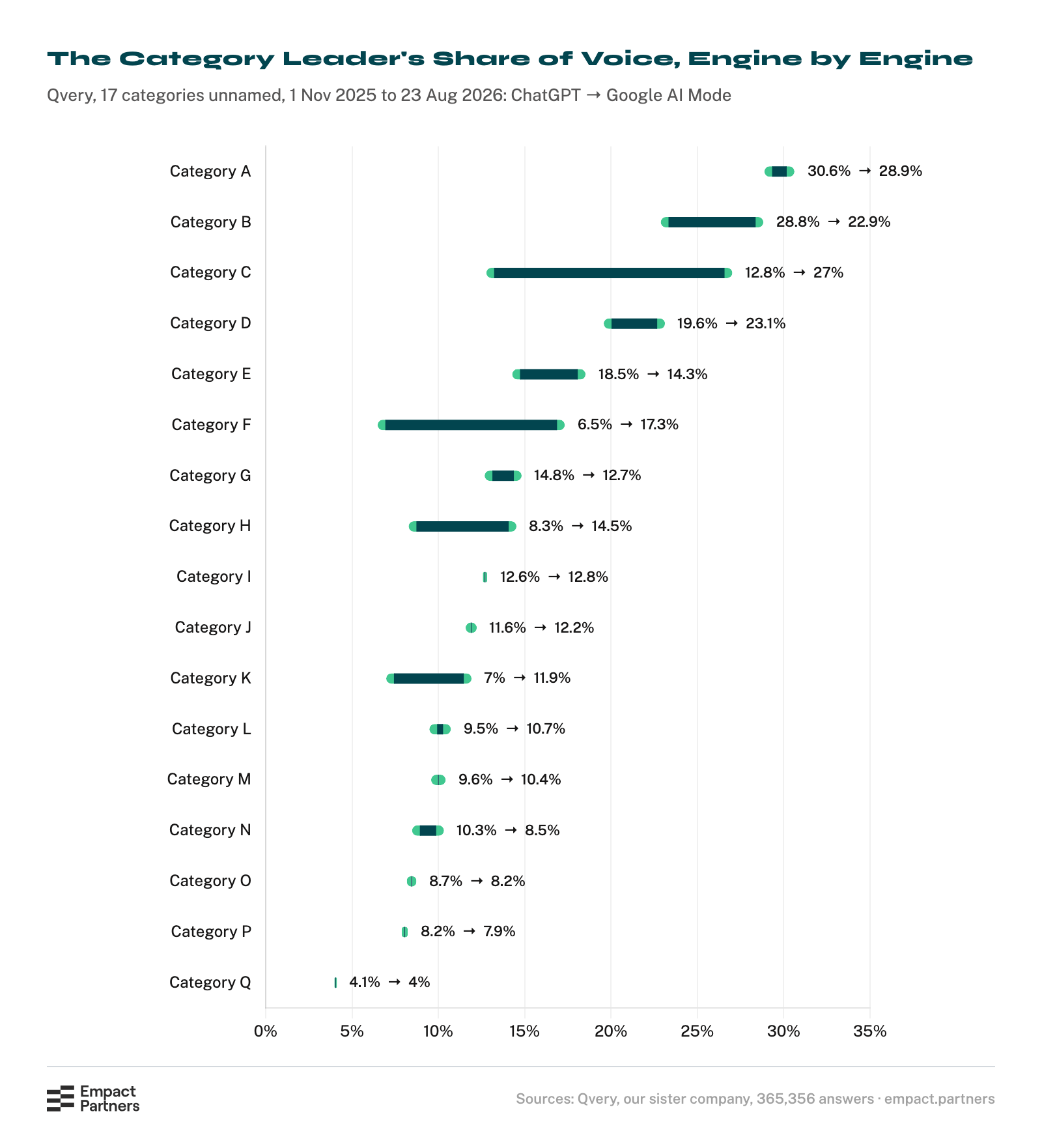
A blended number hides all of it. When a tool weights each engine by the traffic it sends, a brand strong on Google AI Mode and weak on ChatGPT reads as weak overall. Reading each engine as its own panel is the only way to see which engine the work is moving.
Across a Category, Near-Equal Brands Still Sit a Fifth Apart
One question is a narrow sample. For the wide one we read Qvery’s tracking, which asks buyer questions on ChatGPT and Google AI Mode and records every company each answer names, in order. Its leaderboards for 17 categories, mostly business software, held 365,356 answers between 1 November 2025 and 23 August 2026:2

The gap is smaller here than inside one question, and that is the lesson about denominators. A category’s share is spread across up to a hundred companies and every question tracked, so a fifth of a small share is a point or so. It is still enough to reorder a leaderboard, as it did in 16 of the 17 categories, and visibility cannot see it.
Where Share of Voice Piles Up
Most of a category’s voice goes to a few names, and most names barely register:
Same engines and the same formula, and the leader holds a third of one question or a tenth of a category. The question set is the market definition, so agree it before the first report and keep it fixed between reports.
AI Answers Cite Few of the Pages Google Ranks First
Google’s results and the engines’ answers overlap less than a ranking report would suggest. We pulled Google’s first ten organic results for the same 30 questions on the same day:
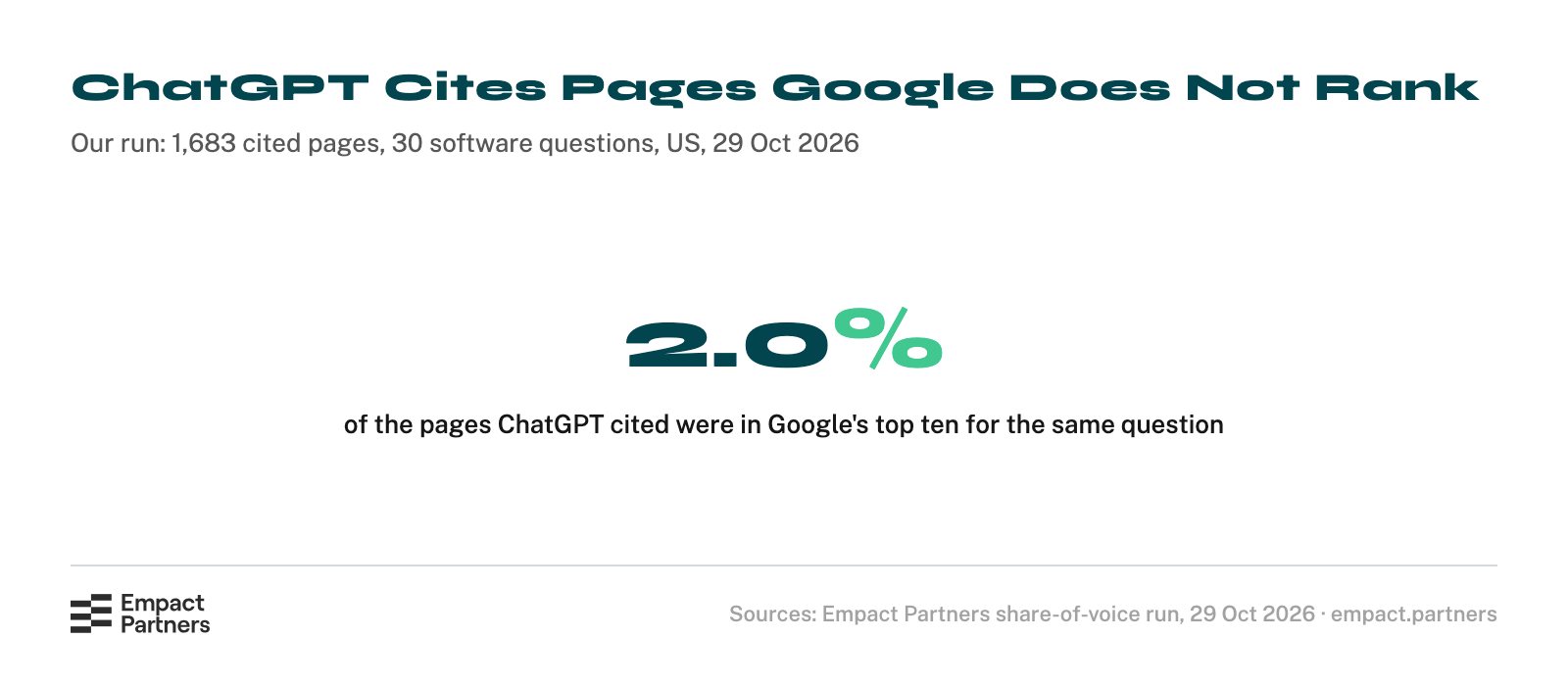
The click is thinning too. Pew watched 900 US adults browse in March 2025: with an AI summary on the page they clicked a result in 8% of visits, against 15% without one. Links inside the summary itself drew a click in 1% of visits.14
What the engines read instead is other people’s pages about you:
So GEO is not SEO renamed. SEO decides whether your pages can be found, and the engines still read the category’s pages. Who gets named, and in what order, is mostly settled on pages you do not own, and in our run most of the options named again and again had no page of their own cited at all.
At Empact Partners the findable-pages half sits with SEO, read as Search Everywhere Optimization, which treats every place a buyer searches as part of the job. The GEO half is getting a partner’s product onto the pages the engines quote.
Move Visibility Until You Are Named, Then Move Position
If your brand is named in a minority of your category’s answers, visibility is the first job, because a position-weighted share is built from answers that name you. Once you are named in most of them, the gap that matters is position.
Our formula for GEO is UGC plus mentions. UGC, user-generated content, is the threads where people who use a product talk about it. Mentions are the independent pages that list it. Both sit upstream of the answer:
The lists and threads an engine reads put brands in an order, and in our reading of the answers, that order is what the answer inherits. We have no clean measurement of the hand-off. It is our observation from the GEO work, and it is why the position work happens on other people’s pages rather than on your own.
Those lists and threads are where Empact Partners spends a Generative Engine Optimization partnership. We place a partner’s product in the community threads and roundup articles that answers draw on, then watch which answers begin to name it, and in what position.
A partnership opens with an audit and a roadmap, and a named consultant runs it. The reports carry visibility and Qvery’s position-weighted share of voice for each engine, and the horizon is quarters, because GEO takes months before momentum shows.
What none of these figures settles is whether a lead in AI share of voice turns into market share, the way extra ad share of voice did for Binet and Field’s brands. We know of no study that has measured it, so we judge the work by the answers moving and not by a growth rate borrowed from advertising.
The number to watch is the gap between your brand and the one named just above it, in the same answers, on each engine. It moves when the list work lands, and visibility alone will not show it.
If your share-of-voice report is one number from one engine and you need one you can defend, book a call with me. Together we will work out whether building it is a job for us.
Sources
- Empact Partners, the share-of-voice run: 450 answers to 30 B2B software-buying questions from ChatGPT with web search forced, Google AI Mode and Gemini, asked five times each from the United States in English, plus Google’s first ten organic results for the same questions, collected through DataForSEO on 29 October 2026. Options read against a hand-curated list per question, each placed where its answer first presented it.
- Qvery, our sister company: category leaderboards (up to 100 named companies each, with visibility, position-weighted share of voice and average rank) for the 17 categories it tracked, mostly business software, 365,356 ChatGPT and Google AI Mode answers, 1 November 2025 to 23 August 2026, read from Qvery’s analytics on 29 October 2026.
- McKinsey & Company, New front door to the internet: Winning in the age of AI search, Elizabeth Silliman, Kelsey Robinson, Julien Boudet, Desirae Oppong and Nilay Shah, 16 October 2025.
- Nielsen, Need to know: What is share of voice?, March 2025.
- LinkedIn B2B Institute, The 5 Principles of Growth in B2B Marketing, Les Binet and Peter Field, from IPA Databank cases, 2019.
- Peec AI, Share of Voice, product documentation, read 29 October 2026.
- LLM Pulse, How to Measure AI Share of Voice (Complete Guide for 2026), Esteve Castells, June 2026, updated October 2026.
- Ahrefs, AI Share of Voice: What It Is, How to Measure It…, Si Quan Ong, 22 October 2026.
- Qvery, AI Visibility vs. Share of Voice vs. Average Rank: What Each Number Lets You Decide, Vlad Shvets, March 2026, updated October 2026.
- SparkToro, NEW Research: AIs are highly inconsistent when recommending brands or products; marketers should take care when tracking AI visibility, Rand Fishkin with Patrick O’Donnell of Gumshoe.ai, 27 January 2026.
- Conductor, New Conductor Survey of Enterprise CMOs Shows AEO/GEO Investment Is Accelerating and Late Movers Are at Risk, press release for the 2026 AEO/GEO CMO Investment Report, 13 January 2026.
- Qvery, Double Jeopardy in AI Search: Smaller Companies Lose Twice, Vlad Shvets, March 2026, updated October 2026.
- Ahrefs, Update: 38% of AI Overview Citations Pull From The Top 10, Louise Linehan, 2 March 2026.
- Pew Research Center, Google users are less likely to click on links when an AI summary appears in the results, 22 July 2025.
- Ahrefs, An Analysis of AI Overview Brand Visibility Factors (75K Brands Studied), Louise Linehan, 26 May 2025.
- Qvery, The Pages AI Answers Cite for CRM and Voice-Agent Buyers, and Who Owns Each, Vlad Shvets, September 2026, updated October 2026.
- Gartner, Gartner Survey Finds 69% of B2B Buyers Turn to Sales Reps to Validate AI-Generated Insights, press release, 20 May 2026.
- Empact Partners, KKday: Reddit marketing case study, three months of threads, read live 29 October 2026.


