


Mostly, no. A first-page Google ranking does not carry a page into the answers ChatGPT and Google AI Mode give your buyers. Both engines run searches of their own for the question a buyer asks, then quote whatever answers it most plainly, and most of what they quote is not on page one.
If organic has slid for six months, penalties, technical faults and content decay are ruled out, and the rank report still says page one, this is probably the gap you are looking at. This page settles what that ranking is still worth, which parts of it carry into an AI answer, and how to check your own pages for them.
Empact Partners is the go-to-market consultancy B2B software companies bring into their own marketing teams, and has been since 2020. We treat SEO as Search Everywhere Optimization, covering Google and every AI engine and community where buyers ask. We built the Empact Panel to see which of a partner’s pages those engines quote.
SEO Teams Have Split Into Two Camps Over the Same Rank Report
Ask a room of SEO people whether page one still matters and the room splits. One camp runs search the way it has for a decade: keyword research, search volume, rank tracking, and links to the pages that count. The other camp watched organic traffic fall while leads held, decided rankings had stopped paying, and moved the money.
The keyword camp has a better case than the other side admits. Google’s own guidance for site owners says a page needs only to be indexed and eligible to be shown with a snippet to appear as a supporting link in AI Mode, that no special optimization is required, and that all existing SEO fundamentals continue to be worthwhile.
The other camp argues from its own falling clicks, and the wider data backs it. In Pew Research Center’s browsing data on 900 US adults from March 2025, people shown an AI summary clicked a traditional result in 8% of visits, against 15% when there was none. A ranking that used to mean a visit now often means a page the buyer never opens.
What people on Reddit say, from both camps
“GEO is simply SEO 2.0. 95% of GEO is having great SEO anyway soooo.” — u/JamieHBrown, r/SEO, Oct 2026
“The chances are minimal that ranking at position 50 in native search will get you an AI mention. I believe good SEO is the key to getting into the AI heart.” — u/easyedy, r/SEO, Oct 2026
“We looked at hundreds of keywords where we ranked in the top three on Google. We found that SEO rank does not correlate to being picked up by the AI.” — u/DarthKinan, r/DigitalMarketing, Mar 2026
“Organic Search is done. Maps lives and Discover. But organic is a directory.” — u/Mat_Uscenes, r/GenerativeSEOstrategy, Apr 2026
Both camps are reading the same instrument. A rank report says where Google puts a page for a keyword. Neither camp sets it beside a record of what the answers cited for the same buyer questions, and that comparison settles more of the argument than either side will enjoy.
Most Sites AI Answers Cite Are Off Page One, and Most of Page One Is Never Cited
Qvery, our sister company, ran that comparison on October 15, 2026. It put the same US buyer questions about software, services, insurance and travel to Google, to ChatGPT with web search on, and to Google AI Mode on one day, then matched the sites each answer cited against Google’s top ten.
Because Qvery is ours, mark the finding down for that and check its method yourself rather than trusting our summary. The headline runs both ways. 89.6% of ChatGPT’s sources and 76.8% of AI Mode’s sat outside Google’s top ten for the question they answered.
From Google’s side the gap is wider still: of the sites on page one, 87.3% went uncited by either engine. The same day reads four ways, and the row that decides how you check your own site is the exact-URL one.
| October 15, 2026, the same buyer questions | ChatGPT | Google AI Mode |
|---|---|---|
| Cited sites that were on Google’s first page | 10.4% | 23.2% |
| Cited pages that were on Google’s first page, exact URL | 1.9% | 7.6% |
| Page-one sites the engine cited | 6.9% | 8% |
| Answers sharing no site with page one | 61.3% | 49.4% |
Read the first two rows together. Where ChatGPT and Google agreed on a site, the page ChatGPT cited was usually not the page that ranked, and in AI Mode it was the same page only about a third of the time. A check that asks whether your domain shows up tells you less than one that asks which page did.
The keyword camp’s favorite figure moved the same way. Ahrefs found in July 2025 that about 76% of AI Overview citations came from the top ten, then re-ran the study on 863,000 keyword results pages and published 37.9% in March 2026.
Why a ranking page drops out of the answer
The cause is in how an answer gets built. Google documents AI Mode running several related searches across subtopics for one question, which it calls a query fan-out, so a single buyer question turns into searches no rank report tracks.
The keyword camp’s answer is to track those searches as keywords too. Our read is that this narrows the gap in AI Mode at best: the sub-searches are written for each question as it is asked, no rank tracker is told what they were, and ChatGPT barely draws on Google’s list to begin with.
Question length widens the gap. In ChatGPT, 66.7% of answers to questions of twelve words or more shared no site with page one, against 52.2% for questions of six words or fewer. Search volume is counted on short phrases, which makes it a count of the questions buyers are least likely to ask an assistant.
Position Still Buys Odds in Google AI Mode, and Far Fewer in ChatGPT
Read the same day from Google’s side, position by position, and the two engines part ways. In AI Mode, the site in first place was cited 18.4% of the time and the site in tenth 2.3%, an eightfold slope. ChatGPT’s line is gentler and noisier: 10.9% at the top, 3.4% at the bottom, and fourth place cited more often than second.
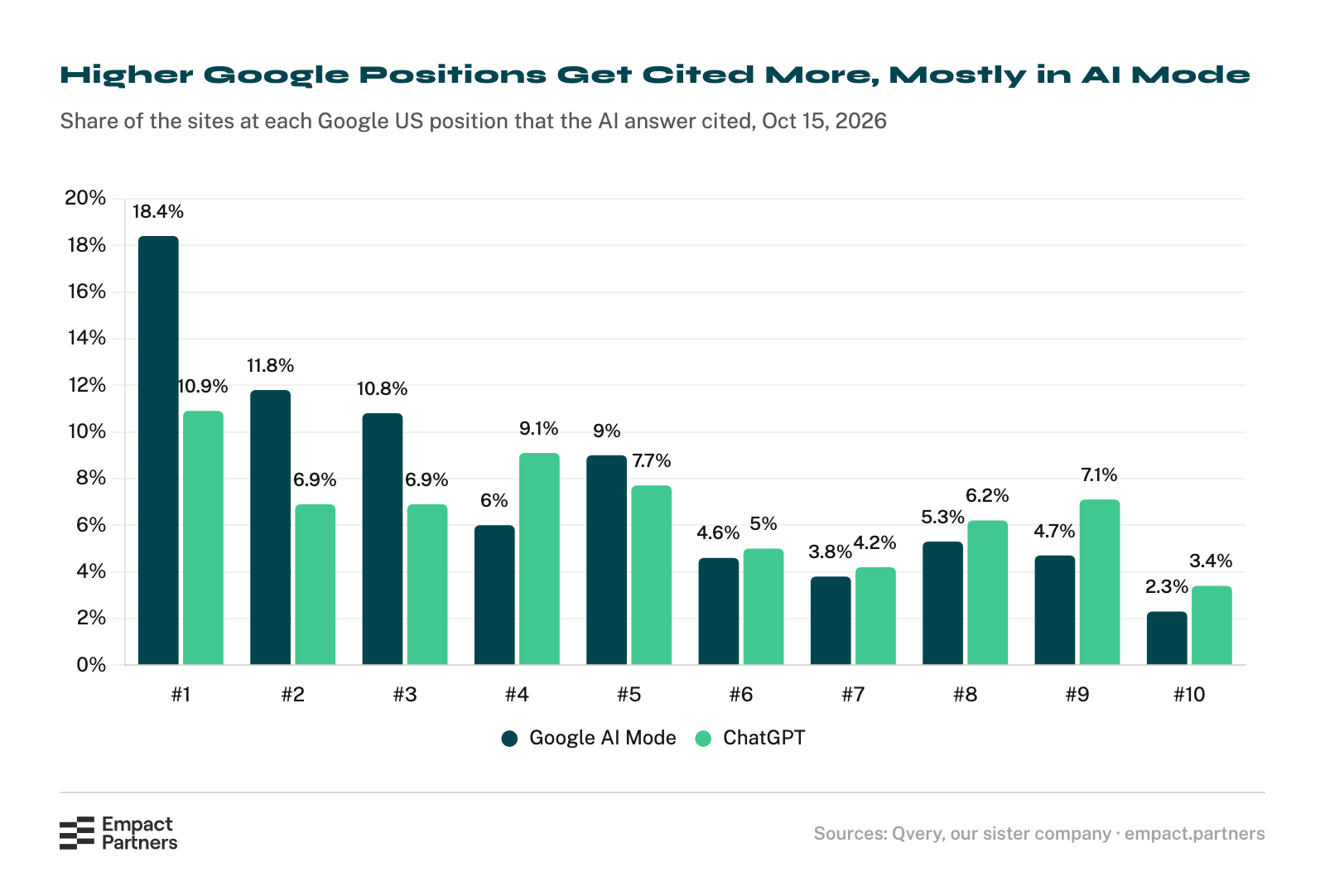
The slope has a plain cause. AI Mode draws its sources from Google’s own index, so a page Google ranks highly is already in the pool its searches pull from. ChatGPT leans on a different web: 64.7% of the sites it cited belonged to a company its answer named, so much of what it cites is the shortlist’s own websites.
We said a version of this in July 2025, at a workshop where a partner’s own team had noticed AI Overviews recommending products from pages that ranked well. Our reading: good pages rank and good pages get quoted, and the engines have no idea what your domain rating is. The numbers since kept that reading and shrank it.

So each camp is right about half. A position is not a seat in the answer, which is what the camp that moved its budget saw in its analytics. A position still raises the odds, most of all in the engine that searches Google’s own index, which is the part the keyword camp gets right and cannot show on a rank report.


What a Ranking Page Carries Into an Answer, and What It Leaves Behind
A ranking scores a whole page against a keyword. An answer is put together from whichever pages the engine’s own searches turned up, quoting the parts that answer the buyer’s sentence. Some of what earned the ranking survives that trip, and some of it stays behind.
| Property of a ranking page | Carries into an AI answer? | What shows it |
|---|---|---|
| Indexed and eligible for a snippet | Yes, and it is the entry ticket to AI Mode | Google’s guidance for AI Mode’s supporting links |
| A plain answer to the buyer’s full question | Yes | Google’s own fan-out: the searches run on the question, not the keyword |
| What you do, for whom and on what terms, on your own pages | Yes, most of all in ChatGPT | 64.7% of the sites ChatGPT cited belonged to companies it named |
| The backlink profile | Only through the position it buys, in AI Mode | Qvery, September 2026: among high-authority software brands, the backlink score barely separated who ChatGPT named |
| The keyword and its search volume | No | Long questions share the least with page one |
| The exact URL that ranks | Often not | Exact-page overlap, 1.9% and 7.6%, sits far below site overlap |
The backlink row stings, because it is where most SEO money goes. Qvery’s September 2026 study set four measures against how often ChatGPT named software brands it already knew. The top quarter by how many cited roundups mentioned them was named in 8.89% of answers at the median. The top quarter by backlink score managed 5.56%.
None of that retires the links. Empact Partners helped flair earn over 500 links rated DR 40 and up within two years, and its monthly organic traffic rose 1600% in three. Links buy position, and in AI Mode position buys odds, so links carry into answers the long way round.
The shorter way runs through other people’s pages. Our SEO workstream runs Existing Article Outreach, or EAO, beside the ranking work: we get a partner’s product named in the list articles Google ranks and the answers already quote, which is where the two contests overlap.
Check the Ten Pages That Kept Their Rank and Lost Their Clicks
The first pass is an afternoon of work, spread over two days so the second run lands on a different day. It works on pages rather than keywords, because a page is what an answer cites.
- Pick the pages, not the keywords. In Search Console, compare the last six months with the six before, and take the ten pages whose average position stayed on page one while their clicks fell the most. Those are the pages where the rank report and the dashboard disagree.
- Take the buyer’s question from the people who hear it. Sales call notes, demo requests and inbound emails hold the sentences buyers use. Write two or three per page with the buyer’s situation in them, and keep the writing away from whoever wrote the page, who will phrase them to match it.
- Ask both engines, logged out, on two days. Use ChatGPT with search on and Google AI Mode, in a private window, from the same location. Record every site each answer cites, which of your pages appears, and which companies it names. Answers move between runs, so one asking is a single draw.
- Sort each page into one of three piles. Cited, citable, or never from this page. A page counts as cited if any answer cites it or another page of your site, and you note which page the engine chose. It counts as never only if it is missing from every run.
- Open what got cited instead. For every page that missed, read the pages that took the citation. A competitor’s product page, a roundup and a forum thread each point at a different fix.
Each pile gets a different job.
Two calls go wrong most often. One is believing a single asking: a page cited on Monday and missing on Thursday is a coin flipped twice. The other is rewriting a page in the never pile, then deciding the rewrite failed, when the engine was never going to read a page like it for that question.
Ten pages and two engines fit in an afternoon. The version a board will believe does not: every page that ranks, three engines, enough askings per question that a move is real, run every week, with a record of whose pages took the citations you wanted.
Keep the Rank Report, and Put a Citation Record Beside It
We run the same check on ourselves, and the result is the best argument against hiring us. In 4,200 answers to 500 questions about the work we sell, from ChatGPT, Google AI Mode and Claude between October 4 and 23, 2026, the engines cited one of our 138 pages, once: a case study (we write about this for a living, so it stung).
That record comes from the Empact Panel, built because no rank report could produce it. Each week it puts a partner’s buyer questions to ChatGPT, Google AI Mode and Claude, keeps every source each answer cites, and reads the partner’s pages to record how each is built. On top of it sit the measures a rank report never had:
An SEO partnership with us opens on that record laid beside the partner’s rank report, which is the audit, and a roadmap built from it. One named senior consultant owns the work and joins your calls. The ranking work keeps going, the citable pages get rewritten first, and every weekly report carries a first step.
The never pile goes to EAO and, where the answers cite threads and reviews, to getting the partner talked about there, which is our Generative Engine Optimization workstream. It all runs in quarters, and we say so before anyone signs: rankings move over months, and in AI answers momentum takes months to show.
This check is how we open an SEO partnership, so treat the advice as coming from people who sell it. If all ten of your pages come back cited, keep your money.
What these numbers cannot settle yet
Cause, mostly. Qvery’s comparison is one day of US answers, and position going with AI Mode citations is an association: the first-place page may just be the clearest answer, which Google’s ranking and both engines would reward. Nor can we show a citation turning into pipeline, because the answer is read before anyone clicks.
Whether rewriting a citable page puts it into the answer is what we watch every week, page by page, and one day of data cannot promise it. So watch the count your rank report does not carry: how many of the ten pages are cited, in each engine, month over month.
If your rank report still says page one and your pipeline says otherwise, book a call with me, and we’ll see whether we are the right people to close that gap with you.


