Ask the Gemini app and Google AI Mode the same software-buying question on the same day and they hand back two different reading lists. On the 20 questions we asked both on 20 October, the Gemini app cited 17.03 links per answer and AI Mode cited 3.44.1
This page sets the Gemini citation figures published this year beside the studies that measured them, adds our own run and our sister company Qvery’s record of Google AI Mode, and reads them for a B2B software team deciding whether its Gemini work belongs on its own pages or on other people’s.
Empact Partners, the B2B software go-to-market consultancy behind this page, settles that decision before any Gemini money moves. Our Generative Engine Optimization (GEO) work for a partner starts with which pages each engine cites for the partner’s buyer questions, and which of those pages the partner can change.
Highlights
Read together, they say the share of Gemini’s citations that lands on a vendor’s own pages belongs to the market a study measured and to the line it drew around “vendor”, not to the engine.
What holds everywhere is that Gemini reads wide, swaps its sources between identical runs, and names products it already knows. A citation won on your own page is real, and it is a different thing from being recommended.
In B2B Software Studies, Gemini Is the Most Vendor-Heavy Engine
Foundation and AirOps ran commercial buyer prompts for 81 B2B software categories across six AI surfaces from 22 June to 24 July 2026, about 380,000 answers in all. Their vendor class is wide: “product” domains are vendor sites, tool directories, and comparison pages. For Gemini they found:
Geeky Tech measured the same question with a narrower ruler. It asked 613 B2B queries in the US and the UK in July 2026, 1,226 tests on Gemini and ChatGPT, and had a language model tag each cited page by type, checked by hand on a sample. On the same questions:
On B2B buying questions, then, the page Gemini cites is usually one a vendor wrote, and it is rarely a page from the vendor’s corporate site. The vendor’s share is carried by articles and comparison pages, where a buyer’s question gets a long answer.
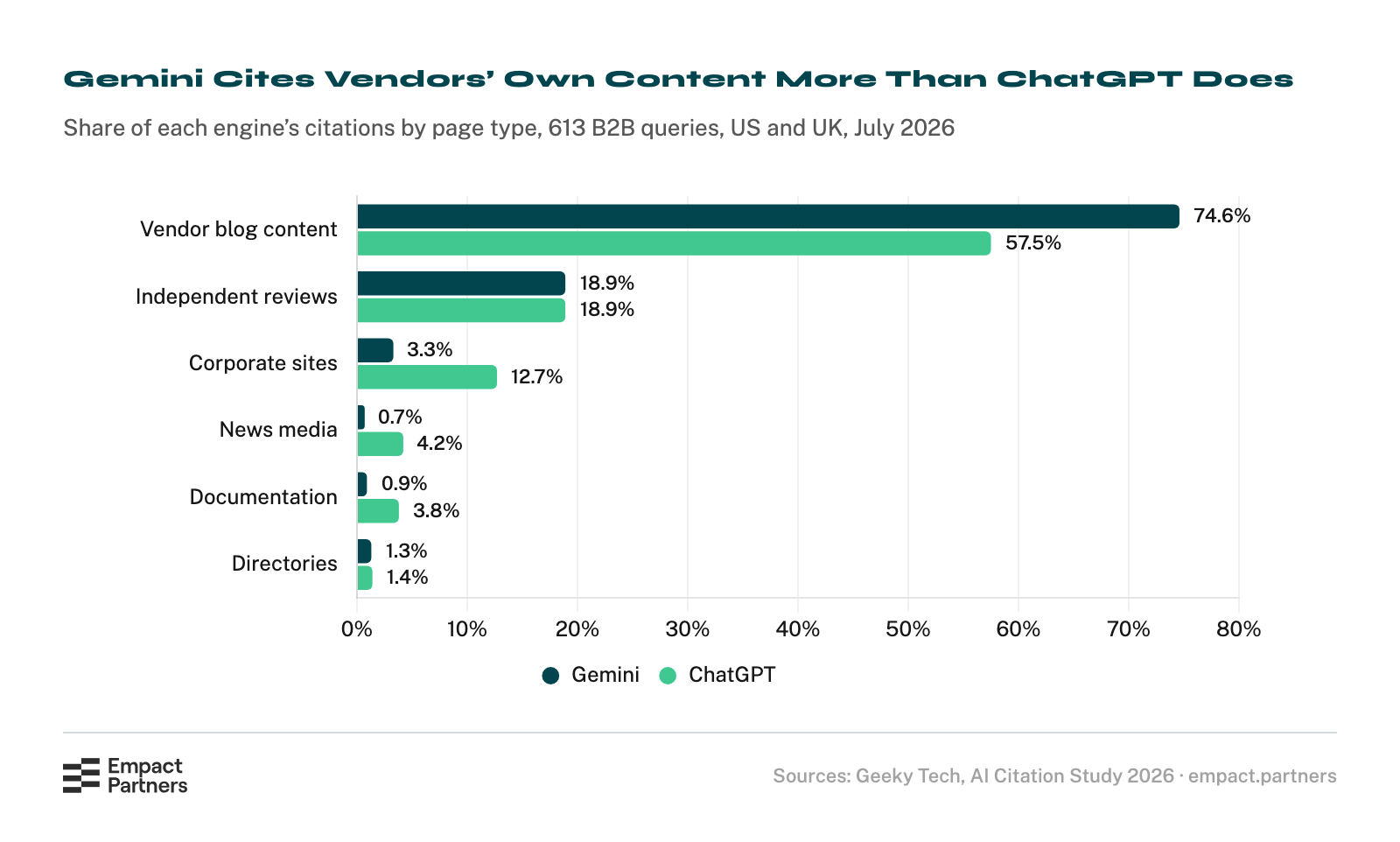
Those pages are the part of a Gemini plan a team controls outright, and keeping them accurate is part of the Content Marketing work we run for partners.
Outside B2B Software, the Same Engine Reads Mostly Third Parties
Mahe Chen and Nick Koudas measured a consumer market instead: 651 questions written for a US fiber internet provider, asked every day of ChatGPT, Perplexity, and Gemini’s API with Google Search grounding, with 26,069 Gemini answers between late July and 21 September 2026. Gemini there looked like a different engine:
The same paper ran a second market of small B2B vendors, and there vendors’ own sites took about half of every engine’s citations.4 The same team and the same method gave two different vendor shares, and what changed between them was the market.
Omnia read Gemini’s citations in its own database for four weeks to 16 June and filed them by ownership: 6.7% went to owned domains and 90.1% to third-party editorial and independent sites, with 0.32% on product pages and 12.17% on review and comparison pages.5
In local search, Steady Demand’s 1,500 queries across 50 US metros put the business’s own website at 49.6% of Gemini’s citations in September, against 10.5% of ChatGPT’s.9 Set side by side, with what each study counted as the vendor’s:
| Study, market, and window | Counted as the vendor’s | Gemini | ChatGPT |
|---|---|---|---|
| Geeky Tech: B2B queries, US and UK, July 2026 | Vendor blog content | 74.6% | 57.5% |
| Foundation and AirOps: 81 B2B software categories, June to July 2026 | Vendor sites, directories, comparison pages | 71.63% | Not published |
| Steady Demand: local services, 50 US metros, September 2026 | The business’s own website | 49.6% | 10.5% |
| Chen and Koudas: one US consumer market, July to September 2026 | The providers’ websites | 16.8% | 64.3% |
| Omnia: its own database, May to June 2026 | Owned domains | 6.7% | Not published |
The same engine lands at both ends of the scale. In two of the three markets that report both engines, Gemini sits above ChatGPT, and in the third it sits far below.

The way out is to take the count in your own category. The Empact Panel, which we built, does it every week for our GEO partners on ChatGPT, Google AI Mode, and Claude: the partner’s own buyer questions asked of each engine, and every cited page sorted by who owns it. Gemini is not in the Panel, so we ran Gemini ourselves.


Every Count Agrees That Gemini Reads Wider Than ChatGPT
Every study here agrees on breadth, as long as nobody puts their numbers on one axis, because each counts something different:
Both YouTube figures hold. One YouTube link among nine sources puts YouTube in the answer and barely moves its share of the links.
Our own run measured the consumer apps on software questions. On 20 October we asked the Gemini app, ChatGPT with web search on, and Google AI Mode the same 20 questions, from “What is the best CRM software for a small business?” to web hosting, three times each from five countries: 300 answers per engine.
We kept how many links each answer cited and which products it named, not the addresses behind the links:
On these questions an owned page is one link among the seventeen or so in a Gemini answer, and the other links shape what the buyer reads as much as it does.
Gemini’s Sources Change Between Identical Runs More Than Its Shortlist Does
Prefer asked each question three times within 23 seconds. Two Gemini runs of the same question shared 35% of the sites they cited between them, and only 2 of 200 pairs cited the same set.6 Steady Demand found the same drift on local queries asked twice in a row: the cited sources matched about 41% of the time.9
Over weeks the whole mix moves. Between Steady Demand’s July and September waves, reddit.com fell from 13.7% to 1.7% of Gemini’s local citations and local-service directories rose from 10.4% to 19.1%, while the business’s own site went from 58.8% to 49.6%.9 Google announced none of it.

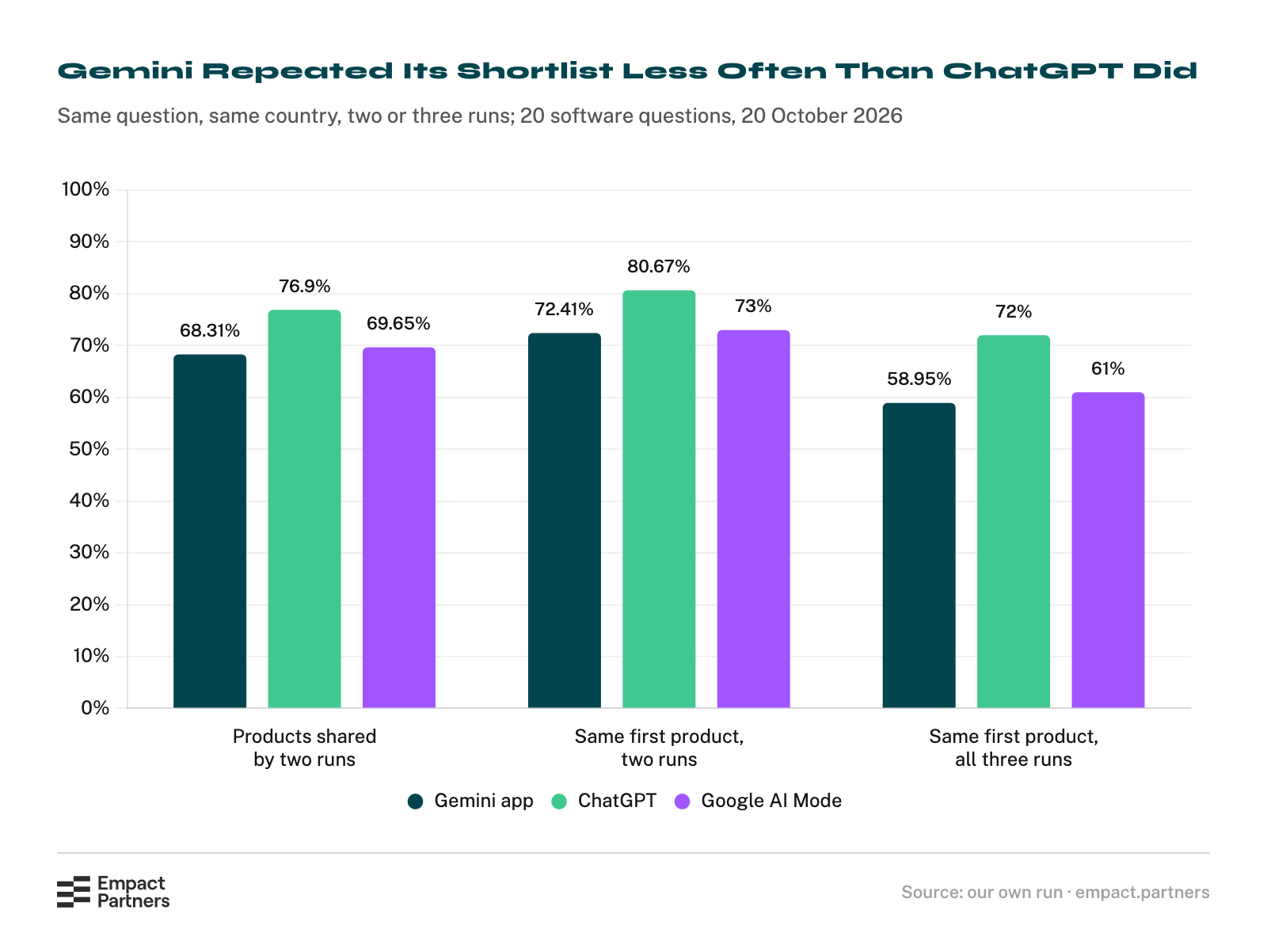
The products Gemini names move less. In our run, two Gemini answers to the same question from the same country shared 68.31% of the products they named, and the first product named held between two runs 72.41% of the time.
All three answers led with the same product in 58.95% of question-and-country cells, behind ChatGPT and close to AI Mode on all three measures.1
Local search runs the other way. Steady Demand found Gemini named the same recommended business on a repeat only 5.1% of the time, where Google’s local pack kept its top listing 83.3% of the time.9
We read the difference as the field. A city holds hundreds of plumbers, and a small-business CRM question has a handful of leaders the model already knows. Where it knows the field, the names hold while the links move.
Gemini Names the Vendors It Already Knows
Chen and Koudas also tested where the names come from:
The authors put it in one line: “Pages are thus cited when searched; brands are also named when remembered.”4 Page work moves Gemini’s citations, measurably.
Whether it moves Gemini’s recommendation is the part nobody has measured. No study here, ours included, recorded a Gemini shortlist before and after a page changed, so treat any promised lift as unproven.
That route is the half of Generative Engine Optimization a team cannot run from its own website. We describe GEO as user-generated content plus mentions: what real users say about a product in public, and what independent pages say about it.
Getting a partner named in the roundups the engines already quote is a method of our own, Existing Article Outreach, and the ×17.7 is why it sits early in a Gemini plan.
Google’s Two Gemini-Powered Answers Read Different Webs
Google answers with Gemini in two places: the Gemini app, and AI Mode inside Search, which Google moved to Gemini 3.5 Flash as its default model on 19 May 2026.8 Asked our 20 questions on the same day, their reading lists were not the same length.1
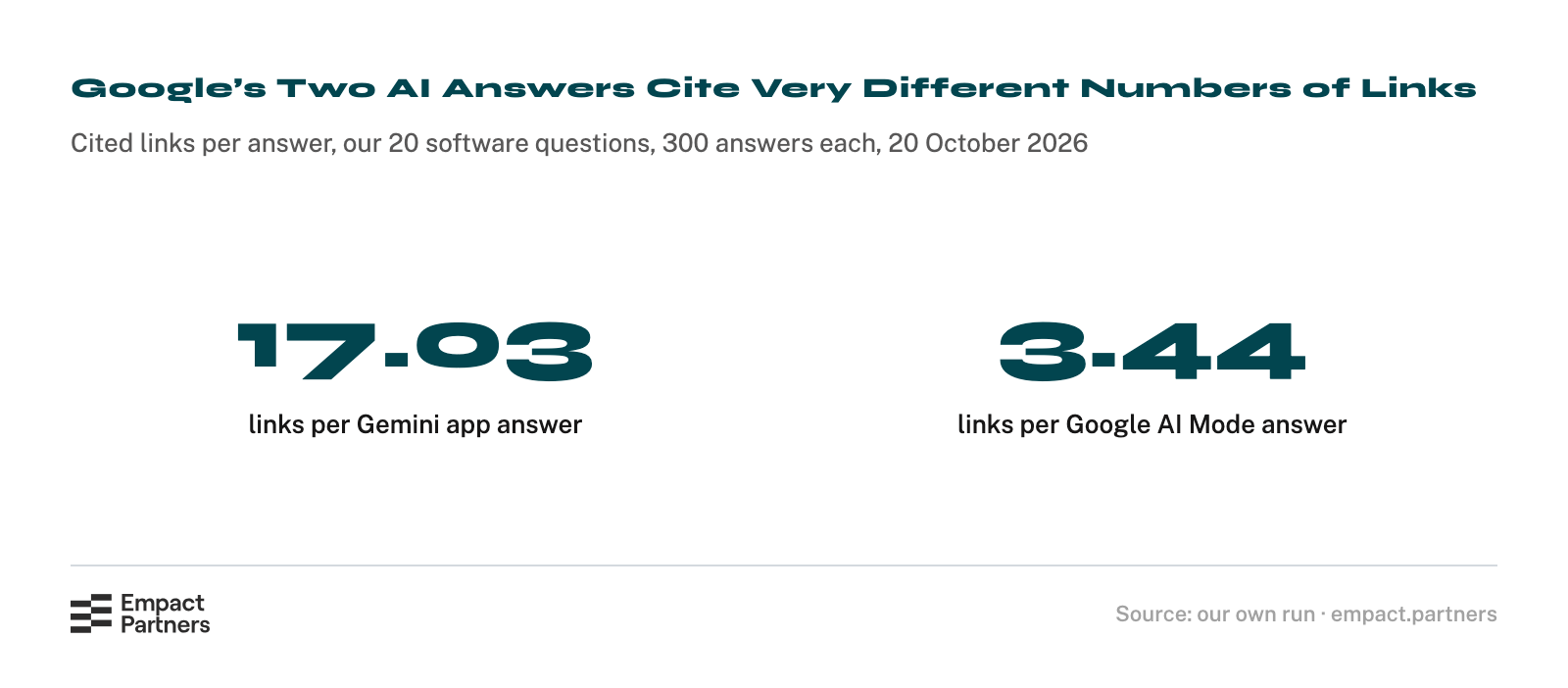
The two answers differed in more than length:
AI Mode is the Google surface Qvery measures. Qvery is our sister company: it builds AI agents that measure brand visibility, and it records what ChatGPT and Google AI Mode answer to the buyer questions it tracks, every day, about 749,000 answers by September.10
Qvery does not ask the Gemini app. We own it, so weigh its numbers accordingly. Its monthly series and the method behind it are published for anyone to check.7
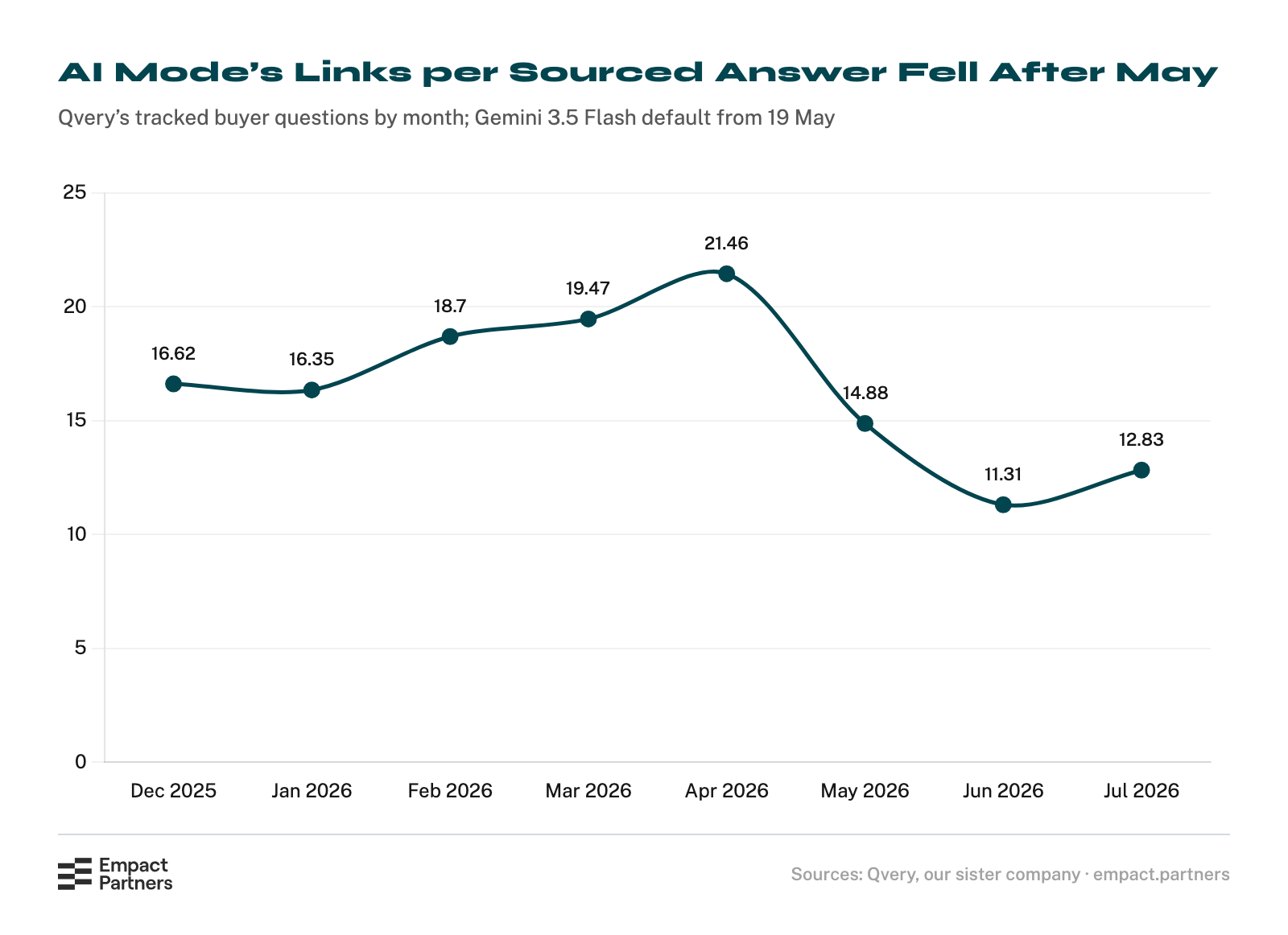
Its record shows AI Mode’s sources changing after Google’s model switch. Links per sourced answer rose to 21.46 in April and fell to 11.31 in June, and the day-by-day record dates the step to 5 June, more than two weeks after it, from about 18 links to about 10.7
Foundation and AirOps’ data separates Google’s Search answers from Gemini too: social domains such as YouTube and LinkedIn took about 7% of the citations on AI Overview and AI Mode and 0.3% or lower on Gemini, ChatGPT, and Claude.2
What AI Mode cites is not what the Gemini app cites, either. In Qvery’s July records AI Mode cited at least one list in 76.91% of sourced answers, and product pages were 25.34% of its links, against 50.33% of ChatGPT’s.11
The model family is shared and the reading habits are not, so a Google AI Mode plan and a Gemini plan belong on separate lines of a report.
Measure Gemini on Your Own Category Before You Fund Either Side
Counting got easier in October. Search Engine Journal reported on 1 October that Gemini had started adding UTM parameters to its outgoing links, which Google has not documented.12 Gemini visits that used to land in “direct” can now be counted in analytics, at least when the tags fire.
The rest is a count any team can run on its own category:
- Ask the Gemini app your buyers’ own questions, three times each.
- Sort every cited page into yours, a competitor’s, and a third party’s.
- Check every answer for whether it names you, and who it names first.
If your category looks like the B2B studies, keep your own comparison and use-case pages current. If it looks like the consumer one, the money goes to the third-party pages Gemini reads.
Either way, judge the work by the share of your category’s Gemini answers that name you, beside the tagged Gemini visits. Citations will move every week whatever you do. That share moves when the shortlist does.
A partnership with us on it opens with an audit of the partner’s buyer questions on each engine, then a roadmap that splits the work between the partner’s pages and the pages that name its competitors. A named senior GTM consultant runs it, with a standing report on what each engine named and cited, and the work is measured in quarters.
If Gemini answers your buyers’ questions with your competitors’ names, book a call with me. We will find out together whether we are the right people to change that.
Sources
- Empact Partners, our Gemini run: 20 English software-buying questions asked of the Gemini app (DataForSEO’s Gemini scraper), ChatGPT with web search forced, and Google AI Mode on desktop, three times from each of five countries (US, UK, Germany, Brazil, India), 300 answers per engine, collected 20 October 2026; cited links counted and named products compared run against run and engine against engine. Read 29 October 2026.
- Foundation and AirOps, The State of B2B AI Discovery 2026, 2026; about 380,000 answers in 81 B2B software categories on six AI surfaces, 22 June to 24 July 2026. Read 29 October 2026.
- Geeky Tech, AI Citation Study 2026, 2026; 613 B2B queries in the US and the UK, 1,226 tests, July 2026. Read 29 October 2026.
- Mahe Chen and Nick Koudas, What Drives AI Citations? Content, Retrieval and Model Knowledge in Generative Engine Optimization (GEO), arXiv, 2026; a US consumer market (651 questions, 24 June to 21 September 2026) and a market of small B2B vendors. Read 29 October 2026.
- Omnia, How to Rank in Google Gemini: Visibility, Citations & AI Search Strategy, 2026; Omnia’s citation database, 22 May to 16 June 2026. Read 29 October 2026.
- Prefer, How AI engines search and cite: 960 answers measured (Prefer AI answer study, September 2026); 80 questions about AI search, three runs on four engines through their APIs, 13 September 2026. Read 29 October 2026.
- Qvery, our sister company, AI Search Citation Trends, March 2026: Half the Sources, Nearly the Same Shortlist, 2026, updated 20 October 2026; the same buyer questions asked of ChatGPT and Google AI Mode every month, December 2025 to July 2026. Read 29 October 2026.
- Google, A new era for AI Search, 19 May 2026. Read 29 October 2026.
- Steady Demand, AI Citation Ledger, updated 9 September 2026; 1,500 local-service queries in 50 US metros through Gemini’s grounding API, with a matched ChatGPT run. Read 29 October 2026.
- Qvery, our sister company: the GEO Agent’s records, about 749,000 ChatGPT and Google AI Mode answers (ChatGPT from 28 October 2025, Google AI Mode from 18 December 2025), read from Qvery’s production database on 19 September 2026.
- Qvery, our sister company, Are Listicles Still the Most Cited Pages in AI Search? Yes on Google AI Mode, No on ChatGPT, 2026, updated 20 October 2026; the GEO Agent’s July 2026 records. Read 29 October 2026.
- Search Engine Journal, Google Gemini Adds UTM Parameters For Referral Attribution, 1 October 2026. Read 29 October 2026.