


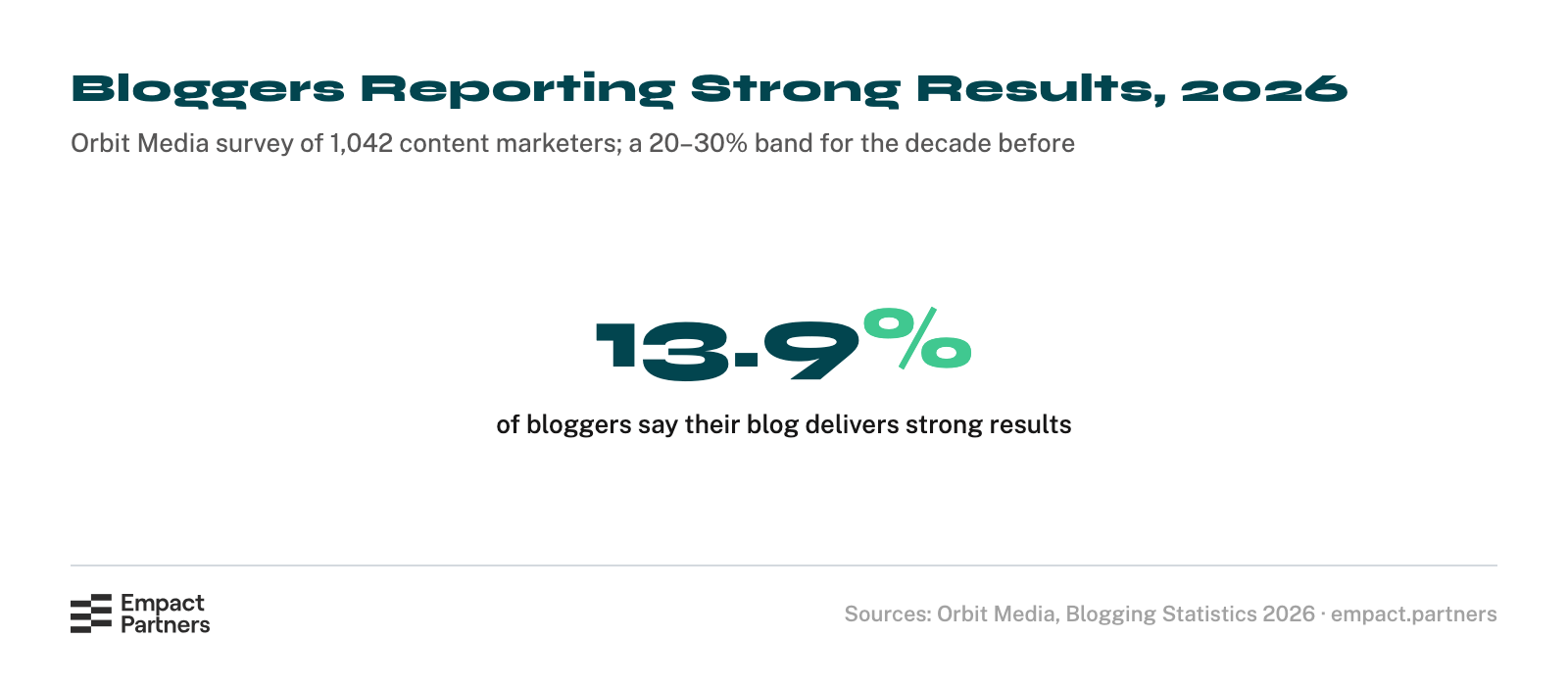
Only 13.9% of bloggers told Orbit Media this year that their blog delivers strong results, the lowest share the survey has recorded.1 The usual fix for a flat blog is more posts, and twelve years of the same survey say volume stopped being the variable long ago.
The B2B content marketing statistics below cover what changed between 2014 and 2026, what AI engines read now, and what still earns results, for the head of content deciding what the team makes next quarter. Empact Partners builds content programs for B2B software companies, so this is a practitioner’s reading, not a neutral one.
Highlights
Read together, they describe a decade in which content got cheaper to make and harder to make matter. The posts a competitor or a model could have written stopped earning anything, and the pages built from what only one company knows kept earning.
Blog Posts Grew Longer for a Decade, and Strong Results Grew Rarer
Orbit Media has surveyed bloggers every year since 2014, which gives it more than a decade of what content teams put in and what they say comes out. Its 2026 edition asked 1,042 content marketers:
Effort rose for most of the decade and results fell anyway, and since 2022 the effort has eased without the results coming back. The metric most teams report is part of the problem: 42% of Orbit’s marketers treat traffic and sign-ups as their main measure, and only 11% of them report strong results.1
B2B teams describe the same decade more kindly. CMI’s 2026 report found 97% of B2B marketers with a content strategy and 61% saying it improved over the year, yet only 12% called their marketing highly effective.4 The year before, 22% rated their content marketing extremely or very successful.2


Content Brings Leads More Often Than It Brings Revenue
Ask content teams what the work produced and the answers thin out the closer they get to money. Content Marketing Institute’s 2025 benchmark, fielded among 980 B2B marketers in the summer of 2024, reads like a funnel drawn by the people standing inside it:
Half the teams cannot say content made money, and half are not sure they measure it well. They may well be the same teams, and they are the ones a CEO’s question lands on hardest.
A year later CMI asked 1,015 B2B marketers what stands in the way, and the top answers sit at the bottom of that funnel: creating content that prompts action (40%), then resources (39%), then measuring effectiveness (33%).4 Differentiating content from competitors came in at 24%, which is low for the problem that decides the other three.4
What teams make most is not what works best for them. Among CMI’s 2025 respondents:
HubSpot’s State of Marketing data puts blog posts third among the formats marketers use (38%), behind short-form video (60%), and ranks short-form video first for ROI at 49%.8 The format teams publish most is rarely the one they would defend in a budget meeting.
Content marketing, at its narrowest, is that calendar of short posts. Since 2020 Empact Partners has sat inside B2B software marketing teams as their go-to-market consultancy, and for those partners it builds something else: a publication.
The publication carries original research, experts who sign their own opinions, and tutorials written from inside the product, which no rival can lift. That is our Content Marketing work, and the 49% is the figure it is aimed at, because a publication is judged by the buyers it brings to a sale.
The Old Search Signals Stopped Deciding What Gets Read
For years a B2B post was built to rank: choose the keyword, repeat it, earn links, climb. Google spent 2024 closing that road. Its spam policies name keyword stuffing, filling a page with keywords to game rankings,9 and its March 2024 update left 45% less low-quality, unoriginal content in results, by its own count.10
Researching the question still pays. Repeating the phrase does not. Orbit’s marketers who research keywords for every post report strong results 22% of the time, against 10% for those who never do, yet more of them now never research keywords (23%) than always do (18%).1
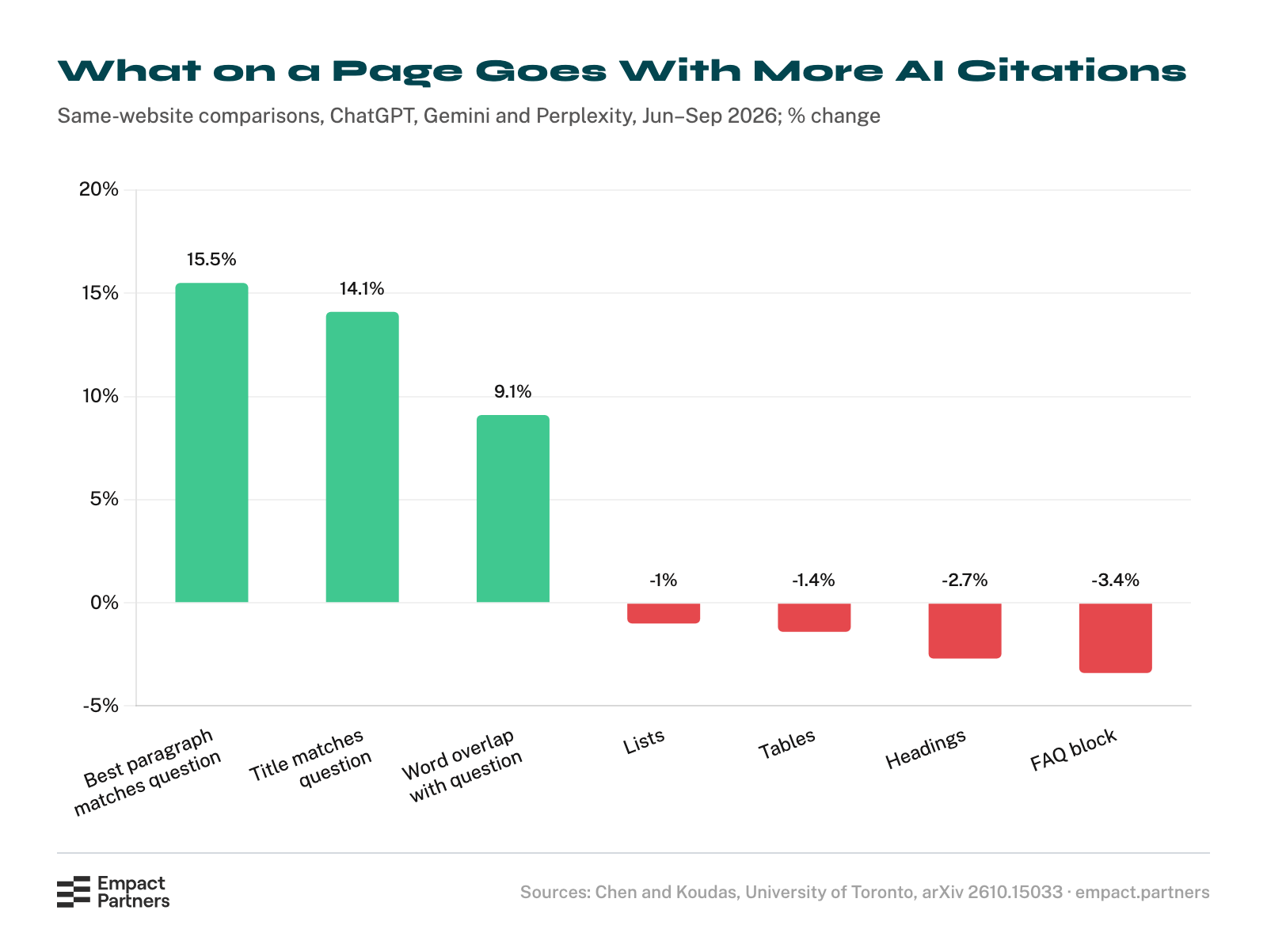
What earns an AI citation is in the words too, though repetition is the weakest part of it. Comparing pages on the same website across ChatGPT, Gemini and Perplexity answers, two University of Toronto researchers found:
The words that answer the question did the work, and the structure added to please a search engine did nothing anyone could measure.
Rankings count for less than they did, too. Qvery, our sister company, runs an agent that asks ChatGPT and Google AI Mode buyer questions every day, mostly software companies’, and records every page each answer cites. Its research runs through this page, so discount our reading accordingly, and check its method in the article linked beside each figure.
Qvery’s comparison of AI citations with Google rankings put the same US buyer questions to ChatGPT, Google AI Mode and Google search on one day in October 2026:
Ranking still helps. It no longer decides, because most of what the engines read sits off page one and most of page one goes unread.
Authority metrics lost the same ground. Each figure below is a correlation, on a scale where 1 means a signal rises and falls exactly with how often the brand is named:
A brand’s link profile says little about whether an engine names it. Whether the brand sits on the pages that engine reads says a great deal more.
Getting a brand onto the lists the engines quote is off-page work, and at Empact Partners it belongs to our Generative Engine Optimization work, the neighbour of the content program: one makes the pages worth quoting, the other gets the brand onto pages the engines already read.
AI Made Content Faster to Make, Not Better at Earning Results
Then the cost of a post fell to almost nothing. Ahrefs found AI-generated text in 74.2% of new web pages it crawled in April 2025,14 and Graphite puts primarily AI-written articles at about half of everything published since early 2025.15
The teams writing B2B content adopted it fastest. Inside one CMI question asked two years running, team use of generative AI went from 72% to 81% of B2B marketers.2 CMI’s 2026 report asked a broader question and found 95% at organizations using AI-powered applications, 89% of them with AI content-creation tools in place or on the way.4
What the tools changed is the part worth reading. CMI asked the marketers using AI to create content what got better, and the gains shrink the closer they get to results:
AI made the team faster. It did not make the content work harder, and about one user in eight says the work got worse.

The rankings are not punishing AI text. They are passing over the average version of it:
AI text is not barred from the top. It is outnumbered there by pages people wrote. Inside Orbit’s survey, 92.4% of respondents use AI, and users and non-users report strong results at the same 14%, while those with a formal editor reach 22%, against 12% for those who let AI edit their work.1
Our own content work runs AI-native as well. Models draft, and the Empact consultant who signs each piece decides what it argues, brings the evidence only our partnerships hold, and makes the call to publish. That last part is the one a competitor’s model cannot copy.
The budgets are pointed the other way. Asked where they will add money in 2026, 45% of B2B marketers named AI-powered marketing tools among their top three, and 15% named research and insights.4 Teams are paying to make the average post faster, and few are paying for what the average post lacks.

Fewer Searchers Click Through, and Buyers Ask AI First
The reader moved while the content changed. Google says AI Overviews have more than 2.5 billion monthly users,19 and OpenAI says more than 1.2 billion people use ChatGPT every week.20 Semrush found an AI Overview on 15.69% of US desktop queries in November 2025, after a July peak of 24.61%.21
Pew Research Center tracked the browsing of 900 US adults through March 2025 and measured what a summary does to the click:
A summary answers the question on the results page, so the click that used to follow mostly never comes, and ranking first does not shelter a page from it. Ahrefs measured a 58% lower click-through rate for the top result when an AI Overview appeared in December 2025, narrowing to 19.4% at tenth.22
Marketers feel it. Nearly 30% of those HubSpot surveyed reported less search traffic as people turned to AI tools, and over 92% now optimize for both kinds of search.8
B2B buyers moved first. Forrester found 94% of business buyers using AI in their buying process, up from 89% a year earlier.23 In 6sense’s study, buyers picked the winner from their first-day shortlist 95% of the time.24 When that shortlist is drafted inside an AI answer, the answer’s sources are where a content program competes.
AI Engines Quote Product Pages, Guides and Lists, Almost Never Case Studies
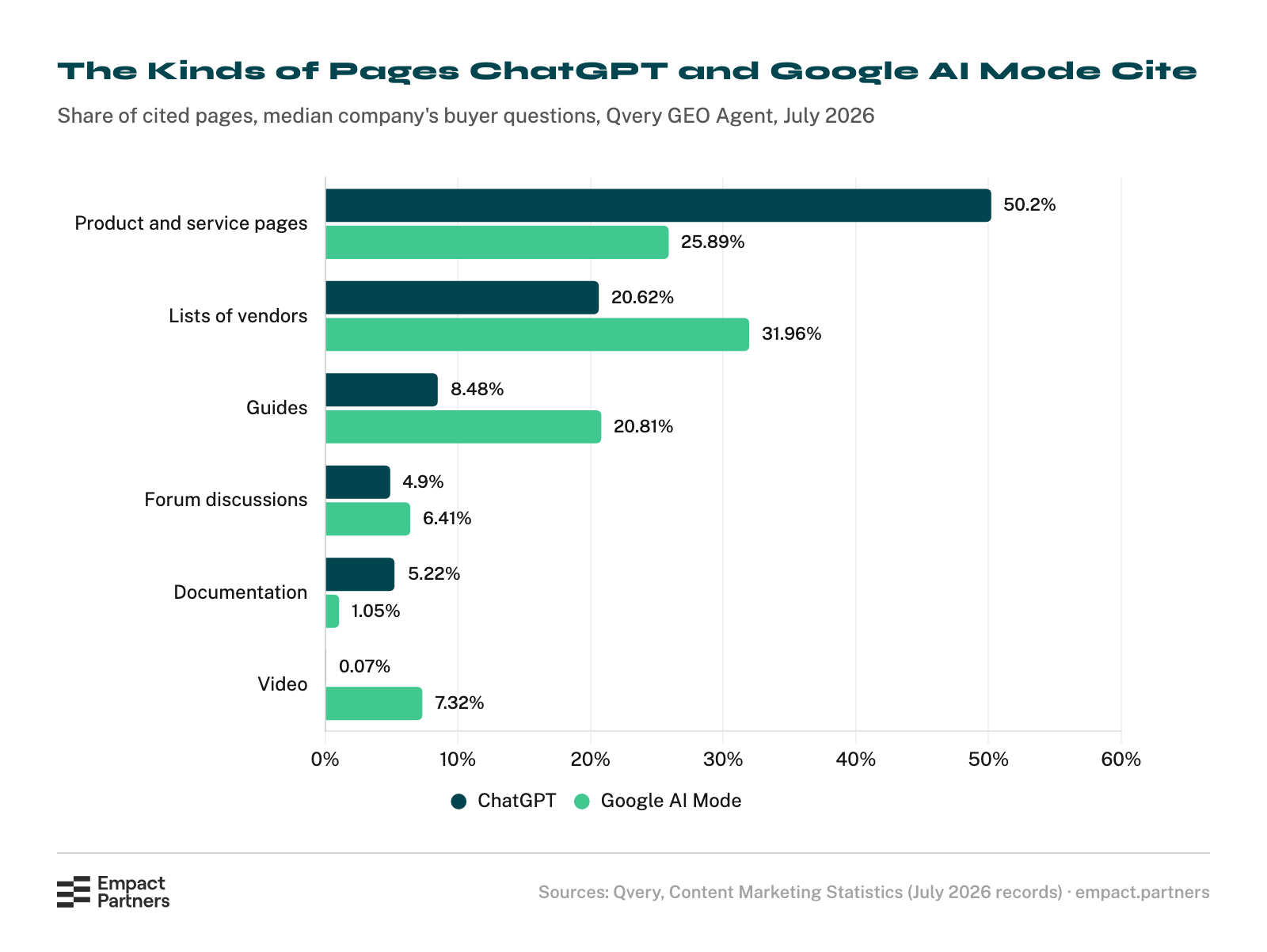
So the buyer’s first read is more and more often an AI answer, which makes that answer’s reading list the one that matters. In the July 2026 records Qvery published on content types, every page ChatGPT and Google AI Mode cited for its tracked buyer questions was tagged by kind. For the median company:
The two engines read different libraries. ChatGPT leans on vendors’ product and service pages, while Google AI Mode reads lists, how-to guides and video. A content plan written for one engine is half a plan.
The sharpest gap is the case study. CMI’s respondents named case studies and customer stories their second-best format, at 53% of the teams making them.2 In Qvery’s July records a case study appeared in 0.107% of ChatGPT answers and 0.232% of Google AI Mode answers, about one ChatGPT answer in a thousand.6
A company’s own site is a small part of what gets read at all: 3.13% of ChatGPT’s cited pages and 2.94% of Google AI Mode’s, for the median company. Of the own pages that did get cited, guides made up 13.99% and 19.66%.6
Even the list, the format everyone rushed to publish, is moving. Qvery’s tracking of list citations found the share of ChatGPT’s cited links that were lists fell from 32.26% in February to 21.40% in July 2026, on the same questions each month. Google AI Mode’s slipped from 37.18% to 31.68%.25

What decides the page is the question. Buying questions cited a list in 60.27% of ChatGPT’s sourced answers and how-it-works questions in 6.22%. On Google AI Mode the pair was 70.60% and 8.43%.25
Qvery’s read of CRM and voice-agent answers found the same split: shortlist questions cited comparison or best-of pages in 74.00% of answers against 40.00% for specific ones, while help and docs pages rose from 3.00% to 33.33%.26
For exactly this reason, the first pages our content work ships for a partner are product tutorials and help-style guides. They answer the how-it-works question with the product inside the answer.
What Still Earns Results Is Information Nobody Else Has
Strip the tools out and the surveys agree on what works. Effective teams in CMI’s 2026 report credited content relevance and quality (65%) first, and teams whose strategy improved credited refining it (74%) well ahead of new technology (51%).4 Top performers in the 2025 report named industry expertise in 70% of cases.2
Original work is where the gap shows. Orbit’s marketers who publish original research report strong results 22% of the time against a 14% benchmark, yet the share publishing it fell from 49% to 37% this year.1 CMI’s research reports were named a best performer by 45% of the teams making them, and only 36% of teams made any.2
Buyers say they want it: 71% of hidden buyers in Edelman and LinkedIn’s 2025 study, the finance, legal and procurement people who rarely meet sales, rated thought leadership above traditional marketing for showing a vendor’s value.27 Yet 37% of marketers whose companies publish thought leadership say fewer than 5% of their experts take part.4
What our own partnerships show
Our own record points the same way. These figures come from the public case studies of four partnerships, each over its own window:
None of those programs won on volume alone. The pages doing the work were ones only that company could publish: guides written from inside PDF Reader Pro, Linearity’s own design expertise, a blog launched alongside DottedSign itself.
Empact Partners opens a content partnership with an audit: what the team has published, what its category’s AI answers cite, and what the CRM says produced pipeline. The roadmap that follows moves the hours into pages only that company can write.
A named consultant owns the work from inside the partner’s own channels. The first quarter is the audit, the cuts and the first pages. Traffic follows over quarters, which is why every case study above runs in years.
The number worth watching next quarter is how many of last quarter’s posts a competitor could have published under its own logo. Those are the posts an engine replaces with someone else’s page, and the hours they took are the budget for the pages only you can write.
If your calendar is full and your CEO still cannot see what it sold, book a call with us, and we will see whether we could build that publication together.
Sources
- Orbit Media Studios, Blogging Statistics 2026: What 1,042 Content Marketers Told Us About What Works, Andy Crestodina, 8 September 2026: 1,042 content marketers, a survey run every year since 2014; chart figures read from the images.
- Content Marketing Institute and MarketingProfs, B2B Content Marketing Benchmarks, Budgets, and Trends: Outlook for 2025, Stephanie Stahl, 9 October 2024: 980 B2B marketers surveyed 25 June to 16 August 2024.
- Qvery, AI Citations vs Google Rankings: 89.6% of ChatGPT’s Sources Aren’t on Page One, Vlad Shvets, 17 March 2026, updated 15 October 2026: US buyer questions on ChatGPT, Google AI Mode and Google search, 15 October 2026.
- Content Marketing Institute and MarketingProfs, B2B Content and Marketing Trends: Insights for 2026, Robert Rose, 8 October 2025: 1,015 B2B marketers surveyed 24 June to 14 August 2025.
- Pew Research Center, Google users are less likely to click on links when an AI summary appears in the results, Athena Chapekis and Anna Lieb, 22 July 2025: browsing of 900 US adults, March 2025.
- Qvery, Content Marketing Statistics That Show AI Answers Cite Service Pages, Not Case Studies, 9 July 2026, updated 18 October 2026: GEO Agent records of unbranded buyer questions on ChatGPT and Google AI Mode, July 2026.
- Empact Partners, PDF Reader Pro case study (empact.partners/partners/pdf-reader-pro): the partnership from June 2023, figures as the page publishes them, read 29 October 2026.
- HubSpot, 2026 Marketing Statistics, Trends & Data, figures sourced on the page to the HubSpot State of Marketing Report 2026, read 29 October 2026.
- Google Search Central, Spam policies for Google web search, last updated 28 August 2026: the keyword stuffing and scaled content abuse definitions.
- Google, New ways we’re tackling spammy, low-quality content on Search, Elizabeth Tucker, 5 March 2024, updated 26 April 2024 after the rollout.
- Mahe Chen and Nick Koudas, University of Toronto, What Drives AI Citations? Content, Retrieval and Model Knowledge in Generative Engine Optimization (GEO), arXiv, 10 October 2026: 158,099 answers from ChatGPT, Gemini and Perplexity collected June to September 2026; within-website estimates.
- Ahrefs, Top Brand Visibility Factors in ChatGPT, AI Mode, and AI Overviews (75k Brands Studied), Louise Linehan, 12 December 2025: Spearman correlations across 75,000 brands.
- Qvery, Domain Authority Is a Weak Guide to the SaaS Brands ChatGPT Names. The Lists It Cites Are Better., Vlad Shvets, 22 September 2026, updated 20 October 2026: eleven software categories, US, UK, Canada and Australia, September 2026.
- Ahrefs, 74% of New Webpages Include AI Content (Study of 900k Pages), Ryan Law, 19 May 2025: 900,000 pages first crawled in April 2025.
- Graphite, AI Now Writes as Many Online Articles as Humans, Jose Luis Paredes, Gregory Druck and Ethan Smith, 15 May 2026: 55.4k Common Crawl articles, January 2020 to March 2026.
- Semrush, Does AI content rank well in search? [Survey + Data study], 1 April 2026: 42,000 blog pages from Google’s top ten for 20,000 keywords, November 2025.
- Ahrefs, Google Doesn’t Punish AI Content; It Punishes Bad Content (331k Pages Studied), Ryan Law, 27 July 2026: top-ten pages from 100,000 searches, June 2026.
- Graphite, How Does AI-Generated Content Perform in Search and Answer Engines?, 14 October 2025: articles ranking in Google and cited by ChatGPT and Perplexity across 10 categories, June 2025.
- Google, Google I/O 2026: Sundar Pichai’s opening keynote, 19 May 2026.
- OpenAI, GPT-6 and Intelligent UI for everyone, 7 October 2026.
- Semrush, Semrush AI Overviews Study, Jana Garanko, refreshed 15 December 2025: 10M+ US desktop keywords, January to November 2025.
- Ahrefs, Update: AI Overviews Reduce Clicks by 58%, Ryan Law, 4 February 2026: 300,000 keywords, desktop click-through in December 2025 against December 2023.
- Forrester, B2B Buyers Make Zero-Click Number One, John Buten, 22 January 2026: Forrester’s Buyers’ Journey Survey, 2025, nearly 18,000 business buyers.
- 6sense, 2025 B2B Buyer Experience Report, released 12 November 2025: just under 4,000 B2B buyers.
- Qvery, Are Listicles Still the Most Cited Pages in AI Search? Yes on Google AI Mode, No on ChatGPT, Vlad Shvets, 29 March 2026, updated 20 October 2026: GEO Agent records February to July 2026, and ten industries in September 2026.
- Qvery, The Pages AI Answers Cite for CRM and Voice-Agent Buyers, and Who Owns Each, Vlad Shvets, 1 September 2026, updated 15 October 2026: CRM and AI voice-agent buying questions, late August 2026.
- Edelman and LinkedIn, 2025 B2B Thought Leadership Impact Report, June 2025: nearly 2,000 global professionals, including hidden decision-makers.
- Empact Partners, Linearity case study (empact.partners/partners/linearity): the partnership since the first site launched in 2019, figures as the page publishes them, read 29 October 2026.
- Empact Partners, KDAN Mobile case study (empact.partners/partners/kdan): the DottedSign blog’s first three years, figures as the page publishes them, read 29 October 2026.
- Empact Partners, FAIR VC case study (empact.partners/partners/fair-vc): flair’s figures from 2021, as the page publishes them, read 29 October 2026.


