


Organic traffic has slid for six months, and you have already ruled out a penalty, a technical fault and content decay. What is left looks like an off-page problem, and your inbox has three answers to it: guest posts, link placements and paid spots in “best of” lists, each one priced by the seller’s domain rating.
Most of those offers are priced for a link, and the link is no longer the valuable part. The valuable part is a mention on one of the few listicles AI engines cite when your buyers ask what to buy, and it can be worth more than any link in the inbox. This page shows how to tell which pitches offer one, what each is worth, and what to refuse to pay for.
Empact Partners is a go-to-market consultancy, and the evidence on this page is ours: since 2020 we have run SEO and AI visibility programs inside software companies’ marketing teams. Getting partners named on the lists the engines cite is the off-page half of that work.
The Three Offers in Your Inbox Ask for Different Things
Every one of these emails calls itself a collaboration. That word hides the fact that they ask for three different things and leave three different things behind:
| Offer | What lands | What it is sold on | What decides its worth now |
|---|---|---|---|
| Guest post | A new page on their site, written by you, with your link in it | The host’s domain rating | Whether that new page is ever cited, and every new page starts at zero |
| Link placement | Your link or your name added to a page that already exists | The host’s domain rating | Whether that page is cited for your buyers’ questions today |
| Paid placement | A spot in someone’s roundup, usually ranked, for a fee | Domain rating and a traffic figure | Whether the roundup is cited, where you sit on it, and for how long |
The third column is where every seller and most SEO budgets still agree, and it is the column that stopped predicting much. Domain rating estimates what a link passes to Google’s rankings. The fourth column asks a different question, because your buyer now asks a different place.
A Link Moves Rankings, and a Mention Moves the Answer
When a buyer asks ChatGPT or Google’s AI Mode which tool to use, the engine runs a search, reads a handful of pages and writes a shortlist. In software, a large share of those pages are lists of products. Whether your name sits on those pages decides much of whether it sits in the answer, with a link or without one.
Mention building means getting your product named, in a good position, on the pages the engines cite for your buyers’ questions. A link is welcome and optional. The name on a page the engine reads is the point, and a link on a page it never reads still does its old job with Google and nothing at all for the answer.
We measure this every week in the Empact Panel, our own build. It asks ChatGPT, Google AI Mode and Claude the unbranded questions a partner’s buyers ask, and keeps every page the answers cite. Here is what it counted for one B2B software partner, and what our listicle study counted across a whole category:
The 32% is an association inside our answers, since an engine already leaning toward a brand may go and fetch the pages that name it. It is also far too large to dismiss as noise, and a cited list that leaves you out is worse for you than no list at all.
Empact Partners runs this work as Existing Article Outreach, one of the methods in our SEO workstream. We read SEO as Search Everywhere Optimization now, because your buyers search in more places than Google. We find the lists a partner’s category answers already cite, then work to get the partner named on the ones that leave it out.
One offer this summer made the case better than any figure. A list owner declined to link to one of our partners, for a reason that had nothing to do with the list, and offered to name it on the list without a link. Five years ago that was the consolation prize.


A Handful of Listicles Decide What the Engines Say
So the mention is the unit that counts, and where it sits decides what it is worth. The engines do not spread their attention across every list in a category. They keep returning to a few.
In the B2B software category our listicle study measured, 76.26% of the list citations ChatGPT made over eight weeks went to the most-cited tenth of lists. The third of cited lists that turned up in only one answer carried 1.3% between them. The short list also holds still: every one of the 50 lists ChatGPT leaned on hardest in the first week of September was still being cited in October.
Concentration is why one mention on the right list can be worth more than a stack of links elsewhere. For the B2B software partner above, the nine lists carrying its mention that the engines cite turned up in 3,031 answers over the 90 days to 29 October, the busiest of them in 667 on its own.
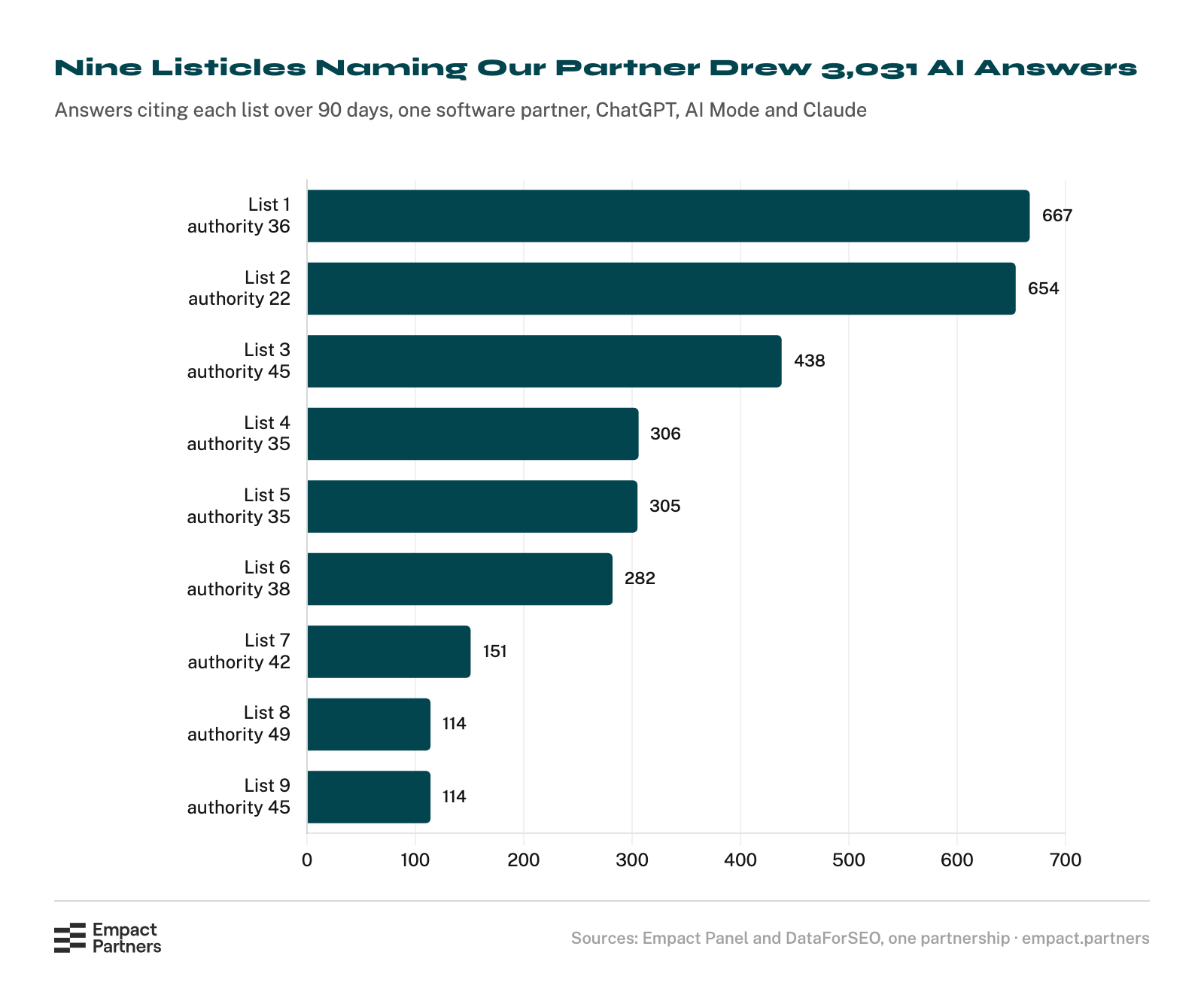
Every one of those answers is a buyer asking which tool to use and an engine reading a list that names our partner before it replies. A link on a page nobody’s questions reach does none of that.

The value of a mention is set by the list before anyone sends an email. So the first job is finding the lists the engines already cite for your buyers’ questions, and the second is getting onto the ones that leave you out. Every pitch in your inbox should be measured against that short list, and it is the one thing the pitch itself never mentions.
Domain Rating Does Not Tell You Which Listicle Gets Cited
If the list decides, the obvious shortcut is to let authority pick the lists, which is what every rate card invites. The lists doing the most for our partner say that shortcut misses.
We scored the domains behind those nine cited lists with DataForSEO’s domain rank, its counterpart to domain rating, on a 100-point scale. They range from 22 to 49, and most are other software companies’ own blogs. The second-busiest list in the set turned up in 654 answers from a domain scoring 22.
None of them is the high-authority publication a rate card leads with. Ahrefs, the company behind domain rating, found the same thing at scale: counting 3,000 “best” lists that ChatGPT cited across software, products and agencies, it found 35% of them on low-authority domains. The engines are not reading the column the rate card is written in.
Qvery, our sister company, tested the question on ChatGPT in September. Whether a brand appeared on the roundups the engine cited tracked whether it got named more closely than backlinks rank or organic traffic did.
Qvery is ours, so discount it as you would any vendor grading its own homework. The answers behind the test are open to anyone who wants to check them.
None of this retires domain rating, or the traffic figure that usually travels with it. Each still does a job:
What neither can do is price a mention, and neither was built to.
Vet Every Pitch Against the Page, Not the Domain
Here is the check, in the order we run it. Most pitches fail in the first two steps, which is the point of running them first:
- Get the exact URL. “A placement on our site” is nothing you can check. Ask which page, and if the answer is a page that does not exist yet, you are looking at a guest post, whatever the email calls it.
- Ask the engines your buyers’ questions. Five to ten of them, in your buyers’ words, on ChatGPT and Google’s AI Mode, and write down every page each answer cites. If the URL never appears, its mention is worth close to nothing for the answer, whatever its domain rating.
- Count the competitors on it. A cited list that names three of your competitors and not you is the most valuable page in your inbox, because it argues against you every time it is cited.
- Check the date and the habit. A list with this year in its title that gets refreshed is a page you can join. A dated feature from three years ago rarely is.
- Ask whether the spot is permanent. A position that rotates among paying vendors, or expires after six months, is rented, and your name leaves the cited page when the term ends.
- Refuse the swap shape. Two links that go live between two sites on the same day are a reciprocal exchange, and search engines are built to spot the pattern. When a traceable pattern gets discounted, the loss arrives as a cliff, not a slope.
You do not need a tool for a first pass: a browser and a spreadsheet will do this week’s inbox in an afternoon. Running the same questions every week across a whole category is where measurement starts to need building, and it is what the panel exists for.
Once you have run it, the three offers sort themselves:
What a Placement Is Worth, and Why We Pay Nothing
Which leaves the money. A placement is worth what its page is cited for, how near the top of the page you sit, and how long you stay there. Domain rating is not in that sentence, and neither is the pitch’s traffic figure, because neither tells you whether your buyers’ answers ever reach the page.
Position earns its place in that sentence. AirOps, studying discovery questions in four software categories, found 80% of the brands engines named through a list or comparison sat among the first three companies on that page. Here is how each part of the worth reads off a pitch:
| What sets the worth | How to read it | What it does to the price |
|---|---|---|
| How often the page is cited | Ask your buyers’ questions and count the answers citing the URL | No citations means no worth, at any price |
| Where you sit on it | Ask for the position and whether it can move | The top three of a cited list beat the bottom of the same list |
| How long you stay | Ask whether the spot is permanent or rotates | A rented spot is worth only the months it runs |
| The seller’s domain rating | Leave it out of this sum | Nothing |
If you price anything, price the citations. Compare two offers by how often each page turns up across the same set of buyer questions, and treat a page that turns up nowhere as worth nothing at any price. That ranks a mention on a well-cited vendor blog above one on a famous domain, which is the opposite of how the rate cards are written.
Our own answer is that we do not pay. For one partner we declined or dropped sixteen paid offers over a summer. The terms on one of them show the problem: a top-three position shared among paying vendors on rotation, sold for six or twelve months, with permanence refused outright.
A rotating slot on a timer is a rental of the one thing that makes a mention worth having. We refused anything non-permanent from the start, closed the paid lane altogether that August, and every mention live for that partner since has been unpaid. Buying a ranked spot carries a legal risk too, and the FTC’s rules on paid rankings put part of it on the brand that paid.
What we trade instead of a fee
What we offer instead is something the list owner’s readers can use: a login so their reviewer can test the product, a named expert to quote, a figure from our own data, or a mention on a page we control. We take the slot offered on a cited page rather than haggle for the top three, and earn the move up when the list is refreshed.
What practitioners on Reddit say about paid spots
“Paid placements aren’t really guest posts, they’re just ads dressed up in editorial clothing.” — u/sumizeit, r/SEO, Sep 2026
“You can get on comparison pages (top 3 blah blah blah services) which will usually always cost money.” — u/ZuluShack, r/SEO, Sep 2026
Both describe a market priced for links. The same spots now carry a second value, the mention an engine might read, and the price never tells you which of the two you are buying. The check does.
The check is an afternoon, and it works on this week’s inbox. Earning mentions on the pages it surfaces is a different job: personal outreach to people with their own reasons to say no, repeated across a list for a quarter, by somebody whose job it is. That half needs an owner, and it is most of the work a partnership with us carries.
Write the Rules Once, Publish Them, and Let Pitches Sort Themselves
The same three offers reach your own site from the other direction: a guest post for your blog, a link inside your best-performing article, a paid spot on the list you publish. Once your pages are the ones getting cited, they become the currency in every one of those trades, and you will field more of them.
We learned what a written rule saves in a training session for PDF Reader Pro’s marketing team. We ran it so their people could handle simple inbound requests themselves while we ran the structured outreach.
The two halves taught the same lesson. On the outbound side, a manual review cut a long keyword list of candidate pages down to the short list worth pitching. On the inbound side, a written policy settled most requests before anyone had to negotiate one. A public guidelines page does that first pass for you, and here is the draft we would start from:
Publish it where the pitches will find it and most of them answer themselves. The ones left over are the ones worth a person’s time.
What We Watch Instead of Domain Rating
Empact Partners runs this work for partners in a fixed order, with a named consultant on it from the first week. We start with an audit of which pages the engines cite for the partner’s buyer questions, engine by engine. Then we work the partner onto the heaviest of those pages that leave it out, and watch every week in the panel whether the answers start naming it.
The work moves over quarters rather than weeks, and we decline paid spots and swaps the whole way. The number we watch is simple: of the pages the engines cite most for your category, how many name you. Every pitch in your inbox raises that number or does nothing to it, and the domain rating in the email will not tell you which.
If your inbox is full of placement offers and you cannot tell which of them your buyers’ answers will ever read, book a call with me, and let’s find out together whether this is work we should run for you.


