92% of B2B organizations have started on generative engine optimization (GEO), the effort to be the company an AI answer recommends when a buyer asks what to buy. Look at the split before you panic: 48% are experimenting and 44% have made it routine.1
The panic that number sells is being the last team to start, and it is the wrong panic. Starting is the common part. The rare part, and the one this year’s surveys keep landing on, is a visibility number a team can trust and act on.
Empact Partners, a go-to-market consultancy, works from inside the marketing teams of B2B software partners, and GEO is one of the six workstreams we run there. Our GEO workstream now opens every program by producing that number.
Highlights
Read together, starting, paying for GEO and tracking it are now common, dedicated GEO roles are rare, and reading the number is where most teams stall. Teams seeing results are far more likely to say they can measure it.
Nine in Ten Have Started GEO, and Half of Them Are Still Experimenting
Start with what “started” means, because every survey draws the line somewhere else. GNW Consulting and Demand Metric asked 225 B2B marketing and revenue leaders in the first quarter of 2026 how far their organizations had taken GEO, and 92% had begun.1 Just over half of that is still trials.

Experimenting covers a lot of ground. It can mean a program with a budget line and an owner, or one person typing the company’s category into ChatGPT on a Friday afternoon and pasting the answer into Slack.
Other surveys drew the line in other places, among other people:
Centerfield, On Marketing and SEOFOMO asked three different populations a year apart, so nothing on this page averages them. They agree on the direction: in 2025 most marketers had not started, and by 2026 almost every search professional had been asked about it. Starting is cheap. The next stage is who pays for it.


The Money Arrived This Year, Mostly Out of the SEO Budget
SEOFOMO, Aleyda Solís’s newsletter, has asked search professionals the same questions two years running. Its 2026 edition, 171 people in 36 countries answering for their organization or the brands they work on in late August, shows the budget arriving:
Tracking and ownership moved in the same year.
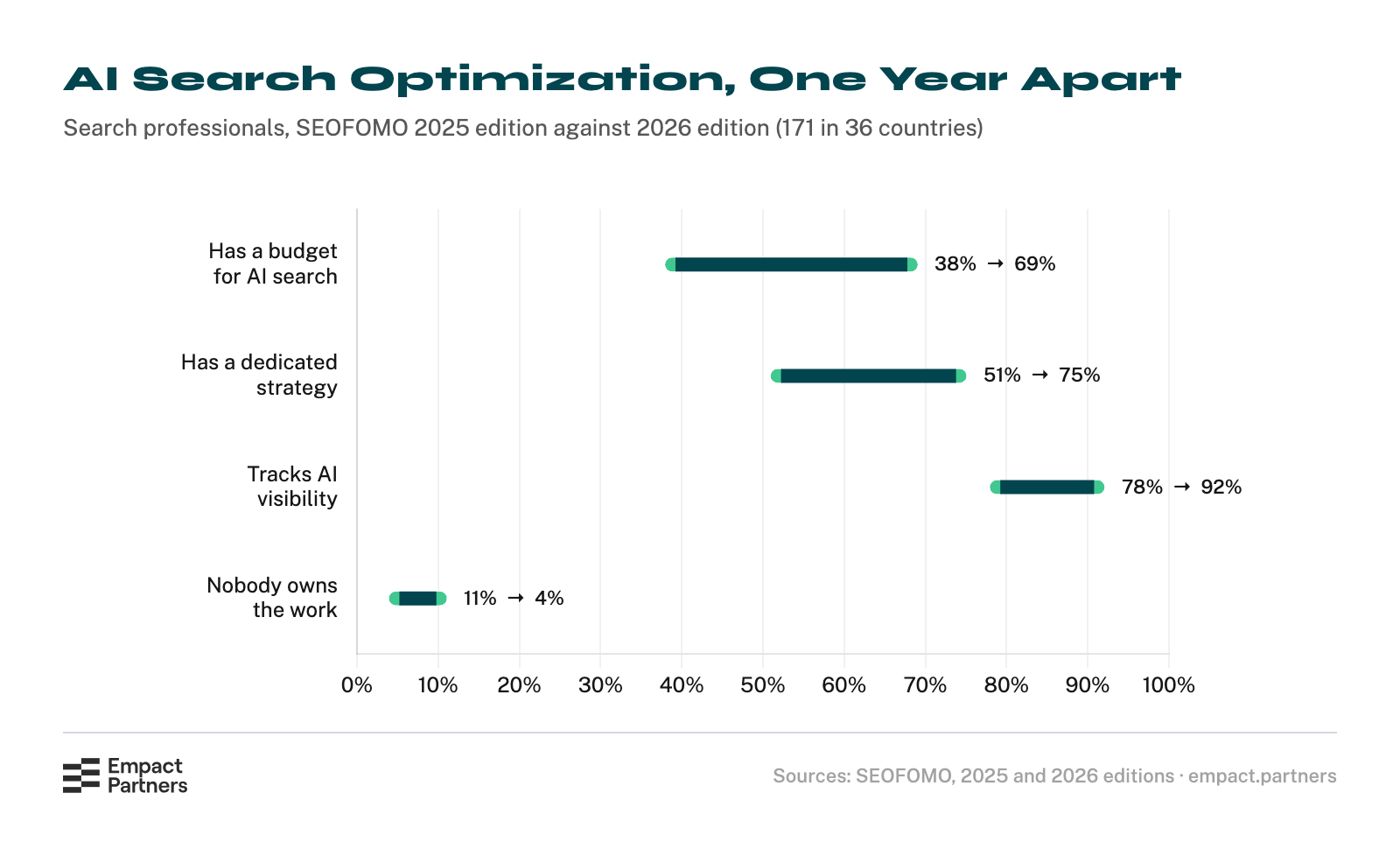
So the money is real, and for most of these teams it sits inside the SEO budget, which means GEO tends to be judged by what SEO was bought to produce: rankings and traffic.
Other surveys measured the money another way, among other people. Centerfield’s poll of 878 US marketers in August 2025 put GEO well behind SEO and social campaigns in the average share of marketing resources:7

GNW asked its 225 B2B organizations for a share of total marketing spend instead: 43% put between 1% and 5% into GEO, and 16% put in more than 5%.1 A few percent of a budget buys a test, which fits GNW’s own 48% still experimenting. And money borrowed from SEO arrives with SEO’s owner attached.
Somebody Owns It Now, Mostly a Team With Another Job
Ownership and staffing are two separate questions, and the surveys answer them differently. On ownership the news is good: the share of SEOFOMO’s respondents saying nobody owns AI search work fell from 11% to 4% in a year.2 Somebody has it now. Who?
Owned, then, and rarely staffed. The three surveys asked different people in different words, but they agree that most of this work sits on the desk of someone hired for something else. In SEOFOMO’s sample, that someone is the SEO team.
Where it landed with the SEO team, that made sense. In Centerfield’s 2025 poll, 33% of US marketers rated their understanding of GEO good or expert, against 72% for SEO.7 A company that handed GEO to its SEO team handed it to the people who already spoke the language.
The catch is the owner’s scoreboard. Among the in-house marketing and PR professionals in Scribewise and Scrunch’s US survey this spring, 62% said leaders outside marketing still judge their team mainly on SEO metrics or web traffic.3 An answer that names your product without a link sends no visit, so the work can move while the scoreboard sits still.
In a partnership with us, a named senior GTM consultant owns the GEO work beside the partner’s team, in the partner’s own channels, and sits on the calls. Its neighbor is SEO, which we run as Search Everywhere Optimization: the pages AI answers cite are pages somebody has to own, so the two run in one roadmap.
Teams Track AI Visibility Far More Often Than They Trust It
Tracking was already common a year ago and is near universal now: 92% of SEOFOMO’s respondents track AI visibility and citations, up from 78%.2 Reading what the tracking says is where most teams stall, and Scribewise and Scrunch’s survey of 602 shows both halves in the same respondents:
Half the people with a documented strategy doubt it. The teams bought the tools. What they lack is a reading they believe.
Semrush’s survey of 481 marketers, SEO professionals and business owners, published in June, found the same thing from another side:
More of them check by hand than can tie what they see to the business.
GNW’s pair tells the same story with two different measures: 73% of organizations track AI referral traffic at least occasionally, while 34% highly trust their GEO visibility metrics.1 On Reddit, a practitioner wrote about sitting through six AI search optimization pitches, and another replied:
“a score you can’t reproduce is selling opacity, not measurement. if they can’t explain the calc, it’s usually because the calc is ‘we ran some prompts and counted,’ dressed up.” r/digital_marketing, July 2026
SEOFOMO asked about challenges, and 94 of its 171 respondents put reliably measuring AI search visibility among their three biggest.2 SEOFOMO prints that as 19%, a share of all the answers given. As a share of the people answering, it is 55%.

Here is why the reading is hard. The first study below draws on about 130,000 ChatGPT and Google AI Mode answers that Qvery, our sister company, logged in August and September 2026.9 It is ours, so weigh its numbers as you would any vendor’s own research, and check the working in the two articles linked below.
Qvery’s study of what each visibility number lets you decide took companies named in at least 10% of their market’s answers in August 2026 and measured each one’s visibility from two runs of its question list. The two readings landed a median 3 points apart across both engines, and on ChatGPT 8 points or more apart one time in ten.4
Qvery also asked each question every day for the month and compared visibility from the odd days with visibility from the even days. Across both engines, the two landed a median 0.68 points apart, and on ChatGPT 2.02 points or more one time in ten.4

Qvery’s study of SaaS category shortlists asked how many buyer questions a reading needs to find the four products that hold a seat on project management’s AI shortlist, meaning they sit in the top five of every asking. Random sets of ten questions found them 32.05% of the time, twenty 86.45% of the time, and thirty 99.5%.10

In CRM, the other category it tested, no set size reliably found the two products that hold a seat there. Two other products sat in the top five in five of the six askings (three on each engine), one asking short of a seat, so whether a smaller set counted them came down to which questions it drew.10
A manual check of ten prompts is a small sample of noise, read once.
So what does a reading look like when it is taken properly, on the day a program starts?
What a GEO Program Looks Like on the Day It Starts
One practitioner handed GEO for the first time asked the right question, in two parts:
“How do you check where a site stands right now in ChatGPT, Perplexity, AI overviews etc? And how do you measure if the work made any difference later?” r/SEO, September 2026
Our answer to the first part is a baseline taken before the first piece of work ships. The Empact Panel, which we built, asks 1,000 or more unbranded buyer questions per partner on ChatGPT and Google AI Mode, each list approved by a person first. It has measured our partners weekly since September 2026, more than a dozen of them by now.11
We also pointed it at ourselves, on a smaller list of 500 buyer questions about our own category, asked on ChatGPT and Google AI Mode with a Claude sample. Four weekly waves in October produced 4,200 answers, and Empact Partners was named in one of them. The first wave named us in none of its 1,050.6
Our own starting line and three partners’ show how different day one can look:
| Whose starting line, and when | Named in | Standing among the brands named |
|---|---|---|
| Empact Partners, our own category, over four weekly waves in October 2026 | 1 of 4,200 answers6 | not ranked |
| A B2B software partner in a category that barely existed two years ago, five days before its first Reddit thread | none of 6,000 answers11 | not named |
| An infrastructure software partner, three days before its program began | about one answer in five, of 2,05011 | mid-field of twelve |
| A healthcare partner restarting its program, from the day it restarted | more than a third, of 2,60011 | near the top of sixteen |
The new-category partner starts from zero, so any later wave that names it shows movement measured from a line drawn before the work began. The healthcare partner starts near the top overall, so its Reddit work since the restart has gone after where the baseline showed it weakest.
The Empact Panel did not exist a year ago,11 and one partnership from before it shows what is missing when a program has no day-one line. That partnership ran four months of Reddit and mention work. Through January the partner complained it could not trace leads to the work, and the email that ended the partnership said its AI visibility had stayed flat.12
Our tracking of its AI visibility had begun about a month into the work, so neither side had a reading from before the first post to measure those four months against. Our reports had led with views and engagement.12
So a GEO partnership with us now opens with an audit and that baseline, then a roadmap set on what the baseline shows. The infrastructure partner above agreed that its targets for the second and third months will be set after its first month of panel readings.11
The work follows the formula on our workstream page, GEO = UGC + Mentions, where UGC is user-generated content. On the UGC half, that is Reddit marketing from accounts with a real history in the communities buyers read. On the mentions half, it is Existing Article Outreach, our method for placing a partner in the listicles AI answers already quote.
Yes, a consultancy that sells measurement is telling you to measure first. Take a first AI visibility baseline reading yourself before you take our word for it. A baseline only earns its keep when results get judged against it.
Teams Seeing Results Are Far More Likely to Say They Can Measure It
Semrush split its 481 respondents by whether they were seeing results from AI search. Among teams seeing results, 41% call AI visibility clearly measurable, 6% have no consistent way to measure it, and 3% have no clear owner. Among teams that are not, the same answers come in at 15%, 27% and 22%.5

Semrush’s split is an association in self-reported answers, so read it as one. Teams that can measure may simply be the teams whose work went well enough to measure. A team with no consistent measure and no owner, though, has no way to find out whether its work is going well at all.
SEOFOMO asked its 171 respondents what AI search visibility has done for the business so far:
GNW’s respondents, the people who decide on marketing strategy, report something sunnier: 78% of organizations investing in GEO say they see a measurable return.1 SEOFOMO asked the people doing the search work. Both surveys record what respondents say, and neither measured the outcome itself.
Our clearest case comes from one partnership. A specialty insurance brokerage came to us after its own first five Reddit posts drew 100,000 views and zero leads. We rebuilt the program around qualified leads, and it produced about 40 in one month.13
Here is what I would check this quarter, before any new tool or budget line. Was the baseline taken before the work started, on enough questions that a second reading would land close to the first, and does everyone who will judge the work accept it as the scoreboard?
Where all three are true, the months of work before GEO’s results show up get measured against a line instead of argued about.
If your team has started on GEO and cannot yet tell what it is moving, book a call with me, and let’s see whether we could work together.
Sources
- GNW Consulting and Demand Metric, The State of GEO in B2B Marketing, 2026 edition, 225 qualified B2B respondents, first quarter of 2026.
- SEOFOMO, Aleyda Solís, The State of AI Search Optimization Report, 2026 Edition, 171 search professionals in 36 countries, 17 to 27 August 2026, compared with the 2025 edition.
- Scribewise and Scrunch, Moving fast, flying blind: 2026 AI search survey, 602 US marketing and PR professionals, 19 May to 2 June 2026.
- Qvery, AI Visibility vs. Share of Voice vs. Average Rank: What Each Number Lets You Decide, 2026, updated 15 October 2026.
- Semrush, Only 22% of marketers have fully integrated AI search and SEO, 3 June 2026, 481 respondents after an attention check.
- Empact Partners, the Empact Panel on our own category: 500 unbranded buyer questions asked in four weekly waves on ChatGPT and Google AI Mode with a Claude sample, 4,200 answers, 4 to 23 October 2026, read 26 October 2026.
- Search Engine Land, Marketers aren’t ready for GEO: Survey, Danny Goodwin, 11 September 2025, publishing the Centerfield Gen-AI Search Readiness Survey of 878 US marketers, August 2025.
- On Marketing, Emerging Trends in Answer Engine Optimization 2025, Tehra Peace, 3 October 2025, 250 US marketing professionals, September 2025.
- Qvery, our sister company: its daily records of completed ChatGPT (65,705) and Google AI Mode (64,308) answers, 1 August to 30 September 2026, counted read-only for this article on 26 October 2026.
- Qvery, Breaking Into a SaaS Category’s AI Shortlist Starts With Counting Its Open Seats, 2026, updated 20 October 2026.
- Empact Partners, the Empact Panel: baseline-wave reports for three partners (waves of 28 September and 15 October 2026) beside each partner’s program record and call notes, and the instrument they follow (1,000 or more unbranded buyer questions per partner, approved by a person before collection; weekly partner reports since September 2026), read 26 October 2026.
- Empact Partners partnership records: one GEO partnership from its kickoff to its end, September 2025 to February 2026, read 26 October 2026.
- Empact Partners, Insurance Brokerage: From Zero Leads To Record Revenue, case study, read 26 October 2026.