
How Long to Give Outbound Before Deciding It Works
When outbound works, kept meetings come within a quarter and revenue a sales cycle later. What to count in month one, at day 90, and after.
 Samantha SpiroWith
 Vlad Shvets
On this page
Empact Newsletter
One email a month on what is working in AI search and SaaS go-to-market.
Six weeks into outbound, the board asks what it has produced. The honest answer is a few replies and a couple of calls on the calendar. There is no new revenue yet, and someone in the room wants to know whether to keep paying.
Jennifer Rasmussen, CMO at Cylindo, has faced that question. She presented her team’s AI SDR, software that prospects by email the way a sales development rep does, to her board and leadership team. By her own account she over-promised and under-delivered for months. It took about four months to ramp, and the change that mattered most was the offer.2
Empact Partners runs outbound for SaaS companies the way we run our own, starting from a change at each company we write to. Our own outreach supplies the timings below, which tell a founder how long outbound deserves and when a zero means stop.6
Why Revenue Is the Wrong Number at Week Six
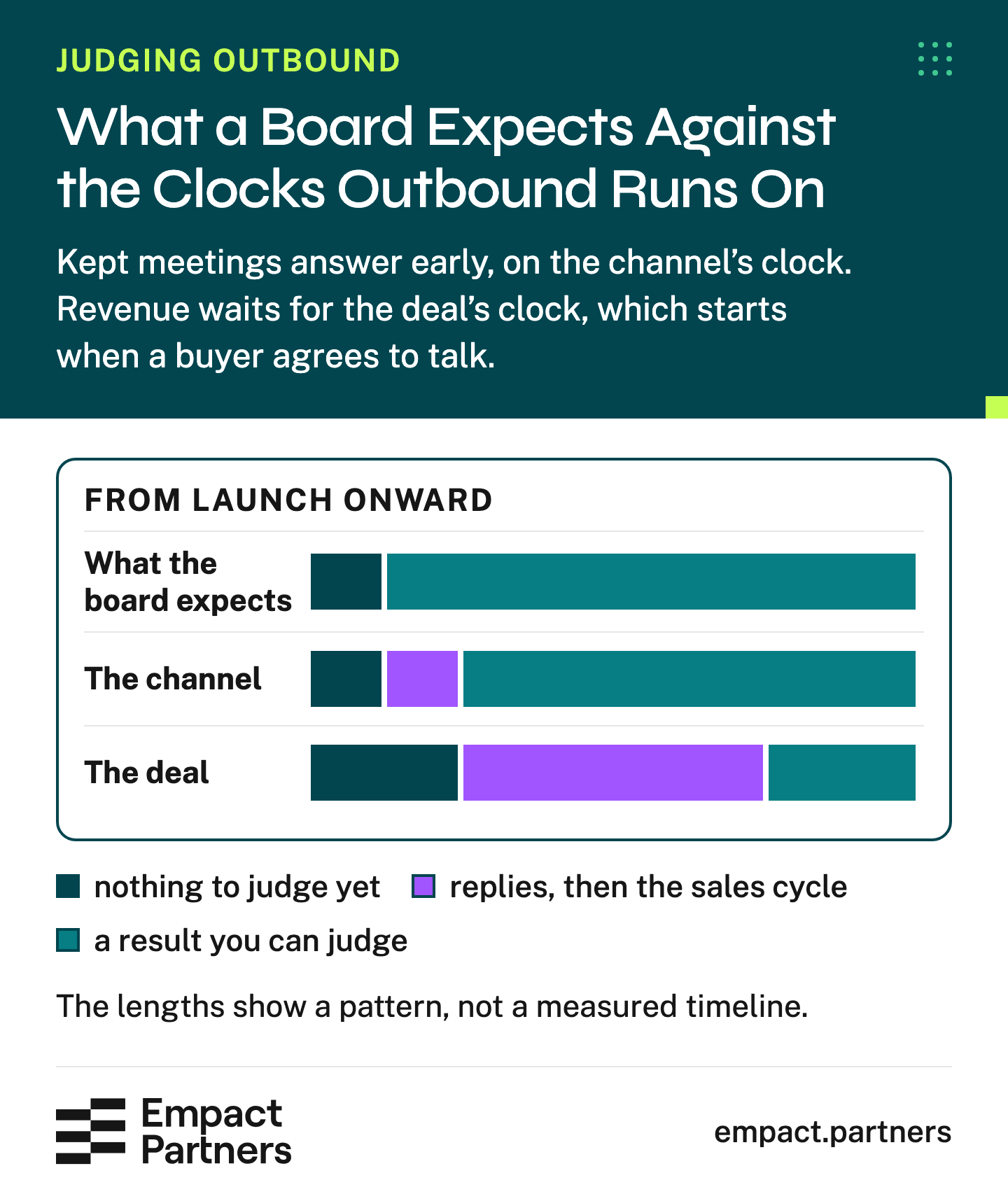
Outbound runs on two clocks. The channel’s clock measures whether your emails land, whether the right people answer and whether they agree to talk. The deal’s clock is your sales cycle, and it only starts when the first call happens.
Our own selling shows how far apart the two run. Our cold campaigns have brought 144 companies into our pipeline since September 2024. Of the 66 with a dated first call, the median call came 15 days after our first email. The 11 that signed after a dated first contact took from 15 to 446 days, with a median of 49 days.6
Week six sits early on both clocks, so any revenue by then comes from the rare deal that met fast and closed fast:
We sell a considered purchase, and a smaller ticket runs a shorter deal clock without closing the gap. Alex Vacca, who co-founded Frontal AI, sees inbound deals close in two to four weeks and outbound ones in four to eight.4 He puts the difference down to whether the buyer trusted his team before the first call.
The number a board tends to remember runs the other way. Vacca also wrote that one build took a 25-person compliance software company from no outbound to 20 opportunities in 20 days.5 The post does not say what counted as an opportunity, how long the domains were prepared before day one, or what the 20 became. It shows the channel’s clock at its fastest.
If revenue cannot speak at week six, the first month has to be read from something that can.
What to Count in the First Month
Nothing in month one means anything until the emails reach an inbox. Silence across a few hundred sends tells you nothing about the offer, because a buyer who never saw the email could not have turned it down. A reply of any kind, a rude one included, at least proves the email arrived.
That is why none of our sending domains carries volume before one of our test emails has landed in an inbox at both Google and Microsoft. A new domain needs weeks of warm-up to get there, and those weeks come out of the board’s six.
If replies never started or suddenly stopped, check where one of your emails lands before anyone rewrites the copy. This test is the free version of an agent we run for our Outbound partners:
Once the emails land, the replies are the month’s evidence, and their kind tells you more than their count. Between August 2025 and August 2026 our own campaigns drew 318 replies from people we had never spoken to, and the main kinds read like this:7
Scroll horizontally to see all columns when the table is wider than this page.
| What the reply said | Replies | What it tells you |
|---|---|---|
| Asked for more information | 134 | The message reached someone curious enough to ask |
| Asked for a meeting | 92 | This data and this email can put calls on the calendar |
| Not now | 27 | A deal with a date on it, if you write the date down |
| Named someone else | 16 | The right company and the wrong person, a fix to your data |
| No, or remove me | 21 | The email reached someone able to judge it |
None of those is a reply rate, and that is the point. A board has no way to tell whether a rate is good, but it can follow what each kind of answer proves. Before the first report, set up the count:
The month-one count
- Inbox first. Test emails land at Google and Microsoft before any volume goes out.
- Replies by kind, never folded into a single rate.
- Dated “not now” replies, each entered in the pipeline with the month it named.
- Named colleagues, added back to your data against the company that named them.
- Silence diagnosed, as a question about placement or the data and never as a verdict on the offer.
Replies prove that the data and the message work. Only a meeting proves a buyer wants the conversation. If replies keep arriving at week six with no meetings among them, look at the ask before the calendar. That was Rasmussen’s fix: once her team offered something people wanted, positive responses rose about six or seven times.2
Judge the First Quarter on Kept Meetings
A kept meeting is a call that took place with someone who could buy, as opposed to one that was booked and missed. It is the first result that proves the whole chain worked, because the email landed, the right person read it and they gave you half an hour.
When outbound works, those meetings come early. Of our 66 cold-campaign deals with a dated first call, 33 had it within two weeks of our first email and 57 within 90 days:6
How Soon Our Cold Campaigns Reached a First Call
Days from our first email to the first call, 66 of our own cold-campaign deals
View the data
| Label | Value |
|---|---|
| Within 7 days | 19 |
| 8 to 14 days | 14 |
| 15 to 30 days | 10 |
| 31 to 60 days | 7 |
| 61 to 90 days | 7 |
| After 90 days | 9 |
The published ramp accounts point the same way, each tied to its setup. The Bridge Group’s survey of 351 B2B companies puts a new SDR’s ramp at 3.0 months.1 Rasmussen’s AI SDR took about four, much of it trial and error until the offer worked.
Alex Hormozi opened outbound as a second channel because paid social carried all of his sales to gym owners. His team called and emailed on tickets of $20,000 and up, and made one sale in the first month, two in the second and four in the third.3 By month 14 the channel brought about 45 sales a month, roughly 60% of his volume.
Write the day-90 test into the first board deck, before the first email goes out. Count kept meetings with people who could buy, and agree in advance what a zero, a few and a steady flow each mean. Once the rule is on paper, nobody has to argue about patience in month two.
 Samantha Spiro on LinkedInOpens in a new tab
Counting kept meetings takes a deliberate step, because most tools never record them. Our sending tool counts emails, replies and the leads someone marks as opportunities. It has no field for a meeting held.
Our CRM moves a deal forward when the meeting took place, read from the team’s calendars, notes or the email thread. Its own stage guide says the calendar alone cannot see a no-show, so a missed call exists there only when someone logs it.
The test cuts both ways. In November an SDR posted on r/SaaSSales that three months had booked him no meetings. He had sent nearly 6,000 emails and made 4,000 calls, starting with small manufacturers as targets for a managed security provider.8 He did not lack patience, and the sellers who answered him pointed at who he called and what he offered:
Tips from Reddit
What sellers told an SDR with no meetings after three months
150 conversations and zero meetings says people are picking up, so the leak is in the first 30 seconds of those calls. Cheapest fix: record 20 of them and write down the exact line each one dies on.
150 conversations with zero conversions is not a you problem, the offer just isn’t landing.
Both answers send him back to the setup. Our own record cannot tell you how often a channel with no kept meetings at day 90 recovers by itself a month later. It does show that when our outbound worked, the meetings came early, which is why we would change the setup before waiting to find out.
A quarter of outbound that reaches inboxes and books no kept meetings calls for a new offer or new data before anyone agrees to wait longer.
So read day 90 backward through the chain. If nothing came back, look at placement and the data first. If replies came without meetings, the offer or the ask needs work. If meetings were kept, the rest of the wait belongs to your sales cycle.
When Revenue Can Fairly Be Judged
Revenue belongs in the board report once the first kept meetings have had one full run of your sales cycle. Start from your own recent deals, counting the days from first call to signature on the last few that closed. Then allow for the cold buyer, who met you on that call. Vacca’s numbers put his outbound cycle at about twice his inbound one.4
Our own tail is the honest part. Three of our 11 dated signatures came 161, 334 and 446 days after the first email.6 Those were buyers whose timing came later, and they are the reason a “not now” goes into the pipeline with its date rather than into the bin.
Put together, the board report changes as the quarters pass:
Scroll horizontally to see all columns when the table is wider than this page.
| When | What to count | What a zero means |
|---|---|---|
| Month one | Test emails in the inbox, replies by kind | No replies after a few hundred landed sends: check placement and the data |
| End of the first quarter | Kept meetings with people who could buy | Replies without meetings: change the offer or the ask. No replies: fix the setup first |
| One sales cycle after the first kept meetings | Pipeline, then revenue from those meetings | Meetings that never become deals: you are reaching people who talk but cannot buy |
The last row is also the first point at which outbound’s acquisition cost means anything, because the sum needs customers the channel has won. Once those deals have closed, you can set the channel against your others:
Until then, a cost per customer for outbound divides by a number that has not had time to exist.
How We Run Outbound Against These Milestones
Our take is that a board should extend outbound’s runway only for evidence it can see, and the first piece of evidence is whether the email lands. When we run outbound for a SaaS company, nothing goes out at volume until a test email has landed in an inbox at both Google and Microsoft. Revenue is the last thing worth judging, one sales cycle after the first kept meetings.
The writing starts from a change at the company, such as a new sales leader, a product launch or a move into a new market. That change is what gives a cold email a reason to exist this week, and Heather Holland wrote the method up as a playbook:
Behind those milestones sits the daily work, which our team does for you:
What our Outbound work covers
- New sending domains for your outreach, warmed before use and kept away from your business mail
- No volume from any of them before a test email lands at Google and Microsoft
- A real colleague’s name on each email
- Caps on sending, and a stop your own team can use
- Each reply read and answered by us
- Buyers ready to talk passed straight to your sales team
- Timing and subject-line ideas tried on our own outreach before yours
Watch one number this quarter: kept meetings with people who could buy. If the emails land and that number is still zero at day 90, change the offer before you change the timeline. If it is climbing, give revenue one full sales cycle from the first of those meetings, and write that date into the board deck now.
Frequently Asked Questions
How long should we give outbound before deciding it works?
One quarter to judge the channel, and one of your sales cycles after that to judge revenue. In the first quarter the question is whether emails land, replies come in and some of them turn into kept meetings.
If all three happen, keep going until the first meetings have had time to close. If the quarter ends with no kept meetings despite emails that land, fix the setup before you spend another quarter.
What should we report to the board in month one?
Report whether your test emails landed in inboxes at Google and Microsoft. Then give the replies sorted by kind: questions, meeting requests, “not now” with its date, named colleagues and refusals.
Add the kept meetings so far, even if there are none yet, so the board learns early which number the quarter will be judged on. Leave reply rate and revenue out of the first report, because neither can be read yet.
What counts as a kept meeting?
A call that took place with someone who could buy, or who will carry the decision to the person who can. A booked slot that nobody attended does not count, and neither does a pleasant call with someone who has no role in the purchase.
Log no-shows on purpose, because most calendars and CRMs record the booking and miss the absence. A meeting moved and then held counts once, on the day it happened.
What does it mean when we get replies but no meetings?
Usually that the email works and the ask does not. A reply proves the message reached someone who understood it. A meeting needs a reason to give you half an hour, so change what you offer for the call before changing who you write to. Rasmussen’s team saw positive responses rise about six or seven times once the offer changed.
Should we wait longer if outbound gets no replies at all?
No. Waiting helps a channel that is working slowly, and silence across a few hundred sends usually means the emails are not reaching an inbox. Run a placement test first, at Google and at Microsoft separately, because the two can treat the same email differently.
If the emails land, check whether the companies in your data have the problem you solve, and whether the person you wrote to owns it. Do that before rewriting a single subject line.
Does outbound take longer to close than inbound?
Usually, yes. An inbound buyer has read your pages and often trusts you before the first call, while a cold buyer meets you for the first time on it. Vacca’s numbers put outbound at about twice the cycle of inbound. Use your own inbound cycle as the floor for outbound, never as its forecast.
How do we set a revenue date if we do not know our sales cycle?
Take the last few deals you closed from any source and count the days from first call to signature. Add room for a cold buyer who did not know you before that call. If you have closed too few deals to measure, judge outbound on kept meetings for longer, because there is nothing honest to compare revenue against yet.
What if our sales cycle is longer than a quarter?
Then the first quarter still judges the channel, and revenue waits longer. Kept meetings tell you the emails reach people who want to talk, and that answer does not depend on how long they take to sign.
At the enterprise end the wait can run to years. One seller on r/sales closes one to three deals a year across 30 target companies, each over a sales process of about two years.9 Follow the meetings through your own pipeline stages, such as a second call, a proposal or a trial, so the board sees movement before a signature arrives.
Does an AI SDR ramp faster than a human SDR?
Not in the published cases we have read. The Bridge Group’s survey puts a human SDR’s ramp at about three months. Rasmussen’s AI SDR took about four months of trial and error to find an offer that worked. The software sends faster than a person can, and that does not shorten the time it takes to learn what your buyers want to hear.
Should we sign a long outbound commitment with an outside team?
Tie the commitment to the two tests rather than to a term. Month one should prove the emails land and replies arrive, and the end of the first quarter should prove kept meetings. A team confident in its setup can agree to both. Neither test needs revenue, which is why neither should wait on a contract length.
When should outbound’s cost per customer enter the discussion?
Only after the channel has won customers, which means after the first kept meetings have had a full sales cycle to close. Before that, any cost per customer divides by too few deals to mean anything. Compare it with your other channels then, over the same period, so the slow start does not count against outbound twice.
Sources (9)
- The Bridge Group, "SDR Tenure and Ramp Time" (2025)↩16 February 2025. SDR ramp time of 3.0 months across 351 B2B companies, online survey 2024 to 2025. Read 18 November 2026.
- Beyond Revenue, "Rebuilding the GTM Engine for the AI Era, with Jennifer Rasmussen" (2026)↩1↩26 November 2026. The AI SDR presented to the board, about four months to ramp, the offer and the rise in positive responses. Transcript read 18 November 2026.
- The Alex Hormozi’s Podcast, "How I Scaled My Sales Team" (2026)↩111 October 2026. Outbound as the second channel, monthly sales in its first quarter and at month 14, ticket size. Transcript read 18 November 2026.
- Alex Vacca, "LinkedIn post on trust and close speed" (2026)↩1↩2October 2026. Inbound deals closing in two to four weeks and outbound in four to eight. Read 18 November 2026.
- Alex Vacca, "LinkedIn post on the GTM build order" (2026)↩1A 25-person compliance software company from no outbound to 20 opportunities in 20 days. Read 18 November 2026.
- Empact Partners, "sales record reading" (2024)Empact Partners' own data↩1↩2↩3↩4↩5first contact, first call and signature dates for the 144 companies our cold campaigns brought into our pipeline from September 2024, built 22 October 2026 and recomputed 18 November 2026.
- Empact Partners, "reply records" (2025)Empact Partners' own data↩1human replies to our own sales campaigns by kind, 8 August 2025 to 17 August 2026, counted 18 November 2026.
- u/Key-Ball9536, "SDR seeking advice" (2026)↩1r/SaaSSales, 2 November 2026. Read 18 November 2026.
- u/bigbaldbil, "comment on outbound enterprise sales" (2026)↩1r/sales, September 2026. Read 18 November 2026.
Keep reading
Outbound 5 Salesloft Alternatives for B2B Outbound Teams
Five Salesloft alternatives matched to why teams leave after the Clari merger, and what each move rebuilds in your cadences and CRM.

Outbound Give Your Outbound Agent Credit For The Emails It Doesn’t Send
Stop outbound agents emailing existing conversations. Record justified skips, hold failed checks and give every hold an owner.
Outbound Write Your Outbound Playbook Before You Buy An AI SDR
Before buying an AI SDR, define which emails your team would stop. See the rules, approval process and evidence to judge its work.