
If An AI Assistant Can Already Answer It, Do Not Write It
Before you brief a topic, put its question to ChatGPT and Google AI Mode. If the reply would satisfy your buyer, cut it or narrow it.
 Shanal GovenderWith
 Vlad Shvets
On this page
Empact Newsletter
One email a month on what is working in AI search and SaaS go-to-market.
Before anyone briefs your next article, type its question into ChatGPT and Google AI Mode. If the answers would satisfy the person asking, cut the topic. Outranking the first result no longer decides it, because that result now sits under an answer, and a reader who already has the answer has no reason to click.
Write only where you hold what the answer lacks: how your product does the job, a number from your own users, a project that went wrong, your expert’s call on a situation. If you hold none of it, narrow the topic until you do, or cut it. Documentation, pricing pages, and anything else a buyer needs from you specifically are exempt.
Empact Partners runs this test on each topic before writing a SaaS company’s content marketing, so what ships carries something its buyers can’t get from an assistant.
AI Answers Skipped the Explainers on Two Blogs We Audited
In November we graded every post on one partner’s blog, a few thousand of them, and matched each one against the citations in our Empact Panel.1 Every week the Panel asks ChatGPT, Google AI Mode, and Claude the questions that partner’s buyers ask, and keeps each citation. AI answers cited about one post in eighty.
The citations they did make went to pages only that company could have written. Setup guides and release notes took most of them, and the explainers about the category drew none:
Where One Blog’s AI Citations Went, by Kind of Post
One partner’s blog of a few thousand posts: share of posts and of AI citations
and release notes43.8%77.8%
press releases33.2%17.1%
the category11.7%0%
View the data
| Label | Share of the blog’s posts | Share of the blog’s AI citations |
|---|---|---|
| Setup guides and release notes | 43.8% | 77.8% |
| News and press releases | 33.2% | 17.1% |
| Explainers about the category | 11.7% | 0% |
| Everything else | 11.3% | 5.1% |
Cited posts averaged 9.4 out of 30 on our rubric and the rest 9.2, so the grade barely separated them. The kind of page did. An assistant can explain the category without anyone’s help, but it cannot know how that product is set up, or what changed in last month’s release, unless the company wrote it down.
A second partner’s blog, a few hundred articles audited in August, split the same way.2 Nearly one article in five was cited, almost all of them category and comparison pages that show the product doing a buyer’s job. The educational explainers, most of the blog, were close to absent from the citations.
On our 10-point scales, cited articles scored 1.42 points higher on product representation, how specifically a page shows the product at work, and only 0.26 higher on information gain, what a page says that the ranking pages don’t. Both audits rewarded the same kind of page, which gives you a fast way to read your own blog:
Read your own blog with one question in mind: could you have written this post without your product in front of you? On both blogs we audited, the posts that could were the ones AI answers skipped, and the setup guides that couldn’t were the ones they quoted.
 Shanal Govender on LinkedInOpens in a new tab
Both blogs were already published when we audited them, and the cheaper moment is before a brief exists. So we put the opening test itself to a keyword export.
ChatGPT and Google AI Mode Already Settle Most Definitions in a Keyword Export
On 20 November we pulled a keyword export for project management and email marketing, two categories no partner of ours sells in. We kept the 40 questions with the most searches and put every one to ChatGPT and to Google AI Mode.3 Then we graded the 80 answers on our own “end the search” test: would the person who typed the question have to search again?
Definitions came back finished. Of the 30 definition answers, 26 settled the question, and so did all six comparisons and three of the four answers to the two yes-or-no questions. How-tos split, with 10 of 26 settled. Questions that needed a number or a pick, like a good open rate or the best platform, were settled in none of 14:
How Often an AI Answer Settled the Question, by Kind
40 questions from a keyword export, one ChatGPT and one Google AI Mode answer each
(3 questions)100%
(15 questions)87%
(2 questions)75%
(13 questions)38%
(5 questions)0%
(2 questions)0%
View the data
| Label | Value |
|---|---|
| Comparisons (3 questions) | 100% |
| Definitions (15 questions) | 87% |
| Yes-or-no questions (2 questions) | 75% |
| How-tos (13 questions) | 38% |
| Number questions (5 questions) | 0% |
| Pick questions (2 questions) | 0% |
Most of the 35 answers that stopped short were missing something only someone close to the work would know. Fifteen needed a current number for the reader’s own segment. Seven needed a judgment that depends on the reader’s situation, six a worked case, and four the steps in a specific product. Those gaps are where an article on the same topic still has something to say.
The settled answers are the ones to worry about, because readers rarely click past them. Pew Research Center’s browsing data on Google’s AI summaries, from March 2025, found users clicked a search result in 8% of visits with a summary, against 15% without one.4 In 1% of those visits they clicked a link inside the summary itself. An article that repeats a settled answer waits for a click that mostly never comes.
Any topic splits into what an assistant already answers and what only your company can write, and the article belongs on the second side:
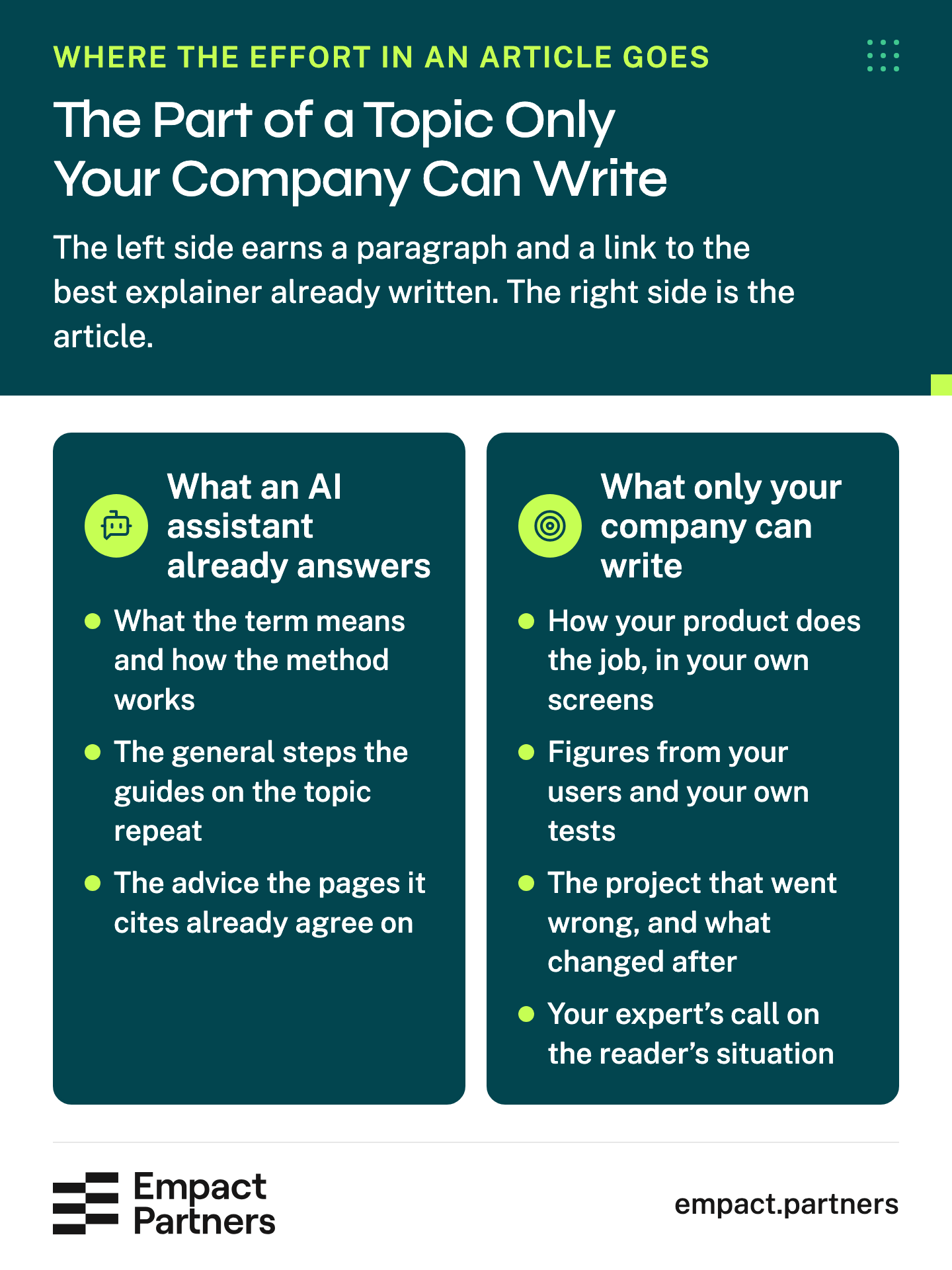
In our run, more than half the answers already sat on the left side. A brief is worth writing only for a topic that reaches the right one.
For the topics that do, our playbook covers writing what AI answers lack, and checking afterwards whether the engines quote what you wrote:
Doesn’t a Blog Need the Basics to Rank?
The argument for writing the basics anyway is that topical authority is built on them. An engine’s answer to a definition is drawn from pages like yours, so somebody has to write them. A blog with no foundational explainers also looks thin to the reader who lands on it. Follow this rule strictly, the argument goes, and a content lead publishes nothing for a quarter.
Part of that is true. In our run the engines settled 45 of the 80 answers, most of the definitions among them, so a strict reading cuts more than half of a keyword export. And the second partner’s older explainers did earn Google clicks: 115 of its articles ranked in Google with no AI citation at all.
The engines already hold the basics, though. The 45 settled answers in our run drew on 105 different sites, software vendors’ own blogs among them. One more explainer gives them nothing they lack. The basics take a paragraph that links to the best explainer already written, and the effort goes to the part that is new. On both blogs we audited, that was the part the engines quoted.
On both blogs we audited, AI answers quoted the pages that put the company’s own product in front of the reader.
The Google clicks those explainers kept were shrinking anyway, along with the rest of the blog. Its traffic had fallen below half its July 2025 peak by August of this year. Practitioners on r/content_marketing drew the same line this autumn:
Tips from Reddit
What practitioners write instead
ai is going to eat the lookup half of blogging, not the whole thing.
What I do now: state the recommendation in the first two sentences, then spend the rest of the post on what I ruled out and why. The ruled-out part is the bit a model cannot invent for me, and it is usually what people reply about.
So I’d write less ‘here’s how to do X’ and more ‘here’s what happened when I did X, and what I’d do differently’.
The second comment names the part worth writing down. What you ruled out, and why, is first-hand by definition, and no assistant has it.
How to Run Your Next Ten Topics Through the Test
Take the next ten topics on your plan before anyone writes a brief, and run each one through these checks:
- Ask the question in ChatGPT and in Google AI Mode, worded the way your buyer would type it.
- Read each answer as the person who asked it, and decide whether they would close the tab.
- If both answers settle it, cut the topic, or give it a paragraph inside a page you were writing anyway.
- If an answer stops short, name what it lacks, whether that is your product, a number of your own, a case, or your expert’s call.
- If you hold that, brief the article around it and cover the basics in one linked paragraph.
- If you hold nothing the answer lacks, narrow the topic until you do, or cut it.
- Documentation, pricing, integration pages, and pages comparing your product with a named rival skip the test.
When we run Content Marketing for a partner, our consultants put every topic on the plan through the test before anything is briefed. Each one that passes gets a named consultant who chooses its angle, interviews the people who hold what the assistant lacks, and signs off the piece.
The drafting is AI-native, which means agents write the first pass and the consultant’s time goes on the part an assistant can’t supply. You end up with a shorter plan, and every topic left on it carries the thing only your company can say.
Once a topic passes and a draft exists, run it through the free Information Gain Check. It reads your draft beside up to eight of the pages that rank and sends back what yours says that they don’t:
The hardest topics to cut are the ones with search volume, because the export makes them look like traffic. In our run, seven of the ten highest-volume questions were definitions, and both engines settled five of those seven.
If a topic on your plan is a definition, assume the assistant already has it and give it a paragraph inside a page you would write anyway. Spend the brief on the questions that need your number or your product. In our run, those were the ones no answer finished.
Shanal Govender on LinkedInOpens in a new tabSo cut the topics an assistant already answers well, and for each one you keep, write down what you hold that the answer lacks before anyone briefs it. Then watch whether the engines quote the pages you kept. If they stay uncited, what you held never made it onto the page.
Frequently Asked Questions
Which AI assistants should we test our topics in?
Use ChatGPT and Google AI Mode, the two we ran this test in. Google AI Mode answers the people who still start their search on Google, and ChatGPT answers the ones who skip it. Ask each question the way your buyer would type it, not the way your keyword tool phrases it. If your buyers use Claude, add it. One answer is a sample, so for a topic you are unsure about, ask twice in a fresh chat and read both before you decide.
What counts as an answer good enough to cut the topic?
Read the answer as the person who typed the question. If they would close the tab, the topic is settled, even if the answer is short. If they would still need a number for their own situation, steps in a specific product, a worked example, or someone’s judgment, the answer stopped short. That gap is the article. In our run, length decided nothing. Some short answers closed the question, and long ones that stayed generic did not.
Should we stop publishing glossary and definition pages altogether?
Not for your own product’s terms. A glossary of what your features are called and how they behave is documentation, and buyers can only get it from you. Generic category terms are different. In our run the engines settled 26 of 30 definition answers, so a standalone page defining a common term adds little. Give it a short, linked paragraph inside a page about something only you can explain.
Do help-center pages and release notes count under this rule?
Help-center pages and release notes are exempt, and on the larger of the two blogs we audited they did most of the work in AI answers. Setup guides and release notes were 44% of its posts and took 78% of its citations. Keep them current, write them for the question a user asks, and link to them from your articles where a reader would need the steps.
What should we do with old posts an assistant already answers?
Check them before you touch them. Some still earn Google clicks, and on the second blog we audited more than a hundred articles still ranked in Google without a single AI citation. Then decide for each one whether to keep, refresh, merge, or remove it. Posts still earning clicks stay, near-duplicates merge, posts with something of yours to add get refreshed, and the rest go, with redirects.
How narrow should a topic get before it is worth writing?
Narrow it until a good answer needs something you hold. “What is a good open rate” looks like a settled question, yet in our run neither engine settled it, because the honest answer depends on the sender’s segment. A page built on your own users’ open rates, by segment, answers it where the assistant cannot. If narrowing never reaches something you hold, cut the topic.
How do we add something new without a research budget?
Most of it is already in the building. Your product’s setup steps and the questions your support team answers every week are a start. So are figures from your own dashboards, a recorded sales call, and an hour with the person who built the feature. An assistant can read none of them.
On the larger blog we audited, almost no post carried a number from the company’s own data, and information gain averaged 2.3 out of 10. That grade is hard to raise with nothing of your own to say, and the missing numbers are the cheapest gap there is to close.
Will cutting informational topics hurt our Google traffic?
Cutting a live page can cost you clicks you were getting, so check your search data first. A topic you haven’t written yet has less to lose than its search volume suggests. With an AI summary above the results, Pew found Google users clicked through about half as often, and the second partner’s blog traffic fell below half its peak within about a year. Judge a new topic by the buyers it can reach and the questions it can answer that an assistant cannot.
Do AI engines cite pages with original data more often?
Our audits point somewhere slightly different. On both blogs the kind of page decided citation more than the information-gain grade did. The cited pages were the ones that showed the product doing the job, while generic explainers went uncited. Original data is one way to give a page that kind of substance, but our audits can’t isolate its effect, because almost no post on the larger blog carried any.
Treat your own figures as a reason for a buyer to read the page, and the product detail as the reason an engine quotes it.
How often should we rerun the test on topics we cut?
Every quarter, and whenever your product changes in a way buyers ask about. AI answers change as the pages they draw on change, and a topic the engines settled last spring may now have a gap your new feature fills. Rerun the questions that sit closest to your product first, since that is where a gap opens. Keep the cut topics on file with the date you tested them, so the next test starts from what you saw.
Sources (4)
- Empact Partners, "blog audit of a partner’s blog of a few thousand posts, November 2026" (2026)Empact Partners' own data↩1↩2every post graded on our rubric and matched against the AI citations in the Empact Panel (ChatGPT, Google AI Mode, and Claude).
- Empact Partners, "blog audit of a second partner’s blog of a few hundred articles, August 2026" (2026)Empact Partners' own data↩1AI citations from two 3,000-question studies in ChatGPT and Google AI Mode.
- Empact Partners, "keyword-export run, 20 November 2026" (2026)Empact Partners' own data↩1↩240 questions from a keyword export in project management and email marketing (US), one ChatGPT answer with web search and one Google AI Mode answer each, 80 answers graded on whether the reader would have to search again.
- Pew Research Center, "Google users are less likely to click on links when an AI summary appears in the results" (2025)↩122 July 2025, pewresearch.org.
Keep reading
Content Marketing How to Measure Information Gain With Firecrawl and Claude
Before you commission the eleventh article on a topic, check what the ranking pages and AI answers already say, and what yours would add.
Content Marketing What To Give A Content Agent Before It Drafts Anything
Give your content agent approved proof, buyer language and a clear owner so your team spends less time fixing generic drafts.
Content Marketing How to Find an Original Angle for Your SaaS Content
Decide which crowded topics deserve an article, what evidence makes them useful, and when to narrow the question or skip it.