


Nine articles rank for how to reduce churn in SaaS, and they make the same handful of points about faster onboarding, health scores and check-in calls. ChatGPT gives the same list in a few seconds. A content team handed that topic usually drops it because it has been done, or writes it longer and tidier than the nine.
Both moves lose, and the reason they lose has changed in the last two years.
Empact Partners is a consultancy that helps SaaS companies get discovered on the web, mostly through content. Some partners are among the best-known names in the most crowded software categories, so nearly every topic we get has been covered a hundred times. We check each one in three parts before any outline, and the check may end with not writing it.
A Topic Covered a Hundred Times Is Still Worth Writing
The hundred pages exist because buyers keep asking the question. A crowded topic is a demand signal, and walking away from it hands the question to whoever answers it next, usually a competitor with a weaker page and a steadier publishing habit.
Crowded categories are where some of our best results came from:
In categories like these the topic is never what fails. What fails is the eleventh version of page one: ten other pages’ points, slightly better organized.
What that eleventh version lacks is information gain: the share of a page that is new against everything already published on the subject. Google patented a score for it in 2022, measuring what a document adds beyond what the reader has seen, served by an assistant or a results page. The patent names the logic. It does not prove any product runs it.
Information gain is the north star of our Content Marketing work. We look for what nobody has written down, argue positions we will defend, and bring what we and our contributors learned doing the work. You can keep the topic buyers search for and still give it an angle of its own, by commissioning it as an argument instead of a keyword.
AI Answers Already Carry What Every Ranking Page Repeats
So the topic is worth writing and the eleventh version is not. The second half of that sharpened once AI engines started answering the question before anyone clicks, and we wanted to see how much.
On October 9, 2026, we took three topics every SaaS content team gets handed: onboarding emails, reducing churn and writing a B2B case study. We read the 25 articles among Google’s three US top tens and listed every distinct piece of advice, 146 points in all. Then we asked ChatGPT and Google AI Mode the same questions that day.
The more pages repeated a point, the more often the AI answer already carried it. ChatGPT gave 64% of the points that four or more pages made, and 13% of the points that only one page made. Google AI Mode wrote shorter answers and fell the same way, from 43% to 4%.
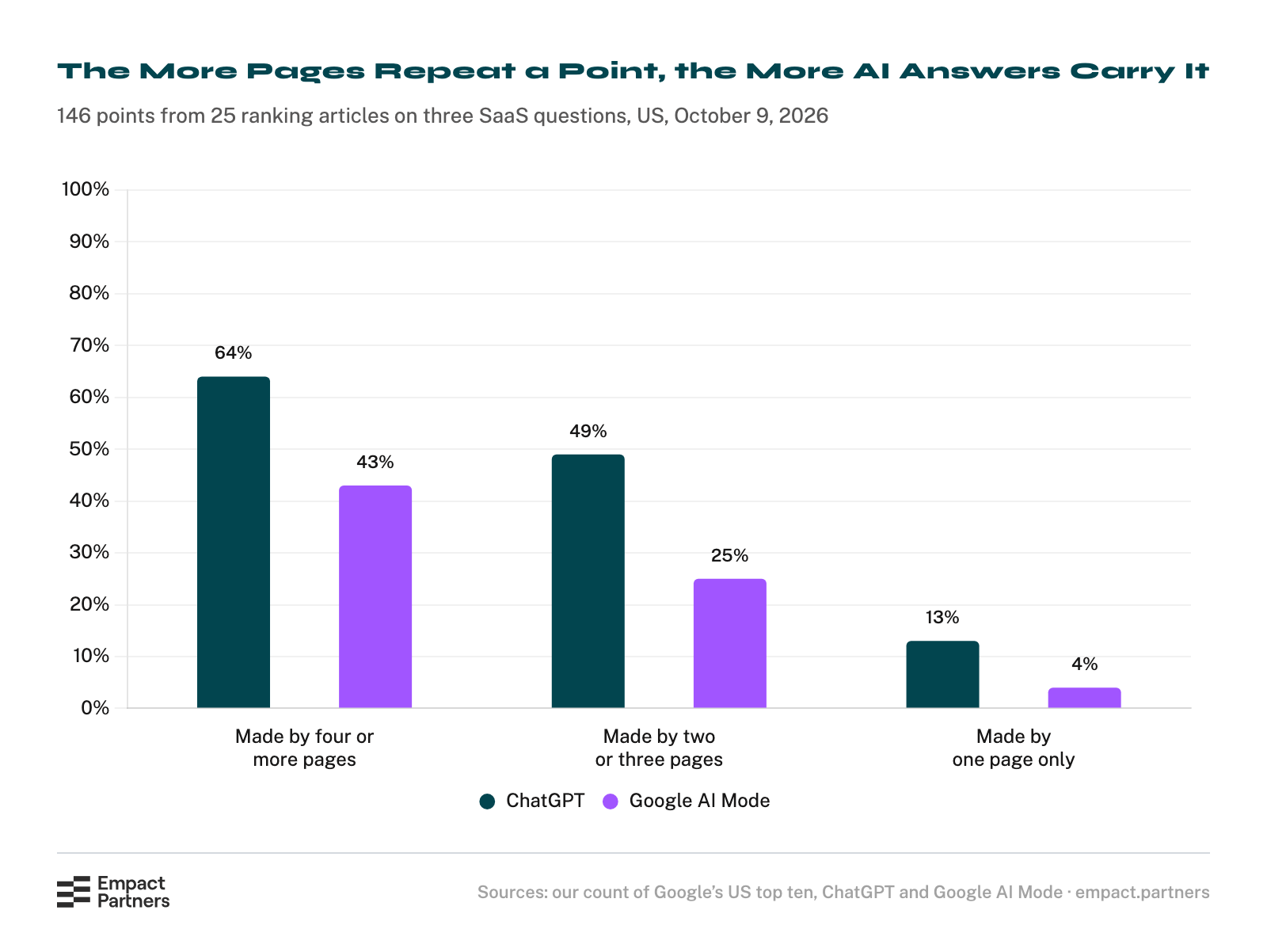
Neither engine cited any of the 25 ranking articles for its own question. ChatGPT found its 19 citations on other pages, and Google AI Mode answered two of the three questions without citing anything at all.

.png)
An engine does not need your page for what every page says, because it already holds that. It needs a page for what it does not hold, and the page it quotes carries its argument and its brand into the buyer’s answer. Recommendations get built from those quotes, so in our read one fact nobody else published can become visibility.
The outside evidence on AI search citations is an association, and it points the same way. Citera compared 350,000 B2B SaaS articles competing for the same keywords: the ones AI engines cited averaged 4.2 statistics against 1.2 for the ones they ignored, and 52% carried a named expert quote against 12%.
Our own run is one answer per engine per question on one day. Taken together, the two say more about what is no longer worth publishing than about what gets a page cited.
Page One’s Repeated Points Are the List of Things Not to Write
The first part of the check takes an afternoon. Open the top ten results for the exact question the piece will answer and work through the articles like this:
- Keep the articles. Set aside the forums, videos and product pages, and note them, because they show where buyers go instead.
- List every point. One plain line per piece of advice, for each article.
- Merge rewordings, never different advice. “Shorten time to value” and “get users to a first win” are one point. “Send a check-in” and “call the accounts going quiet” are two.
- Count the pages behind each point. Anything on half the articles or more is the consensus.
- Mark the outliers. Points on one page only, and whether each comes from somewhere you could check.
On churn, the nine ranking articles made 35 distinct points. The top three, faster onboarding, health scores built from usage and proactive check-ins, sat on 8, 8 and 7 of the nine pages. None of the nine carried anything first-hand: no case with a number its publisher produced, no data it collected, no named practitioner disagreeing.
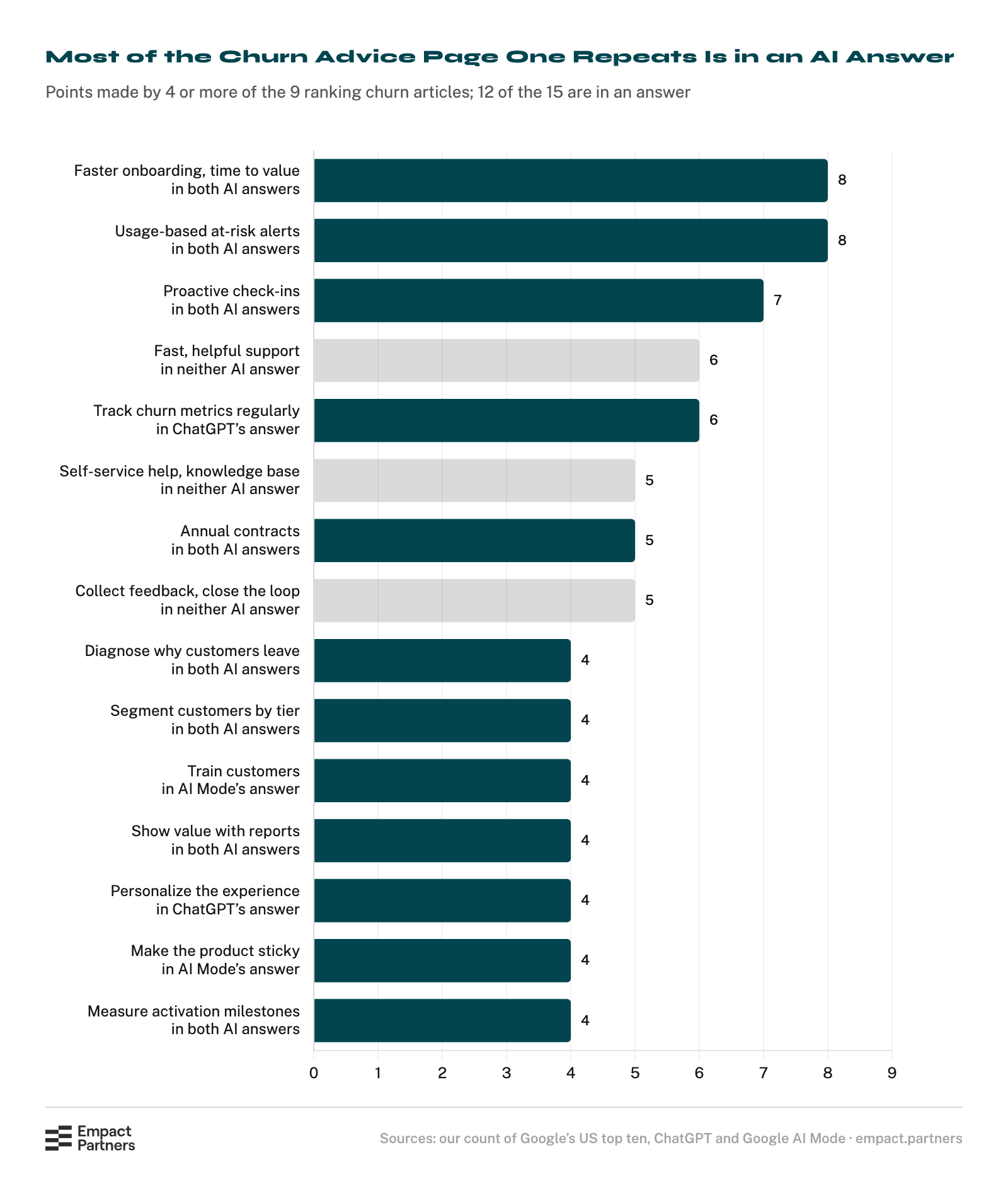
The consensus list is the most dangerous document in the process, because it looks like an outline. Teams write it up section by section and publish the tenth version of a list ChatGPT already gives in full. In your piece the list earns one line or a link, and never a section.
Practitioners who write in crowded categories see the same thing from the inside:
“If the top 10 results all cover the same 15 headings, and your article covers the same 15 headings a little better, Google still doesn’t have much reason to reorder the results.” — u/Professional_Elk8981, r/content_marketing, August 2026
A content score of 100 tells you so little for the same reason: it rewards a draft for matching the points page one already repeats.
If the AI Answer Covers Your List, Narrow the Topic or Skip It
The second part takes ten minutes. Ask ChatGPT and Google AI Mode the exact question, then mark which points on your consensus list appear in each answer.
In 2024 we stopped asking first whether our article could beat the one ranking first, and started asking whether an AI assistant could already answer the question. Two years on, for a topic like churn, it can.
What you do next depends on what the answer covers and what you hold:
| What the AI answer does | What you hold | What to do |
|---|---|---|
| Covers the consensus | A case, a person or a first-hand use | Write it, led by what you hold. The consensus gets a line |
| Covers the consensus | Nothing beyond the consensus | Narrow the topic to a situation the answer skips, or drop it |
| Covers the consensus, and the page has a sales job | Your own product | Write the product-specific version: your tool doing this job |
| Is thin, vague or wrong for your buyer | Anything you can verify | Write the better answer, with the evidence on the page |
A sales job is what saves a good page from the rule. A how-to that shows your own product doing the job is a demo as much as an article, and its value does not depend on the engine lacking the generic steps. PDF Reader Pro’s guides were exactly that.
Narrowing means one situation the general answer does not reach. None of the eight case-study articles we read, and neither AI answer, says what to do when the customer will not let you use their name. We meet that situation with most of our partners, because most have never been named in a public case study.
Run the check for every question, and never assume its result. On onboarding emails, half of the points found on only one page still turned up in an AI answer, four of them in ChatGPT’s, so advice that was rare on page one was not necessarily missing from the answers.
The Part Only You Can Add Is a Case, a Person, or a First-Hand Use
Clearing the ground leaves the third part, and it is the only one that produces anything. The thing worth adding is almost never a new theory. In our partnerships it has been one of three things:
A candidate has to pass three questions before it earns the piece. Is it missing from page one and from the AI answer? Can you say where it came from? Would your reader do something differently because of it? A clever framework with a new name fails the second, and an interesting fact the reader cannot act on fails the third.
.png)
PDF Reader Pro’s guides were first-hand use. Each one showed the product doing the job step by step, so someone searching for help with a PDF got a demonstration instead of the generic steps. No competing PDF tool was ever going to publish a walkthrough of PDF Reader Pro.
For Vestlane, a fund-operations platform selling into private equity, the source was people. We first found the gaps in the competitors’ content, then spent more than nine hours interviewing the founders and outside experts. Those conversations became 16 specialized pieces for readers who drop an article the moment a term is wrong.
Our count across three questions is a case of our own. Nobody on page one had counted anything, so the numbers were something we could add that no page and no answer held.
Write the Commission Sentence Before Anyone Writes an Outline
Everything the check found goes into one sentence, written before the outline and before anyone is assigned the piece. It has three slots: what the piece argues, what it adds that page one and the AI answer do not, and where that comes from. If the third slot is empty, you have a topic and no angle yet.
We have commissioned topics as arguments since 2024, when we stopped handing partners keyword lists and started handing them content plans in which every topic states what the piece will argue. A keyword tells a writer where to stand. The sentence tells them what to say and where to get it.
Here is the sentence for the narrower case-study topic, filled from what our run found missing:
The third slot is filled from something we hold, which is the test. When it reads “research”, the writer has been handed a keyword and a deadline, and nothing to build the angle from.
Every Brief We Write Starts With the Check
Content Marketing at Empact Partners starts every piece with this check, and the rest of the work is built around it:
Our run cannot tell you whether publishing a point only you hold gets that point, and your brand, into an AI answer. One answer per engine is a snapshot, and an answer can leave a point out for reasons unrelated to how new it is. For partners we track their category’s answers every week, which is where we see whether it happens.
If your team keeps getting topics the whole internet has already covered, and you want each one to come back with something only you could publish, put a call in my calendar and we will see whether we are the right people to do that with you.


