Why a Narrow Category Is Easier to Win in AI Search
An AI answer names about six products in any category. We narrowed 12 buying questions to see who gets those seats.
 Sharné McDonaldWith
 Vlad Shvets
On this page
Empact Newsletter
One email a month on what is working in AI search and SaaS go-to-market.
Plenty of SaaS companies file their product under the widest category they can defend, because “marketing automation” sounds like a bigger company than “text messages for restaurants.” Then a buyer asks ChatGPT for the best marketing automation software and gets HubSpot, ActiveCampaign and Mailchimp. The company with the big label is not in the answer.
Most teams answer that with more articles, more mentions and more budget, as if the fix were to out-shout HubSpot. This page is about the choice that comes before the spend. It shows how the category you claim changes your odds of being named when a buyer asks an AI engine for software, and how to test a narrower one.
Empact Partners helps SaaS companies choose their category and write the positioning and messaging around it. In AI search, that first choice sets how many rivals share an answer with you.
An AI Answer Has About Six Seats, Whatever the Category’s Size
Start with how many names an answer has room for. In October we asked ChatGPT and Google AI Mode three buying questions about each of 113 software categories on G2, from niche to crowded. The size of the category barely moved the size of the answer:
The seats stay at about five or six whatever the category holds, so a bigger category means more products chasing the same seats. In a small category the answers name a large share of the products listed. In a crowded one each seat has dozens of listings behind it, and the names the engines repeat in every answer already hold it.
A broad question and its narrow twin get answers of the same length, chosen from very different fields:
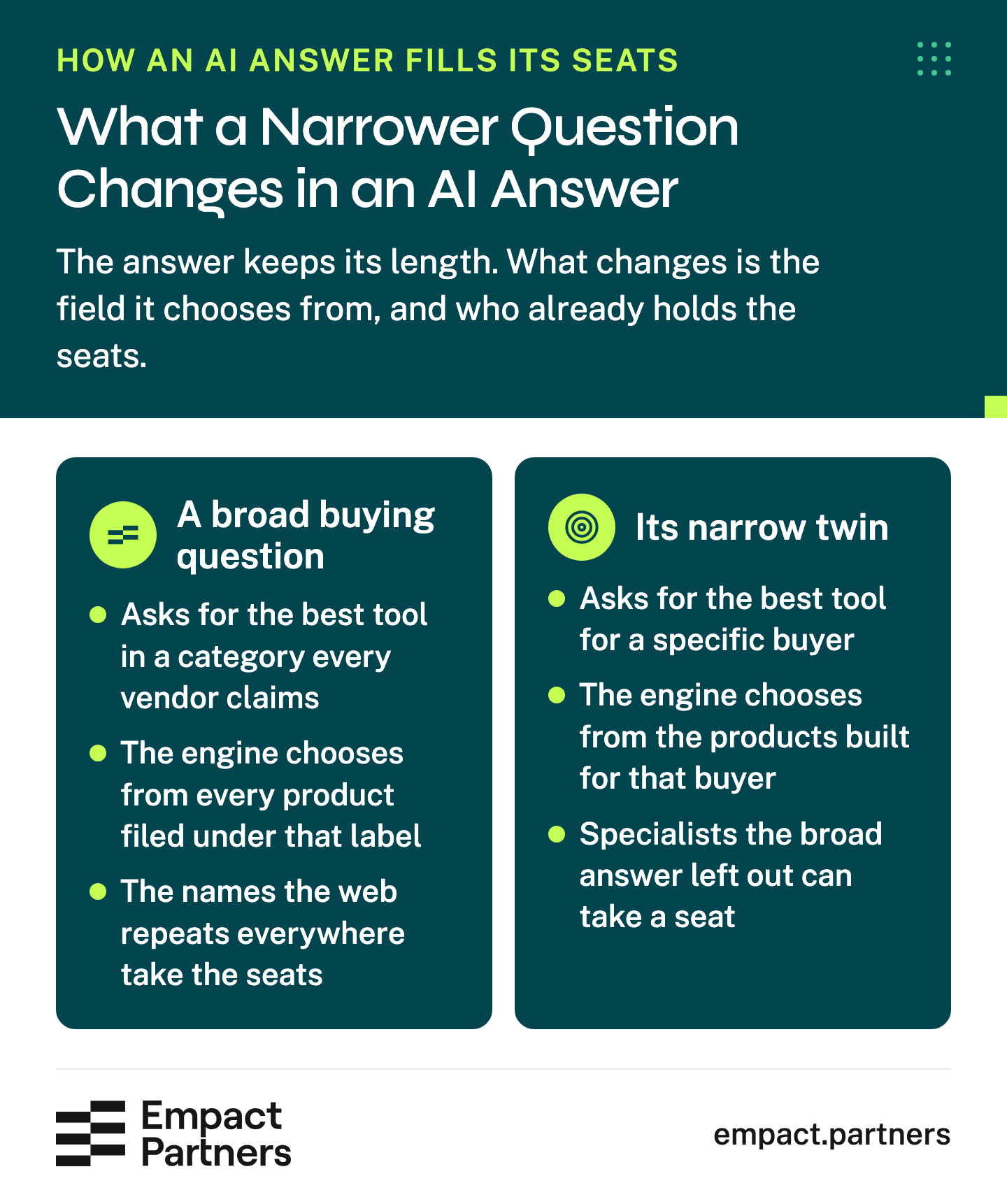
Those October figures compare different categories, though, and a buyer never picks between a niche category and a crowded one. They ask a question, and you choose the words that make your product an answer to it. The test that matters narrows one broad buying question and watches who the seats go to.
What Changed When We Narrowed the Same Question
On 20 November we ran that test on 12 pairs of a broad question and its narrowed twin. Each was asked three ways, twice in ChatGPT and once in Google AI Mode. Two pairs share a broad question, so that came to 207 answers.2 Six pairs narrow by who buys, like CRM for real estate agents, and six to a job, like employee onboarding.
Narrowing did not change the number of seats. ChatGPT’s answers ran a little longer than in October, a median of 7 products, and AI Mode’s named 6, on the broad and narrow sides alike. Each side drew about 15 different vendors across its nine answers. What changed was who sat in them.
The three vendors named most for each broad question held 38.7% of mentions there. Once the question narrowed, they held 17.6%, the median across the pairs, and their share fell in all 12 pairs on ChatGPT and in 11 of 12 on AI Mode:
How Much the Broad Leaders Keep When the Question Narrows
Share of mentions held by the broad question’s top three vendors, 12 pairs, nine answers a side
for architecture firms37.7%14.1%
for real estate agents46.6%9.1%
for Shopify stores35.1%25%
for dental practices38%0%
for breweries35.6%0%
for photographers45%21%
to lead scoring39.4%23%
to embedded analytics37.1%23.7%
to employee onboarding45.6%37.7%
to NPS surveys44.8%25%
to headless CMS37.9%0%
to SMS marketing39.4%0%
View the data
| Label | Broad question | Narrowed question |
|---|---|---|
| Project management for architecture firms | 37.7% | 14.1% |
| CRM for real estate agents | 46.6% | 9.1% |
| Email marketing for Shopify stores | 35.1% | 25% |
| Scheduling for dental practices | 38% | 0% |
| Inventory for breweries | 35.6% | 0% |
| Website builder for photographers | 45% | 21% |
| Marketing automation to lead scoring | 39.4% | 23% |
| Business intelligence to embedded analytics | 37.1% | 23.7% |
| HR software to employee onboarding | 45.6% | 37.7% |
| Survey software to NPS surveys | 44.8% | 25% |
| Content management to headless CMS | 37.9% | 0% |
| Marketing automation to SMS marketing | 39.4% | 0% |
The CRM pair shows the move at full size. HubSpot, Salesforce and Zoho were in all nine broad answers. For real estate agents, Follow Up Boss, Wise Agent and Real Geeks were in all nine, and none of the three had appeared in a single broad answer.
Scheduling software went the same way. Acuity, Square and Setmore lead the broad answers, and none of them is named for dental practices, where Weave is in every answer.
Narrowing to a job worked only where the job has its own products
The two kinds of narrowing split. Narrowed by audience, the broad leaders’ share fell from 37.9% to 11.6%, and in four of the six pairs the narrow question’s most-named vendor never appeared in a broad answer. Narrowed to a job, it fell from 39.4% to 23.4%, and a new name led in one pair of six.
The reason is who already sells the job. Employee onboarding is a feature of the big HR suites, so Rippling, Gusto and BambooHR led both sides and kept 37.7% of the onboarding mentions. HubSpot was in every lead scoring answer, and Microsoft in every embedded analytics answer.
A job opened the seats only where it is a product category of its own. Text message (SMS) marketing tools and headless content systems are, and both narrow questions dropped every broad leader.
In our pairs, naming the buyer moved an AI answer to specialists more reliably than naming a narrower job.
These pairs show where the seats went on one day, in two engines and US English, on questions we chose. Whether a company that re-files under a narrower label then gets one of those seats is a separate question, and only its own answers over time can settle it.
Which Category Path the Answers Support
A company has three ways to choose its category. It can stay inside one buyers already know, take one and add a qualifier, or invent a new one. Each route puts the product beside a different set of rivals in an AI answer, and staying inside splits in two:
Scroll horizontally to see all columns when the table is wider than this page.
| Path | What the engine chooses from | When the answers support it |
|---|---|---|
| Compete inside the broad category | Every product filed there, with the seats held by the names repeated most | When your product is already one of the names the broad answers repeat |
| Compete inside a smaller category | The products that do that job, plus the suites that include it | When the job is sold as a product of its own, and not as a feature of the leaders’ suites |
| Add a buyer qualifier | The products built for that buyer, often ones the broad answers never name | When buyers say the qualifier themselves and the specialists named for it are ones you can beat |
| Create a new category | Nothing yet, because no buyer asks for it | When buyers already describe the need in their own words and no product owns the answer |
Our pairs point at the third row. A SaaS company outside the top three names of its broad answer should test a qualifier its buyers already say before anything else. The qualifier keeps a question buyers ask, and in our pairs it handed the seats to products built for that buyer. A smaller category can work too, where the job is sold as a product of its own.
We have had this argument with partners over keywords, and it runs the same way in AI answers. A broad term crowded with tools of a different kind looks like the bigger prize. Our view is that the narrower term naming what the product does is the better bet, even at far lower search volume. Here is the order I would test the two narrowings in:
I’d test a qualifier your buyers say out loud before a narrower job. In our pairs the qualifier moved the answer to specialists in four cases out of six and the job in one, because a job is often a feature the category leaders already sell. Run both against your own buyers before you redraw anything.
 Sharné McDonald on LinkedInOpens in a new tab
Creating a category starts with an empty field and no question, and an engine names products for the questions buyers ask. It pays when buyers already describe the need and nobody owns the answer. Our playbook on defining a concept shows how to name the idea buyers need, write the piece that defines it and track who repeats it as you meant it:
Narrowing also has a price, and it is worth saying before anyone redraws the homepage. A narrower label gives up some buyers who only ever search broad, and it shrinks the market slide in a pitch deck. For a company the broad answers already name, it is the wrong move, and that company should defend its seat.
Run the Paired Test on Your Own Category
Search volume will tell you little about a narrow question. “Project management software for architecture firms” shows 40 US searches a month against 201,000 for the broad term, yet Google suggests a bid of $196.46 for it against $45.52.3 Someone pays to reach that narrow searcher, and a question typed to an AI assistant has no search volume at all.
Two engines and a spreadsheet are enough to repeat our pairs on your own category. The test answers what our pairs cannot, which is whether your narrower question has a seat you could take:
Check that buyers ask the narrow question.
Look for the qualifier in sales calls, demo requests and the words in deals you won, more than in a keyword tool.
Write the broad question and its narrow twin.
Use your buyers’ own words for both, the way they would type them to an assistant.
Ask each question three ways in both engines.
Ask for the best tool, for a recommendation and for a shortlist, each in a fresh chat, and ask ChatGPT twice, so each side has nine answers.
Write down every product each answer names.
Count the different names on each side, the names in every answer, and whether your product appears.
Compare the two sides.
If the narrow answers name the broad leaders again, the narrowing points at a feature of their suites. If they name specialists you can beat, that is the narrower category to test.
The test shows which products ChatGPT and AI Mode name. It cannot show which category they file you under, and a product filed wrongly misses the narrow seats too. Our How AI Describes Your Brand tool checks that half, setting the engines’ description of your company against your own:
A Narrower Category Counts Only Where Buyers and Engines Read It
ChatGPT and AI Mode describe you with whatever words your site and other sites use, so the old label lingers wherever it is still written. Engines with live web access can pick up a new listing within days, while answers drawn from training data lag by months. Before the engines can name you for the narrower question, the new category has to show up here:
- The homepage headline and the About page, in the words buyers use for the narrow question
- The sales deck, and the way your sellers introduce the product on a first call
- The category you choose on G2, Capterra and the other directories your buyers read
- Your comparison and use-case pages, each written for the buyer the qualifier names
- The listicles and Reddit threads the narrow answers cite, beside the specialists they already name
Working with Empact Partners on this opens with an audit and a roadmap. Here the audit sets your buyers’ own words for the product against your homepage. The message is Brand Marketing work and the cited pages are Generative Engine Optimization, and the two run together:
What the work includes
- The core message, found with your team, and the messaging framework written around it
- That framework carried through your site and the story your sellers tell
- Your product and use-case pages rewritten so an AI engine can find the narrower category on them and quote it
- The case for your product put to the editors of the best-of listicles the narrow answers cite
- Reddit replies that help buyers asking the narrow question, with the product named only where it belongs
- The Empact Panel, our own build, rerunning your narrow and broad questions weekly in ChatGPT, Google AI Mode and Claude, with every answer kept
A named senior GTM consultant leads the work and is on your calls. Expect months before the answers move, because AI search work takes that long to build.
Then compare the narrow question’s answers with the broad question’s, asked the same way every few weeks. If the narrower category is working, look for your name in the narrow answers first, since those seats are the less settled ones.
Frequently Asked Questions
How narrow can a category get before AI answers stop naming anyone?
Narrower than most founders expect. In our pairs, even inventory software for breweries drew answers naming a median of six products, because an engine fills its seats from whatever the pages about that need mention.
What limits a narrowing is whether buyers ask the question at all, because an answer nobody requests sends you nobody. Look for the qualifier in sales calls and demo requests before you commit, and drop any narrowing your buyers never say in their own words.
Will a narrower category cost us Google rankings for the broad term?
Not by itself. Pages that rank for the broad term can stay. The narrower words go into the homepage headline, the About page, the directory listing and the comparison pages that describe the product for one buyer.
A rankings drop after repositioning usually comes from rewritten or removed pages. Change the message on the pages, keep the URLs that already earn traffic, and watch the broad term for a quarter.
Can a SaaS company claim more than one narrow category?
On separate use-case pages, yes, one for each buyer the product serves well. The homepage, the sales deck and your main directory category carry one category at a time, because that is where engines and buyers read what you are.
Pick the narrowing where the paired test shows specialists you can beat and lead with it. Add the others as pages once the first starts showing up in answers.
How long before AI answers reflect a new category?
Two clocks run at once. Engines with live web access can pick up a new listing or page within days, so some answers move soon after the directory category and the cited pages change. Answers drawn from a model’s training data keep the old picture until the next model update, which takes months.
Ask the same questions the same way every few weeks. Read the trend across many answers rather than one screenshot, since two people asking the same question can get different names.
Which directory category should we pick if none matches our narrower label?
The closest existing category your narrow buyers already browse, with the qualifier carried into the listing’s headline and description. A directory files you against the products in that category, so a listing in a crowded parent category puts you back in the broad field.
Where the directory offers a smaller category that matches your buyer or your job, take it, even if it holds fewer products. Fewer products is the point, since those are the rivals a buyer browsing that category compares you with.
When is creating a new category the right call for AI visibility?
When buyers already describe a need in their own words and the answers to it are a mix of tools that each solve part of it. Then nobody owns the answer, and the company that names the need and gets that name repeated on other sites can own the question.
If buyers do not describe the need yet, a new category name is a question nobody asks, and the engines have nothing to answer for you.
What if a strong specialist already owns our narrow question?
Then the narrow field is held too, and you are back to competing inside it. In our headless content system pair, Sanity was in every narrow answer and already in 77.8% of the broad answers, so narrowing gave a newcomer no free seat there.
Try a qualifier on top of the job, such as a buyer the specialist serves poorly, and compare those answers before choosing. A field held by one specialist is still smaller than the broad one, so the question is whether you can beat that specialist for one kind of buyer.
Does narrowing work the same in ChatGPT and Google AI Mode?
In our pairs it worked in both. The broad leaders’ share fell in all 12 pairs on ChatGPT and in 11 of 12 on Google AI Mode. AI Mode answers named a median of 6 products against 7 in ChatGPT.
The names often differ between the two engines. Run the paired test in both, and treat a narrowing as working only where both start naming you.
How do we tell an audience qualifier from a job narrowing?
An audience qualifier names who buys, such as real estate agents or dental practices. A job narrowing names one task the broad category already does, such as onboarding or lead scoring.
The difference matters because the category leaders often sell the job as a feature, so they come along into the narrow answers. They rarely build for one industry’s buyers in the same way, which is why the audience pairs handed more seats to specialists.
What does moving a SaaS company to a narrower category involve?
It is mostly a consistency job. The same narrower words have to appear on the site, in the sales deck, in the directory listing and on the pages AI answers cite. Anywhere they are missing, ChatGPT and AI Mode read the old label.
Expect it to take months, since cited pages change at their own pace and model updates arrive when they arrive. Keep the pages that already earn search traffic while their wording changes.
Sources (3)
- Empact Partners, October 2026 category run: 113 hand-picked G2 categories asked on 28 October 2026 in US English, 989 answers from ChatGPT (two passes, web search on) and Google AI Mode (one pass). Published in, "71 SaaS Category Competition Statistics and AI Shortlists" (2026)Empact Partners' own data↩1
- Empact Partners, "November 2026" (2026)Empact Partners' own data↩1↩2paired run. Asked on 20 November 2026 in US English: 12 pairs, each a broad software category beside a narrowed twin (six narrowed by audience, six by job), three phrasings per side, 207 answers from ChatGPT (two passes, web search on) and Google AI Mode (one pass).
- Empact Partners, "November 2026" (2026)Empact Partners' own data↩1search-volume lookup. Google Ads monthly search volume and suggested top-of-page bids for each pair’s exact phrases, US, averaged over twelve months, read through DataForSEO on 20 November 2026.
Keep reading
Brand Marketing Competitor Comparison Pages: Answer “Why Not You?” First
Turn buyer objections into an honest SaaS comparison page, with evidence, approval owners and a plan to keep claims current.

Brand Marketing How to Check Whether AI Engines Still Find You After a Rebrand
Find outdated profiles, broken pages and missing recommendations after a rebrand, then assign the fixes your team can make.
Brand Marketing Keep Your Brand Consistent When Every Team Ships Content
Stop teams recreating your brand. Build one approved library, name its owner, and check files and wording before they spread.