
33 B2B CRM Statistics on Data Quality and AI
33 figures on how accurate B2B CRM data is, what bad records cost and what changes once AI reads them, our own pipeline included.
 Shanal GovenderWith
 Vlad Shvets
On this page
Empact Newsletter
One email a month on what is working in AI search and SaaS go-to-market.
When we moved our own pipeline off a Monday board on 29 September 2026, the board’s proposal column held 37 deals. Seven weeks later, with every stage tied to a dated email or meeting, one of the 37 still reads proposal sent.1 On moving day, 31 of them had not heard from the buyer in 60 days or more, so most of the column described deals that had already gone quiet.1
Every one of those deals had a stage, an owner and a date, so the board looked complete and was mostly out of date. This page puts numbers on that gap, from six published studies and our own pipeline: how much teams trust their CRM data, what bad records cost and what changes when an AI agent reads them.
I work on RevOps, short for revenue operations, at Empact Partners, a go-to-market consultancy for SaaS companies. We clean the CRM data your teams share so the pipeline an agent reads shows which deals are still alive.
Highlights
- 31 of the 37 proposals on our old board had not heard from the buyer in 60 days or more when we moved the pipeline.1
- 76% of CRM users say less than half of their organization’s CRM data is accurate and complete.2
- 37% of CRM users report losing revenue as a direct result of poor data quality.2
- 71.4% of marketers say poor CRM data has fed inaccurate or misleading AI results, and only 21.3% call their data very well prepared for AI.3
- 38% of the leaders Workbooks surveyed use AI inside their CRM, against 91% who use AI regularly.4
- 55% of executives think their CRM is used effectively, against 27% of non-executives.5
- 70% of companies that run sales plays do not effectively build them into their CRM and other revenue tools.6
Side by side, the studies describe one problem. Most teams already doubt their CRM, and the doubt costs them deals and hours. The AI now reading the CRM arrived before anyone fixed it. The people approving that AI trust the records most. None of these surveys samples B2B SaaS alone, so treat them as the size of a common problem and our pipeline as one measured case of it.
What Inaccurate CRM Data Costs a Revenue Team
Validity, which sells data-quality software for CRMs, surveyed 602 CRM users and administrators in the US, the UK and Australia for its 2025 report. The answers rate their own data rather than audit it, so read them as the view from inside the CRM:
- 76% of respondents say less than half of their organization’s CRM data is accurate and complete.2
- 37% of CRM users report losing revenue as a direct consequence of poor data quality.2
- 16 deals a quarter is the average a company loses to poor-quality data, by respondents’ estimate.7
- 13 hours a week go on hunting for basic information in the CRM.7
- 37% of staff regularly fabricate data to tell leaders what they want to hear.7
Three of those figures land on a revenue team every quarter, whatever its forecast says:
The 37% counts respondents who saw revenue go, not the share of revenue lost. So it is a weak number for a business case and a strong one for deciding what to fix first. More than a third of daily CRM users can point at a deal the data cost them.
The 13 hours are the quieter cost. That is about a third of a working week spent checking the system before anyone trusts it, which means the CRM is costing time even on the days it costs no deal.
The figure I would underline is the fabricated data. A CRM fills up with confident entries when the people typing them are judged on how the pipeline looks. More mandatory fields make it worse, because a rep with a deal to save picks whatever value lets the save go through. The fields end up complete, and the forecast reads them as true.
Completeness is the test most CRM audits run, and it is the wrong one. Every one of our 37 board proposals had a stage, an owner and a date. None carried the date of the buyer’s last word, and that field alone would have shown us 31 had gone quiet for two months or more.
 Shanal Govender on LinkedInOpens in a new tab
What We Found When Our Own Pipeline Moved to a New CRM
We run RevOps on ourselves first. Our own CRM moves a deal only on an event the record shows, such as a reply, a meeting, a proposal sent or a signature. A deal whose buyer stays quiet after our chases moves to nurture by rule. Before 29 September, our pipeline lived on a Monday board where people moved deals between columns by hand, so a stage showed whatever someone last dragged.
The board’s proposal column is the clearest before and after we have. This is how long each deal in it had been waiting on the buyer on the day we moved:
How Long Our Board’s 37 Proposals Had Waited on the Buyer
Days since the buyer’s last word on 29 Sep 2026, the day we moved our pipeline
View the data
| Label | Value |
|---|---|
| Under 30 days | 2 |
| 30 to 59 days | 4 |
| 60 to 89 days | 4 |
| 90 to 179 days | 20 |
| 180 days or more | 3 |
| No word in the record | 4 |
Twenty of the 37 had last heard from the buyer three to six months earlier, and four had no word from the buyer anywhere in the record. The median wait was 124 days.1 An agent forecasting from that board would have counted 37 open proposals, so its forecast would have rested on 31 buyers who had been silent for at least two months.
Seven weeks after the move, one of the 37 is still a live proposal. Thirty-two are in nurture, and 24 of them got there when one person checked every proposal against the record on 9 November.1
The proposal column was not lying on purpose. It never heard the buyer stop answering, and nobody had a reason to move a card that still looked hopeful. I trust a stage something in the record moved, and I treat every other stage as a guess until it earns the trust.
Shanal Govender on LinkedInOpens in a new tabToday our pipeline counts 40 deals as open, and every one of those buyers has written or met with us in the last 30 days. The median is 8 days.1 Nobody on the team got more diligent. The rule changed, so a deal stays open only while the record shows the buyer is still in it. The before and after are different sets of deals, each the set our system called open on its date, and that is the point.
Even with events doing the stages, the field a person types still lags. Only 23 of our 40 open deals carry a written next step.1 Every one has an owner and a due date the system works out. The gap is the sentence only the owner can write, so that is where a reminder belongs, since another required field only adds guesses.
Moving the records did not make every stage provable, though. This is what each deal’s current stage rests on, by where the deal sits now:
What Each Stage in Our Own Pipeline Rests On
Share of each column’s deals, event-backed right, board-only left, 20 Nov 2026
View the data
Press Enter or Space to pin the note. Press Escape to release it.| Label | Backed by a dated event in the record | A person’s correction | Only the old board’s column | Note |
|---|---|---|---|---|
| Open | 97.5% | – | 2.5% | |
| Nurture | 32.1% | 34.4% | 33.6% | |
| Lost | 61.9% | 38.1% | – | |
| Won | 39.3% | 3.3% | 57.4% |
The open column is the part an agent would act on, and 39 of its 40 stages rest on a dated event.1 So an agent working those deals reads stages it can trust. The won column is the weakest, with 57.4% of its stages resting only on the old board’s column.1
The median one of those partnerships sat on the board about a year before the first email our record holds for it, and four have no email in the record at all.1 So the inbox cannot prove those stages again. For a team planning a migration, that means the oldest wins are where the guesses survive.
You can run the first of those counts on your own CRM. The CRM Health Report works from one CSV export of your CRM, the spreadsheet file a CRM downloads, with no login. It counts duplicates, records missing a required field, stale records, lifecycle gaps and records with no owner, ranked for cleanup. We run the full version of that agent for our partners, and this run of it is free:
AI Now Reads CRM Data Most Teams Say Is Not Ready
Validity’s 2026 report moved the same questions onto AI. It surveyed 500 B2B and B2C marketers in the US, the UK, Brazil, Australia and New Zealand, so this is the marketing side of the CRM.8 Asked about AI and their CRM data, they reported:
- 66.7% of organizations increased how many marketing decisions they hand to autonomous AI agents over the past year.3
- 71.4% of marketers say poor CRM data has directly contributed to inaccurate or misleading AI results.3
- 21.3% of marketers believe their CRM data is very well prepared to fuel those tools.3
Each bar answers its own question, so the three never add up to a whole:
What 500 Marketers Told Validity About CRM Data and AI
Validity, State of CRM Data 2026, three separate questions, share of marketers
View the data
| Label | Value |
|---|---|
| Gave AI agents more decisions | 66.7% |
| Say bad CRM data fed bad AI results | 71.4% |
| Call their data very well prepared | 21.3% |
Read in order, they describe a year in which two thirds of teams gave agents more decisions. Over the same period, about one in five called the data under those agents very well prepared.
The 21.3% is the top answer only, so everyone outside it is not necessarily unprepared. A year earlier, 45% of the CRM users Validity surveyed said their company’s CRM data was not prepared for AI.7 Either way, agents received more decisions in a year when few teams called their data very well prepared.
An agent reads a stage field the way a new hire reads it on day one, as true. The new hire learns within a month which columns nobody updates. The agent never does, so the cleanup that matters is the fields it will read, done before it reads them.
Shanal Govender on LinkedInOpens in a new tabInside the CRM itself, AI is still early. Workbooks, a CRM vendor, surveyed 247 sales and marketing leaders in the US and the UK in October 2025. Of them, 91% use AI regularly and 38% use it inside their CRM to some degree.4 Only 17% use more than two of its AI features, and 62% plan to use more within a year.4
The teams already using AI in their CRM report a different set of problems from the ones the others expect:
Challenges of AI in the CRM, Expected Against Faced
Workbooks, 247 US and UK leaders, Oct 2025, % of responses, expected to faced
View the data
| Label | Expected by teams not yet using AI in their CRM | Faced by teams already using it |
|---|---|---|
| Poor data quality | 14% | 33% |
| Lack of internal expertise | 38% | 48% |
| Cost of implementation | 34% | 35% |
Data quality is the widest gap. Among teams not yet using AI in their CRM, 14% of responses expected poor data to be a problem, against 33% from the teams that have faced it.4 Cost barely moves between the two groups. So a team planning its first CRM agent should budget for the one problem the experienced teams found and the newcomers underrate.
Leaders Trust CRM Data More Than the People Who Enter It
Insightly, another CRM vendor, commissioned Ascend2 to survey 379 US professionals at B2B companies of 50 to 500 people in early 2025. Just 34% of teams say they fully embrace and effectively use their CRM.5 And 94% of its sales professionals use less than three-quarters of their CRM’s features.5 So most CRM projects have a use problem long before they have a feature problem.
Adoption and fit move together in the same survey. Of respondents with full adoption, 86% feel their CRM is the right size for their team, against 62% of those with less.5 It is a correlation inside one survey, not proof that buying a smaller CRM fixes adoption, so treat it as a reason to check use before shopping.
The split that matters for an agent is who believes the data. Three separate surveys asked leaders and frontline staff about the same thing, and each found the same direction:
Scroll horizontally to see all columns when the table is wider than this page.
| Survey | What was asked | Leaders | Frontline |
|---|---|---|---|
| Insightly and Ascend2, 2025 | Is the CRM used effectively? | 55% of executives5 | 27% of non-executives |
| Validity, 2025 | Do leaders change course when the data disagrees? | 84% of leaders say they do7 | 19% of CRM users say they do |
| Validity, 2026 | Have you acted on an AI recommendation you later suspected was wrong? | 77.8% of C-suite and 92% of SVP/VPs3 | 41% of individual contributors8 |
Validity’s 2025 release adds that 68% of executives believe their teams have adequate data.7 Against the last row of the table, the pattern is uncomfortable. The people furthest from the records trust them most, and they are also the ones most likely to act on what an agent makes of those records.
The executive reading an agent’s forecast is the person least likely to know which stage fields nobody updates.
Our own board fits the pattern. From the leadership view the proposal column looked healthy, a column of 37 cards. Only the date of each buyer’s last word showed how many were gone, so that is the date a leader should ask to see beside every forecast.
Who Should Write to Your CRM Once an Agent Can
Bain’s research finds the same gap in the sales process. Of the senior commercial executives it surveyed at large companies in January 2025, 82% say they run sales plays, the repeatable motions for a type of deal, and 21% realize their full value.9 Of the companies running plays, 70% do not effectively build them into their CRM and other revenue technology.6
Bain’s respondents run large enterprises, far from a SaaS team of 50, and the lesson carries anyway. An agent can only follow the process the CRM holds, so a play that lives in a slide deck does not exist for it, and you should decide what the CRM holds before the agent arrives.
Once the process lives in the CRM, the next question is who may change the record. Practitioners argue about it in public, because an agent that can write to the CRM can make the record wrong faster than any rep:
Tips from Reddit
What sales operations people say about who writes to the CRM
Pipe those in as events and derive stage from them instead of having it typed.
In your place I'd go through the list of mandatory fields and decide for each one who writes it: a script on an event, the model with the rep's sign-off, or the rep, if it's their own call on the deal.
Reps still need to maintain dates and next steps, but we build in review triggers.
Their rules come down to naming a writer for every field before an agent gets access. Sorted that way, a deal record splits in two:
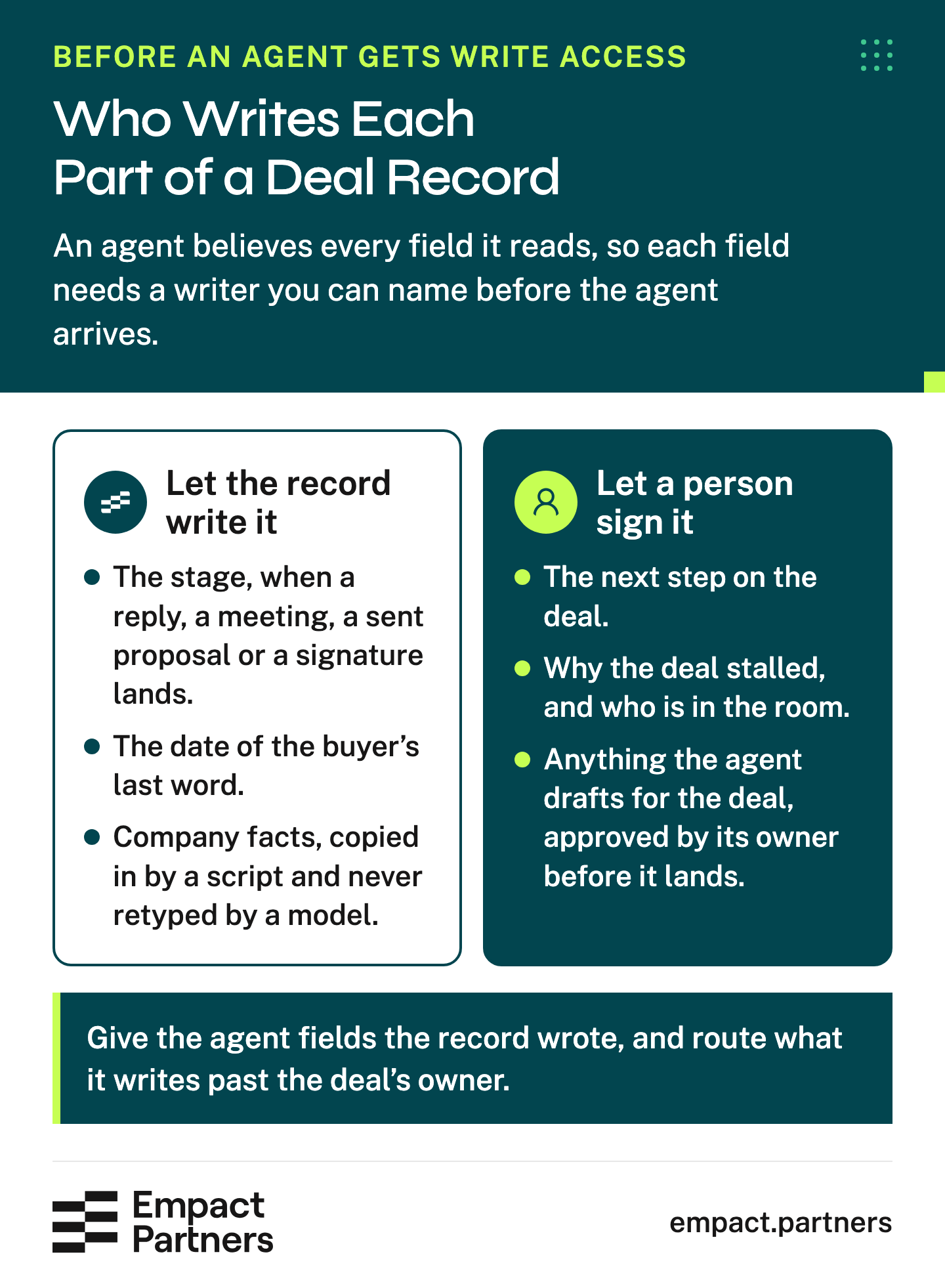
Watching the record matters as much as writing it. When Validity asked marketers what would most raise their confidence in CRM data, 39% named continuous, automated monitoring that catches problems as they happen.8 That is well ahead of moving onto one platform (23%) or buying third-party enrichment (19%), so plan the monitoring before the next tool purchase.
Working with us starts with an audit of your stack and the data flows between your tools, to find what is broken. Before an agent goes near the CRM, our take is that two things decide whether its summaries are worth reading: the fields your forecast reads, and the date of the buyer’s last word on every open deal. The rest of the work happens in the CRM you already have:
- The CRM cleaned and enriched, so every team pulls from the same records
- Deal alerts that say which deals need a move
- Pipeline reports and attribution in the dashboards your team already uses
- Stages that move only on an event the record shows
- CRM update agents, each answering to someone on your team
Our playbook on getting a CRM ready for its first agent covers the cleanup half in detail, starting from the records that agent will touch:
None of the studies here measures whether cleaner CRM data makes an agent’s output better, and our own pipeline cannot say it yet either. What our record does show is narrower. Once our stages had to rest on dated events, dead deals stopped sitting in our open column. The number that tells you where you stand is the age of the buyer’s last word on your open deals. If its median runs to months, an agent will forecast from deals that have already ended.
Frequently Asked Questions
How many companies use a CRM?
Fewer than a SaaS team might guess, once you leave software. Eurostat’s 2025 survey of EU enterprises with 10 or more employees found 28.51% used CRM software.10 The rate climbs from 24.69% of small enterprises to 65.43% of large ones, and peaks at 63.14% in information and communication.10
Eurostat counts every surveyed industry across Europe, and no study we could open at its origin measures SaaS companies alone. For a SaaS team the question is rarely whether a CRM exists. It is whether its stages can be proven.
How do we know if our CRM’s pipeline stages are true?
Check the date of the buyer’s last word on every open deal. That means their last email or a meeting they attended, not your last chase. A proposal with a last word several months old is a nurture deal with a hopeful label. In our own pipeline, 31 of 37 board proposals failed that check on moving day.
Then ask what moved each stage. A stage set by an event the record shows, such as a reply or a signed contract, can be trusted. A stage someone dragged across a board is a guess until something in the record backs it.
Should we clean the whole CRM before we use AI?
No. Clean the fields the agent will read and the records it will act on, and leave the rest for later. An agent that drafts follow-ups needs true stages, owners and last-contact dates on open deals. It does not need tidy job titles on contacts from 2019.
A full cleanup delays the agent for months. It can still miss the fields that matter if nobody named them first. The sales operations practitioners we read start from the fields too, deciding for each one who writes it.
Can an AI agent update the CRM for us?
An agent can draft most updates and should write few of them alone. One practitioner we read moved company figures to a script after the model kept putting them in the wrong fields. The same team sends the model’s call notes through an approval step with the manager before they reach the deal.
In Workbooks’ survey, 33% of the responses from teams already running AI in their CRM named poor data quality as a challenge they had faced. Among teams that had not started, it was 14%. Decide who writes each field before you switch the agent on.
Which CRM fields should an AI agent read first?
The ones its job depends on, and on open deals before anything else. For an agent that drafts follow-ups or summarizes the pipeline, that means the stage, the owner, the date of the buyer’s last word, the next step and the close date.
Check each for meaning as well as presence. A close date nobody has touched since the deal was opened is filled in and still useless to an agent. Leave contact titles, industries and old closed deals until the agent needs them.
How do we measure the quality of our CRM data?
Count the problems that change a decision. They are duplicate records, records missing a field your team requires, records with no update in more than 90 days, deals with gaps in their lifecycle stages and deals with no owner. Our CRM Health Report runs those five checks on an exported file and returns them ranked.
Then add the check most audits skip, the age of the buyer’s last word on open deals. It needs your email and calendar history, which is why it belongs inside the CRM itself.
Does moving to a new CRM fix bad data?
Only the data you can prove again. On 20 November, 39 of the 40 deals our system called open had a stage resting on a dated event. The won column came across with 57.4% of its stages resting on nothing but the old board.
For the median won partnership resting on the board, the board knew it about a year before our email record did. A migration is the cheapest moment to tie stages to events. It is also the worst moment to copy old columns across unchecked, because a fresh system gives old guesses a new date.
Why do executives and reps disagree about CRM data?
Executives and reps see different parts of the CRM. Executives see the summary, the dashboard and now the agent’s forecast. Reps see the record, including the fields they filled in to get past a required box.
Insightly found 55% of executives think their CRM is used effectively, against 27% of non-executives. Validity found 84% of leaders say they change course when the data disagrees, while 19% of users say they do. So put the evidence behind each stage where the executive can see it, not only the stage.
Is our CRM data ready for an AI agent?
Probably less than your dashboard suggests. Validity found 21.3% of marketers call their CRM data very well prepared for AI, while 71.4% say poor CRM data has already fed bad AI results.
A quick test is to pick ten open deals and open each record. Check whether the stage, the owner and the buyer’s last word would survive a call with that buyer tomorrow. If more than a couple fail, the agent will repeat those failures in every summary it writes.
Sources (10)
- Empact Partners, "our own pipeline" (2026)Empact Partners' own data↩1↩2↩3↩4↩5↩6↩7↩8↩9↩10↩11↩12every deal on the Empact Partners line of our CRM, 274 deals, internal deals dropped; the board’s proposal column at the cutover from our Monday board on 29 September 2026, 37 deals; stages, stage history, next steps and the dates of email and meeting events, read 20 November 2026. Method in research/data/own_pipeline.py.
- Validity, "The State of CRM Data Management in 2025" (2025)↩1↩2↩3↩4page, 2025, 602 CRM users and stakeholders. Read 20 November 2026.
- Validity, "State of CRM Data" (2026)↩1↩2↩3↩4↩5↩6report page, 500 marketers worldwide. Read 20 November 2026.
- Workbooks, "The state of AI in CRM in B2B" (2025)↩1↩2↩3↩4↩5December 2025, 247 sales and marketing leaders in the US and the UK, surveyed October 2025. Read 20 November 2026.
- Insightly and Ascend2, "Right-sizing your CRM" (2025)↩1↩2↩3↩4↩5May 2025, 379 US B2B professionals at companies of 50 to 500 employees, fielded February and March 2025. Read 20 November 2026.
- Bain & Company, "70% of companies struggle to integrate their sales plays into CRM and revenue technologies" (2025)↩1↩2PR Newswire, 23 April 2025, more than 1,200 senior commercial executives at major companies in 18 industries. Read 20 November 2026.
- Validity, "Releases ‘State of CRM Data Management in 2025’ Report" (2025)↩1↩2↩3↩4↩5↩6↩7PR Newswire, 10 July 2025, 602 CRM users and administrators. Read 20 November 2026.
- Validity, "Releases ‘State of CRM Data Management in 2026’ Report" (2026)↩1↩2↩3PR Newswire, 25 August 2026, 500 B2B and B2C marketing professionals in the US, UK, Brazil, Australia and New Zealand. Read 20 November 2026.
- Bain & Company, "The B2B Growth Divide: What Sets Winners Apart" (2025)↩1Commercial Excellence Agenda 2025, 23 April 2025. Read 20 November 2026.
- Eurostat, "E-business integration" (2025)↩1↩2Statistics Explained, 2025 data, enterprises with 10 or more employees. Read 20 November 2026.
Keep reading
Statistics 43 SaaS Community Statistics
43 figures on what SaaS communities cost and return, and which ones AI answers cite: Reddit far more than any vendor’s own forum.

Statistics 45 Gemini Citation Statistics for B2B Software Teams
Gemini citation data for SaaS teams on which pages it cites, how its answers shift and how to count your category before funding work.
Statistics 40 YouTube AI Citation Statistics
40 figures on how often ChatGPT, Google AI Mode and Claude cite YouTube for software buyers, and whose videos they pick.