40 YouTube AI Citation Statistics
40 figures on how often ChatGPT, Google AI Mode and Claude cite YouTube for software buyers, and whose videos they pick.
 Teddy CipollaWith
 Vlad Shvets
On this page
- Highlights
- Most U.S. Adults Use YouTube, and Most Consumers Prefer Video for Learning About a Product
- All-Topic Studies Put YouTube Near the Top of Google’s AI Answers
- In Our Partners’ Software Categories, Only AI Mode Cites YouTube
- Google AI Mode Cut Its YouTube Citations in Late October
- AI Mode Cites YouTube Far More for How-To Questions Than for Buying Questions
- Which Videos AI Mode Cites, and Whose Channels They Sit On
- All Three Engines Cite the Written Tutorial
- How We Decide Which Tasks Get a Video
- Frequently Asked Questions
Empact Newsletter
One email a month on what is working in AI search and SaaS go-to-market.
Ask ChatGPT a software buyer’s question and it will almost never send them to YouTube. Across the buyer questions we track for 13 software partners, at most 0.3% of ChatGPT answers cited YouTube this autumn. In Google AI Mode, the median share of answers citing YouTube fell from 9.4% in October to 3.6% in November.1 So the headline that YouTube is AI search’s most cited source should not set a software team’s video plan.
Here the published studies behind that headline sit beside our own count of those 13 partners’ buyer questions and a fresh test of how-to questions. It is for the marketing or content lead deciding whether product video belongs in next quarter’s plan, and which videos.
I write product tutorials for SaaS companies at Empact Partners, with the people who know each product. Those tutorials sit at the center of our Content Marketing workstream, and these numbers are how I would choose which of them also deserve a video.
Highlights
- 3.4% of AI Mode’s citations went to YouTube in the median panel in October, and 11 of 11 panels cited it less in November.1
- 7% of how-to answers in AI Mode cited YouTube on 18 November, against 0.8% of buyer answers, and 0 of 260 ChatGPT answers did.2
- 57.3% of cited long videos in the median panel were reviews, comparisons and roundups, and 12.8% were how-tos.1
- 76.4% of cited how-to videos sat on a software vendor’s own channel in the median panel, against 16.7% of cited reviews.1
For a software company, YouTube shows up in AI answers almost only through Google AI Mode, and less often since late October. When AI Mode does cite a video, a buyer comparing tools gets an independent reviewer’s roundup. Someone asking how to do a task gets a tutorial, and the vendor wins it when the task happens inside its own product. That tutorial works best filmed after the written version, which all three engines read.
Most U.S. Adults Use YouTube, and Most Consumers Prefer Video for Learning About a Product
The demand is not in doubt. Pew Research Center asked U.S. adults which platforms they use:
YouTube’s own press page adds the supply side, in its own figures:
That much video means any task a user might search for has been filmed by someone, often by several people. So a vendor’s how-to video almost always has rivals, and most of them are not other vendors.
Wyzowl, which makes explainer videos for a living, surveyed 266 marketers and consumers in late 2025. Among the consumers, and among the marketers who use video:
- 96% of consumers have watched an explainer video to learn about a product or service.5
- 85% have been convinced to buy something by a video.5
- 82% of video marketers have used YouTube, and 69% of them rate it effective, more than any other channel.5
Asked how they would most like to learn about a new product, the consumers chose a short video by a wide margin:
How People Would Most Like to Learn About a Product
Share of Wyzowl's consumer respondents choosing each format, late 2025
View the data
| Label | Value |
|---|---|
| Watch a short video | 63% |
| Read an article | 12% |
| View an infographic | 7% |
| A sales call | 5% |
| Read an ebook or manual | 4% |
| A webinar | 4% |
Among consumers, five times as many would rather watch than read about a product. We found no survey of B2B buyers on product video that publishes its method, so take that as a consumer figure. If software users lean the same way, a tutorial with no video leaves much of its audience to someone else’s channel. Whether the AI answers your buyers read will show them a video is a separate question.
All-Topic Studies Put YouTube Near the Top of Google’s AI Answers
The headline about YouTube comes from trackers that count AI citations across millions of searches on every topic. Ahrefs’ two most recent YouTube readings:
- YouTube is the most cited domain in Google’s AI Overviews, and its citations there grew 34% in the six months to March 2026.6
- 18.2% of the cited pages that did not rank in Google’s top 100 for the same search were YouTube videos.6
- 17.0% of the citations among Google AI Mode’s 50 most-cited sources went to youtube.com in November 2026, third behind google.com and reddit.com.7
Two other trackers split the count by engine, and both find the same gap between Google and ChatGPT:
- BrightEdge measured YouTube’s share of citations at 29.5% in AI Overviews, 16.6% in AI Mode and 0.2% in ChatGPT, from May 2024 to September 2025.8
- OtterlyAI found that of every YouTube citation it logged in 30 days, 36.6% came from AI Overviews, 19.6% from AI Mode and 4.4% from ChatGPT.9
All five counts cover every topic, from recipes to car repairs, where a video is often the best answer anyone has. Most of the YouTube in them is Google’s AI citing Google’s own video platform, and in the two that also count ChatGPT, it is the small number.
An all-topic share tells you YouTube answers a lot of questions about fixing a leaky faucet. It doesn’t tell you whether ChatGPT or Google AI Mode shows your tutorial to someone choosing software in your category. Before a video budget moves, tally what each engine cites when your own buyers ask.
 Teddy Cipolla on LinkedInOpens in a new tab
In Our Partners’ Software Categories, Only AI Mode Cites YouTube
So we counted it on software questions. Once a week our Empact Panel puts the questions each partner’s buyers ask to ChatGPT, Google AI Mode and Claude, and stores the answers and their sources. For Claude it keeps the pages Claude’s search returned, the closest view we have of what Claude reads. Each partner’s questions make one panel, counted on its own, and the median panel below is the middle one.
Across 13 partners in software categories, 91,848 AI Mode answers and 96,150 ChatGPT answers from 9 to 31 October cited at least one page, so each engine can be read against the others:
BrightEdge put YouTube at 16.6% of AI Mode’s citations across all topics, and on our partners’ software questions it took 3.4%.8 The years and the questions differ, so read the gap as a rough size: on our partners’ software questions, YouTube got about a fifth of its all-topic share. In ChatGPT and in what Claude reads, it barely exists.
Google AI Mode Cut Its YouTube Citations in Late October
The October median did not hold. Week by week, the share of the median panel’s AI Mode answers that cited YouTube moved like this:
Google AI Mode Answers Citing YouTube, Week by Week
Median partner panel, share of AI Mode answers citing YouTube, Oct to Nov 2026
View the data
| Label | Value |
|---|---|
| Week of 12 Oct | 10.5% |
| Week of 19 Oct | 10% |
| Week of 26 Oct | 4.4% |
| Week of 2 Nov | 1.9% |
| Week of 9 Nov | 3.6% |
The share held near one answer in ten through the middle of October and fell under one in fifty in the first week of November. A week later it had risen to 3.6%, so a team that checked in late October saw a very different engine from one that checked mid-month. It was not one partner’s category either. Every one of the 11 panels with readings in both months fell:
AI Mode Answers Citing YouTube, October Against November
11 anonymous software partner panels, share of AI Mode answers citing YouTube
View the data
| Label | October | November |
|---|---|---|
| Panel A | 16.2% | 5.9% |
| Panel B | 14% | 3.9% |
| Panel C | 12.1% | 4% |
| Panel D | 10.5% | 2.9% |
| Panel E | 9.7% | 6.5% |
| Panel F | 9.4% | 5.7% |
| Panel G | 9% | 2.8% |
| Panel H | 8.6% | 2.6% |
| Panel I | 3.9% | 2.4% |
| Panel J | 3% | 0.8% |
| Panel K | 2.4% | 1% |
Part of the fall is general. In the same weeks, with answers collected through the same data provider, AI Mode cut the sources it cites per answer by about a third, from a median of 3.6 to 2.4.1 The share of answers citing YouTube fell by about three fifths, from 9.4% to 3.6%, so video was cut harder than the average source. Ahrefs’ November table shows the same direction across all topics, with youtube.com down two places in AI Mode.7
Our counting did not cause the drop. On 18 November we put a dozen questions to AI Mode again, ones whose answers had cited YouTube in October and not in November. Their raw answers carried no YouTube link anywhere, so the change sits in the answers themselves.
Whether Google changed what it cites or only how it shows video cannot be told from outside Google. AI Mode’s YouTube share has swung like this before, as our count of AI search citations found in September.
One month of Google AI Mode readings is too few to plan a video budget on.
If your own AI Mode video citations looked healthy in October, check them again over several weeks of the same questions before you commission a series. A single week can sit far from the month around it, as our volatility figures show for citations in general.
AI Mode Cites YouTube Far More for How-To Questions Than for Buying Questions
Inside the Panel, the kind of buying question barely changed how often AI Mode cited video. In the median panel it cited YouTube in 9.7% of answers to questions that describe a job or a pain. Questions asking for a shortlist, a comparison or a price got 9.2%, and the job questions came out ahead in only half the panels.1
But all 41,936 questions in those 13 panels come from buyers choosing software, and none asks how to do a task. So on 18 November we asked both engines 130 how-to questions, ten in each of the 13 categories, and 130 buyer questions drawn from the same panels:
- 9 of 128 AI Mode answers to how-to questions cited YouTube, 7%.2
- 1 of 123 AI Mode answers to buyer questions did, 0.8%.2
- 0 of 260 ChatGPT answers cited YouTube, how-to and buyer questions together.2
Side by side, the two kinds of question on the two engines look like this:
Answers Citing YouTube, How-To Against Buyer Questions
Our run of 18 Nov 2026: 130 how-to and 130 buyer questions across 13 software categories
View the data
| Label | How-to questions | Buyer questions |
|---|---|---|
| Google AI Mode | 7% | 0.8% |
| ChatGPT | 0% | 0% |
Nine answers against one is a small count, and each question was asked once, on one day, so read it as a direction rather than a rate. AI Mode reaches for a video when someone asks how to do something, and hardly ever when they ask which tool to buy. ChatGPT reaches for none at all.
Which Videos AI Mode Cites, and Whose Channels They Sit On
Which videos AI Mode picks decides whether a vendor should film at all. We read the title and the channel of every video cited in October’s AI Mode answers, 3,964 different videos behind 11,168 citations. Sorted by title, the long ones look like this:
What Kind of Video AI Mode Cites
Lowest to highest of 9 partner panels, share of cited long videos by title type, Oct 2026
View the data
| Label | Range |
|---|---|
| Reviews and roundups | 17.1% to 89.5% |
| How-tos and tutorials | 6.1% to 52.8% |
| Demos and explainers | 0.3% to 12.4% |
| Talks and podcasts | 0% to 7.4% |
| Other titles | 4.2% to 35.7% |
In the median panel, 57.3% of cited long videos were reviews, comparisons and “best of” roundups, and 12.8% were how-tos and tutorials.1 A software buyer’s question gets a long review far more often than anything else, so that video is mostly out of the vendor’s hands.
Shorts made up 2.5% of YouTube citations in the median panel. OtterlyAI found the same lean across all topics, with long videos taking 94% of YouTube’s AI citations.9 For a vendor, one long tutorial is worth more to AI answers than a run of Shorts.
The channel splits the same way. Where we could tell whose channel a cited video sat on, how-to videos mostly belonged to the software vendor, and reviews mostly to an independent creator:
Reviews and roundups sat on a vendor’s channel 16.7% of the time, and in all seven panels with enough of both, how-tos were more often the vendor’s own than reviews were.1 Across every cited video whose channel we could identify, vendors held 32.0% in the median panel, so the vendor’s own channel is a real route into AI Mode only for tutorials.
Our partners’ own channels took 1.1% of AI Mode’s YouTube citations across the 13 panels together, so the vendor tutorials winning those citations were nearly all other vendors’.1
In the how-to questions we asked on 18 November, 10 of 13 videos AI Mode cited were tutorials, but only 4 of 13 sat on a software vendor’s channel.2 Each of those four showed a task done in that vendor’s own product. For a task any product could do, an independent teacher’s video won, so a vendor’s chance is the task that happens inside its own product.
The tutorial is the one video where the vendor knows more than any reviewer. A reviewer can compare five tools in ten minutes. Only your own team can show the task done start to finish in your product, with the setting people miss on their first try. That is the video a vendor can win when someone asks how to do it in the product.
Teddy Cipolla on LinkedInOpens in a new tabChannel size matters less than it looks, judging by OtterlyAI’s study of every AI citation it logged in a month:
- -0.03 was the correlation between a video’s views and how often AI answers cite it, so views made no difference.9
- 40.83% of cited videos had fewer than 1,000 views.9
- 35% of cited channels had under 10,000 subscribers.9
A tutorial on a small vendor channel is not at a disadvantage for being small, so a vendor can start with the channel it already has. Put together, the question a person asks decides the video that gets cited:
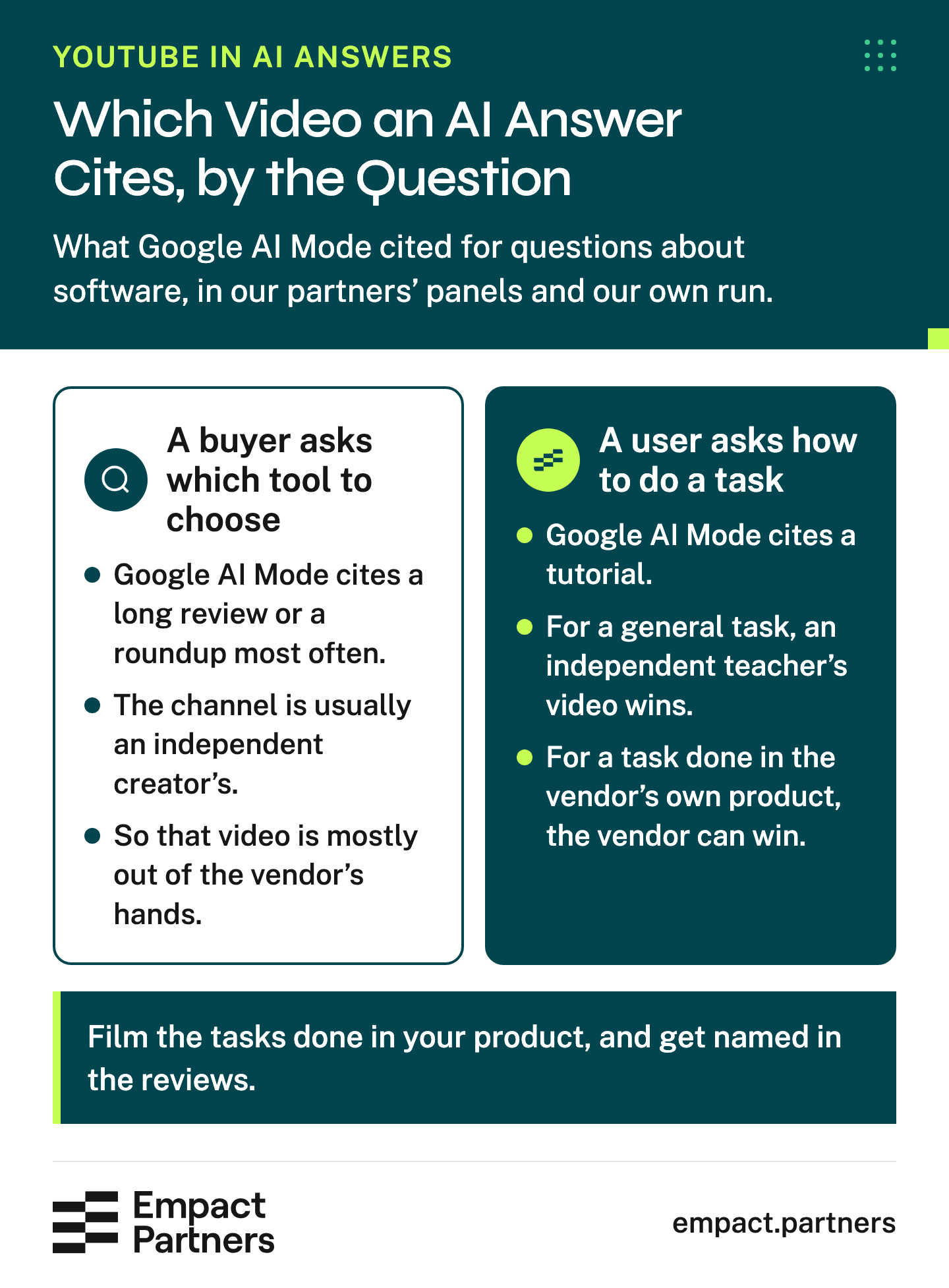
On the buyer’s side the work is with the reviewers. On the task side it is the video a vendor films itself.
All Three Engines Cite the Written Tutorial
Of the three engines, only Google AI Mode cites video, and less of it since late October. The written tutorial reaches all three. ChatGPT cites 8.6 pages per answer in the median panel and almost never a YouTube video, so the written tutorial is what puts you in its answers.1 Here is how the three engines cited one software partner’s own pages over the last 30 days:
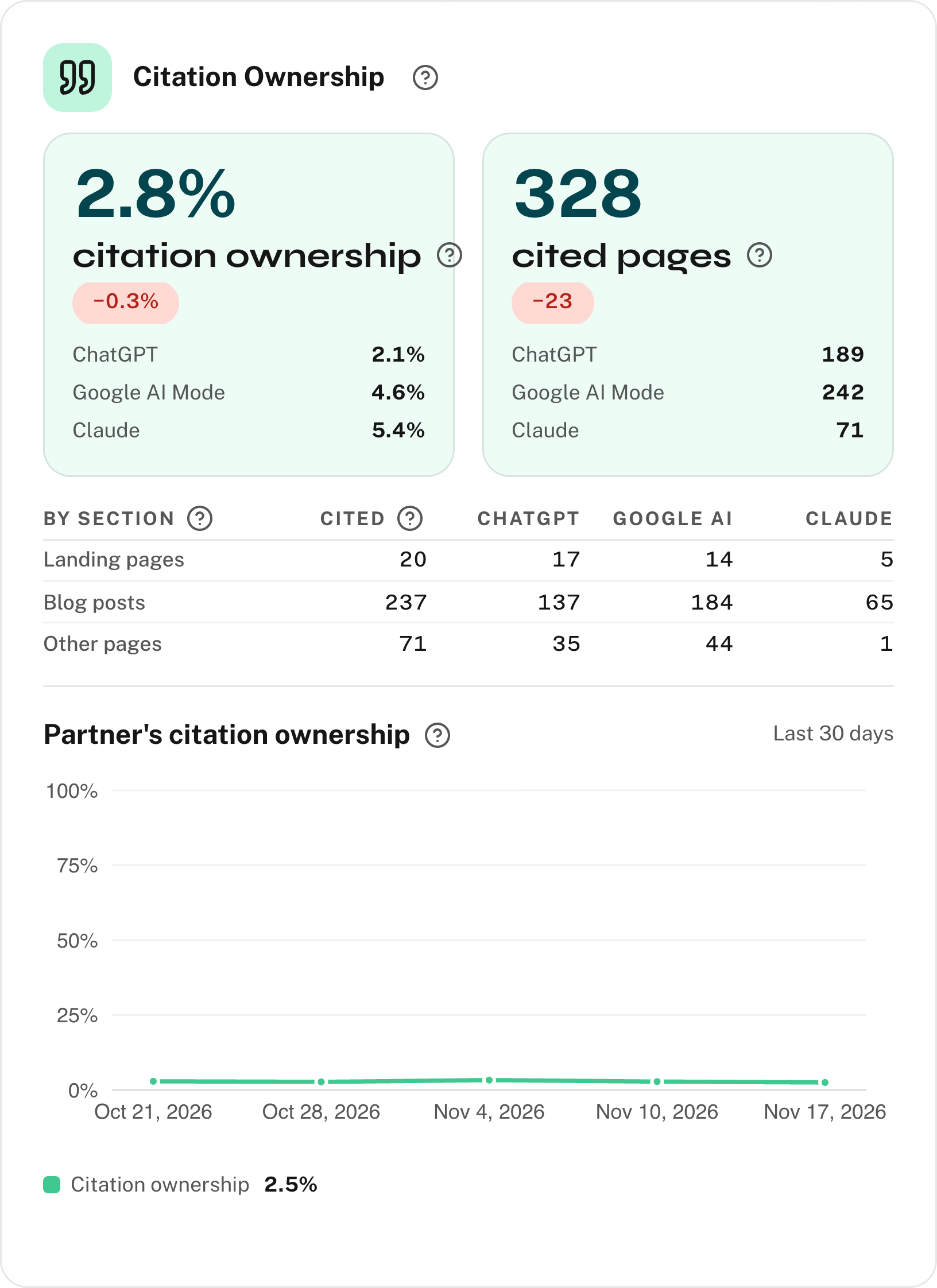
All three engines read that partner’s written pages, Claude included, and what Claude reads holds almost no YouTube. So the written tutorial goes first, and the video is a second version of it for the one engine that cites video. The written version also keeps working where no engine is counting, in support tickets and onboarding.
For shortlist questions the video that counts is somebody else’s review. Getting your product named in those reviews means outreach to the reviewers, the same work as getting into the listicles AI answers cite.
Ahrefs found that brands named in more YouTube videos, in their titles, transcripts and descriptions, are named more often in AI answers. Of every factor it tested, this one tracked AI mentions most closely, a correlation of 0.737.10 It is a correlation, not proof, and the mentions it counts sit mostly in other people’s videos, so it points at reviewers rather than at your own camera.
How We Decide Which Tasks Get a Video
Our tutorial work starts inside the product. We learn it in depth, write with the people on your team who know it best, and keep improving what is already published. On video, we would start where these numbers point: the tasks your users ask the engines how to do, already covered by a written tutorial that gets cited. A task earns a video when it passes these checks:
Before a task gets a video
- It happens inside your product, so only your team can show it done start to finish
- People search how to do it, not which tool does it
- A written tutorial for it exists and is cited, or is written first
- Text alone gets it wrong: a setting, a sequence or a screen people miss
- Google AI Mode answers the question with a video across several weeks, not one
A task that fails the last check can still deserve a video for the people who would rather watch, but judge that video on YouTube, not in AI answers.
The tasks to test come from what your buyers need and what your rivals already cover. Our Content Gap Analysis tool starts from your website, finds your rivals and sends page ideas for the themes they rank for and you don’t. Each one is a candidate tutorial:
Once a tutorial is live, judge it by whether the answers cite it over several weekly readings. Watch that the written page keeps its citations in ChatGPT and Claude while the video works on AI Mode. Getting the written page cited takes work of its own, from writing articles that add what AI answers lack to checking that ChatGPT and Google AI Mode quote them correctly. This playbook walks through both:
What none of this settles yet is where AI Mode’s video citations land after November, or whether a cited video sends a buyer to a demo. The number to watch is the share of your how-to questions whose AI Mode answers cite a video, read every week on the same questions.
Frequently Asked Questions
Does ChatGPT cite YouTube videos?
Very rarely, and on software questions almost never. In our fresh run on 18 November, none of 260 ChatGPT answers to how-to and buyer questions cited a YouTube video, though every one cited other pages. BrightEdge measured YouTube at 0.2% of ChatGPT’s citations across all topics.
If ChatGPT matters to your buyers, the page to work on is your written one: product pages, tutorials and the third-party articles it already reads.
Does Claude cite YouTube?
In the two partner panels where we collect enough Claude answers, YouTube showed up among the pages Claude’s web search returned in about one answer in a thousand. We see the pages Claude’s search retrieves, not which of them each answer quotes, and YouTube is almost absent even from that wider set on software questions. Plan Claude visibility on written pages and on the sites that write about your category.
How often does Google AI Mode cite YouTube for software questions?
In October, a median of 9.4% of AI Mode answers to our partners’ buyer questions cited YouTube, with panels ranging from 2.4% to 16.2%. By November the median was 3.6%. Your category may sit at either end, so count your own buyers’ questions over several weeks before you decide. Count how-to questions separately, because they draw far more video.
Why did our YouTube citations in AI Mode drop in November?
AI Mode’s YouTube citations fell in all 11 of our partner panels with readings in both months. In the same weeks it trimmed its sources per answer by about a third, and YouTube lost more than that. Before treating it as lost ground, compare your other cited pages over the same weeks. If they dipped too, the engine changed and your standing may not have.
Do AI answers cite YouTube Shorts?
Seldom. Shorts made up 2.5% of the YouTube citations in AI Mode answers to our partners’ buyer questions in the median panel. OtterlyAI found Shorts at 5.7% of YouTube’s AI citations across all topics. AI answers lean on long videos that walk through a task or compare products. A Short can still earn views on YouTube, but it is a weak bet for AI citations.
Does a video need views or subscribers to be cited?
No. OtterlyAI found almost no link between views, likes or subscribers and how often a video is cited, and four in ten cited videos had fewer than 1,000 views. What earns a citation is answering the exact question well. That favors a vendor’s tutorial on a small channel, as long as its title names the task the way people search for it.
Should we film a tutorial video or write the tutorial first?
Write it first. ChatGPT cites written pages and almost never a video, Claude’s search turns up almost no video, and Google AI Mode cites both. A written tutorial also serves support and onboarding, and it gives the video a script someone has already tested. Film the tutorials whose tasks people search how to do, that happen inside your product, and that text struggles to show.
How do we get our product into the review videos AI Mode cites?
Treat the reviewers like the authors of the listicles AI answers cite. Find the channels whose roundups keep coming back in the answers for your category. Then give each reviewer a reason to include you: a working trial, a clear angle on who your product suits and someone who can answer their questions.
Your own “best tools” video rarely stands in for theirs, because buyers and engines both lean on the independent verdict.
What should a tutorial video’s title and description say?
Put the task in the title in the words people type, so the video matches the question an answer is built from. In the description, write out the steps and name the product settings each one uses. Add a chapter for every step, so an answer can send someone to the exact moment.
Then link the written tutorial from the description and the video from the written page, so the two versions of the task point at each other.
Do B2B buyers watch product videos before they buy?
The best-documented figures are consumer ones. In Wyzowl’s late-2025 survey, 96% had watched an explainer video to learn about a product and 63% would most like to learn about one by video. We found no survey of B2B software buyers on this that publishes its sample and method. The most useful evidence is your own: which of your buyers’ questions the AI answers meet with a video.
How do we measure whether our videos get cited?
Keep a fixed set of questions, split into how-to questions and buyer questions, and ask ChatGPT, Google AI Mode and Claude every week. For each answer, record whether it cites YouTube, which video and whose channel.
Read the trend over several weeks rather than one. Check your written tutorials’ citations at the same time, since those are what two of the three engines use.
Sources (10)
- Empact Partners, "Empact Panel, ChatGPT and Google AI Mode answers to the unbranded buyer questions of 13 partner panels in software categories, every weekly collection from 9 October to 17 November 2026" (2026)Empact Partners' own data↩1↩2↩3↩4↩5↩6↩7↩8↩9↩10↩11↩12↩13↩14↩15with every cited page, and the pages Claude’s search returned in the two panels with enough Claude answers. Each panel counted alone, medians and ranges across panels. Cited videos’ titles and channels read from YouTube’s oEmbed records. The Citation Ownership card is one software partner’s panel, last 30 days, captured 18 November 2026. Read 18 November 2026.
- Empact Partners, "fresh run of 18 November 2026" (2026)Empact Partners' own data↩1↩2↩3↩4↩5↩6130 how-to questions, ten in each of 13 software categories, and 130 buyer questions drawn from the same 13 panels, each asked once on Google AI Mode and on ChatGPT through DataForSEO, with every cited page. Read 18 November 2026.
- Pew Research Center, Jeffrey Gottfried and Eugenie Park, "Americans’ Social Media Use" (2025)↩1↩220 November 2025, surveys of 5,022 U.S. adults (5 February to 18 June 2025) and 5,123 U.S. adults (24 February to 2 March 2025). Read 18 November 2026.
- YouTube, "for Press" (2026)↩1↩2the official press statistics page, figures as shown on 18 November 2026. Read 18 November 2026.
- Wyzowl, "Video Marketing Statistics 2026" (2025)↩1↩2↩3↩4State of Video Marketing survey of 266 marketers and consumers, late 2025. Read 18 November 2026.
- Ahrefs, Louise Linehan, "Update: 38% of AI Overview Citations Pull From The Top 10" (2026)↩1↩22 March 2026, 863,000 keyword results pages and 4 million AI Overview URLs from Ahrefs Brand Radar. Read 18 November 2026.
- Ahrefs, Si Quan Ong, "The 50 Most-Cited Websites in Google AI Mode (November 2026)" (2026)↩1↩2updated 3 November 2026, U.S. queries on all topics, Ahrefs Brand Radar. Read 18 November 2026.
- BrightEdge, "AI Engines Choose YouTube 200x More Than Any Other Video Platform" (2025)↩1↩2Weekly AI Search Insights, 25 September 2025, BrightEdge AI Catalyst, May 2024 to September 2025. Read 18 November 2026.
- OtterlyAI, Rick Tousseyn, "The YouTube Citation Study" (2026)↩1↩2↩3↩4↩5last updated 2 March 2026, more than 100 million AI citation instances over 30 days across six AI search platforms. Read 18 November 2026.
- Ahrefs, Louise Linehan, "Top Brand Visibility Factors in ChatGPT, AI Mode, and AI Overviews (75k Brands Studied)" (2025)↩112 December 2025, 75,000 brands, Spearman correlation, Ahrefs Brand Radar. Read 18 November 2026.
Keep reading
Statistics 40 Reddit Google Search Visibility Statistics
40 figures on how much of Google’s software searches Reddit holds, and why AI Mode cites Reddit on other questions than Google ranks it.

Statistics 25 AI Engine Citation Overlap Statistics
How few sources ChatGPT, AI Mode, Gemini and Claude share for one question, and which engine and source work to fund first.
Statistics 36 Claude Citation Statistics on Sources Other Than Reddit
36 figures on what Claude cites for software buying questions, where Reddit and review sites fit, and how to plan for it.