
5 Best Message Testing Tools for B2B Positioning
Five message testing tools for B2B positioning, sorted by who answers each test, what it costs, and which ones reach real buyers.
 Eulene du PlessisWith
 Vlad Shvets
On this page
Empact Newsletter
One email a month on what is working in AI search and SaaS go-to-market.
Message testing software puts a homepage, a headline or a positioning line in front of people and reports what they understood, preferred or pushed back on, before you rewrite the site. The report is only as good as the people who filled it in, and a cheap panel of the wrong people answers fast, sounds sure of itself and points you at the wrong homepage.
Empact Partners works on positioning and messaging with SaaS companies, and the hardest part is rarely writing the new line. It is knowing, before the homepage changes, whether the buyers you want would repeat it back.
The tools have split over who that buyer can be. Wynter sells a panel of checked B2B professionals, PickFu and Lyssna sell broad panels with work filters added, and Perspective AI interviews buyers you already have. We reviewed all five by the test each is built for and by who answers it, and we say plainly which cannot reach a B2B decision-maker.
Scroll horizontally to see all columns when the table is wider than this page.
| Tool | Best for | Who answers | Reaches B2B decision-makers | Price per test |
|---|---|---|---|---|
| Wynter | Message tests with verified B2B buyers | Its own panel, checked against LinkedIn and work email | Yes, senior leaders are a tier of their own | $911 to $2,734 for 15 people, pay as you go |
| Lyssna | First impressions and comprehension | 690,000+ panelists, filtered by the job they report | Partly, through filters and a screener | $1 per test minute per response, $2 more for a screener |
| PickFu | Quick preference polls | Verified consumers in 15 countries | Not reliably, it recruits consumers | From $1 a response, $1.50 more for job seniority |
| UserTesting | Watching people use your live site | An opt-in contributor network in 60+ countries | Through screeners or a paid custom audience | Quote only, one free test |
| Perspective AI | AI interviews with your own buyers | Customers and prospects you invite | Yes, if they are among the people you invite | About $1 a conversation on Pro |
Wynter
Best for: B2B marketers testing a new positioning or homepage message with verified buyers from their market.
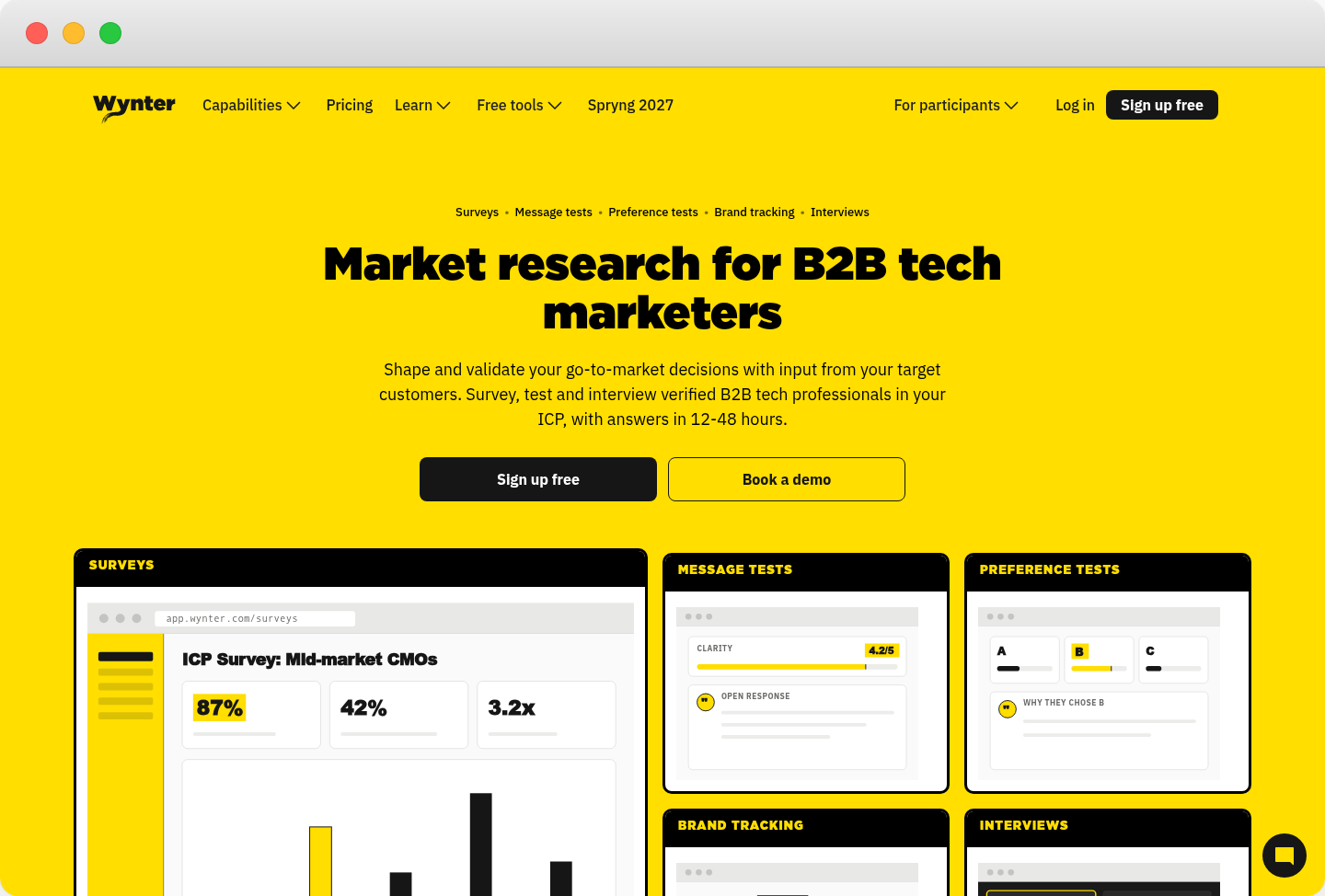
Wynter runs message tests, preference tests, surveys and interviews on its own panel of B2B professionals, and SaaS marketing teams are its main buyers. You upload a page or a set of claims, pick the roles and the seniority, and get scores and open comments back in 12 to 48 hours 2.
The panel is why it sits first. Wynter says every participant is vetted by hand, with the LinkedIn profile and the work email checked, and it recruits through industry newsletters and associations rather than a consumer panel 3. Vice presidents (VPs) and C-level leaders are a priced tier of their own, so a test can reach the people who sign.
The knock is price, and thin pools in narrow markets. A 15-person message test costs $911 with specialists and $2,734 with VPs and C-level, pay as you go 4. Reviewers in narrow industries describe widening their criteria to fill a test, which quietly turns a buyer panel into a neighboring one.
Pricing
- Pay as you go: a 15-person message test costs $911 with specialists, $1,519 with managers and directors, $2,734 with VP and C-level.
- Pro: $20,000 a year for 20,000 credits, which brings the same tests to $609, $1,009 and $1,829.
- Elite: $40,000 a year for 27,000 credits, a research advisor and managed projects.
- Your own panel: testing with participants you bring costs nothing.
Pros and cons
Wynter costs the most per answer of the tools with published prices, and it is the only panel here that says it checks the job behind each answer:
Pros
- Panelists checked against LinkedIn and a work email
- VP and C-level sold as its own tier
- Scores and comments back in 12 to 48 hours
Cons
- $2,734 for one 15-person test with senior leaders
- Thin pools in narrow industries
- Fixed test templates
What G2 reviewers and Reddit say about Wynter
Reviewers praise the reach into B2B roles and complain about the size of niche pools and the bill:
The other, well-known user research panel providers don't tend to have deep benches for B2B roles.
Founder and CEO at a small businessMay 2025 I wish the respondent pool was bigger for my industry & people I want to hear from.
Reviewer in financial servicesApr 2026 r/ProductMarketing
View threadWynter is expensive but kinda neat.
Nov 2026
The heatmap marks the part of the page that lost the reader
A message test scores your page for clarity and collects open comments, and the heatmap marks the parts of the page respondents reacted to. That turns “the homepage tested badly” into the paragraph that needs rewriting 5.
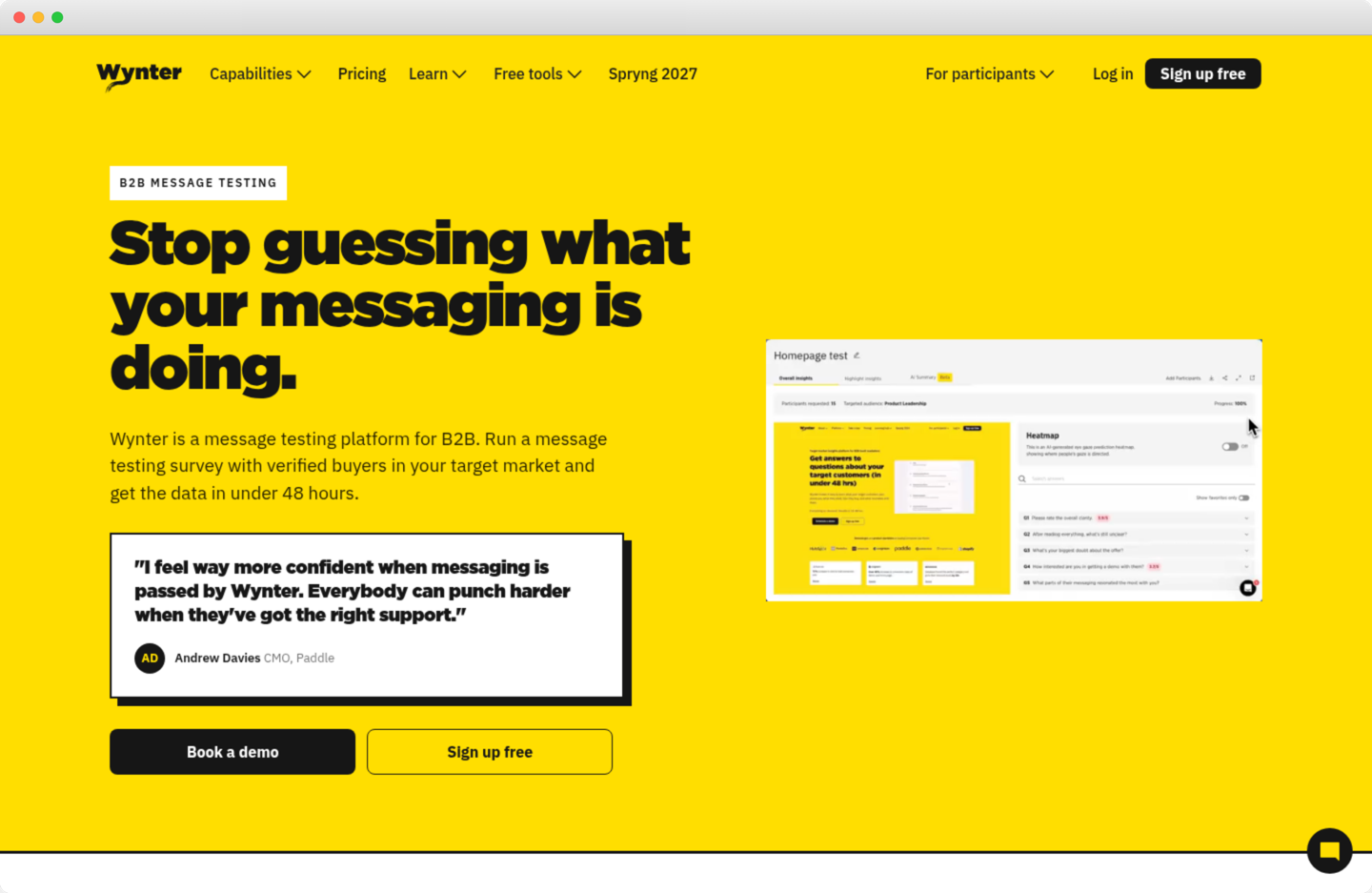
Verdict: the tool for a positioning change aimed at B2B buyers, because it is the only panel here that says it checks the job behind each answer. We would pay for the senior tier only for the claim the whole homepage hangs on. Skip it for headline polish, where a broad panel answers the same question for a fraction of the price.
Lyssna
Best for: checking whether prospects understand and remember a headline or value proposition at first glance.
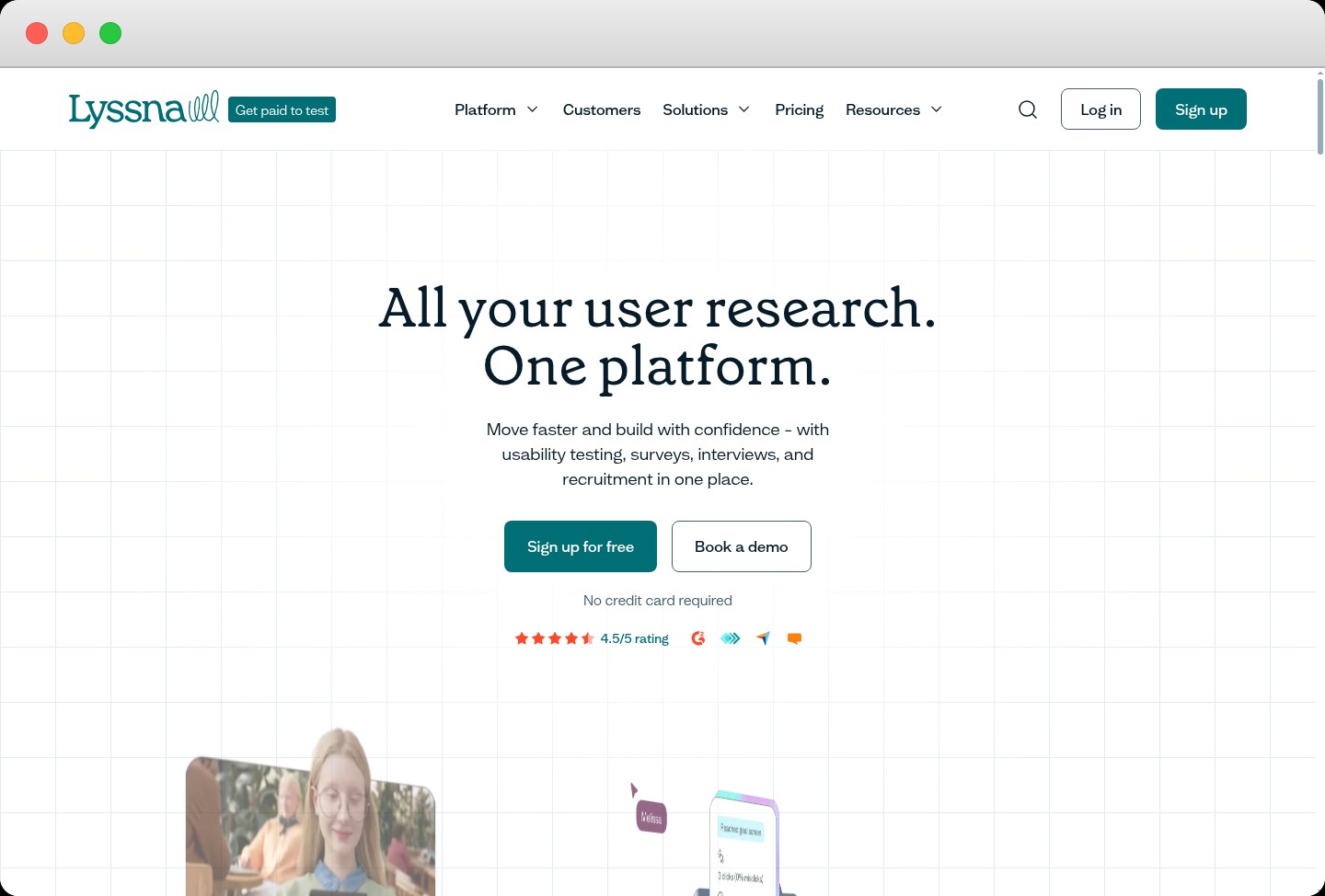
Lyssna, the research platform that used to be UsabilityHub, runs five-second tests, first-click tests, preference tests, surveys and interviews, and recruits from a panel of 690,000+ people 6. For a homepage line, the five-second test is the useful one: people see the page briefly, then say what it offered.
Panel answers are priced by the minute. A response costs one credit, $1, per minute of test length, with $2 more for a screener question 7. A short test Lyssna estimates at two minutes therefore costs $2 a response, or $4 with a screener.
The knock sits in the targeting. Lyssna filters by job role, seniority, industry and company size, and its help page says nothing about checking the job a panelist reports 8. Users also say the price moves with Lyssna’s own estimate of how long a study takes.
Pricing
- Free plan: $0, 3 seats, unlimited quick studies, panel responses paid per response.
- Growth: $166 a month billed annually or $199 monthly, 5 seats and 5 in-depth studies a month.
- Enterprise: quoted, with unlimited seats and single sign-on.
- Panel responses: $1 per test minute per response, $2 more for a screener and $2 for a recording.
Pros and cons
Lyssna is built for learning whether a line is clear, at a few dollars a response, and its work filters are only as good as what panelists say about themselves:
Pros
- Five-second tests built for first impressions
- Panel responses paid one at a time, on any plan
- Job role and seniority filters at no extra charge
Cons
- Job filters rest on what panelists report
- The study length estimate sets the price
- In-depth studies capped on Growth
What G2 reviewers and Reddit say about Lyssna
Users like how fast a short test fills and grumble about how the price is worked out:
Panel demographic filters let me match the target customer without a separate recruiting step, so a test is often live the same afternoon and two cohorts of 10 to 15 finish within one sprint.
UX designer at a small businessOct 2026 Pricing per study can be unpredictable, since it's dynamic based on Lyssna's predicted completion time - sometimes that time is wildly inflated, unfortunately, and there's no real way to contest/appeal those estimates.
Reviewer in financial servicesOct 2026 r/UXResearch
View threadMy team has had a generally positive experience with recruit quality on Lyssna, but we tend to run rather short, task based studies with them rather than using their think-aloud options.
Oct 2026
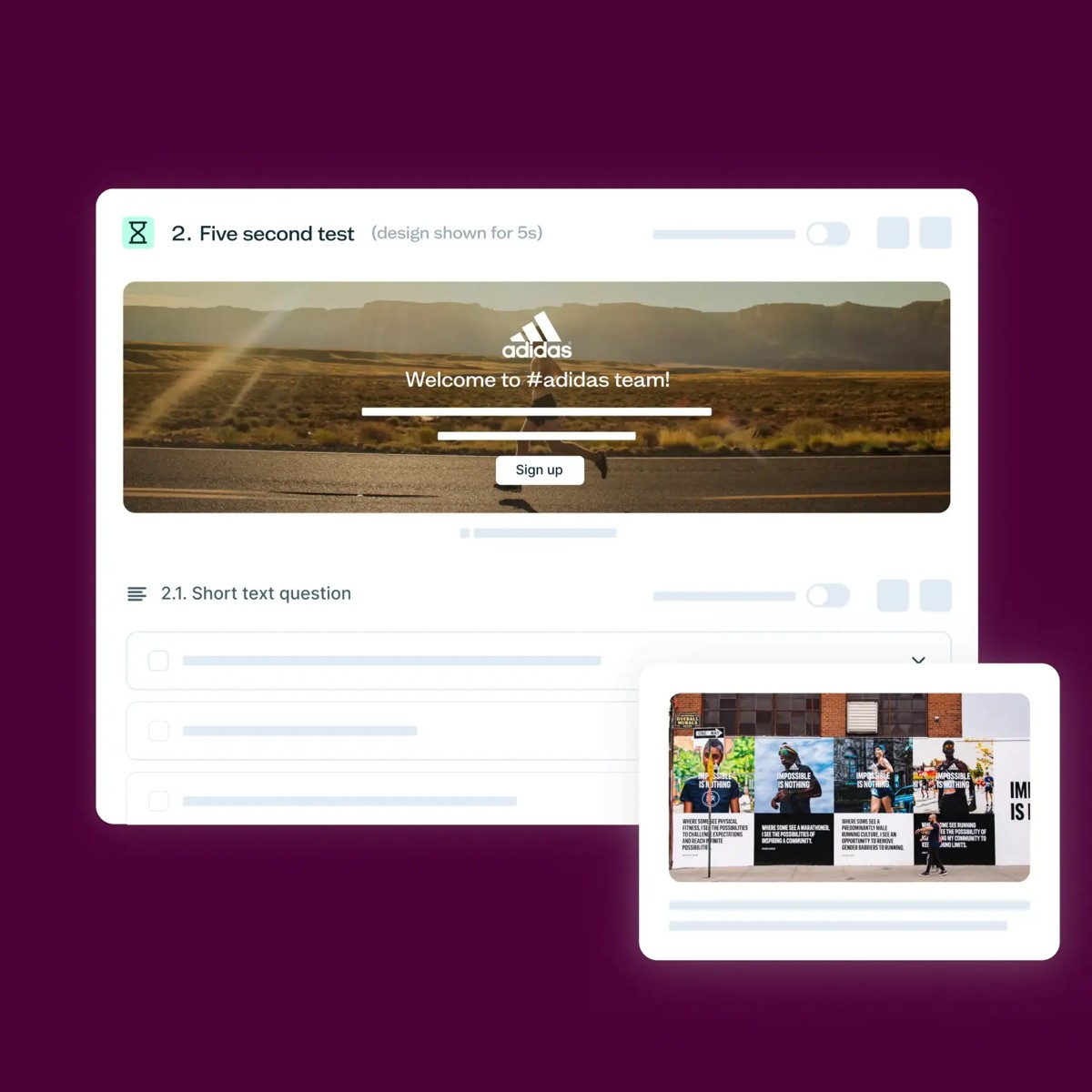
The five second test checks what people remember
The five-second test shows a page for a few seconds and then asks what people remember. A positioning line that nobody can play back after that glance will not survive a buyer skimming your homepage between meetings either 9.
Verdict: the test for clarity and recall, at a price that lets you run it on every draft. Add a screener question only a buyer could answer, and treat the result as a reading test, never as a verdict from decision-makers. Skip it as the final check on a claim aimed at senior buyers.
PickFu
Best for: quick preference polls between headline or creative versions, answered by a broad audience within hours.
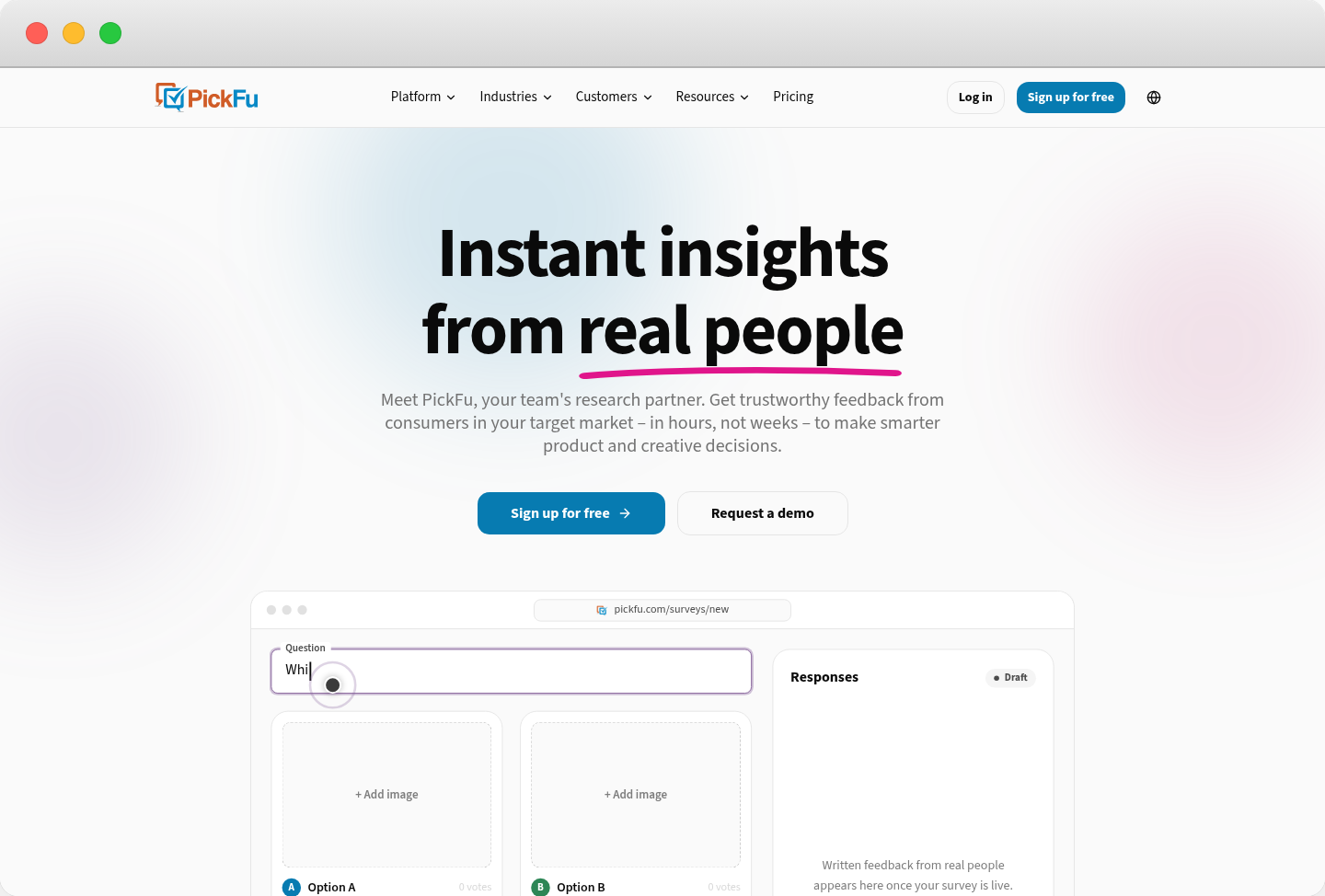
PickFu runs polls and short surveys. You put two or more versions side by side, and every respondent votes and writes a reason. Its homepage promises feedback from consumers in your target market in hours, and its respondents are verified consumers from consumer panels in 15 countries 10 11.
Work traits exist, at a price. B2B buyers, job department and job seniority are Specialty traits that add 1.5 credits, $1.50, per respondent 12. A one-question poll to 50 people filtered by job seniority therefore costs $125.
PickFu cannot promise you a B2B decision-maker. Its panel is recruited as consumers, and its help pages describe checking identity, with nothing said about checking a job. One G2 reviewer counts 10 to 15% of answers as off the question.
Pricing
- Pay as you go: from $1 a response, with no subscription.
- Starter: $200 a year, 30 panel credits a month.
- Pro: $1,000 a year, 120 panel credits a month and standard targeting included.
- Team: $5,000 a year, 600 panel credits a month and roles for the team.
- Targeting: $0.50, $1 or $1.50 more per respondent for each standard, premium or specialty trait.
Pros and cons
PickFu tells you which version people prefer and why, and because it is built for consumer audiences, whether those voters buy software like yours stays a guess:
Pros
- A written reason with every vote
- Answers within hours
- From $1 a response
Cons
- A consumer panel with work traits on top
- Job traits are self-reported
- Specialty traits add $1.50 per respondent
What G2 reviewers and Reddit say about PickFu
The praise comes from consumer brands, and the warnings are about reading the result:
I wanted to test a few homepage headline options before committing to one. PickFu let me ask that exact audience directly, which made the feedback feel genuinely relevant.
Reviewer in consumer goodsNov 2026 I would say about 10-15% of the answers I get are either irrelevant to the question or the whole image/test as a whole.
Marketing researcher and creative strategist at a small businessJun 2026 r/ecommerce
View threadI would almost never trust anything “close”, but if it was overwhelming…well then maybe.
Aug 2025
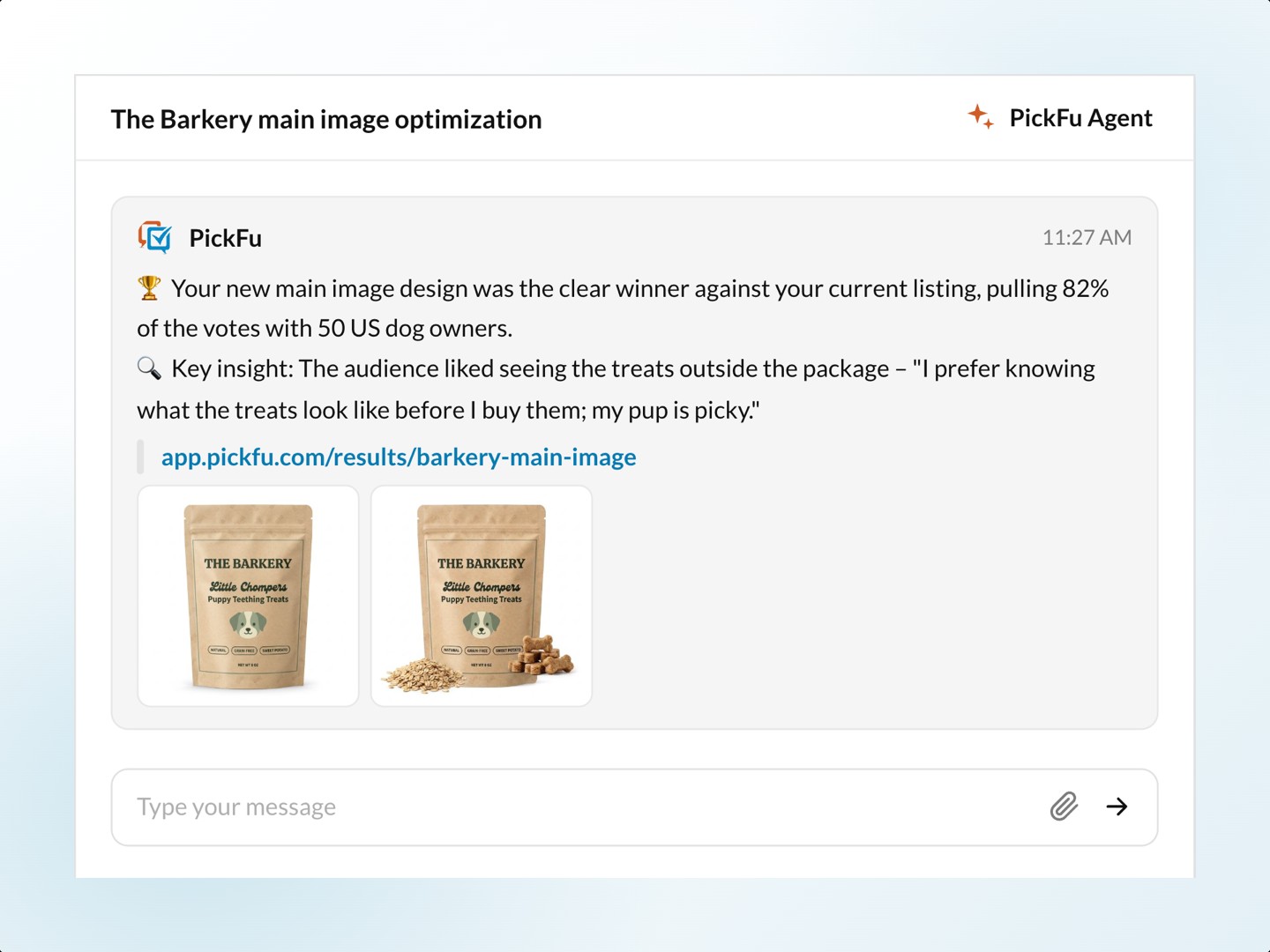
PickFu Agent writes up the result and the reasons
Every finished poll comes with an AI summary of what people said and the main themes 13. PickFu Agent reports it in chat: the winning version, its share of the vote and the reason people gave.
Verdict: the poll for copy any adult can judge, such as which of two headlines reads more clearly. It is not built to reach B2B decision-makers, so never let it choose your positioning. Use it to clear the obvious losers before a buyer panel sees the rest.
UserTesting
Best for: watching people react to your message while they move through your live website, in their own words.
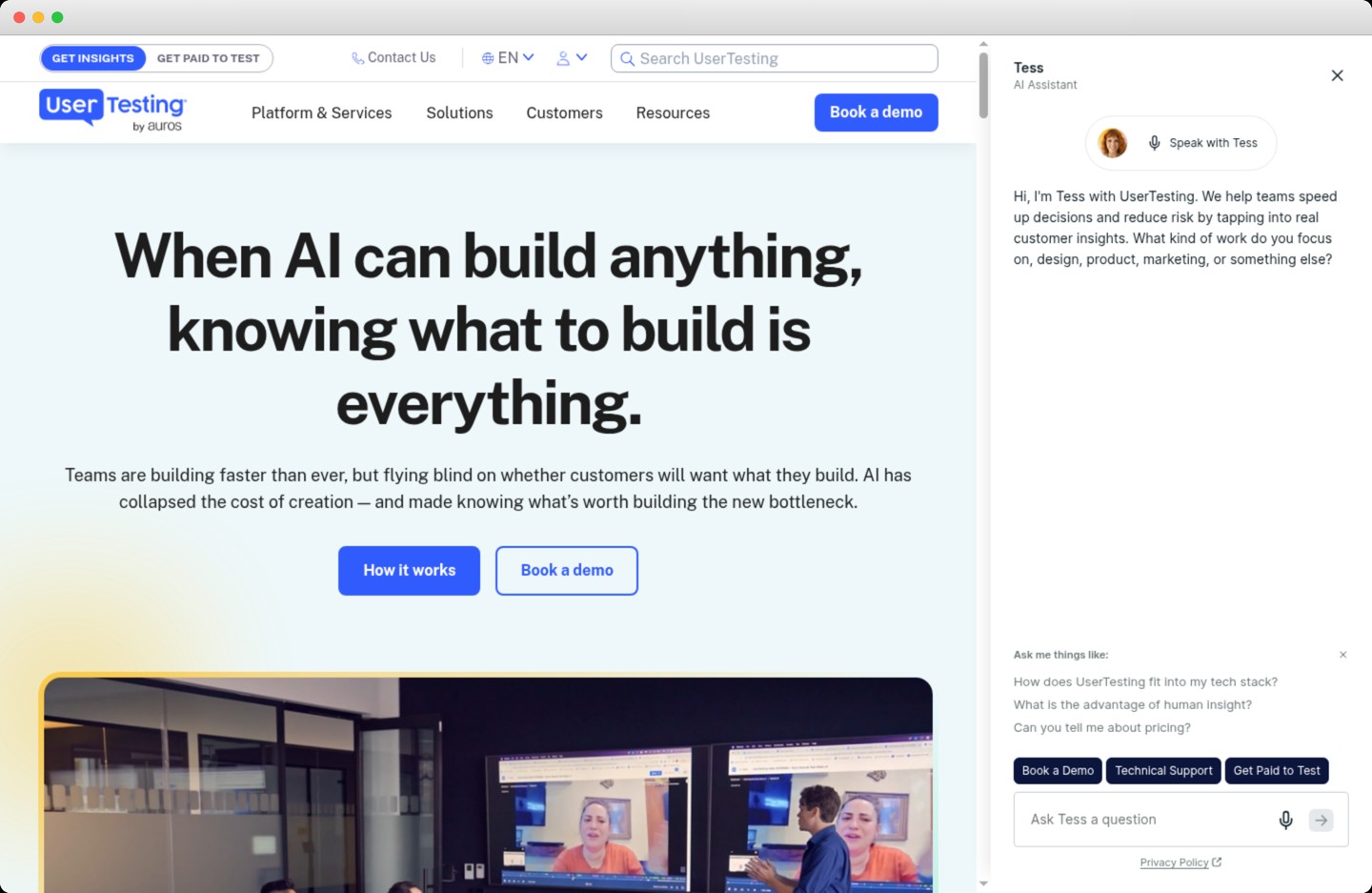
UserTesting records people using your site and thinking aloud, in unmoderated tests or live conversations, and sells mainly to enterprise research teams 14. On 29 September 2026 the company behind it took the corporate name Auros, which now sits above UserTesting and User Interviews. Its CEO told users that nothing about how they work with UserTesting changes 1.
The panel is an opt-in contributor network across 60+ countries, narrowed with demographic filters and screener questions. Custom audience sourcing comes with the top plan, Ultimate+ 14. Every plan is priced on request, and one free test shows you the format.
The knock is who answers by default. A researcher on Reddit calls the panel closer to the general public, and on G2 one participant admits speeding through tests that ran three or four times longer than promised. A screener question can filter for a buyer, and on the default panel it is the main filter you control.
Pricing
- Advanced: price on request, unmoderated tests, live conversations, demographic filters and screeners.
- Ultimate: price on request, adds AI analysis, card sorting and your own audiences.
- Ultimate+: price on request, adds custom audience sourcing and a dedicated consultant.
- How you buy it: pay per test or a team plan with unlimited tests, and one free test to start.
Pros and cons
UserTesting shows you a person reading your page aloud, and on its own panel that person may not be the buyer you sell to:
Pros
- Video of a person reading your page aloud
- Results within hours on its own panel
- No per-seat charges
Cons
- No published price
- A general panel unless you pay for custom sourcing
- Screeners carry the job of finding buyers
What G2 reviewers and Reddit say about UserTesting
Researchers like the video and the speed, and doubt who is on the other side of it:
r/UXResearch
View threadUsertesting is pretty much closer to general public because they almost don’t vet their panels at all and they pay minimal.
Sep 2025 Sometimes the users who test are perfect and amazing, but sometimes they don't make the same effort or are less familiar with the app's domain. UserTesting is also quite expensive, and I would love for it to be cheaper.
Co-founder at a small businessOct 2026 Some were advertised as taking five minutes but actually took 15 or 20, so I ended up speeding through them, which wasn’t very helpful.
A test participant reviewing the platformOct 2026
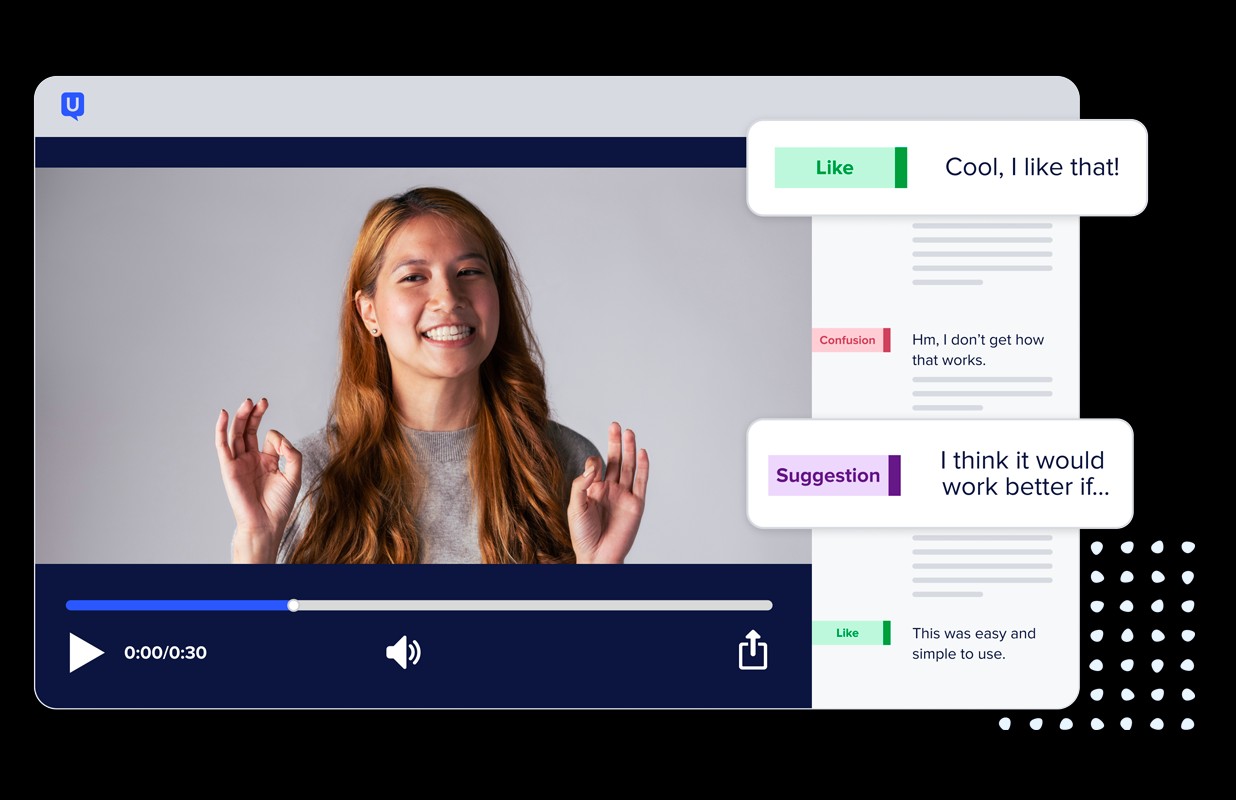
Sentiment tags take you to the moment of confusion
Each session’s transcript is tagged where the person liked something, got confused or suggested a change 14. You jump to the moment your headline lost them instead of watching every video.
Verdict: the test for a homepage rebuild, where how people read the page matters more than how they score it. Bring your own buyers or pay for a custom audience. Skip it on the default panel for B2B positioning, unless a screener or a custom audience puts your buyers on the video.
Perspective AI
Perspective AI
Best for: teams with their own buyers to invite, hearing objections and the words buyers use in AI-led interviews.
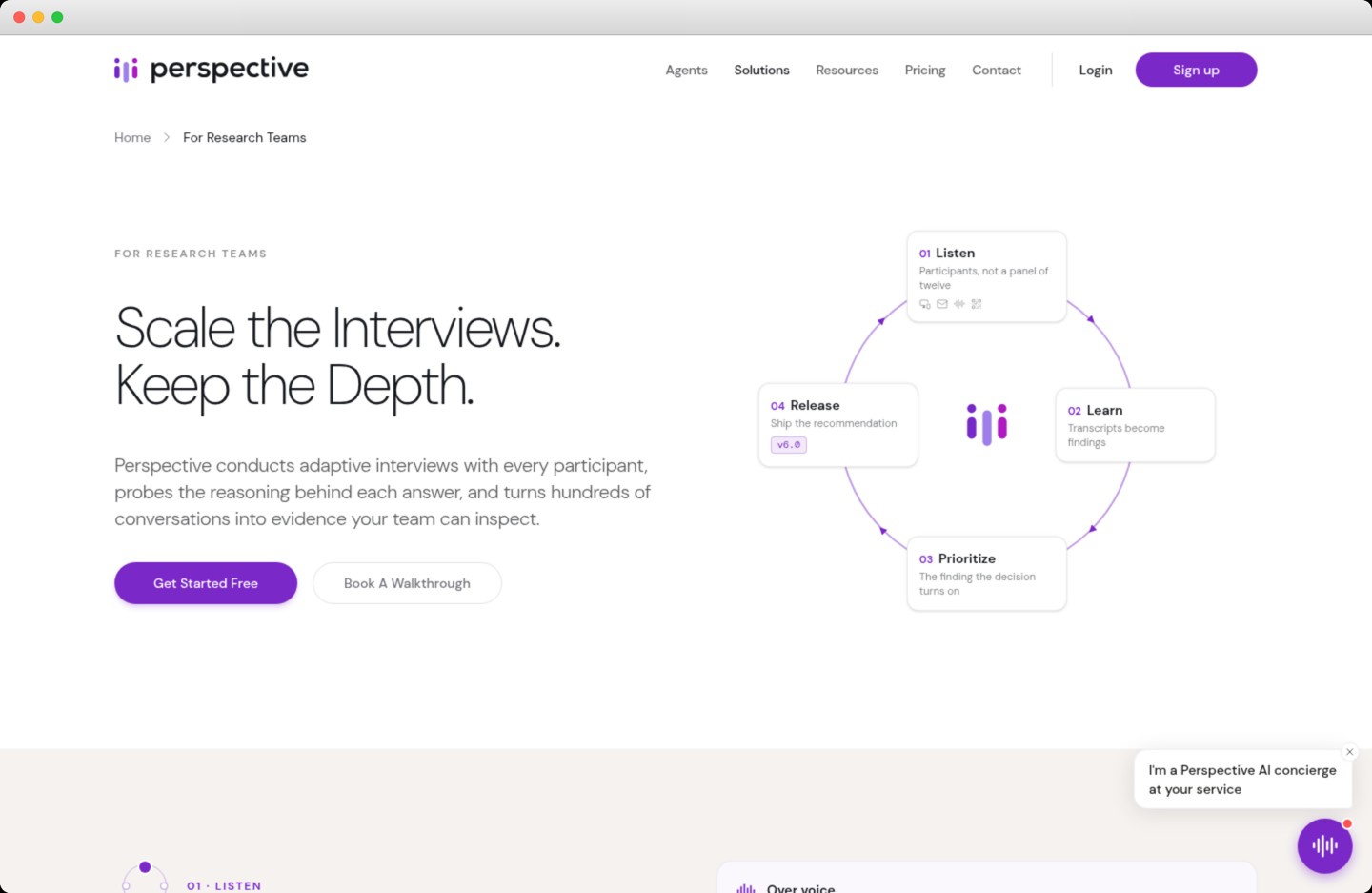
Perspective AI runs interviews by text or voice. You write an outline and send a link to your customers or prospects, and the AI asks each person follow-up questions on their answers 15. It suits the question a panel cannot answer, which is what your own buyers object to and how they say it.
Perspective AI publishes the lowest price per interview of the tools here. Every account starts with 100 free credits, about ten text conversations, and Pro costs from $99 a month for 1,000 credits, about $1 a conversation 16. Recruiting strangers is a separate quoted service, so the people answering are mostly the people you invite.
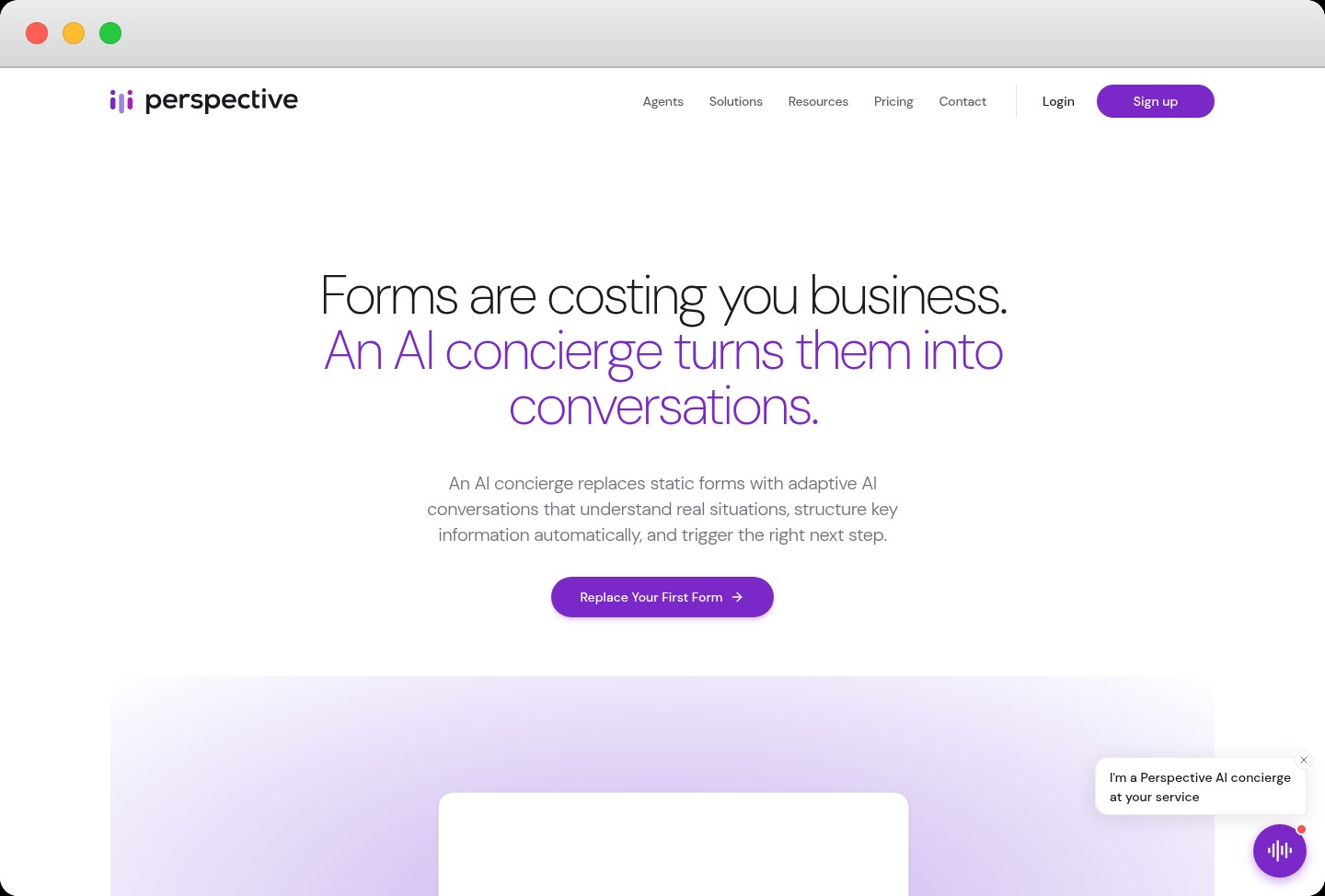
The knock is focus. The homepage now sells an AI concierge that replaces intake forms, and G2 files the product as intake software with two reviews. Research is one use among several, and with only two G2 reviews there is little independent record to quote.
Pricing
- Free plan: 100 credits on every account, about ten text conversations.
- Pro: from $99 a month for 1,000 credits, about $1 a text conversation.
- Voice: 2 minutes per conversation included, then 5 credits a minute.
- Recruitment: participants sourced on request, quoted separately.
Pros and cons
Perspective AI gets you the reasons behind a reaction from your own buyers, cheaply, and reaches mostly people you can already email:
Pros
- About $1 a conversation on Pro
- A follow-up question on every answer
- Text or voice, from one outline
Cons
- Only as good as the people you invite
- A homepage that now sells intake forms
- Almost no independent reviews
With so little independent record, the judgment here is ours:
Your own buyers are the one panel you never have to vet. Invite the deals you lost along with the customers you won, or every interview will flatter the new positioning. Then read the questions buyers ask you back, because a buyer who asks how the claim works is interested.

The AI interviewer asks a follow-up on every answer
The interviewer adapts its next question to each answer and probes the reasoning behind it, so a vague “sounds good” turns into the sentence that tells you why 15.
Verdict: the test when your buyers already answer your emails and you need their words, not a score. It reaches decision-makers mainly through the people you invite, unless you pay for its recruitment service. Skip it before you have a buyer audience, or for a market that has never heard of you.
Which Test Fits the Decision You Are Making
A new line passes checks that need different people, and that rules out tools faster than price does:
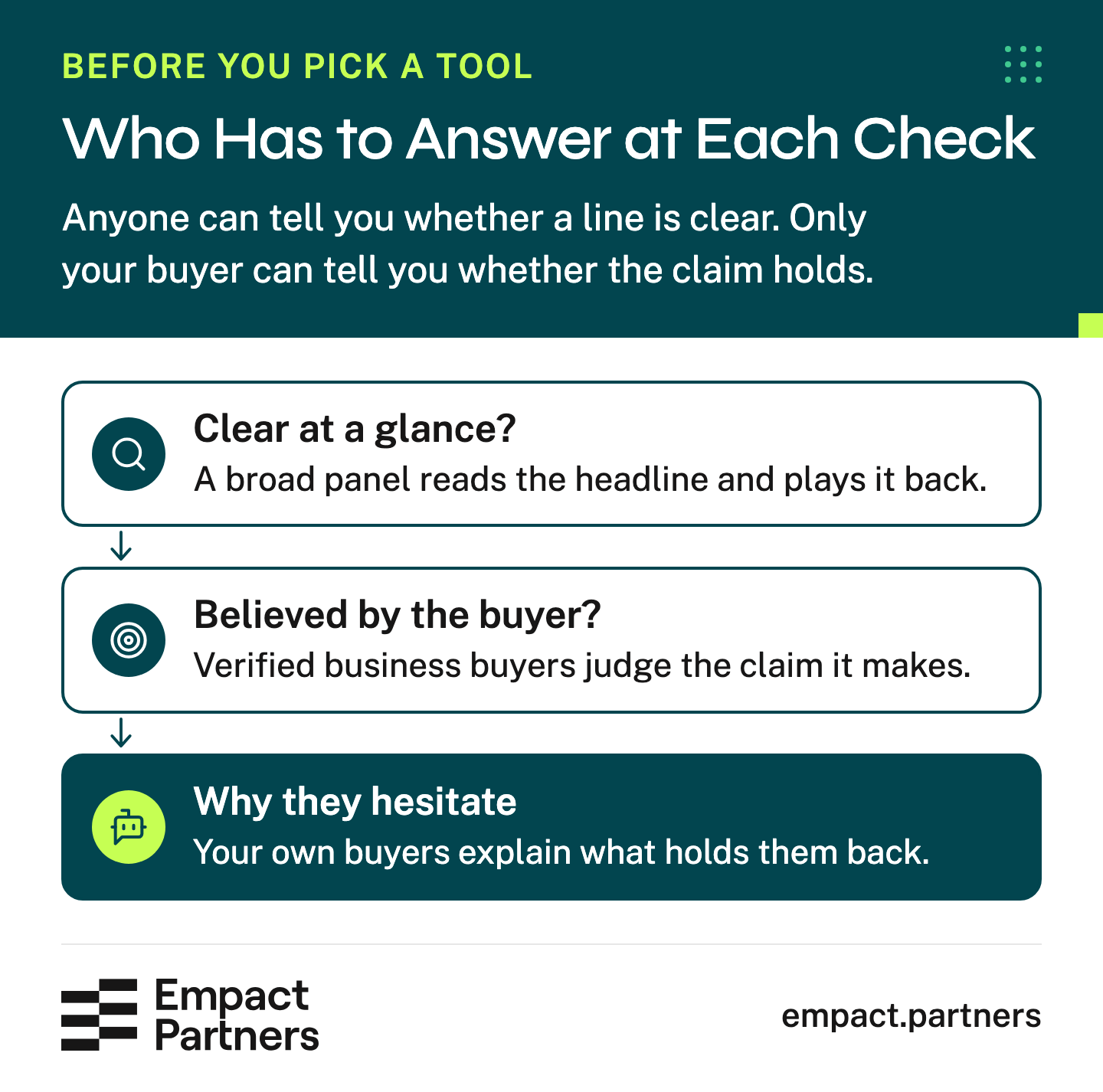
A broad panel can tell you whether people understand the line. Only buyers can tell you whether they believe it. With that settled, pick by the decision in front of you:
- New positioning: Wynter, at the seniority your buyer sits at.
- A homepage headline: Lyssna’s five-second test, then the winner to buyers.
- Two versions: PickFu, for copy any adult can judge, never for the claim itself.
- A homepage rebuild: UserTesting, with a custom audience or your own contacts.
- Your own buyers: Perspective AI, to hear objections in their own words.
The cheap routes save money only when they end with buyers, so budget for that last check whichever tool you start with.
What Our Own Cold Email Taught Us About Testing Angles
The usual advice for a site with little traffic is to move the test to a channel with volume, often cold email subject lines or small paid ads. We run Outbound for ourselves first, and we have tested angles through cold email.
In May and June 2026 we sent three different angles on the same offer to 338, 449 and 353 people, and 4, 4 and 3 of them replied. Our own analysis treats anything between 200 and 499 sends as an anecdote, so none of the angles won. Across 82 of our own campaigns and 18,513 leads, from August 2025 to October 2026, delivery explained more of the reply rate than the copy did.
A reply-rate test on cold email measures the inbox as much as the message.
Our own test is why the five tools above are panels and interviews, not cold email. Practitioners who test positioning without much traffic have reached similar rules on Reddit, starting with calls to people who fit the ideal customer profile (ICP):
Tips from Reddit
How marketers test positioning without much traffic
or just get on 10 calls with people who fit the ICP and read them the one-liner. watch which version makes them ask a follow-up question instead of nodding politely.
how did you control for deliverability while testing 47 angles? if inbox placement varied between weeks or angles, reply rate might be skewed by infra, not message.
Now we re-test angles quarterly, not just at launch.
Ideally, you'd research voice of customers before building the product or writing the page. But it's not too late to do that now.
A test also needs one line to test, and many SaaS sites carry more than one. Our free Messaging Consistency Audit reads how you describe yourself on your site, LinkedIn and review sites. It shows where those descriptions contradict each other and names the one line to keep, so run it on your own site before you pay for a test:
When we work with a SaaS team on a positioning change, the first job is the core message, found together and written down as a messaging framework. The site and the sales story are rebuilt from it after that. Our advice is to test the new line with people who match the buyer before the homepage changes. The work includes:
What you get from our Brand Marketing work
- A core message, found with your team
- A messaging framework written from it
- Your site rewritten to carry it
- Your sales story rewritten to carry it
If you would rather build the framework yourself, Sharné McDonald’s playbook takes you from your buyers’ words to one page your team starts every draft from:
Whichever tool you buy, read the open answers before the score. For a positioning change, the buyers who ask a follow-up question are the ones the line reached.
Frequently Asked Questions
Can message testing tools reach real B2B decision-makers?
Some can, and the difference is whether anybody checks the job. Wynter vets each panelist against a LinkedIn profile and a work email and sells VP and C-level as a separate tier.
Lyssna and PickFu let you filter by job role or seniority, but those are traits panelists report about themselves. UserTesting reaches buyers through screeners, a custom audience or contacts you bring, and Perspective AI reaches the people you invite, plus anyone its quoted recruitment service finds.
How much does a message test cost?
On 23 November 2026, a 15-person Wynter message test cost $911 to $2,734 pay as you go, depending on seniority, or $609 to $1,829 on its $20,000 annual plan.
A short Lyssna test costs about $2 to $4 a response, and a 50-person PickFu poll filtered by job seniority costs $125. Perspective AI works out at about $1 a conversation on Pro, and UserTesting quotes every plan.
How many people should a B2B message test include?
Enough to see where the page confuses people, and that is a smaller number than most teams expect. Wynter’s smallest tests use 15 participants, which shows the sections people stall on.
A disagreement between segments, say founders against VPs of marketing, needs a group of that size for each segment. For interviews, a handful of buyers who ask real follow-up questions tells you more than a large group that nods, and the questions they ask are the part worth writing down.
Is a preference poll enough to change a homepage?
For a headline or an image, it can settle which version reads better. For positioning it cannot, because a poll tells you what people prefer, not whether a buyer believes the claim or would pay for it. Use a poll to clear the weak versions, then put the survivors in front of verified buyers or your own customers before anything ships.
Can we test positioning with cold email or paid ads instead?
You can, but read the result with care. In our own cold email, three angles sent to a few hundred people each got replies from three or four people apiece, which proves nothing, and across 82 campaigns delivery explained more of the reply rate than the copy. If you test in a channel, check inbox placement first and give each angle far more sends than feels necessary.
Do we still need a panel if our site gets real traffic?
Traffic answers a different question. An on-site A/B test tells you which version more visitors clicked, after the page is live, and it needs enough of them to settle. A panel tells you, before anything ships, whether the people you want understood the line and believed it. Once your traffic can settle an A/B test, run it on the headline you already chose with buyers, not instead of asking them.
Should we trust synthetic or AI respondents for positioning?
As a cheap first pass on wording, perhaps. As a verdict on positioning, no. Synthetic respondents predict what a panel would say from past answers, so they inherit that panel’s blind spots, and none of them has bought software like yours. PickFu labels its Synthetic Audiences and never mixes them with human results, which is the right way to treat them.
Is UserTesting now called Auros?
Its parent company is. On 29 September 2026 the corporate brand became Auros, which owns UserTesting and User Interviews and sells new AI services under its own name. The UserTesting product, its plans and its contributor network continue under the UserTesting name, and the CEO wrote that nothing about how customers work with it had changed.
When should we interview our own buyers instead of buying a panel?
When you need the reasons behind a reaction, in more depth than a written comment gives. Interviews with your own buyers surface objections, the words they use and what they compared you with, none of which a scored panel gives you. They suit a positioning change in a market that already knows you. If your market has never heard of you, a verified panel or a paid recruitment service is how you reach strangers who match the buyer.
How often should we retest a winning message?
Whenever the market around it moves, such as a new competitor claim, a price change, a new segment or a launch that changes what you sell. Some practitioners on Reddit retest winning angles every quarter, because a line that worked at launch can stop working once rivals copy it. Retest with the same audience criteria, so a change in the result is less likely to come from a change in who answered.
What does working with Empact Partners on positioning look like?
Work begins with an audit, then a roadmap. One named senior consultant owns it and joins the calls, positioning runs alongside the workstreams it feeds, and the horizon is quarters rather than weeks.
Sources (16)
- UserTesting, "Introducing Auros: built for the AI era" (2026)↩1
- Wynter, "pricing" (2026)↩1
- Wynter, "B2B audiences" (2026)↩1
- Wynter, "Pricing calculator" (2026)↩1
- Wynter, "B2B message testing" (2026)↩1
- Lyssna, "Plans and pricing" (2026)↩1
- Lyssna, "Plan and pricing overview" (2026)↩1
- Lyssna, "Demographic targeting" (2026)↩1
- Lyssna, "Five second testing software" (2026)↩1
- PickFu, "Test anything with real people in minutes" (2026)↩1
- PickFu, "Who are PickFu’s respondents?" (2026)↩1
- PickFu, "Standard, Premium, and Specialty traits" (2026)↩1
- PickFu, "pricing" (2026)↩1
- UserTesting, "Plans" (2026)↩1↩2↩3
- Perspective AI, "AI qualitative research platform for research teams" (2026)↩1↩2
- Perspective AI, "Pricing" (2026)↩1
Keep reading
Brand Marketing The 7 Best Digital Asset Management Tools for a SaaS Brand
Compare asset libraries for SaaS teams by update rules, storage, pricing and the copies they cannot fix.

Brand Marketing Community Marketing for SaaS: Beyond the Slack Channel
Find out whether your SaaS community helps renewals and sales, who acts on what members ask, and where buyers talk outside it.

Brand Marketing Creative SaaS: Choose Your Segment Before Spending More
Lessons from creative software for choosing a buyer segment, testing your product’s fit and deciding where to spend next.