5 Best Win-Loss Analysis Tools for Product Marketers
Five win-loss tools compared by who interviews your buyers, whether it reaches the people in your deals, and who acts on what they say.
 Gabby SaaymanWith
 Vlad Shvets
On this page
Empact Newsletter
One email a month on what is working in AI search and SaaS go-to-market.
Win-loss software asks the buyers of your closed deals why they chose you or a rival, and sorts their answers into reasons. Without it, most teams learn why they lose from the reason a seller picks in the CRM, usually price. A team that believes it starts discounting, or rewrites a page that was never the problem.
Empact Partners writes the positioning and messaging SaaS companies sell with, so the site and sales team give buyers one reason to choose them. We build it from how your buyers talk about their problem, which is exactly what a win-loss interview records.
We reviewed five win-loss tools, and the question that decides whether one pays off is who on your team will act on what buyers say. Each serves a different owner. They also differ in who runs the interviews, whether the people interviewed were in your deals, and what each vendor publishes about price.
Scroll horizontally to see all columns when the table is wider than this page.
| Tool | Best for | Who asks | Who is asked | Published price |
|---|---|---|---|---|
| Clozd | Expert-run programs for revenue and product marketing leaders | Clozd researchers, or AI follow-ups on recorded questions | Buyers from the deals you hand over | None, quote only |
| Klue | Getting findings into battlecards and in front of sellers | An AI interviewer, Klue’s experts, or interviews you upload | Your deals’ buyers and sellers, plus outside buyers | None, quote only |
| TruVoice | Coaching sellers on what their buyers saw | Automatic surveys, plus Corporate Visions interviewers on chosen deals | Buyers from won, lost and no-decision deals | None, quote only |
| Diffly | Hearing buyers across the full buying journey | Surveys, your own team, or Diffly’s experts on chosen deals | Buyers after lost and won deals, then at renewal | None, quote only, with a free test |
| User Intuition | Self-serve AI interviews with your own won and lost buyers | An AI moderator, nobody else | The buying committee of each deal, invited by you | $30 an interview with your own buyers |
Clozd
Best for: revenue and product marketing leaders who want experienced researchers to interview the buyers of their deals.
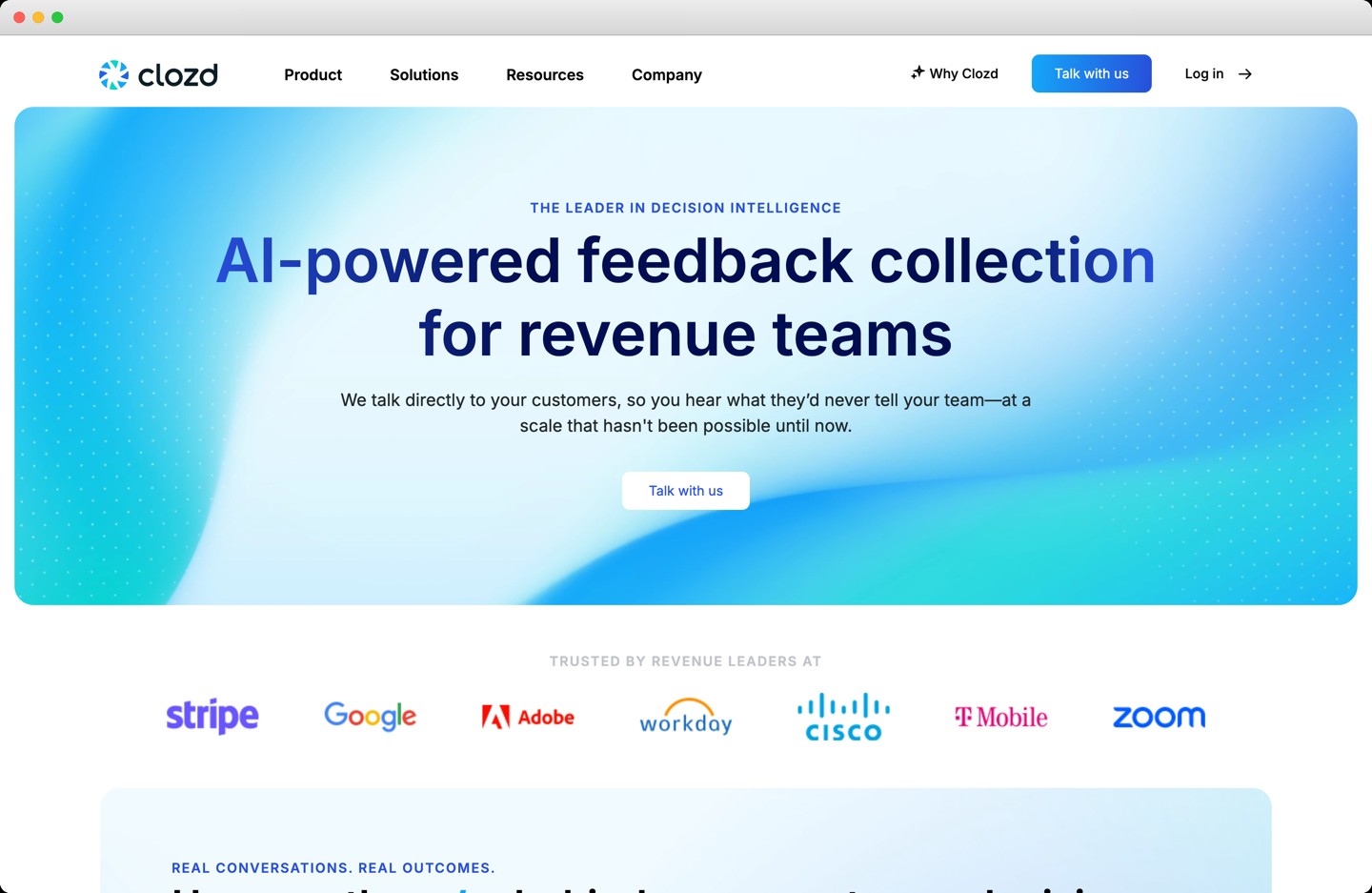
Clozd runs win-loss programs for revenue teams. You hand over the buyers and prospects from the deals you want explained. One of its qualitative researchers then interviews each of them for about 30 minutes. Transcripts, themes and recommendations arrive in the Clozd platform 1 2.
The interviewers are the reason to buy it. A buyer who refused a debrief with your seller will often talk to a neutral researcher, and G2 reviewers describe exactly that. For deals that do not justify a live call, Flex interviews send recorded questions and let an AI ask the follow-ups. A fully AI-led mode is listed as coming soon 1.
You cannot check Clozd’s price before you talk to its sales team. It publishes none, and one G2 reviewer calls it expensive next to other providers, with the cheaper interview types as the way to cut the bill. Another wants its interviewers to know their market better.
Pricing
- Published price: none, every program is quoted after a call.
- Interview types: Live interviews with a researcher, Flex interviews with AI follow-ups, and an AI-led mode marked coming soon.
- Included: goals set with its research team, then transcripts, recordings, themes and recommendations in the platform.
Pros and cons
Clozd sells trained interviewers and a neutral voice, and it shows no number until you talk to its sales team:
Pros
- Researchers interview your deals’ buyers live
- AI follow-ups for deals that do not merit a call
- Transcripts, recordings and themes in one place
Cons
- No published price
- The cheaper interview types give up the live conversation
- A reviewer wants interviewers who know the domain better
What G2 reviewers say about Clozd
Reviewers credit Clozd with reaching buyers who would not talk to sales, and grumble about the cost:
It’s also great for when a decision maker won’t debrief with the Sales team, but will debrief with Clozd
Reviewer in IT services at a mid-market companyNov 2026 Can be expensive compared to some other providers but possibility to cut down the costs by choosing Scale/Flex/Survey interviews instead of Premium
Reviewer in computer software at an enterpriseMay 2026 I would like Clozd to be more knowledgeable in our domain.
Director of product marketing at a mid-market companyApr 2026
A researcher on every live call
In a Live interview the researcher listens for tone and hesitation as well as words, and asks follow-up questions the guide did not anticipate. That is the part a recorded question or a survey form does worst, and it is what Clozd’s price pays for 2.
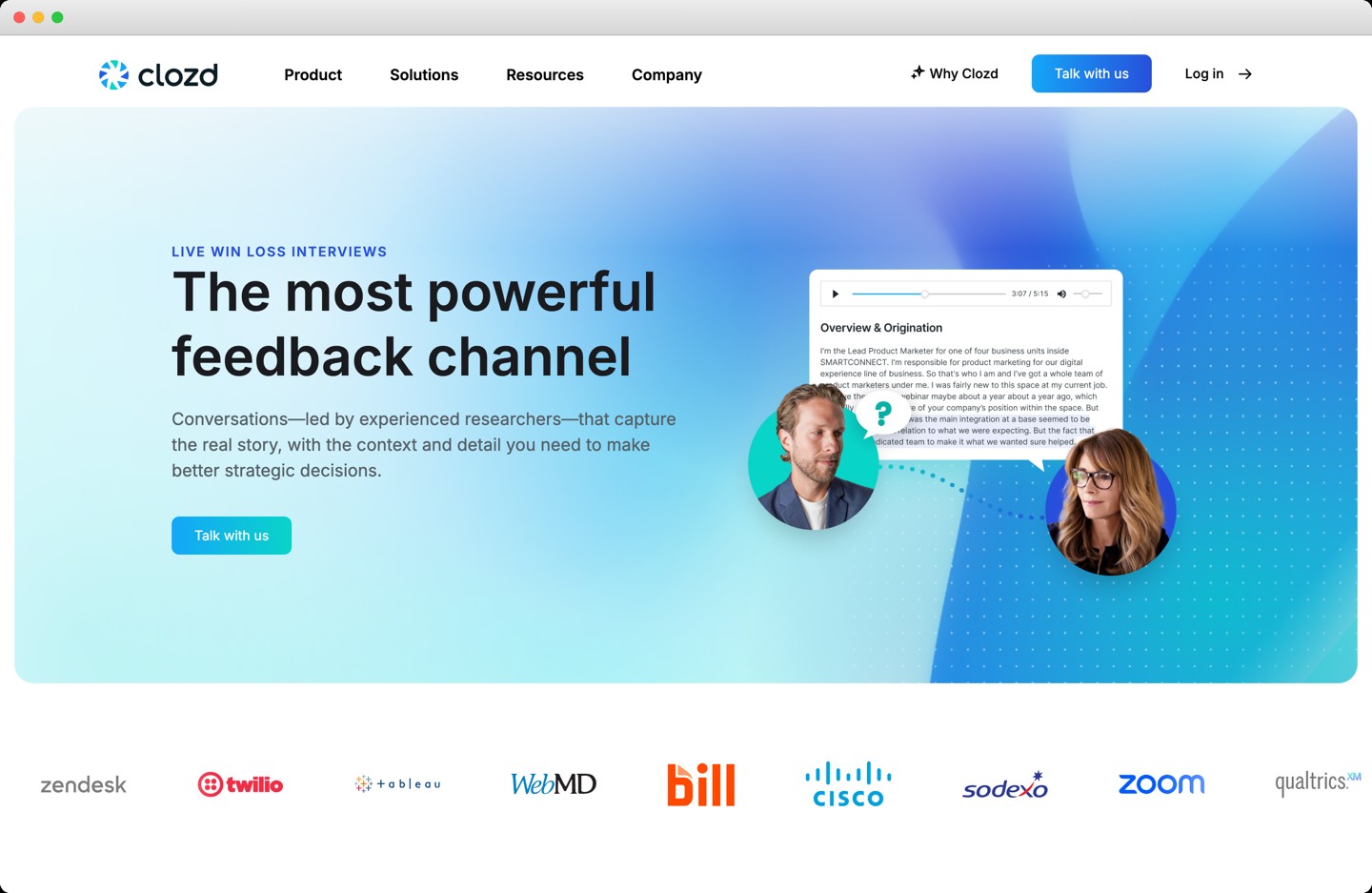
Verdict: buy Clozd when a product marketing or revenue leader needs the real reasons behind enterprise losses and has the budget for researchers. We would aim the first round at deals lost to one rival, so the findings can change one page of messaging quickly. Skip it if you need a price before the first call, or if your deals are too small to justify a researcher.
Klue
Best for: competitive intelligence and product marketing teams that want buyer interview findings inside the battlecards sellers already open.
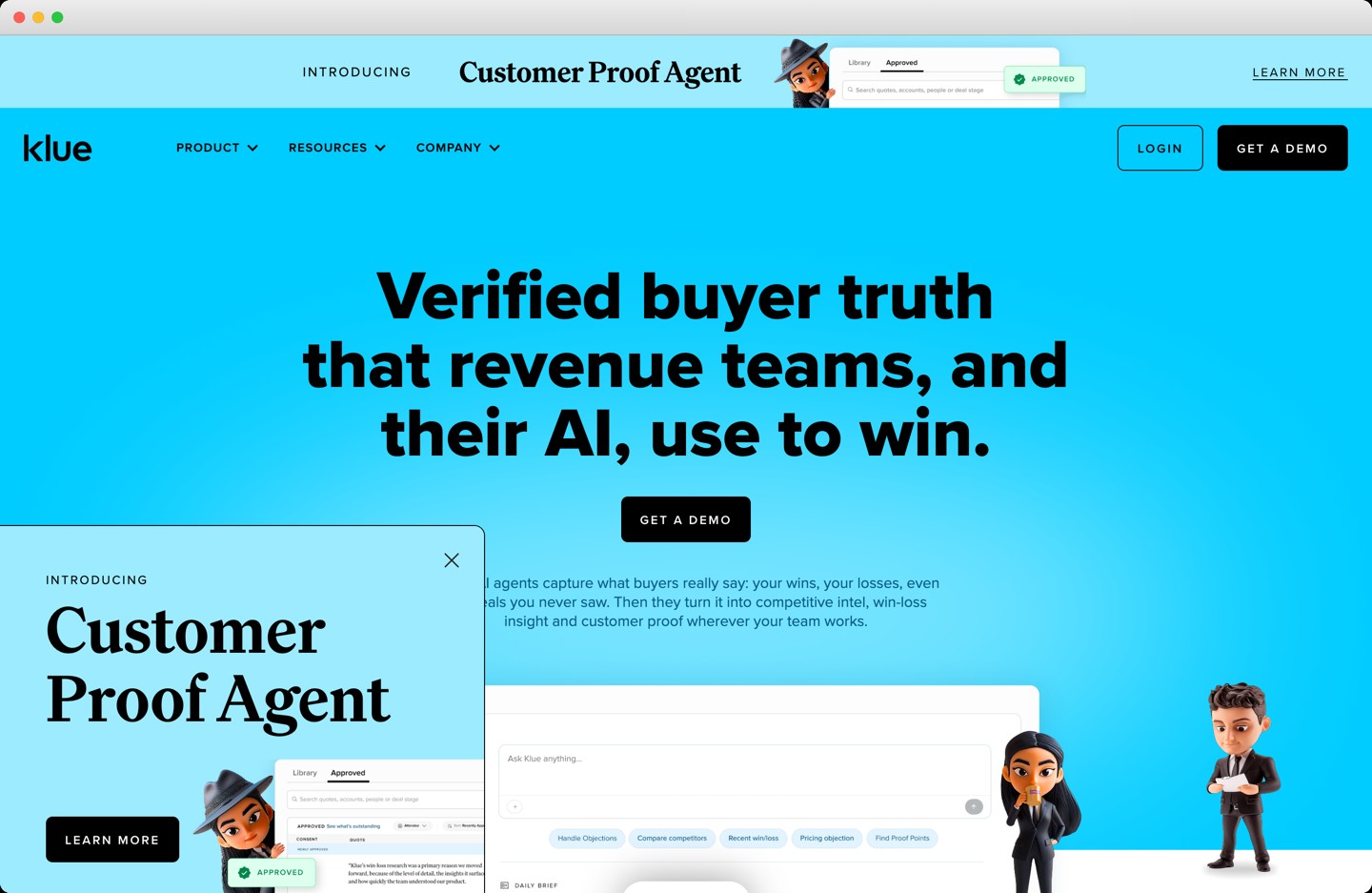
Klue sells competitive intelligence and win-loss in one platform, and battlecards are its home ground. Klue captures buyer feedback five ways: short AI interviews with buyers and sellers, interviews by human experts, AI interviews with buyers outside your pipeline, deal stories written when a deal closes, and interviews uploaded from elsewhere 3.
Its strength is where the findings go. Klue writes win-loss context into the battlecards and sends sellers Deal Tips in Slack, Teams and email, so nobody has to turn each interview into sales guidance by hand 3. G2 reviewers name its interview team DoubleCheck Research by Klue and praise the interviewers.
Its quickest interviews are its shallowest, and some interviewees were never in your pipeline. The AI interviewer runs two to five minutes, which Klue itself pitches at high-volume, lower-value deals, and Blindspot interviews reach buyers who never sat in your deals. A recent G2 reviewer calls the analytics basic, and Klue publishes no price.
Pricing
- Published price: none, every plan starts with a demo.
- Capture methods: AI Interviewer, Human Expert Interviews, Blindspot Interviews, Win & Loss Stories and Bring Your Own Interview.
- Where findings land: battlecards, Deal Tips in Slack, Teams and email, and the Ask Klue assistant.
Pros and cons
Klue sends buyer feedback straight into battlecards and sellers’ chat tools, and its quickest interviews are also its shallowest:
Pros
- Findings flow into battlecards and Deal Tips
- Human experts and an AI interviewer in one product
- Interviews from other vendors can be uploaded
Cons
- No published price
- AI interviews last two to five minutes
- Blindspot interviews are not your deals’ buyers
What G2 reviewers and Reddit say about Klue
Reviewers like the interviewers and doubt the reporting, and a product marketer on Reddit warns that the platform needs owners:
I appreciate that the interviewers learn about our business, prepare to ask the right questions, and know when to go off script.
Marketing analytics manager at an enterpriseNov 2026 I think the analytics piece of Klue Win-Loss is very basic, and there’s not a lot to see beyond how many interviews and comments we have.
Marketing analytics manager at an enterpriseNov 2026 r/ProductMarketing
View threadInternal adoption is absolutely key. We had an instance, but it wasn’t updated by the teams with key information so we ended up getting rid of it.
Jun 2025
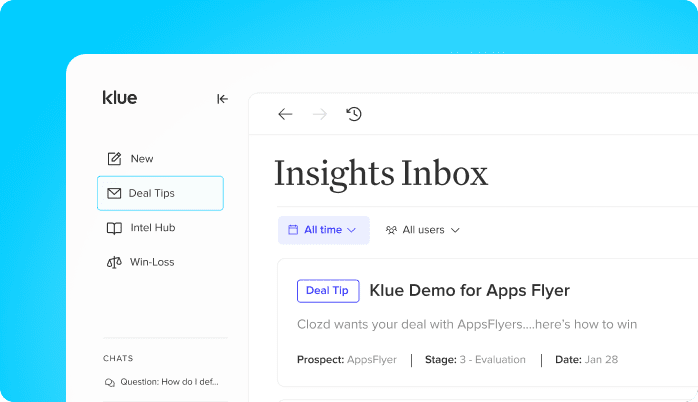
Deal Tips carry the findings into open deals
Deal Tips are recommendations for one specific open deal, built from win-loss findings and sent to the seller in Slack, Teams or email without anyone asking. That puts a buyer’s words in front of a seller while the deal can still change 3.
Verdict: buy Klue if your team already keeps battlecards and wants buyer feedback to keep them current. In our judgment it changes sales conversations faster than it changes positioning, so add a few longer interviews before you rewrite a homepage. Skip it if nobody owns the battlecards, because an unmaintained instance gets switched off.
TruVoice
Best for: sales leaders who want buyer feedback tied to each seller’s behavior and turned into coaching.
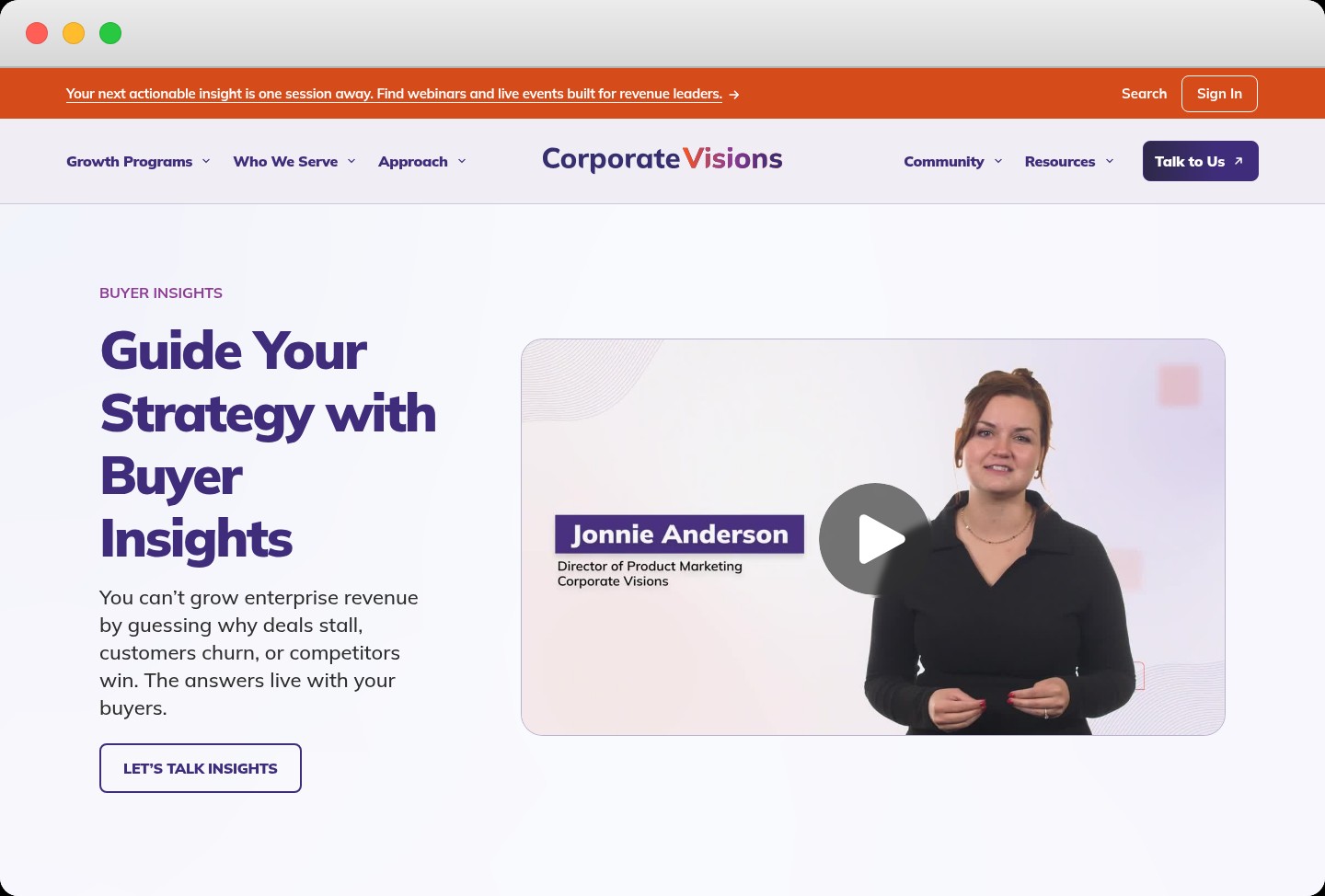
TruVoice is the buyer feedback platform of Corporate Visions, which older G2 reviews know as Primary Intelligence. It sends surveys automatically when deals are won, lost or end with no decision, and its own team runs live interviews on the deals you choose 4.
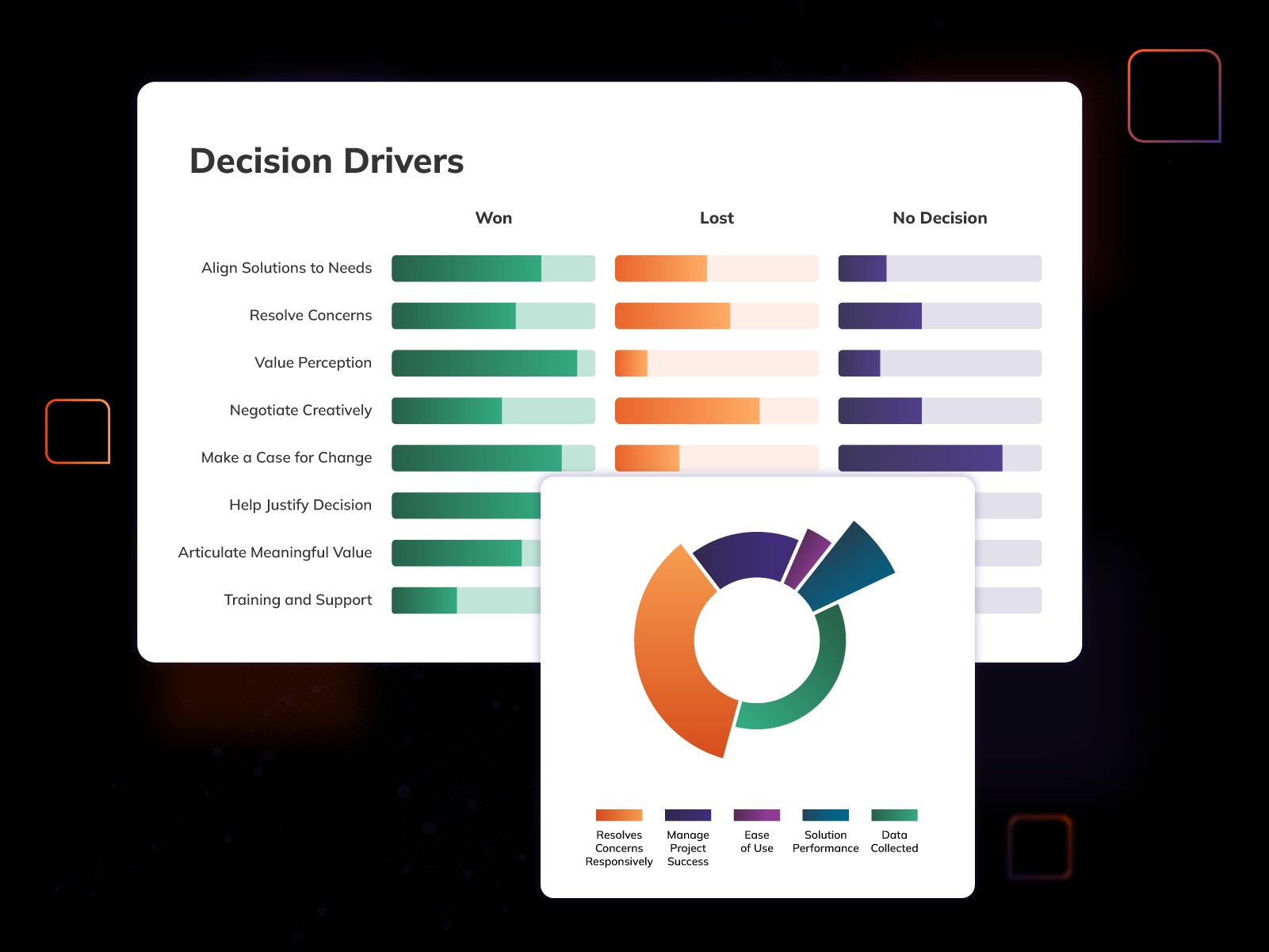
Its distinctive move is the link to sellers. Buyer answers are mapped to seller skills such as explaining value and standing apart from rivals. Reps see their own deal feedback and trend lines against the team, and managers see who needs coaching on which behavior 5.
The weak spot is depth. A G2 reviewer says some buyers tick the multiple choice boxes and write nothing, and another says rolling the platform out to sales leaders has been hard. Corporate Visions publishes no price.
Pricing
- Published price: none, quoted through a sales conversation.
- Collection: surveys triggered by deal outcomes, plus live interviews by Corporate Visions’ team on chosen deals.
- Views: win-loss analysis and sales performance analysis, with dashboards and alerts.
Pros and cons
TruVoice is built to change how sellers sell, and it hears buyers mostly through short survey answers:
Pros
- Buyer feedback mapped to each seller’s skills
- Rep and manager views built for coaching
- Surveys sent automatically on won, lost and no-decision deals
Cons
- Surveys collect short answers
- Live interviews only on chosen deals
- No published price
What G2 reviewers say about TruVoice
Reviewers value the coaching and admit the program takes work to roll out:
Working with consultants who are top in their craft to make us better sellers.
Reviewer in real estate at an enterpriseApr 2024 Some respondents only answer the multiple choice questions and don’t provide color commentary or quotes, so I wish there was a way to encourage that.
Reviewer in computer software at a mid-market companyJul 2025 It hasn’t been easy rolling this out or making the platform accessible to our sales leaders
Reviewer in hospital and health care at an enterpriseJun 2025
Buyer answers scored against seller behavior
Every answer is tied to the seller behaviors that decide deals, and the scores split by won, lost and no decision. A sales manager can see which behaviors buyers score low in lost deals before the next quarter’s pipeline repeats the pattern 5.
Verdict: buy TruVoice if you lead sales and want buyer feedback to change how each seller sells. Product marketing should still read the open answers, since a skill score cannot tell you that buyers misread what you sell. Skip it if your question is why the market prefers a rival, which takes longer conversations than a survey allows.
Diffly
Best for: revenue teams that want buyer feedback across the full buying journey, from the deals they lose to the renewals they keep.
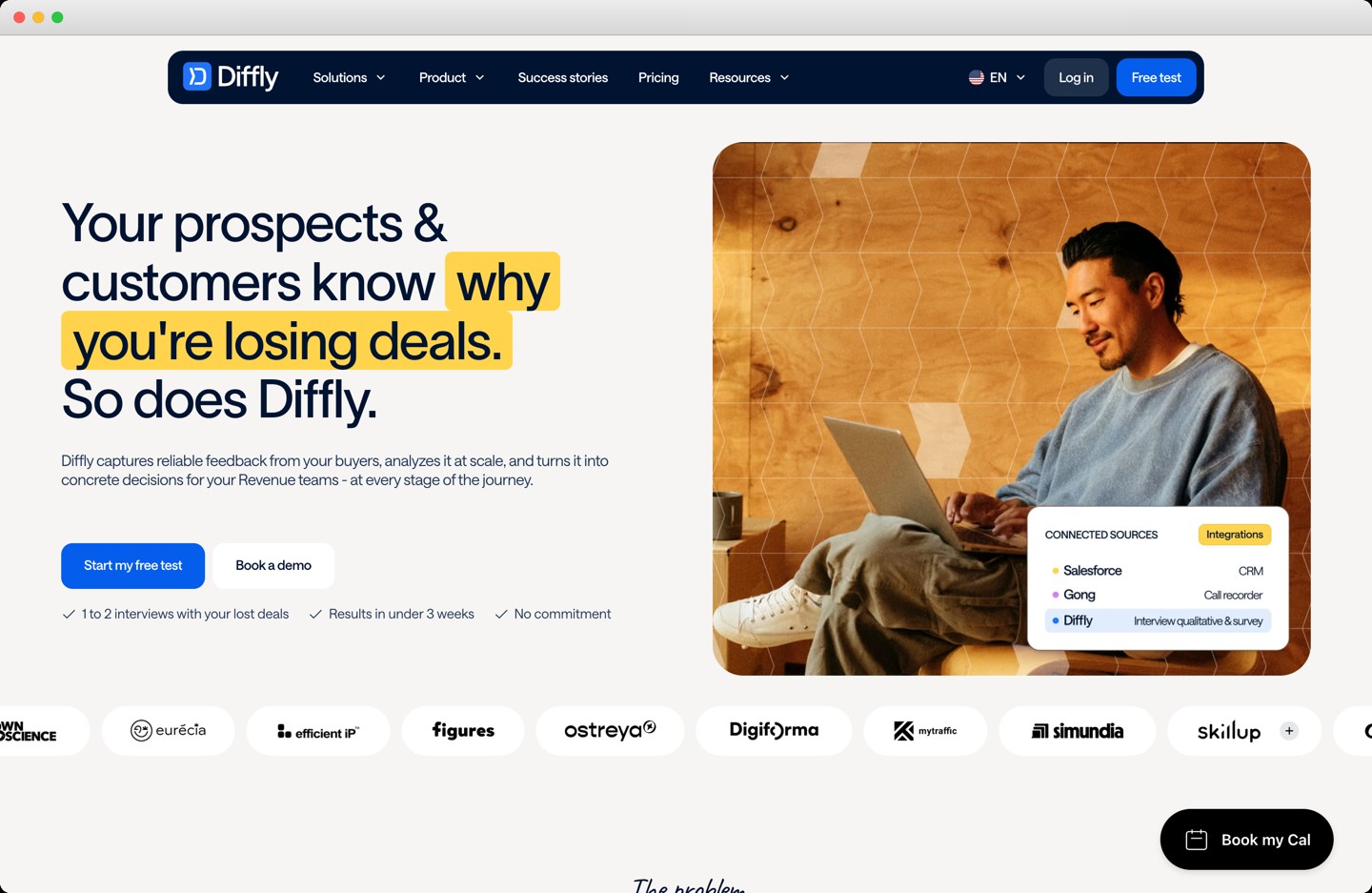
Diffly is a Paris win-loss company, founded in 2023, that raised €1.7 million in October 2025 6. It connects to your CRM and asks for feedback automatically after won and lost deals, then again around churn, retention and satisfaction. Its AI reads calls, emails and CRM notes beside the answers 7.
Interviews come at three depths. On Essential your own team runs them inside the platform. Focus buys 20 to 50 interviews by Diffly’s experts on one topic, and Impact puts its experts on the top 20% of your deals, with a report every quarter. Diffly says its users average a 35% response rate 8.
Diffly has no independent reviews yet, on G2 or Capterra, and every plan is quoted. It sells no single interviews either, so a team that wants a handful of calls about one rival has to buy a program.
Pricing
- Essential: quoted, with CRM-triggered surveys, interviews your own team runs and AI analysis of calls, emails and CRM.
- Focus: quoted by interview volume, 20 to 50 interviews by Diffly’s experts on one topic, a program manager and a yearly report.
- Impact: quoted by yearly deal volume, expert interviews on the top 20% of deals and a quarterly report.
- Free test: one to two interviews with your lost deals, results in under three weeks.
Pros and cons
Diffly follows the same buyer from the deal to the renewal, and asks you to trust it on the strength of its own site:
Pros
- Feedback after lost and won deals, and again before renewal
- Neutral expert interviews on the deals you choose
- A free test on real lost deals
Cons
- No reviews on G2 or Capterra
- No one-off interviews
- Every plan is quoted
We found no independent record of Diffly, on the review sites or on Reddit, so the view here is ours:
Feedback from every stage pays only if someone owns each stage’s answers. Decide who changes the pitch after a lost deal and who changes onboarding after a churn, before the first survey goes out.
 Gabby Saayman on LinkedInOpens in a new tab
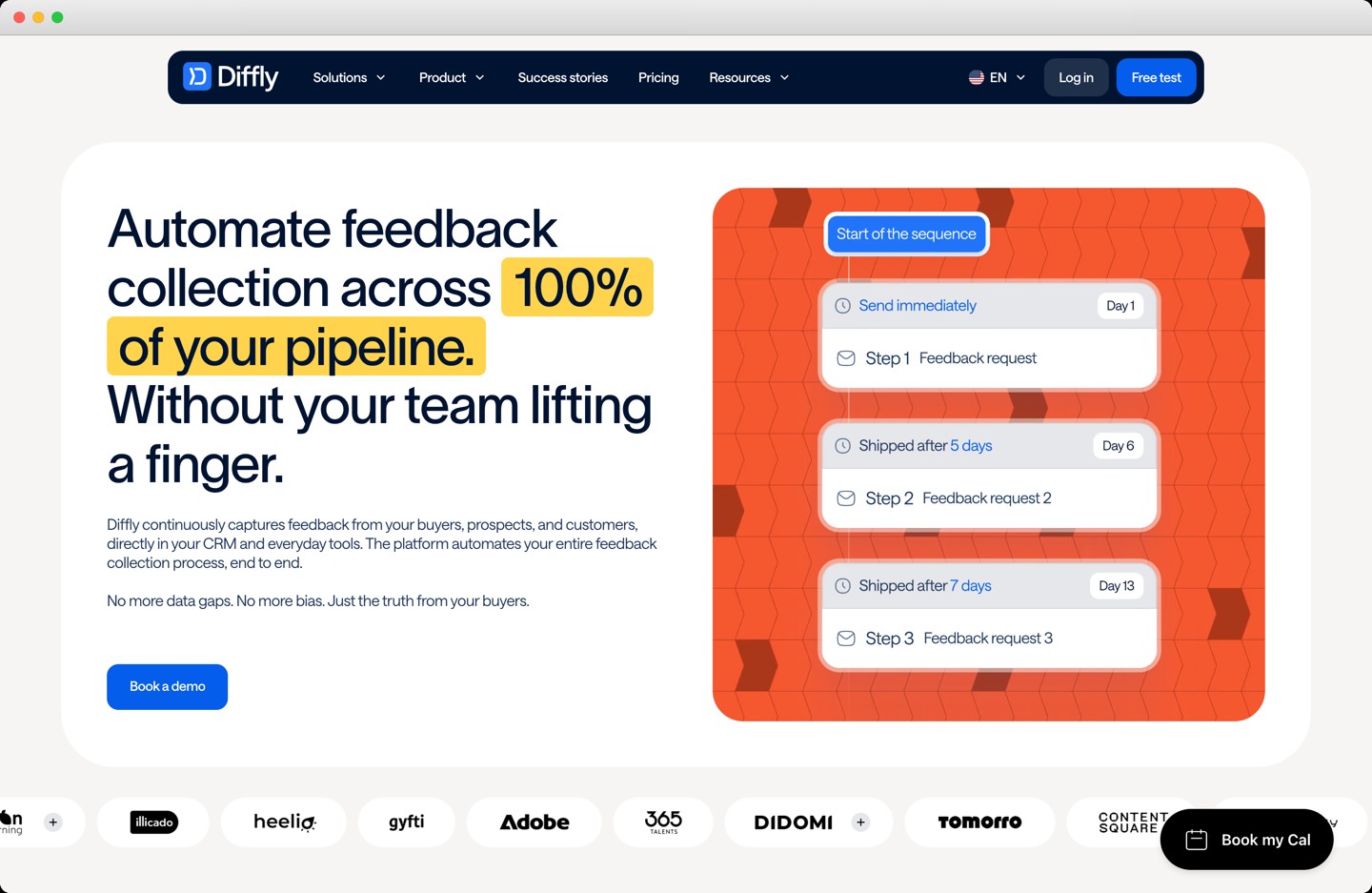
Every closed deal starts a feedback sequence
When a deal closes, Diffly sends a timed run of feedback requests with reminders days later, so collection never depends on a seller remembering to ask. That is what lets it reach the same buyer again at renewal 9.
Verdict: buy Diffly if you want one program that hears from buyers after lost deals and follows the buyers who sign through to renewal. Its experts can take the deals that matter most. Run the free test on your two most painful losses before you sign, since the review sites cannot vouch for it yet. Skip it if you only need a burst of interviews about one competitor.
User Intuition
Best for: lean product marketing teams that want to run AI interviews with the real buyers of their won and lost deals themselves.
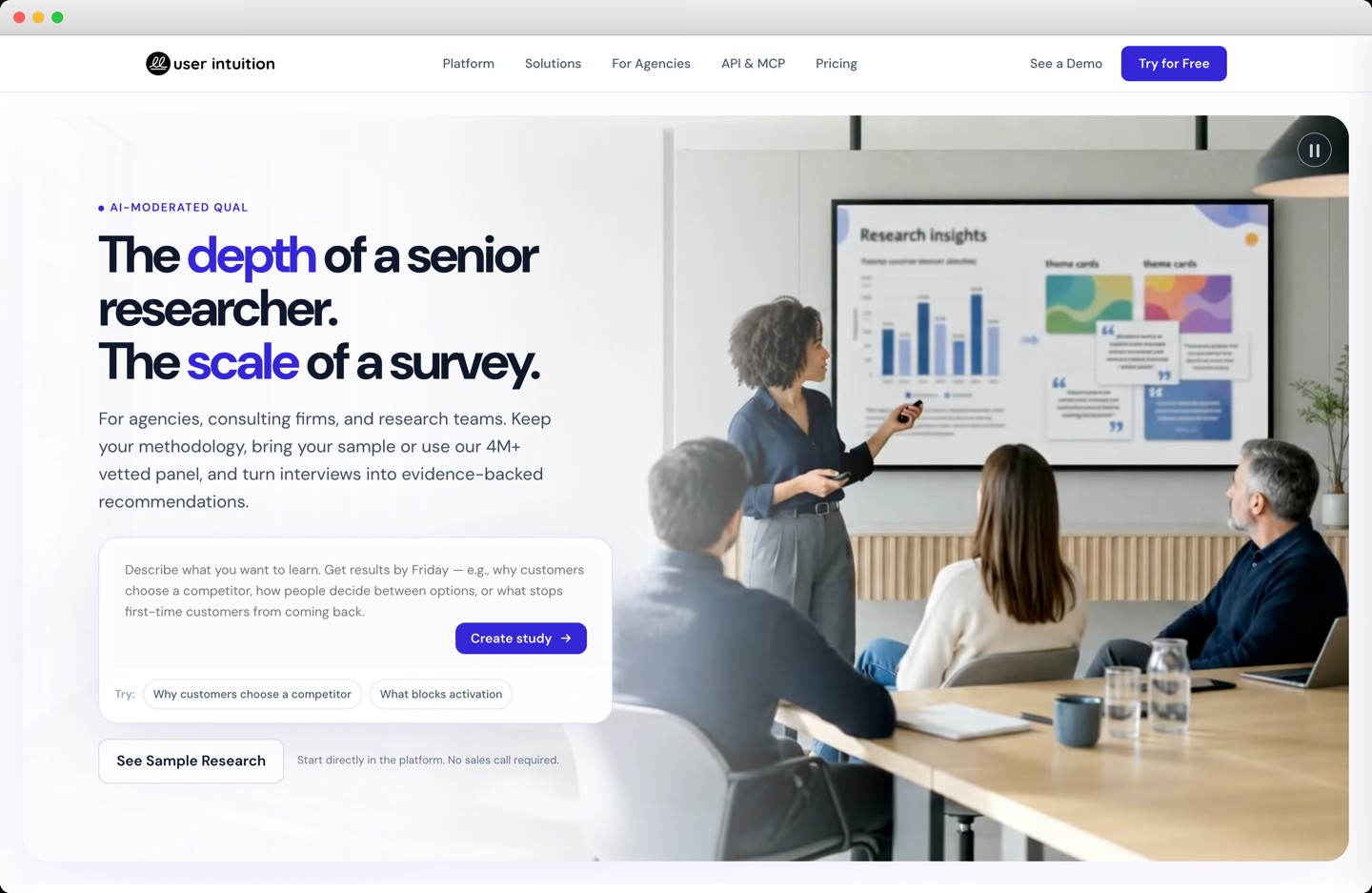
User Intuition is an AI interview platform. You write or approve a guide and invite people. An AI moderator talks to each of them for 20 to 30 minutes by voice, video or chat, then sorts the answers into themes with the recordings attached. No person asks the questions, though you can watch and steer a session live 10 11.
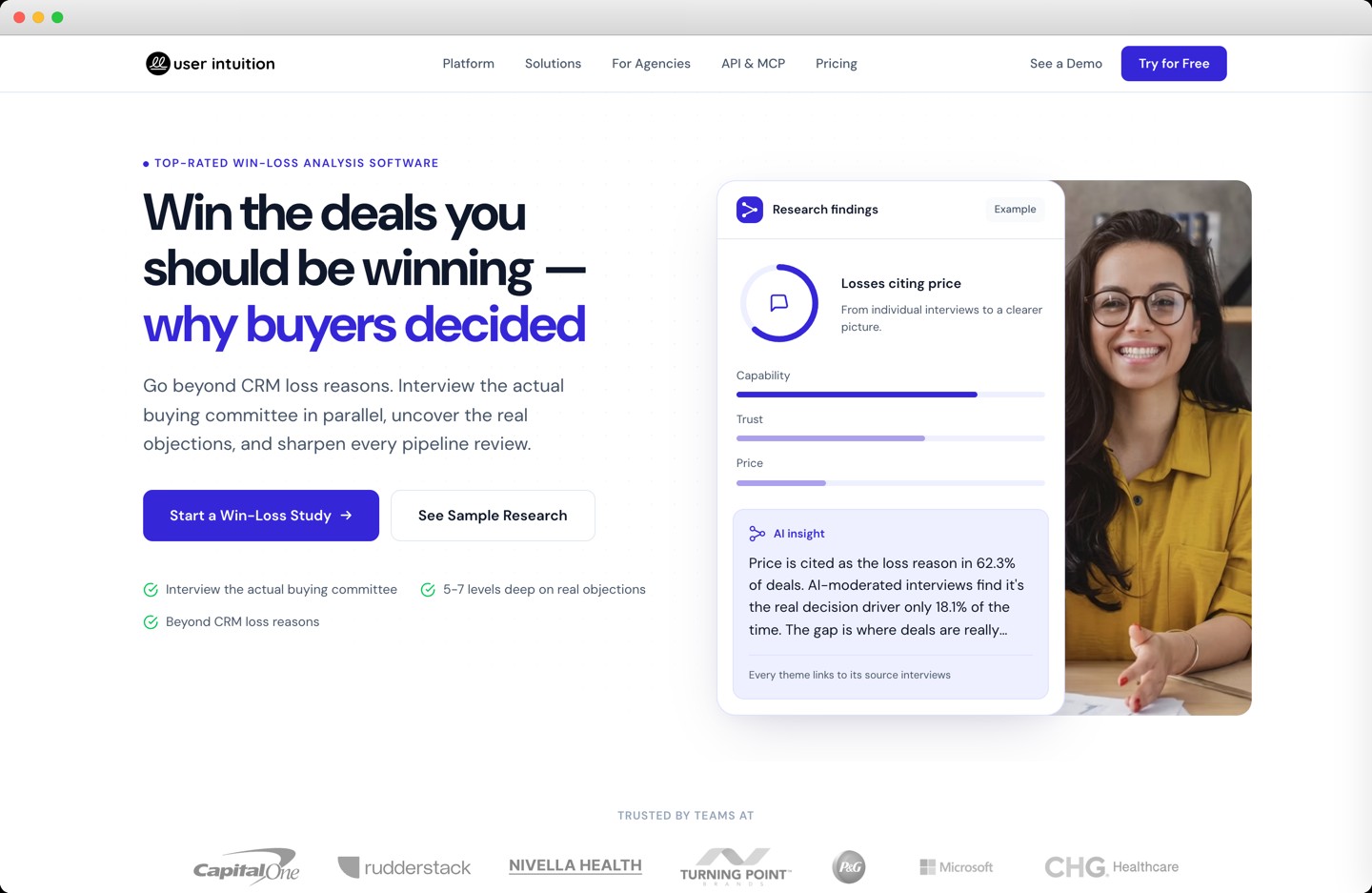
For win-loss it has the only public price here and the clearest view on who to ask. Its win-loss page tells you to invite the economic buyer, the IT lead and the procurement reviewer from each deal, and says a general panel cannot stand in for them. An interview with your own buyers costs $30, and HubSpot can send the invitation when a deal closes 10 11.
Some buyers will not discuss a deal they gave to a rival with a bot, and product marketers on Reddit disagree hard about using AI for these interviews. User Intuition is also sold mostly for other research. Its homepage addresses research teams and people who run research for others, with a retail shopper study as its example, and its G2 reviews describe other kinds of research too 12.
Pricing
- Starter: $0 a month, $30 per voice interview with your own buyers or $60 with its standard panel, chat at half that and video at double.
- Professional: $2,499 a month with 100 voice interviews, $25 each, and a 3-month minimum.
- Enterprise: a custom yearly commitment priced on interview volume.
- B2B recruiting: quoted per audience, with past quotes of $140 to $280 an interview for B2B professionals.
- Free start: three interviews on signup, with panel recruiting billed separately.
Pros and cons
User Intuition is the only tool here with a published price per interview, and the only one where no person asks the questions:
Pros
- $30 an interview with your own buyers
- Several people from one deal, interviewed separately
- Invitations sent from HubSpot when a deal closes
Cons
- AI interviews only
- A mostly general public panel, with B2B recruits quoted extra
- Few reviews from win-loss users
What G2 reviewers say about User Intuition
Reviewers find it easy to start and name gaps in reporting and transcripts, and most of them run other kinds of research:
I find User Intuition really easy for collecting data, especially in conducting quick interviews with senior stakeholders.
Reviewer at a small businessAug 2026 every quarter I’m pulling the same recurring themes together for an exec review, and I’d love a cleaner way to track those over time instead of rebuilding it each time.
Quality assurance specialist at a mid-market companyJul 2026 The interviews had some random pauses, and the transcript had a few small discrepancies, though nothing that would have caused any issues.
Software developer at a small business, guest reviewerOct 2026
One deal, several people interviewed apart
The win-loss studies are built around the buying committee: the economic buyer, the IT lead and the procurement reviewer from the same deal, each interviewed on their own time. Hearing them apart is how you find out whether you lost the whole room or one person in it 10.
Verdict: buy User Intuition if you are a product marketer who will run the study, read the transcripts and change the messaging without help. Start with the deals where a stilted interview costs you least. Keep a human interviewer for the losses that matter most. Skip it if your buyers are senior enough to find a bot interview rude.
How to Choose by Who Will Act on the Findings
The five tools do different parts of one job, and the useful question is where their part stops and yours begins:
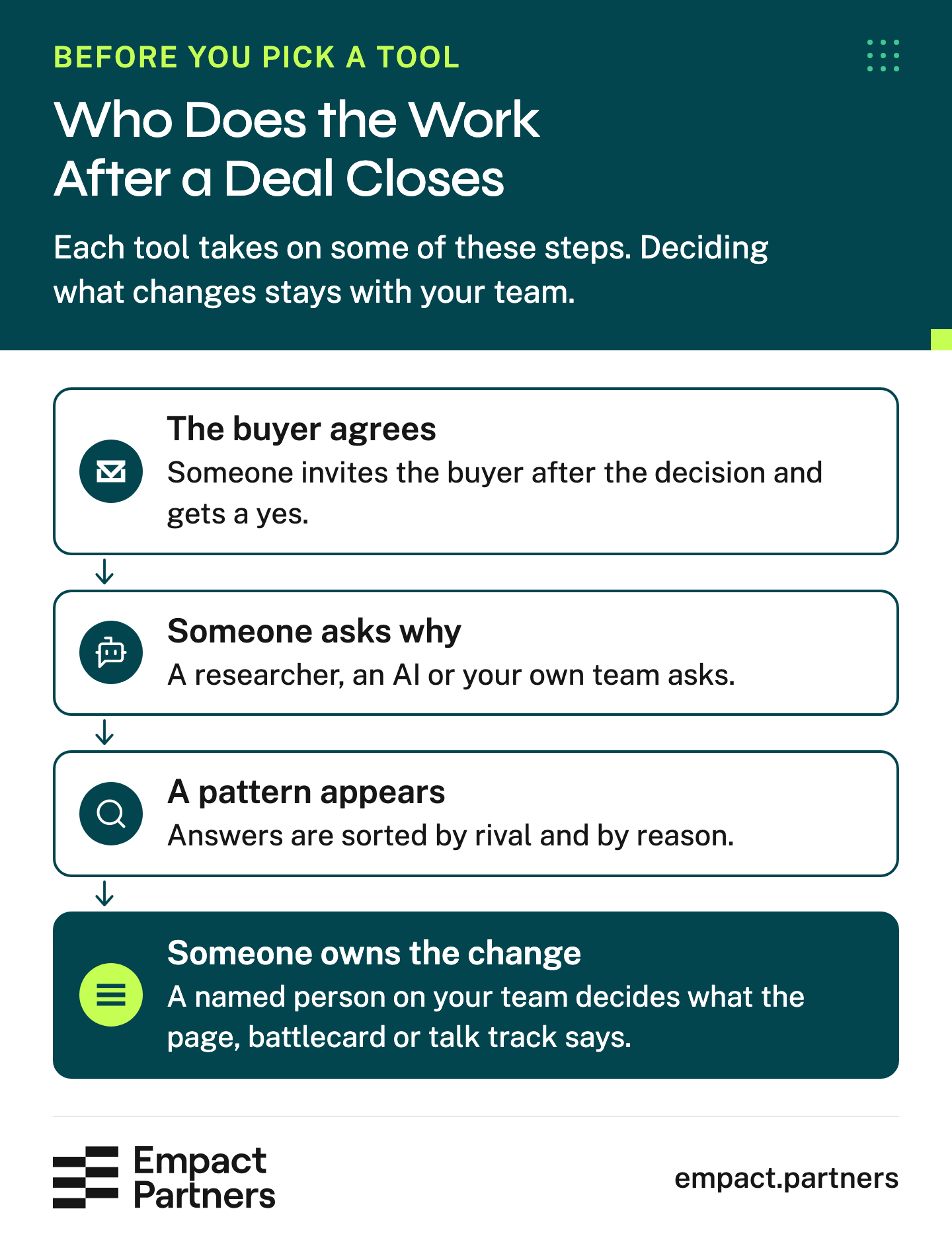
Clozd and Diffly’s expert plans take the asking off your hands. Klue and TruVoice push the pattern out to sellers, and Klue even writes it into battlecards. User Intuition runs the interviews and leaves the reading to you. None of them decides what your pitch says, so choose by the person who will:
- A product marketer rewriting positioning: Clozd for the losses that matter, or User Intuition if you will run the study yourself.
- A competitive intelligence team: Klue, so the findings reach battlecards and open deals.
- A sales leader: TruVoice, so buyer feedback becomes coaching for each seller.
- A whole revenue team: Diffly, from lost deals to renewals.
- Nobody yet: settle that first, because any of the five will then produce findings nobody uses.
Whoever buys, decide before the first interview which page, battlecard or talk track the findings are allowed to change, and who signs that change off. Without that decision, the findings end up in a quarterly deck.
Price Came Up Most in Deals We Went On to Win
In October 2026 we had AI readers go through every sales conversation in our CRM, from emails to call notes. They logged each objection a buyer raised, what we answered and how the deal ended.
Across 141 companies, buyers raised 281 objections, and price came up most, 59 times. Yet 35 of those 59 came from companies that went on to sign, and only 4 ended in a lost deal. In our own pipeline, a price objection was far more often a step toward a signature than the end of a deal.
Our read covered only what buyers told us while a deal was open. When a deal went quiet, the conversation did not say why. To learn that, someone has to ask the buyer after the decision, ideally someone the buyer owes nothing. One product marketer on Reddit found the same gap in a deal they lost:
r/SaaS
View threadWe ‘lost on price’ in the CRM notes. The real loss was that we suddenly looked less native in their stack.
May 2026
In our own deals, price was the objection we heard most, and most of it came from buyers who signed.
Practitioners who run these interviews have settled on a few habits that hold whichever tool you buy:
Tips from Reddit
How practitioners run win-loss interviews
Before any tool: 20-30 min recorded interviews with buyers within ~2 weeks of the decision. Do win, loss, and no-decision. Ask what triggered the search, who else they looked at, and the one thing that tipped it.
I’d keep a person on the interview and use AI for the work afterward: grouping themes and finding relevant quotes across conversations.
We collect win loss details - both drop down and long form style - on competitors in deal, commercial loss reasons, and product loss reasons on all deals. Sellers can’t close the deal without providing that information.
When the interviews keep naming the same rival, the next question is what its site says that yours does not. Our free Competitor Messaging Teardown reads your website beside one competitor’s, compares claims, proof and tone across up to eight pages, and sends a response plan to your work email:
If the interviews point to a positioning problem, we would work with your team to change the messaging, starting with what buyers said about the deals you lost.
We take those findings into the core message, built with your own people and people outside your company, and write it into a messaging framework in your buyers’ words.
We run this work under Brand Marketing, starting with an audit and a roadmap, and one senior GTM consultant leads it and takes your calls. It covers:
- An audit of how your site, sales team and product describe you
- A core message built with your team and the people outside it
- A messaging framework every page and pitch starts from
- Your site and sales story rewritten to carry it
Sharné McDonald’s playbook helps you write a single page in your buyers’ words, which your writers, sellers and AI tools then start from:
Whichever tool you buy, read the first transcripts yourself before you open any dashboard. The sentence a buyer uses about the rival they chose is the one your next homepage has to answer.
Frequently Asked Questions
Who should own a win-loss program, product marketing or sales?
Whoever will change something because of it. If the findings should reshape positioning, product marketing owns the program and sales reads the results. If the goal is better selling, a sales leader owns it and the findings feed coaching.
Shared ownership is how a program ends up producing reports nobody acts on, so name one owner and the pages or behaviors that person may change.
Do win-loss interviews have to be with the buyers from our own deals?
For win-loss, yes. A general panel of B2B buyers tells you what people in your market tend to think, which helps with category research but not with why your deals closed the way they did. Ask each vendor where its interviewees come from.
Klue’s Blindspot interviews and User Intuition’s panel reach outside buyers, while Clozd, TruVoice and Diffly interview the people from deals you name.
Will buyers talk to an AI interviewer about a deal you lost?
Some will, and some find the idea insulting. Product marketers on Reddit report both, and we found no fair comparison of response rates between AI and human interviewers. AI interviews are cheap enough to cover deals you would never pay a researcher for, so use them for volume.
Keep a person on the large losses, where a stilted conversation could cost you a second chance.
How much does a win-loss program cost?
Only one of the five tools publishes a price. On 23 November 2026, User Intuition charged $30 per AI interview with your own buyers, or $2,499 a month for 100 interviews with a three-month minimum.
Clozd, Klue, TruVoice and Diffly quote every plan, so expect a sales call with each. Ask what one finished interview with a lost buyer costs once recruiting and incentives are included.
How many interviews do we need before we change anything?
Fewer than most teams expect, as long as the buyers share a segment. Diffly says results on a well-defined segment become reliable at around 10 to 20 interviews, and practitioners on Reddit suggest running the first 15 to 20 yourself.
Look for the same reason given by buyers who never spoke to each other, and change one page at a time so you can tell what moved.
How do we get lost buyers to agree to an interview?
Ask through someone neutral, and make the time worth it. A lost buyer expects a seller to try again, so an outside interviewer gets more yeses than your sellers will. Some practitioners offer a gift card or an introduction to an executive as the thank-you. Diffly reports an average response rate of 35% on the deals it covers, so ask every vendor for its own number.
Are CRM loss reasons good enough on their own?
CRM loss reasons are a biased starting point. At the end of a deal, a seller reaches for the easiest explanation, and price is the easiest.
In our own sales conversations, price was the objection buyers raised most, yet most of those objections came from companies that went on to sign. An objection is not a reason. Keep the field, make it required, and check it against what buyers say in interviews.
How soon after a deal closes should the interview happen?
Within days, or a couple of weeks at most, while the evaluation is fresh. Practitioners on Reddit aim for about two weeks after the decision, and User Intuition can invite buyers the moment a deal closes in HubSpot. Wait a quarter and buyers remember the outcome but forget the reasons, which are the part you are paying to learn.
Should we run the first interviews ourselves?
Often, yes. A handful of interviews run by your own team teaches you which questions matter and what a useful answer sounds like before you pay for scale. Diffly’s Essential plan and User Intuition both support running your own. Move to an outside interviewer when you have more deals than time, or when buyers stop being candid with someone from your company.
How do win-loss findings turn into new positioning?
Through the messaging framework. Sort what buyers said into the reasons they chose and the words they used. Compare those with what your site and sellers claim, and rewrite the framework where the two disagree. The site, the sales deck and the battlecards are then rewritten from that one document, so the change shows up everywhere at once.
How long before new positioning changes anything?
Plan in quarters. A new message has to reach the site, the sales deck, the battlecards and every seller’s pitch before buyers hear it consistently, and only then do the reasons in new interviews start to shift. When we do this with a partner, the work runs in your own channels at your pace, and we plan it over quarters rather than weeks.
Sources (12)
- Clozd, "Win-loss analysis and buyer feedback" (2026)↩1↩2
- Clozd, "Live win-loss interviews, led by expert researchers" (2026)↩1↩2
- Klue, "Win-Loss" (2026)↩1↩2↩3
- Corporate Visions, "Buyer insights and win-loss analysis" (2026)↩1
- Corporate Visions, "Sales performance analysis" (2026)↩1↩2
- Diffly, "raises €1.7M to become the European leader in win-loss analysis" (2025)↩1
- Diffly, "Win-loss analysis platform" (2026)↩1
- Diffly, "Pricing" (2026)↩1
- Diffly, "Platform" (2026)↩1
- User Intuition, "Win-loss analysis software" (2026)↩1↩2↩3
- User Intuition, "Pricing" (2026)↩1↩2
- User Intuition, "AI-moderated research platform" (2026)↩1
Keep reading
Brand Marketing 5 Best Message Testing Tools for B2B Positioning
Five message testing tools for B2B positioning, sorted by who answers each test, what it costs, and which ones reach real buyers.

Brand Marketing Community Marketing for SaaS: Beyond the Slack Channel
Find out whether your SaaS community helps renewals and sales, who acts on what members ask, and where buyers talk outside it.
Brand Marketing The 7 Best Digital Asset Management Tools for a SaaS Brand
Compare asset libraries for SaaS teams by update rules, storage, pricing and the copies they cannot fix.