
Should Your SaaS Hire an SEO or Outsource the Work?
One SEO generalist can’t run technical work, content, mentions, and Reddit. Name the owner of the roadmap and the pipeline number first.
 Sinead HovelmeierWith
 Vlad Shvets
On this page
- Who Owns the SEO Roadmap in Each Way of Staffing It
- Why One SEO Hire Can’t Cover All Four Lanes
- How to Interview the Person Who Will Own the Roadmap
- How to Check an SEO Result Before You Trust It
- Promises That Should End the Sales Call
- Staff the Four Lanes Around One Roadmap Owner
- Frequently Asked Questions
Empact Newsletter
One email a month on what is working in AI search and SaaS go-to-market.
Most SaaS companies ask whether to hire an SEO or keep outsourcing after a year of monthly reports in which rankings rise and pipeline doesn’t. Somebody runs the numbers and finds the same budget would pay for a senior hire, maybe with a junior beside them. The numbers are usually right.
Those numbers answer a different question from the one that decides results. Moving from an outside team to an employee changes who gets paid. It doesn’t settle who chooses next quarter’s SEO work, or who explains the pipeline number when it stays flat. If nobody owned those two things before, the new hire inherits the same gap.
I’m Sinead Hovelmeier, a Reddit Marketer at Empact Partners, where we do SEO for SaaS companies so buyers searching their category find them on Google and in AI answers. Who owns your SEO roadmap matters more than whether they sit in-house.
Who Owns the SEO Roadmap in Each Way of Staffing It
Each way of staffing SEO can leave that gap open. An in-house SEO with no say over the developers’ sprint or the content budget ends up carrying out other people’s priorities. An outside team working from your brief does what the brief names, so the roadmap is whatever the brief said. A consultancy owns the roadmap only when its scope says so, ours included.
Side by side, the three differ in who decides, who does the work and who answers when the leads don’t come:
Scroll horizontally to see all columns when the table is wider than this page.
| Way of staffing | Who decides, who does the work, who answers for pipeline |
|---|---|
| An in-house SEO hire | Decides what the role gives them a say over, such as developer time and the content budget. Does most of the work alone. Answers for pipeline when the job description names the number. |
| An outside team working from your brief | Works from a brief someone on your side wrote and does the work it names. Reports rankings and traffic. The pipeline number stays with whoever wrote the brief. |
| A consultancy | Writes the roadmap when the scope says so, with specialists doing the work in each lane. Answers for whatever number the scope names, which is worth reading before you sign. |
An employee’s decision rights come from the role, so write them down. Spell out what the person may change without asking and whose time they can call on. Then name the number their review is judged against, and put all three into the job description or a consultancy’s scope before you compare anyone.
Once one person holds the roadmap, the next question is how much of the work that same person can also do.
Why One SEO Hire Can’t Cover All Four Lanes
Search used to mean ranking pages on Google. For a SaaS company it now also means being named when a buyer comparing products puts the question to ChatGPT, Google AI Mode, or Claude. Those answers draw on other sites and Reddit threads as well as your own pages, so the work splits into four lanes, each with its own craft and rhythm:
- Technical work. Keeping the site fast and readable for Google and for the crawlers AI search engines send, which mostly means winning developer time.
- Content. Pages written with your product experts on what buyers search and ask, and older posts refreshed before new ones are added.
- Mentions. Getting your product named in the listicles and articles AI answers cite, one editor at a time.
- Reddit. Threads and replies that help people in the communities your buyers read, inside each community’s rules.
Choosing between those lanes every quarter is a fifth job. Whoever does it decides whether the other four add up to anything. A technical fix competes with a content push for the same developer week. Mentions need pages worth being named for. A Reddit thread needs someone who knows the community and the product.
Whoever picks next quarter’s SEO work should be the person who explains the pipeline number to the board.
Employers already seem to know the choosing is the hard part. Semrush read 3,900 US SEO job listings on Indeed and found Director, Vice President, and Head titles in 59% of the listings.1 Project management came up in more than 30% of them, technical SEO in 6%. Those listings describe a coordinator, and the four lanes still need people.
Some practitioners say AI tools have made technical SEO easy, and for a single audit they have a point. A tool finds the broken redirects in an afternoon. It can’t decide whether fixing them beats rewriting the pricing page this month, and nobody holds it to account when the pipeline stays flat. Reddit is where a part-time effort goes wrong fastest:
Reddit is the lane I’d never hand to an SEO generalist as a side task. A thread that helps the person asking takes knowing that community’s rules and what its members already distrust, and one careless product mention can cost an account its standing there. The roadmap owner should decide which threads matter to the business. Someone whose job is Reddit should write in them.
 Sinead Hovelmeier on LinkedInOpens in a new tab
So the owner doesn’t need to be the best specialist in any lane. They need to choose well between all four and answer for what the choice produced.
How to Interview the Person Who Will Own the Roadmap
A job description that names all four lanes attracts people who have done each of them a little. To find someone who can choose between them, the interview has to ask about decisions. Most hiring conversations ask about tasks.
A strong portfolio shows what a team achieved. It doesn’t show which part the person in front of you decided, so ask about the decisions directly:
- Their last roadmap. What did they choose to do first, and what did they decide not to do?
- Their part in it. Which calls were theirs, and which work did someone else carry out?
- A change of plan. When something stopped working, what told them, and what did they move?
- Your first ninety days. How would they share the time between the four lanes, and who would do each one?
- The number. Which pipeline number would they answer for, and how would sales help measure it?
The ninety-day question is an exercise, never a promise. A good answer names what they would look at first and what would change their mind. A candidate who promises results by a date before seeing your data is showing you how they sell.
A marketer on r/SEO asked how to hire an in-house SEO director after giving up on an outside team. Two of the replies make the same point from opposite ends:
Tips from Reddit
What hiring managers on Reddit advise
Question in detail who did what and who planned what.
Don't try to hire a specialist for a manager function, that's a recipe for disaster.
Put the same questions to any consultancy you talk to. Ask who decides what runs next quarter, who will be on your calls once the work starts, and which of the people in the pitch will do the work.
How to Check an SEO Result Before You Trust It
The interview tells you how someone decides. A result tells you whether the decisions worked, but only when it says where it started, where it ended, how long it took, and how it happened. Traffic up threefold with no timeframe could be one quarter or six years.
We hold our own case studies to those four parts. Here are two of them, wecantrack and flair, read that way:
Scroll horizontally to see all columns when the table is wider than this page.
| Partner | Start, end, timeframe, and how |
|---|---|
| wecantrack, conversion tracking for affiliate marketers | Monthly traffic grew more than 25 times over three years, from about 490 visits a month to over 12,000, and domain rating rose from 55 to 70. The blog grew in phases, with expert-led articles other sites wanted to link to, while older posts were improved. |
| flair, HR software built on Salesforce | Monthly organic traffic rose 1600% within three years, with more than 500 links from sites rated DR 40 or higher inside two. We improved its English and German blogs, wrote with its product experts, and earned links from HR and Salesforce publications. |
Neither row is a pipeline number, and that is the second test. Traffic shows that search is working. Whether it brought buyers is a question for sales, because sales can tell you which of the new leads became real conversations.
flair’s CEO says on its case page that the work took its inbound lead generation “from zero to one.” That is the kind of claim a sales team can confirm or deny.
Rankings can arrive fast and still bring the wrong people. A marketer whose company took SEO in-house six years ago described that on Reddit, and another practitioner in the thread named what sales adds:
Tips from Reddit
What an in-house team learned about ranking fast
We ranked almost immediately....and swamped the sales team with irrelevant leads hahahaha.
Sales provides commercial validation by identifying lead quality, relevance, and whether the business can service that demand.
Ask any SEO owner, hire or consultancy, for both halves. You want the result with its four parts, and what sales made of the leads it brought.
Promises That Should End the Sales Call
The same test sorts a sales pitch. If a promise can’t be checked later against a start, an end, and a timeframe, it is a reason to walk away. We would end the call on any of these:
- Page one in weeks. A ranking can happen fast. A steady flow of buyers from search can’t be promised by someone who hasn’t looked at your market.
- Guaranteed positions or leads. Nobody controls Google or the AI engines, so a guarantee covers a term nobody searches, or it gets explained away later.
- Senior pitch, junior account. Ask who will be on your calls after the pitch, by name, before you sign anything.
- Reports with no first step. Rankings and traffic with no decision attached tell you what happened and leave the next move to you.
- One answer for every problem. If every fix is more links or more content, the plan was written before anyone read your site.
The last warning sign is an explanation nobody can test. One marketer on r/SEO said their outside team blamed two years of falling traffic on a link-spam penalty. The evidence was a few spammy-looking backlinks.
The same team blamed weak local rankings on one competitor’s review count, while six rivals with fewer reviews ranked above them. An explanation like that can’t be proven wrong, so it never changes the plan.
A good plan does the opposite. It names its first fixes and the step that starts each one, so a month later you can see whether they happened. You can see that on your own site before any call. The free SEO Audit below ranks fixes for up to ten of your pages and emails each one with its first step. Our partners get the full version of the agent behind it.
Staff the Four Lanes Around One Roadmap Owner
With the owner chosen, the rest is staffing around them. If a senior marketer on your team can choose between the lanes and will answer for the number, they are the owner. The hire you need may then be a specialist. If nobody can, the owner comes first, on your payroll or from outside, and everyone else works to their roadmap.
Keep in-house the work where knowing the product decides the quality, such as product and comparison pages, launch content, and the expert review every piece needs. Technical fixes, mentions, and Reddit are crafts of their own, so they go to specialists.
Whoever does the work, the owner hears from sales what the leads were worth, and that changes the next quarter’s plan:
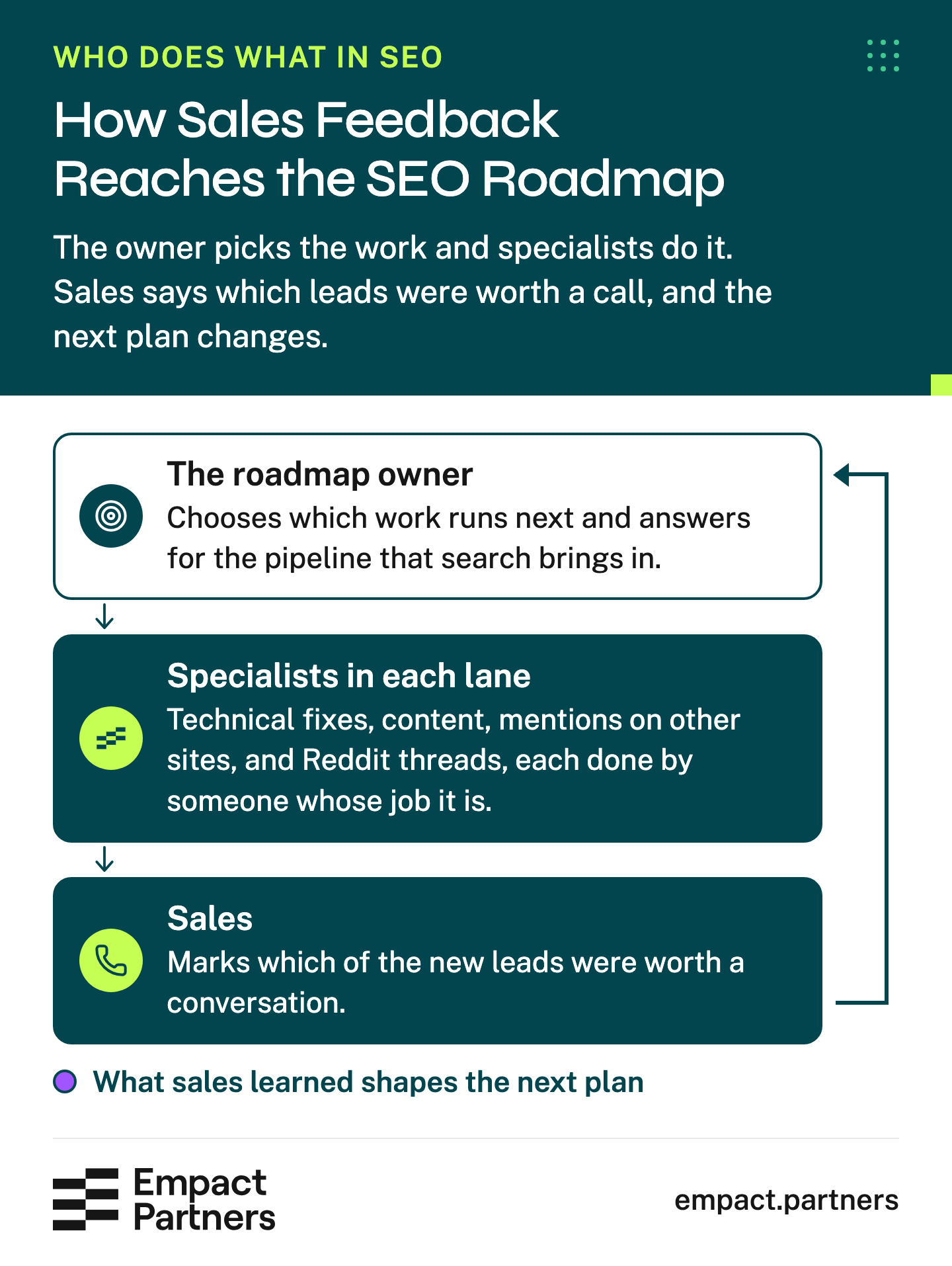
You can do the first part of this before the week is out. Write down who owns the roadmap and which pipeline number they answer for. Running four lanes well is the slow part. It takes quarters, and people whose job each lane is, which is where a single hire runs out of hours.
If the owner you need sits outside your company, Empact Partners takes that role. Every partnership starts with an audit, and the roadmap we write from it picks the two or three lanes to run first. This is what you get with it:
- A named senior GTM consultant who is responsible for the roadmap and joins your calls
- Specialists in technical SEO, content, mentions, and Reddit as each lane begins
- Work that happens in your own channels, at the pace your team sets
- A standing report on search visibility, AI citations, Reddit, and content, with a first step beside every recommendation
The horizon is quarters. Search work compounds, so a plan judged after six weeks is judged before most of it could move. The playbook below shows how to spread a search budget across Google and AI answers and count every lead once. It is the plan any roadmap owner should be able to defend:
So the first hire is the person who can explain the next decision and will answer for the pipeline number. Name that person before you write any other SEO job post. Everyone else on the work, in-house or outside, is there to carry out their decisions.
Frequently Asked Questions
Can our marketing lead own SEO?
Yes, if they can choose between the four lanes and will answer for a pipeline number from search. It is the job they already do for paid search: decide where the effort goes and answer for what it brings.
What they usually lack is time and specialists. Give them the decision rights and a budget for the hands, and don’t pile SEO execution on top of a full job. If they would rather not own it, find out before a role is shaped around them.
When is one in-house SEO hire enough?
When the owner already exists and one lane is the bottleneck. A company whose marketing lead owns the roadmap can do well with one strong specialist, as long as the site mostly needs technical fixes and content.
It stops being enough when mentions and Reddit join the plan. Each needs its own hours and relationships, and a single hire ends up working on whichever lane is loudest that month.
Should the first SEO hire be a player-coach or a manager?
For a small team, a player-coach who can do one lane well and choose between all four. A pure manager with nobody to manage spends the first months writing plans nobody carries out.
As the team grows, move them toward choosing and reviewing, and hire specialists for the lanes they were covering. In the interview, ask which lane they would keep doing themselves and why.
Should an outside SEO team or an in-house hire run our SEO?
The label doesn’t settle it. Ask who will decide what runs each quarter and who answers for the pipeline number. An outside team that executes a brief well is a good choice when someone on your side owns the roadmap.
An in-house hire is a good choice when the role carries decision rights and a budget for specialists. Pick whichever arrangement gives the roadmap a named owner you can hold to a number.
Can a freelance SEO consultant own our roadmap?
Yes, if they have the time and the authority. One experienced person can make the decisions and run the reviews with sales. Ask how many hours a month they will give you, and who does the work they choose.
A freelancer who owns the roadmap still needs hands for the four lanes, either your own people or specialists they bring in. Agree that before the first month, so the roadmap doesn’t shrink to what one person can do alone.
How soon can we judge whether the new owner is working?
Judge the decisions in the first quarter and the results after that. In that first quarter, check that a written roadmap exists, that each lane has someone doing it, and that every report ends on a first step.
Traffic and leads take longer, because search work compounds over several quarters. Write down the review dates and the number at the start. Then nobody can quietly change what counts as success.
What should a monthly SEO report show?
What changed, what it was worth, and what happens next. Rankings and traffic belong in it, beside the leads organic search brought and what sales made of them.
Each recommendation should name its first step and who takes it. A report that shows only rankings proves the work happened. It can’t tell you whether to keep paying for it.
Who should own AI search visibility?
The person who owns the SEO roadmap. Whether ChatGPT, Google AI Mode, and Claude name you depends on your own pages, the listicles and articles those answers cite, and Reddit threads. Those are the same four lanes.
A second team for AI search gives you two roadmaps competing for the same pages. Treat any visibility score the way you treat traffic, and ask how a visibility proposal’s numbers were made before you trust it.
What should we keep in-house if the owner is outside?
Product knowledge and the final word on what is true about your product. Your experts should review every piece, your sales team should judge lead quality, and someone senior on your side should agree the roadmap each quarter.
Writing can sit on either side. A content writer you hire can work inside an outside owner’s roadmap, as long as the split of pieces is written down.
How should sales take part in SEO?
Keyword research tells you what buyers search for. Sales tells you which of the leads that search brought were any good, and which ones the company can’t serve.
Once a month, ask sales to mark each lead from organic search as worth a conversation or the wrong buyer. Hand those marks to the roadmap owner before the next plan is written. A plan drifts when nobody outside marketing tells its owner which pages brought the right people.
Is it a bad sign if an SEO partner won’t guarantee rankings?
No, it’s a good one. Nobody controls how Google or the AI engines rank and cite pages, so an honest partner promises the work and the measures instead.
Ask for a written roadmap, named people, the number they will report on, and the date you will review it together. A partner who can show you a result with its start, end, timeframe, and how is offering more than any guarantee.
Sources (1)
- Semrush, "What 3,900 SEO Job Listings Reveal for 2026: Experiments, AI, and Six-Figure Salaries" (2026)↩130 March 2026. 3,900 SEO job listings on Indeed.com (US) as of 25 November 2025. Read 19 November 2026.
Keep reading
SEO How Should a SaaS Company Split Its SEO Budget?
Decide what your SaaS search budget should fund first: website fixes, relevant mentions, community work or better measurement.
SEO Who Should Own AI Search When You Already Run SEO
Already run SEO? Keep AI search under the same owner and report each AI engine apart. What 500 buyer questions show, and when to hire.
SEO Organic Traffic Dropping? Check Pipeline Before Blaming AI Search
Find which pages lost clicks, whether qualified leads fell, and what to check before changing your SaaS content budget.