


Probably both. The content-writer job post has been open for six weeks, the two finalists both write well, and you still suspect that whichever one you hire, the blog will keep publishing every week and keep producing almost nothing. The suspicion is right, and it has nothing to do with either candidate.
Empact Partners, the go-to-market consultancy I founded in 2020, works inside B2B software companies as an extension of their own marketing teams, and many of those companies chose us instead of hiring a full-time marketer. So we sell one side of this decision, and you should read the rest knowing that.
The order matters more than the choice, and it turns on a question the job post never asks: who owns the jobs that sit beside the writing?
A Writer Owns the Words, and Results Depend on Four Jobs Beside Them
A content writer is hired to own the draft, the voice, and the cadence. A good one owns all three well, and the best bring ideas of their own. What the role rarely covers is the work around the words, because none of it is writing, and none of it gets better when the writing does.
Across the software companies we work with, one in-house hire usually covers one function. The jobs that decide whether a published piece produces anything sit outside it:
The fourth is the job most posts never list, and our own data shows how much rides on it. In the September answers our panel collected, when Google AI Mode named a software vendor, the vendor’s own site was among the sources in 23.2% of those mentions, against 51.5% on ChatGPT.
So three AI Mode answers in four stood on pages the vendor did not write, and the vendor’s own writer had no hand in any of them.
Hire, Freelance Writer, or Consultancy: What Each One Covers
Put the three ways of filling a content seat side by side, and one row settles most cases: who owns the four jobs. The other rows decide how the arrangement feels to run.
| Full-time content writer | Freelance writer | Content consultancy | |
|---|---|---|---|
| What it covers | Drafting, voice, and cadence, inside one company | Drafting, piece by piece, from your brief | The function: strategy, the roadmap, writing, distribution, conversion, and the off-page work |
| Who decides what gets published | You, while the hire learns to | You | The consultancy with you, from an audit and a roadmap |
| The four jobs beside the writing | Only if you hire for each one, or find a rare generalist | Out of scope | Specialists per workstream, sequenced by one roadmap |
| Context on your product | Deep once ramped, on one company | Thin unless you supply it with every brief | Deep on yours, plus the patterns from every other partnership |
| Ramp | Months to recruit, then months to learn the product | Days to start, with the context carried in each brief | Weeks for the audit and the roadmap, then a specialist learns the product |
| Flexibility | Fixed headcount; a new scope means a new hire | Per piece, easy to start and stop | Effort moves between workstreams as the roadmap changes |
| Cost shape | A salary line, plus recruiting, tools, and benefits | Per piece or per hour | One partnership covering several jobs |
| Your time | Managing, briefing, and review | A brief and an edit on every piece | A weekly sync, the monthly report, your experts in review |
| If the person leaves | The seat reopens and the context leaves with them | You brief the next writer from zero | The specialist changes; the roadmap, the history, and the team stay |
| Best when | Strategy and distribution already work and the plan needs more hands | You need specific pieces against a plan you own | Content is not producing pipeline yet, or nobody owns the jobs beside the writing |

.png)
The row most readers skip is context. A hire learns one company, and gets very good at it. A consultancy learns yours and keeps learning from every other partnership it runs, and that second kind of learning is where its speed comes from.
A Consultancy Moves Faster Because It Learns From Every Partnership
An in-house marketer sees one product and one set of mistakes. We see the same problems from inside many software companies at once, in different categories and at different stages, so a method that worked for one partner reaches the next while it is still working. That transfer is deliberate, and it runs through two channels:
The other speed is depth. We give each partner one dedicated specialist with hands-on access to the product, paid tiers included, so they become the expert on it and get faster every month instead of needing the business explained again. It is the part outside writers skip most often, and buyers notice.
What founders and buyers say on Reddit
“The writers clearly did desk research, read our website, maybe skimmed a competitor page. Nobody ever asked to talk to our engineers or sit in on a sales call.” — r/content_marketing, Apr 2026
“Founders assume most hires just need functional expertise to do their job. What they really need is context.” — r/startups, Jul 2026
Both point at the same missing input. A hire arrives with the skill and without the context, and a writer kept outside the company never collects it. An embedded specialist is there to collect it, and that is the line between filling a gap and taking a function.
Empact Partners Takes the Whole Content Function
Empact Partners is not an agency, and the difference is scope rather than branding. We take the whole content function, from deciding what gets published to whether it turns into pipeline, and we answer for the outcome as well as the output.
Scope is also why we call the companies we work with partners, without exception. We are building something that pays them back in year three, and a word for a purchase would describe the wrong relationship.
.png)
In practice, the first deliverable is an audit and a roadmap, and the content calendar comes out of them. One senior consultant, named from day one, owns the partnership and joins your calls, with specialists per workstream, so whoever writes about your product is not also running your outreach. What lands first, in order:
- The audit. What you have published, what your buyers ask the engines, and who already gets named in your category.
- The roadmap. Which workstreams start, in what order, and what each one should move.
- The first work. The first pieces and the first outreach, shipped in your own channels, with a monthly report that carries a first step on every recommendation.
All of this is the Content Marketing workstream, which for us means building a SaaS publication instead of a blog, made of original insight, named experts, and tutorials only your product could support. Two or three workstreams usually move together, because the content gives the outreach something to point at and the outreach gets the content read.
Where the four jobs need other hands, Content Marketing hands off to SEO, which we read as Search Everywhere Optimization because buyers now search Google, the AI engines, and the communities those engines cite, and to Generative Engine Optimization (GEO), the work of becoming the brand AI engines name.
The writing itself is AI-native, the way this publication is made: the models draft, and a named consultant decides what each piece argues, adds what happened on real partnerships, and approves it before it ships.
Hire the Writer When the Engine Already Works, and Run Both When It Does Not
None of that makes a hire the wrong call. Hire the writer when the engine already runs: if you can name who owns strategy, distribution, conversion, and measurement, and the bottleneck is that the plan needs more pages than the team can write, a full-time writer is the plainest way to add hands, and they get better at your product every month.
A senior content lead who sets the strategy and runs freelancers for the writing is the other hire, and it carries more than the words. That is a different job post from “content writer” and a harder one to fill, but it is the in-house way to own the function.
Where there is no marketing function yet, a consultancy can stand in for that first hire, covering several jobs at once instead of asking one person to learn all of them alone.
For everyone between those cases the shape is both, and it is what several of our published partnerships look like:
When both run, the consultancy owns the roadmap, search intent, distribution, the off-page work, and the monthly read of what moved. The hire owns the product context, the drafts that need it most, and review by your own experts, the one input no outside team can supply. It is all built in your channels, so it stays yours.
What It Costs Is Shape and Horizon
We never publish fees, so here is the cost in the terms that decide it. A hire is one salary line covering one function, plus months to recruit and months to learn your product. A consultancy is one partnership covering several jobs, with momentum in quarters and an engine worth more in year three than in year one.
Every column also costs your own time. A hire needs managing, a freelancer needs a brief for every piece, and a consultancy needs a weekly sync and your experts in review. To compare quotes honestly, price every option against the same list of jobs, the four beside the writing included, rather than against a job title.
The horizon is the part buyers underestimate, and our own published results show how long it runs.
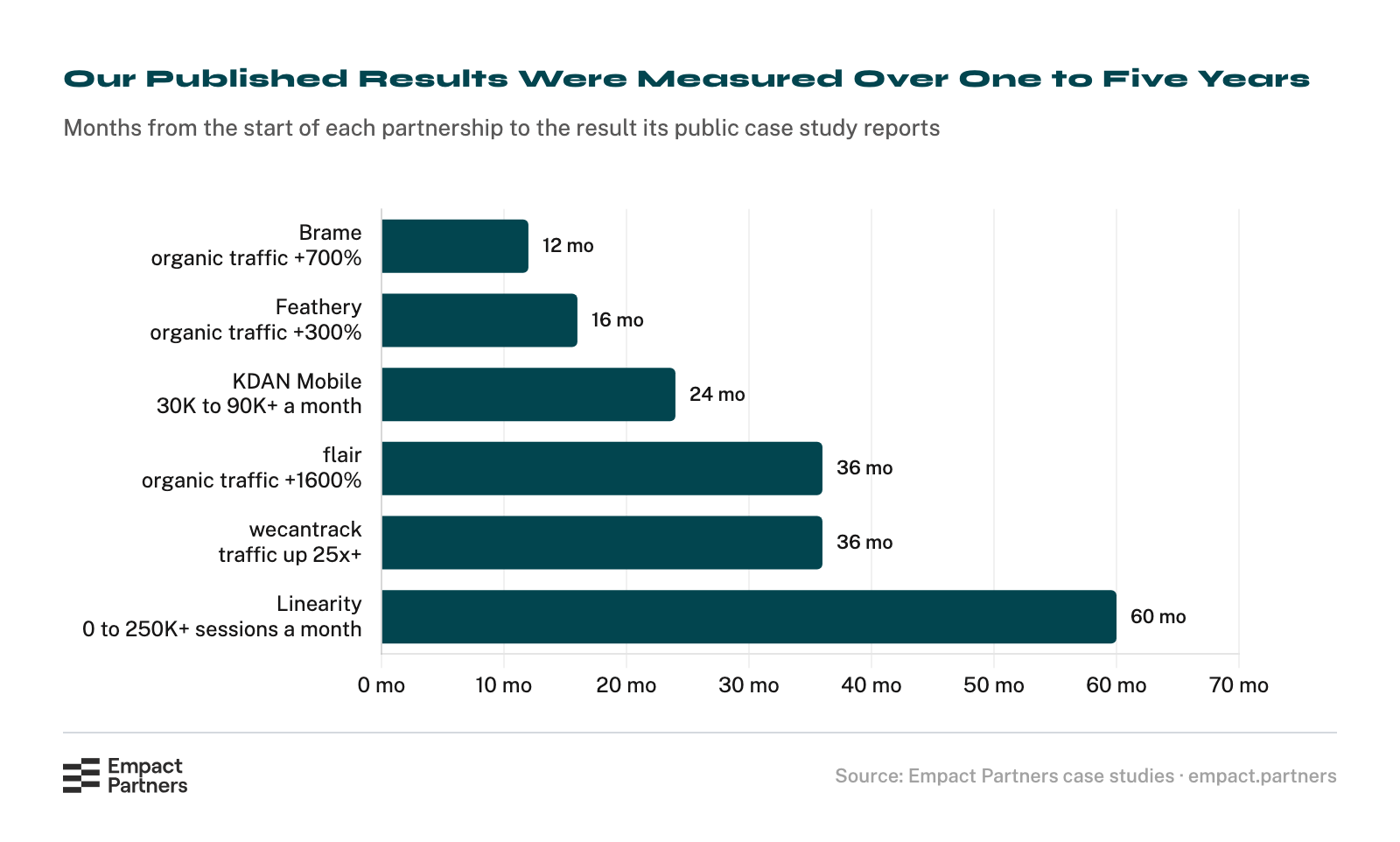
Every result took one to five years to measure, and the largest sit at the long end: wecantrack’s monthly traffic grew more than 25x in three years, flair’s organic traffic 1600% in three. That is compounding, and it is also survivorship, because a partnership that was not working never reached year three. Plan for the horizon the chart shows.
The direction shows much earlier. Brame’s organic traffic rose over 40% after two months of publishing, and its traffic and inbound pipeline grew 700% within the first year. So judge any of the three options on direction in the first quarter and on size in year two or three, and ask for the pipeline the content touched rather than the sessions.
Score Your Team Before You Post the Job
Run this before the job post goes live. Write a name beside each job, the person who owns it today, and leave the line blank where nobody does:
- Strategy. Who decides what gets published next quarter, and would two people on the team give the same reason?
- Search intent. Who knows what your buyers type into Google and ask ChatGPT before they shortlist?
- Writing. Who drafts, and how many pieces a month can they ship at the standard your buyers expect?
- Product context and review. Who gives the writer the product and the engineers, and who catches what only an expert would?
- Distribution. Who gets each piece in front of people after it goes live?
- Conversion. Who owns the path from a reader to a lead, from the offer on the page to the route into your CRM?
- Being named elsewhere. Who works on the roundups, reviews, and threads the AI engines read before your site?
- Measurement. Who reports qualified demand and the pipeline content touched, rather than sessions?
Then read the blanks:
Most teams land in between, with two or three blanks, and that is the case for both. That scorecard is also the first page of the audit we open every partnership with, so I am recommending what we sell. Run it yourself first, and if every line already has a name, you need a writer more than you need us.
Where the lines stay blank, Empact Partners puts a senior consultant on your calls from the audit onward, adds specialists for the jobs your team cannot staff, and gives any hire you make a roadmap to work from instead of a blank page.
If your blog publishes every week and the next decision is whether to hire, grab a time on my calendar, and we will work out together whether we are a fit.


