47 Keyword Search Volume Accuracy Statistics
47 figures on how far keyword volumes stray from Google’s own count, and how much search demand sits below them, measured on our site.
 Teddy CipollaWith
 Vlad Shvets
On this page
- Highlights
- How Far Keyword Tools Stray From Search Console
- Why a Volume Number Describes Last Year
- Most Queries Are Too Rare to Count
- What a Keyword Tool Says About the Searches That Reached Us
- Searches Behind AI Answers Rarely Have a Volume
- How a Topic Earns a Slot Without a Volume Number
- Frequently Asked Questions
Empact Newsletter
One email a month on what is working in AI search and SaaS go-to-market.
You paste the question your best buyer asked on last week’s sales call into a keyword tool, word for word, and it comes back with a zero. The planning meeting reads the zero as “nobody searches for this” and moves on. But rare is not the same as nobody. On our own site, 80% of the clicks our articles earned in the past year came from searches so rare that Google’s Search Console would not tell us what they were.1
The column is shaky at the top too. When Ahrefs checked 72,635 keywords against Search Console, Google Keyword Planner put 91.45% of them above Google’s own count.2 So a volume number misleads in both directions. It runs high on keywords with thousands of searches a month, and it goes blank on many of the longer questions buyers type. The figures below measure both failures.
Highlights
- 91.45% of Keyword Planner volumes ran higher than Search Console’s count for the same keywords, and 45.22% landed within half of it.2
- 32.39% of keywords were closest to Google’s count in Semrush, the best of seven tools in Semrush’s own study.3
- 15% of Google searches each day are ones Google has never seen before.4
- Almost 93% of keywords in Ahrefs’ U.S. database get fewer than 10 searches a month.5
- 80% of the clicks our Empact Zone articles earned came from searches Search Console withholds as too rare to show.1
- 46% of the topic queries that brought our site the most impressions have no Google Ads volume, and 62% of those eight to ten words long have none.6
Read together, the numbers say a volume column is a rough guide to how often people searched, last year, for phrases many people share. Many B2B buyer questions are new, long or rare, and a plan that drops every question showing a zero drops those questions with it.
Search volume is the column Empact Partners sorts last, and the figures below, our own site’s included, are why. We do SEO for SaaS companies, getting them found in Google, ChatGPT, Google AI Mode and Claude by buyers ready to choose a product.
How Far Keyword Tools Stray From Search Console
The vendor studies here grade volumes against Google Search Console, because Search Console counts how often a site’s page appeared for a query. Ahrefs ran a public test in 2021, on 72,635 random keywords with between 1,000 and 10,000 monthly searches. Against Search Console’s count for the same month, Keyword Planner’s figures came out like this:
- 91.45% were higher than Google’s count, and 8.55% lower.2
- 45.22% landed within 50% of Google’s count either way, which Ahrefs calls roughly accurate.2
- 54.28% overstated it by more than half.2
- 14.80% were four times Google’s count or more, often regional keywords like “golf courses”, where one national figure stands for searches each town sees separately.2
So on keywords with 1,000 to 10,000 monthly searches, Google’s own planning tool was right within a wide margin less than half the time, and when it missed, it almost always missed high. A plan that adds up Keyword Planner volumes to forecast traffic starts from a total that is probably too big.
Ahrefs scored its own tool on the same keywords, and it did better:
Keyword Planner and Ahrefs Against Search Console
Ahrefs study, 2021: 72,635 keywords with 1,000 to 10,000 monthly searches
too low0.5%1.84%
either way45.22%60.68%
too high54.28%37.48%
View the data
| Label | Keyword Planner | Ahrefs |
|---|---|---|
| More than half too low | 0.5% | 1.84% |
| Within half either way | 45.22% | 60.68% |
| More than half too high | 54.28% | 37.48% |
Ahrefs landed within half of Google’s count on 60.68% of keywords, against 45.22% for Keyword Planner, and overstated 37.48% of them by more than half.2 Ahrefs puts most of the gap down to separating keywords that Keyword Planner groups together. Even the better score leaves about four keywords in ten off by more than half, on keywords thousands of people search every month.
Semrush ran its own comparison over late 2021 and early 2022, on U.S. keywords, and measured how often each of seven tools came closest to Search Console:
Which Tool Came Closest to Search Console
Share of U.S. keywords where each tool was closest, Semrush's own study, 2021 to 2022
View the data
| Label | Value |
|---|---|
| Semrush | 32.39% |
| Keyword Planner | 26.35% |
| Moz | 24.29% |
| Sistrix | 22.74% |
| Mangools | 20.65% |
| Ahrefs | 20.51% |
| Serpstat | 15.65% |
Semrush came first, closest on 32.39% of keywords, with Keyword Planner second at 26.35% and Ahrefs sixth at 20.51%.3 Set the two studies side by side and each test ranks the vendor that ran it ahead of its rivals, so read each one as a vendor scoring its own tool on its own measure.
Ahrefs’ own description is the most useful line in either. Its volumes are built to be “directionally accurate”, a guide to whether one keyword gets a lot more searches than another, and never the real number.7
The volume column is good for one job: comparing two topics a team is choosing between. If one shows far more searches than the other, it is probably the bigger topic. Whether either deserves an article is a separate question, and the column was never built to answer it.
 Teddy Cipolla on LinkedInOpens in a new tab
If the number is that rough on keywords thousands of people search, the next question is what it does with a phrase nobody searched last year.
Why a Volume Number Describes Last Year
Every volume figure is made from searches that already happened. Semrush divides the total searches of the past 12 months by 12 and refreshes the result once a month. It models those searches from third-party data laid over historical clickstream data (records of which pages people visit and what they search).8 Keyword Planner reports an average for a keyword and its close variants, and rounds it.9
Moz measured how often that kind of average fits the month at hand. When Moz studied Keyword Planner in 2016, it found the average monthly figure sat in the right volume band in only 33% of months for most keywords.10 In the same analysis, a keyword that was taking off looked like a twelfth of its real volume in that average, and a brand-new one did not show up for 30 days.10
So the number on your screen is a smoothed history, and each source smooths a different one:
Scroll horizontally to see all columns when the table is wider than this page.
| Number | What it counts | What it misses |
|---|---|---|
| Keyword Planner volume | Searches for a keyword and its close variants, averaged over a year and rounded | New phrasings, and the gap between one variant and the next |
| A keyword tool’s volume | A model of the past year’s searches, built from third-party and clickstream data | Phrases too rare to enter its database |
| Search Console impressions | Times your page appeared in Google for a query | Searches where your page did not appear, and the wording of rare queries |
Google’s own figure puts a size on what a backward-looking average cannot see:
of Google searches each day are new to Google
Fifteen percent of Google’s searches every day are phrasings it has never seen before.4 No tool has a history for those exact phrasings, so at best they sit folded into a close variant someone typed before.
Our own Search Console gives a smaller, different measure: the queries our site meets for the first time. On the median day between August and October 2026, about 1 in 10 of the listed queries that brought us an impression had not brought one at any point since November 2025.1 Our site is growing, which adds new queries too, so read that as our number and the 15% as Google’s.
Keyword Planner’s own description shows why a new wording comes up empty there, even when buyers type it:
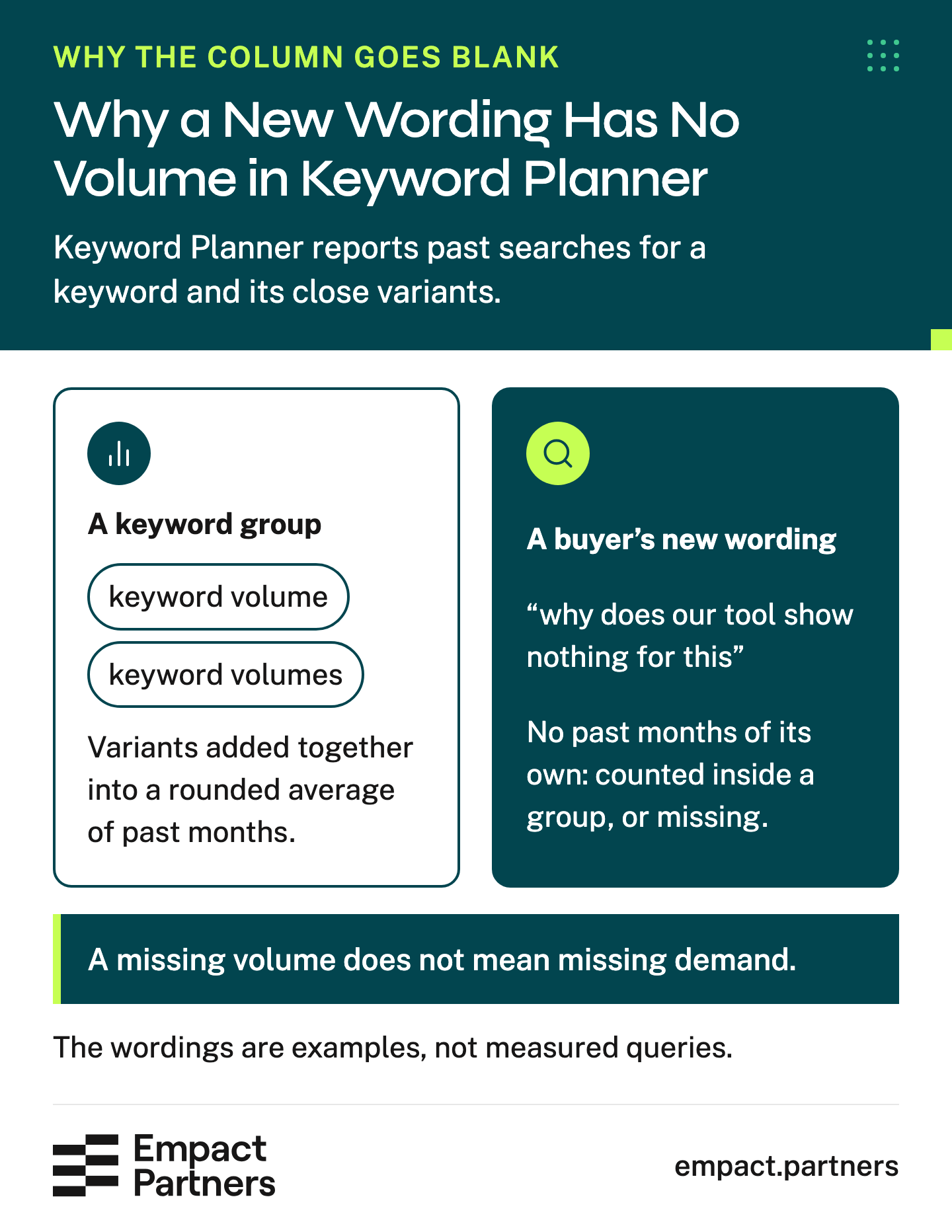
A buyer’s question can matter to a sale even when its exact wording has no reported volume. A team that drops every topic under a volume floor drops those questions until enough people have typed them the same way, and many never get there. Rarity is the other gap, and it is wide.
Most Queries Are Too Rare to Count
Ahrefs published the shape of its own U.S. keyword database in May 2026. Of the keywords it tracks:
- 17,730 keywords get more than 100,000 searches a month.5
- 2.3 billion keywords get fewer than 10.5
- Almost 93% of the database sits in that under-10 band.5
So in one of the largest keyword databases a marketer can pay for, more than nine keywords in ten get fewer than 10 searches a month. Across all its markets, Ahrefs keeps 28.7 billion keywords of the more than 110 billion it has found, because the rest draw too little interest to track.5 The database is mostly made of that thin band, and the 17,730 big keywords are the rare exception.
Google draws its own line at the bottom of that tail, and it decides what you can see in your reports:
We measured that gap on our own site, empact.partners, for the 12 months to the end of October 2026:
- 61.1% of impressions came from anonymized queries.1
- 46.5% of clicks did, across the whole site.1
- 80% of the clicks to our Empact Zone articles did.1
The site figure is lower because searches for our name, and for the companies on our case study and ventures pages, are common enough to show, and they land outside the articles. The articles are where topic searches land, and four clicks in five came from queries too rare for Google to name:
Our Search Traffic From Queries Search Console Won’t Name
empact.partners, 1 Nov 2025 to 31 Oct 2026, share from anonymized queries
View the data
| Label | Value |
|---|---|
| All impressions | 61.1% |
| All clicks | 46.5% |
| Clicks to our articles | 80.1% |
The queries Search Console does show tell the same story from the other side. We grouped our visible topic queries by how many impressions each one brought in the whole year:
Our Listed Queries and Their Clicks, by Impressions
empact.partners, non-brand queries Search Console lists, 1 Nov 2025 to 31 Oct 2026
impressions77%5%
impressions18%11%
impressions5%84%
View the data
| Label | Share of queries | Share of listed clicks |
|---|---|---|
| 10 or fewer impressions | 77% | 5% |
| 11 to 100 impressions | 18% | 11% |
| More than 100 impressions | 5% | 84% |
Most of them are rare. 77% of queries brought 10 or fewer impressions all year, and those queries carried 5% of the listed clicks, while the 5% seen more than 100 times carried 84%.1 Almost half of all listed queries, 45%, showed up on a single day.1
That split is the honest case for paying attention to common searches. The listed clicks gather on searches common enough to show up, and the rare ones only add up once you stop reading them one at a time.
Search Console named the searches behind only a fifth of the clicks to our articles.
So what does a keyword tool say about the searches we can see?
What a Keyword Tool Says About the Searches That Reached Us
We took the 1,000 topic queries with the most impressions on our site over the same 12 months and asked Google Ads for their average monthly searches in those months, worldwide. Brand searches and scripted prompts were left out, and so were searches for other companies that land on our ventures and case study pages. What came back:
- 46% had no volume at all.6
- 40 searches a month was the median for the queries that had one.6
- 1 in 20 of the no-volume queries averaged 10 or more impressions a month on our site alone.6
Almost half the queries in the sample came back with no reported volume, and the half that had one mostly sat at a few dozen searches a month. Our impressions only count searches where our page appeared, so they are a floor on real demand. For one zero in twenty, that floor alone sits at or above 10 a month, the lowest volume any query in our sample was given.
Longer queries come back blank more often:
Topic Queries With No Google Ads Volume, by Length
The 1,000 topic queries with most impressions on empact.partners, Nov 2025 to Oct 2026
View the data
| Label | Value |
|---|---|
| 1 to 2 words | 18.5% |
| 3 to 4 words | 46.6% |
| 5 to 7 words | 45.3% |
| 8 to 10 words | 62% |
One- and two-word queries had no volume 18.5% of the time, and queries of eight to ten words 62% of the time.6 Anything longer cannot be checked in Keyword Planner at all, because it takes at most 10 words and 80 characters,12 and 9.4% of the queries that reached us ran past 10 words.1 A buyer who types the whole problem into Google in more than 10 words is a buyer Keyword Planner cannot see.
One finding runs the other way, and it matters for how you use the rest. Of the 60 visible queries in the sample that earned a click, 56 of 60 had a volume, and the no-volume queries took 26% of the impressions but 3% of the visible clicks.6
So the clicks you can trace to a named query still gather on phrases a tool knows. The clicks no tool can help with are the anonymized ones: nobody can trace them to a phrase, so nobody can look up their volume either. You cannot chase them keyword by keyword, only write the topic well enough to catch them.
A zero on a buyer’s question tells you the tool has no figure for that wording. It does not tell you nobody asks. Most clicks to our own articles came from searches too rare to be named, so the topic a question belongs to is what deserves the plan, and a good page catches the variations.
Teddy Cipolla on LinkedInOpens in a new tabAI search makes the questions longer again.
Searches Behind AI Answers Rarely Have a Volume
Google says the average query in AI Mode, its conversational search, is triple the length of a classic Google search, and that AI Mode queries have more than doubled every quarter since the U.S. launch.13 In our own lookup, longer queries came back without a volume more often.
The engines then run their own background searches, called fan-out queries, to answer each one. Seer Interactive, a search marketing company, pulled the fan-out queries Gemini 3 ran for 100 questions about Seer, twice a day for a week:
- 8.52 fan-out queries ran for each question, on average.14
- 99% of the 11,029 different fan-out queries had no search volume.14
- Only 8 of 11,029 came up in all 13 runs.14
So the searches Gemini ran for Seer’s questions changed from run to run, and almost none of them had a reported volume. Ahrefs, which sells that database, says the same of its own coverage: most fan-out queries do not make the cut.5
Our own Search Console shows a related pattern, though nobody can say where it comes from. 1.6% of non-brand queries we could see read like instructions to a machine (“list only real, existing brands … no explanations”), and none earned a click.1 Search Console cannot tell a person from a tool running questions through Google, which is one more reason to read long queries for their topic and not their count.
If no number can see these questions, a plan needs another way to decide which ones earn an article.
How a Topic Earns a Slot Without a Volume Number
Start from what a page earns. In Ahrefs’ 2017 study of 3 million searches, the average page ranking first for a keyword also ranked in the top 10 for nearly 1,000 other keywords, with a median around 400.15 Traffic comes from a topic and its hundreds of phrasings. The useful question is whether the topic is right, and one phrasing’s volume says little about that.
Before a topic gets a slot in your plan, run it past these checks:
- A buyer asks it, in sales calls, demos or support tickets, in words you could quote
- Your product answers it, so the reader’s next step from the page leads to you
- AI can’t already answer it well, or you have a narrower version it can’t
- You can add something new: a case, a data point or an angle the ranking pages lack
- Related queries show up in Search Console already, a useful sign wherever the topic is not brand new
Volume comes after those, as a way to compare the topics that passed.
When we build a partner’s topic plan, the work starts with an audit and a roadmap. We rank each candidate by the buyer’s intent and its fit with the product above its volume, and read every volume as the estimate it is. We skip a topic an AI assistant already answers, unless we can go narrower or add a case, a data point or an angle. A topic that shows no volume still gets written when it is how a buyer with intent searches.
If you want that first pass on your own site, our Keyword Opportunity Report gives you 30 keywords within reach, each judged for intent, with the type of page to build for each. We run the full agent for partners, and this run is a free preview:
The report finds candidates. Choosing which of them make next quarter is a planning job, and a team without a written rule falls back on the volume column. Our playbook walks a team through that choice, to a quarterly shortlist with a useful page and a business reason for each:
Keep the volume column in your plan for the topics that pass. Compare them with it, and watch it for a phrase that starts to climb. Just don’t let a zero take a buyer’s question off the plan, because on our own site most article clicks came from searches too rare for Search Console to name.
Frequently Asked Questions
How accurate is keyword search volume?
Search volume is accurate enough to compare two keywords and too rough to forecast traffic from. In Ahrefs’ 2021 test of keywords with 1,000 to 10,000 monthly searches, Google Keyword Planner came within 50% of Search Console’s count on 45.22% of them, and Ahrefs’ own figures on 60.68%.
Accuracy drops further on regional keywords, where one national figure stands for many local result pages, and on anything rare, where tools have little data to model from. The 2021 sample also left out the long tail entirely, so it says nothing about how close any tool gets there.
Which keyword tool has the most accurate search volume?
Each vendor’s study names itself. Ahrefs’ test put Ahrefs ahead of Keyword Planner, and Semrush’s test of seven tools put Semrush first, closest to Search Console on 32.39% of U.S. keywords. Treat any accuracy claim from a vendor as a claim about its own sample, and pick a tool for its data on your market and its workflow, since in Semrush’s test even the winner was closest on under a third of keywords.
Are Search Console impressions the same as search volume?
No. An impression counts a search only when your page appeared in the results, so it depends on where you rank, in which country and on which device.
Impressions are a floor on real searches for a query you rank on page one for, and a poor guide for one where you sit on page three. Search Console also hides the wording of rare queries, though their impressions still count in your totals. Impressions can be padded by rank-tracking tools that run searches automatically, though Ahrefs found that kind of padding rare in its 2021 test.
Does zero search volume mean nobody searches for a keyword?
No. A zero means the tool has no reported volume for that wording, which is not the same as no searches, and it often happens because a phrasing is new, long or worded a dozen ways. In our own lookup, 46% of the topic queries that brought our site impressions had no Google Ads volume, and one in twenty of those zeros averaged 10 or more impressions a month on our site alone.
Should you write content for zero-volume keywords?
Write for zero-volume topics when a buyer with intent asks them and your product answers them, and when you can add a case or a data point other pages lack. Skip them when they are only a rewording of a topic you already cover, or when an AI assistant already gives a full answer. The page’s traffic comes from the whole topic, so one phrasing’s zero matters little.
How do you find topics a keyword tool shows as zero?
Start where buyers already speak: sales call notes, demo questions, support tickets and the communities they read. Then open Search Console and look for queries bringing impressions to pages you never wrote for them, because those are questions Google already connects to your site. Group the phrasings by the problem they describe and write one page per problem, never one per phrasing.
Why do keyword tools show different volumes for the same keyword?
The tools count different things. Keyword Planner groups close variants and rounds a yearly average into broad bands. Third-party tools model volume from their own mix of clickstream data and Google’s figures, then split or merge variants in their own way. Each refreshes on its own schedule, so a rising or seasonal keyword can look very different from one tool to the next in the same month.
How many Google searches are new every day?
Google says fifteen percent of the searches it sees each day are ones it has never seen before. No tool has a history for those exact phrasings, because every tool’s figure is built from past searches. On our own site, on the median day of August to October 2026, about one in ten listed queries had not brought us an impression at any point since November 2025.
Why can’t I see most of my search queries in Search Console?
Search Console withholds queries that fewer than a few dozen people searched over two to three months, to protect their privacy, though their clicks still count in your totals. On a B2B site that can be most of the traffic: on ours it was 61.1% of impressions over a year, and 80% of the clicks to our articles. Compare your totals with the sum of listed queries to see your own share.
Do AI search prompts have search volume?
Nobody publishes how many typed AI prompts match a keyword with volume. Google reports that AI Mode queries are about three times longer than classic searches, and in our own data longer queries came back blank more often.
The searches the engines run behind each answer are easier to judge. In Seer Interactive’s run on Gemini 3, 99% of 11,029 fan-out queries had no search volume, and only eight of them came up every time. Track the buyer questions themselves, and the pages the answers cite, instead of hunting for a search volume that will not appear.
How should I report on content written for low-volume topics?
Report by topic and page, never by target keyword. Track the impressions and clicks each page earns across all its queries, including the anonymized share, and ask every new lead how they found you, since a page can bring a buyer without a click Search Console can name. Give such pages months before judging them, because rare queries add up slowly.
Sources (15)
- Empact Partners, "our own Google Search Console for empact.partners" (2025)Empact Partners' own data↩1↩2↩3↩4↩5↩6↩7↩8↩9↩10↩11↩12web search, final data, 1 November 2025 to 31 October 2026, every visible query by day, page totals and page-by-query rows compared with property totals; brand queries and scripted prompts set apart. Read 24 November 2026.
- Ahrefs, Tim Soulo, "GSC vs. GKP: Comparing Search Volumes for 72k Keywords" (2021)↩1↩2↩3↩4↩5↩6↩7↩83 November 2021, updated 18 March 2024, 72,635 random keywords with 1,000 to 10,000 monthly searches. Read 24 November 2026.
- Semrush, "Volume Update! Why Semrush Search Volume Is the Most Accurate on the Market (Study)" (2022)↩1↩2↩322 June 2022, U.S. keywords, study run Q4 2021 to Q1 2022. Read 24 November 2026.
- Google, "Our Approach" (2026)↩1↩2↩3How Google Search Works. Read 24 November 2026.
- Ahrefs, "Long-tail Keywords: What They Are and How to Get Search Traffic From Them" (2026)↩1↩2↩3↩4↩5↩6updated 27 May 2026, Ahrefs’ U.S. keyword database. Read 24 November 2026.
- Empact Partners, "our own volume lookup" (2025)Empact Partners' own data↩1↩2↩3↩4↩5↩6↩7the 1,000 non-brand topic queries with the most impressions in our Search Console (1 November 2025 to 31 October 2026) against Google Ads average monthly searches for the same months, worldwide, through DataForSEO. Run 24 November 2026.
- Ahrefs, Tim Soulo, "There’s No Such Thing as ‘Accurate’ Search Volume" (2024)↩118 March 2024, updated 12 August 2026. Read 24 November 2026.
- Semrush Knowledge Base, "What is Search Volume in Semrush?" (2026)↩1Read 24 November 2026.
- Google Ads Help, "About Keyword Planner forecasts" (2026)↩1Read 24 November 2026.
- Moz, Russ Jones, "Sweating the Details: Rethinking Google Keyword Tool Volume" (2016)↩1↩217 May 2016. Read 24 November 2026.
- Google Search Central Blog, "post on Search Console performance data filtering and limits, October 2022" (2022)↩1Read 24 November 2026.
- Google Ads Help, "Use Keyword Planner" (2026)↩1character and word limits for keywords. Read 24 November 2026.
- Google, "How AI Mode is changing and expanding the way people search" (2026)↩1The Keyword, 19 May 2026. Read 24 November 2026.
- Seer Interactive, "Identifying Signal from Noise" (2026)↩1↩2↩3on query fan-outs and AI search strategy, 27 January 2026, 100 prompts run 13 times on Gemini 3. Read 24 November 2026.
- Ahrefs, "How many keywords can you rank for with one page? (Ahrefs’ study of 3M searches)" (2017)↩18 May 2017, updated 24 August 2026. Read 24 November 2026.
Keep reading
Statistics 40 Reddit Google Search Visibility Statistics
40 figures on how much of Google’s software searches Reddit holds, and why AI Mode cites Reddit on other questions than Google ranks it.

Statistics 43 SaaS Community Statistics
43 figures on what SaaS communities cost and return, and which ones AI answers cite: Reddit far more than any vendor’s own forum.

Statistics 48 AI Search Citation Statistics
See which pages AI answers cite, why your own site is only part of the picture, and where to focus your SaaS visibility budget.