
Approving Marketing Tools When You Sell to Healthcare or Finance
Most marketing tools touch only your buyers’ records. Trace each one, and review hardest the ones that reach data you hold for customers.
 Garith PriorWith
 Vlad Shvets
On this page
- The Three Kinds of Record a Marketing Tool Can Touch
- Trace Where Each Record Goes, Bought or Built
- An Owned Pipeline Lets You Drop Fields Before They Leave
- Set the Review by the Record and What the Tool Can Do
- How We Build Marketing Tools for SaaS Companies in Regulated Markets
- Frequently Asked Questions
Empact Newsletter
One email a month on what is working in AI search and SaaS go-to-market.
Marketing teams at SaaS companies that sell to hospitals, clinics, or banks want the tools their peers are adding. That means an AI agent that writes to prospects, ad tracking that ties campaigns to demos, and product usage flowing into the CRM. Then the security review asks where each record goes, and the vendor answers with a compliance badge.
Regulators have already put a price on health data reaching ad platforms. GoodRx agreed in February 2023 to a $1.5 million civil penalty for sharing users’ health details with ad platforms, in the Federal Trade Commission’s first case under its Health Breach Notification Rule.1 A month later, BetterHelp’s proposed order required $7.8 million for consumers, over health questionnaire answers it shared with Facebook and Snapchat for advertising.2
Empact Partners builds custom marketing tools and data pipelines for SaaS companies, in code and accounts the company owns. When those companies sell to hospitals or banks, the first thing we look at is where each record goes.
The Three Kinds of Record a Marketing Tool Can Touch
Most marketing tools at a SaaS company touch records about your own buyers, such as a hospital IT director’s work email or your notes from a call with a bank. General privacy law still covers them, such as the General Data Protection Regulation (GDPR) for buyers in Europe. They hold no patient’s chart or account balance, unless someone pastes one in.
The other two kinds are where healthcare and finance part ways with every other market. One is the data you hold for customers as their vendor, such as a clinic’s appointments in your scheduling product. The other is what you collect from people using a page you run for a customer, such as a patient portal with your code on it. Depending on the contract, the data, and where you sell, each kind can fall under different rules:
Scroll horizontally to see all columns when the table is wider than this page.
| Kind of record | Example | Rules that may apply |
|---|---|---|
| Your buyers’ business contacts | A hospital IT director’s work email, the notes from a sales call | General privacy law, such as the GDPR for buyers in Europe |
| Data you hold for a customer | A clinic’s appointments in your scheduling product, a bank’s account data in your onboarding flow | The business associate rules of the Health Insurance Portability and Accountability Act (HIPAA), Regulation P under the Gramm-Leach-Bliley Act, and Article 28 of the GDPR |
| What you collect on a page you run for a customer | A patient booking a visit or logging in to a portal you host | Guidance on tracking technologies from the US Department of Health and Human Services, where the data is health information HIPAA protects |
Each text in the second row limits what a vendor may do with data a customer hands it, and each draws the line in its own place. Under the Health Insurance Portability and Accountability Act (HIPAA), a business associate contract may not let the vendor use or disclose the information in a way the covered entity itself could not, with listed exceptions.3
Regulation P’s own example is a company that receives a bank’s customer records to process accounts. That company “could not … use that information for your own marketing purposes.”4 Under the GDPR, a processor acts “only on documented instructions from the controller.” One that decides the purposes and means of processing is treated as a controller for it.5
The US Department of Health and Human Services (HHS) covers the third row. Where tracking on a log-in page like a patient portal collects health information HIPAA protects, the disclosure must be permitted by the Privacy Rule, and the vendor must sign a business associate agreement (BAA).6 A June 2024 court order vacated a narrower part, about IP addresses tied to visits to public pages on a condition or provider.
So the closest look belongs to anything that reaches into the product. A usage event that names the patient, or an email triggered by a loan application, is touching the second kind of record.
Trace Where Each Record Goes, Bought or Built
Which row a tool touches is not on its pricing page. You find it by following the records, and the same questions work for a vendor’s agent and for a tool your own engineers build. A security reviewer wants the answers for each tool on one page:
One page per tool, bought or built
- Which records enter the tool, field by field, and from which system
- Every place a record goes next, the AI model provider and its sub-processors included
- What changes on the way, such as a field dropped, masked, or added
- Which contract covers each destination, whether a BAA, a data processing agreement, or the vendor’s own terms
- Whether the model provider keeps what it receives or trains on it, and whether it signs the contract the record needs
- Who can read the records inside the tool, and who can export them
- What the tool can do on its own, whether that is reading, drafting for a person, or sending
- Who can stop it, and where each send is logged
Take HubSpot’s Prospecting Agent through those questions, using HubSpot’s own documentation. The agent looks at a contact’s engagement from up to the past year, including form submissions, page views, calls, meetings, notes, and email opens.7 It offers two settings, “Review emails,” where you approve each message, and “Send without review.”8
None of that is unusual, and the question it raises is about your records rather than about HubSpot. If a rep pasted a customer’s patient details into a call note, the agent reads that note too. In the second setting, nobody reads its email before the buyer does. So the first fix often sits upstream of the tool, in fewer and cleaner records on each contact.
Our own CRM at Empact Partners keeps the count down at the door, since a company gets no record until it answers us, books a call, or accepts an offer. The records that do get in still need clean notes before an agent reads them, and this playbook takes you through fixing only the records an agent will act on:
An Owned Pipeline Lets You Drop Fields Before They Leave
Keeping records out of a tool is one safeguard on the prospecting side. Ad tracking and product feeds are harder, because their whole job is to send data to another system. The useful question becomes where the fields you cannot send are removed.
HHS answers that for health data in the same guidance. A tracking vendor’s agreement to remove protected health information after it arrives, or to de-identify it, is not enough. Without patients’ authorization, that vendor needs a signed BAA, and the disclosure needs a Privacy Rule permission.6
For a vendor that won’t sign, HHS describes a second vendor under a BAA, such as a customer data platform, that de-identifies the data and passes on only what is left. So the control that matters is where the protected information comes off. Removed on your side, or by a vendor under a BAA, those fields never reach the ad platform. Removed by the ad platform after they arrive, they have already been disclosed:
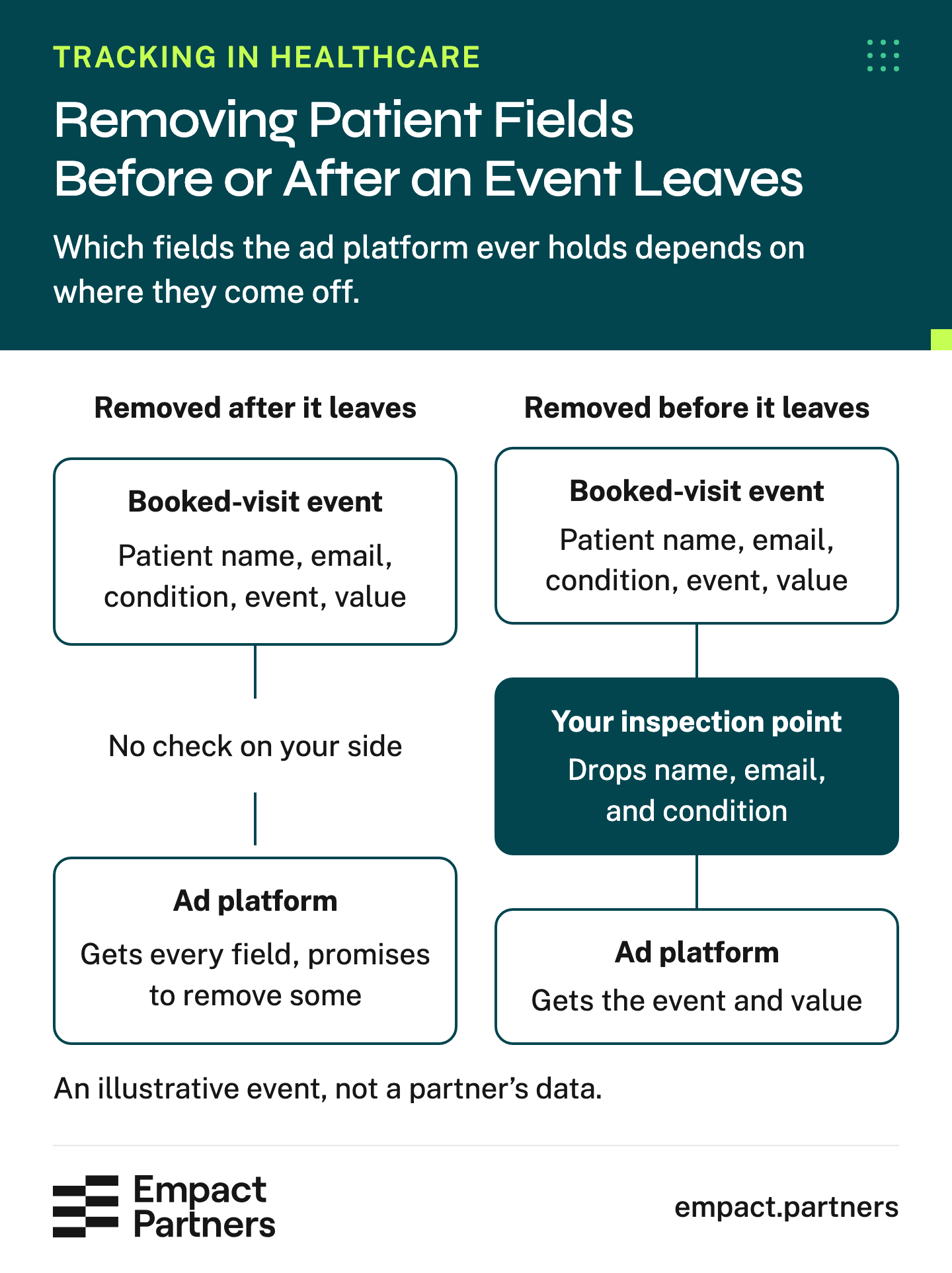
Removing the name, email, and condition before the event leaves keeps those fields off the ad platform, and whether what is left counts as de-identified is counsel’s call. An owned pipeline puts that inspection point in your own hands, as code in your repository running in accounts you control, where you can log every send and switch it off.
A vendor under a BAA that strips fields first is the rented version of the same point. Its field rules answer one of the reviewer’s questions, and the rest of the page still applies. For records you hold for customers, we would want those rules in your own repository, where your security reviewer can read them and your team can change them when a contract changes.
Owning the pipeline helps only where it lets you show, field by field, what leaves and where it goes.
Owning the route still changes nothing about who receives what you send. An event that reaches an ad platform with no BAA in place has been disclosed to it, whether it left from a browser or from your server. Marketers who run tracking for clinics say the same, and add what to send instead:
Tips from Reddit
What healthcare marketers say about server-side tracking
Sending lead data from your server instead of the browser is still sending it to Meta, and Meta won't sign a BAA.
What works is sending a generic conversion like lead or booked call through a server-side tool that signs a BAA and strips identifiers, and keeping the treatment data inside the CRM.
For teams selling in Europe, the consent question sits earlier still, at the visitor’s device. The European Data Protection Board’s guidelines read Article 5(3) of the ePrivacy Directive as applying even when the company receiving the data is not the one that told the device to send it.9 A server you own sits after that step, so it leaves the consent question where it was.
Set the Review by the Record and What the Tool Can Do
You can place any marketing tool in one of three review levels by asking whose record it touches and what it can do with it. A tool that reads and summarizes sits below one that drafts for a person to send, and both sit below one that sends on its own. These levels are a suggested way to decide how much review a tool gets, and counsel still decides what the law asks of it:
Scroll horizontally to see all columns when the table is wider than this page.
| Review level | What the tool touches and does | Examples | Before it goes live |
|---|---|---|---|
| Light | Public data or your own content, read or drafted for a person | A competitor monitor, a page engine built from your public docs, a summary of public reviews | An owner, and a record of what it reads |
| Standard | Your buyers’ contact records, with a person approving what goes out | Lead enrichment, routing, a prospecting agent set to review every email | The one-page trace, the vendor’s contract and sub-processors, opt-outs honored, an owner |
| Strict | Data you hold for customers, a page their users see, or any tool that sends on its own | Product usage fed to an ad platform, a pixel on a portal, an agent set to send without review | Counsel’s sign-off, the contract each destination needs, the fields chosen before anything leaves, caps and a stop your team controls |
The send-without-review setting moves a tool up to strict by itself, whatever records it reads. For Garith Prior, a Reddit Marketer at Empact Partners, that setting is the first thing to check:
On any agent that writes to prospects, I’d check who reads its email before the buyer does. A wrong field in a report can be corrected once someone notices. An email to a hospital buyer that quotes another customer’s details can’t be unsent, and that buyer is deciding whether to trust you with their own data.
 Garith Prior on LinkedInOpens in a new tab
When we run outbound for SaaS companies, a tool writes to people outside the company, so it carries the controls a sending tool needs. Each email names the person who sends it, and sending never runs past a set cap, with your team holding the stop. We read and answer every reply. An agent that sends without review needs at least those three before it goes live.
How We Build Marketing Tools for SaaS Companies in Regulated Markets
In these categories, the record flow is the first thing a reviewer asks for, and for a tool you own, the answer sits in your own repository. Empact Partners would begin by mapping where each record goes for the marketing tools you run and the ones you want next.
A process change, a feature you already pay for, or an off-the-shelf tool that does the job well comes first, and a build only where none of them works. A build in our Marketing Engineering workstream includes:
What a marketing tool built with us includes
- Code in a repository, and accounts, that your company controls
- Documentation and a handover with training, so your team can run and change it
- A log of each step that anyone on your team can read
- Work inside your developers’ repositories and review rules, where you have developers
Those controls hold only while someone checks them. A field rule written for last year’s contract, or a tracking endpoint that stopped sending without an error, looks fine from outside. Before you sign with any builder, judge them by what still runs after the handover.
If you have not chosen what to build first, the agent below reads your website and proposes up to five internal apps, each named by the work it could replace. It is a free preview of one we run in full when we scope builds for partners.
Before a strict-level tool goes live, someone should be able to show where each record goes, which contract covers each destination, and who can stop it. A tool nobody can answer those for is not ready for a hospital or a bank, whoever built it.
Frequently Asked Questions
Is server-side tracking HIPAA compliant?
Not by itself. Moving tracking to a server changes where the data is sent from, but not who receives it or what it contains. HHS’s guidance asks whether protected health information reaches a tracking vendor. If it does, that vendor needs a signed BAA and the disclosure needs a Privacy Rule permission.
A server helps when it is where the protected fields come off before anything goes on, and when someone can show which fields those are. A vendor under a BAA that does the same job is the other route HHS describes.
Can we use product usage data in our marketing?
Some of it, depending on whose data it is and what your contracts allow. How many seats a customer’s team has switched on is a different record from data about the patients or account holders your product serves.
The second kind is held under your contract with each customer. Read that contract with counsel before any of it feeds lead scoring, lifecycle emails, or ad audiences.
Does hashing an email make it safe to send to an ad platform?
Don’t treat hashing as the safeguard. Google’s own help page for Customer Match explains that it compares each hashed email you upload with the hashed emails of Google accounts, and adds any match to your audience.10
If the email belongs to a patient or an account holder you serve, a match still connects that person to whatever the upload says about them. A safer default is a generic event, such as a booked call, with nothing in it about a treatment or an account, and counsel’s sign-off on anything more.
What should we ask a vendor before its tool touches customer data?
Ask for its record flow on one page, the contract it will sign for the data you hold, the sub-processors that will see that data, and the setting that controls what its AI features may read. Ask for the answers in writing, from someone who can commit the vendor to them. A vendor that can’t answer leaves the review unfinished, and the tool waits until it does.
Can a prospecting agent email buyers in Europe?
That turns on the lawful basis for contacting each buyer and on each country’s rules for unsolicited email, which is a question for counsel. What you can settle yourself is the record side, meaning which notes the agent reads, which model provider sees them, and whether a person approves each email. Keep the review setting on. Switching to sending without review moves the agent into the strict level, with everything that level asks for.
Which marketing tools can we approve this week?
Tools that read public data or your own content and draft for a person, such as a competitor monitor or a page engine built from your public documentation. They still need an owner and a record of what they read. Anything that touches your buyers’ contact records goes through the one-page trace first, and anything that touches customer data waits for counsel.
Who should sign off a strict-level tool?
Counsel who knows your customer contracts, the security reviewer who answers your customers’ questionnaires, and the person who will own the tool after launch. The builder’s word alone does not count, because the builder’s work is what is being checked. Write down who signed and what they saw, so the next review starts from that page.
Do these rules reach our marketing website?
Mostly not in the way they reach your product. A public site for hospital or bank buyers collects your buyers’ data, such as the pages a procurement lead read and the form they filled in, and general privacy law, such as the GDPR for visitors in Europe, applies to it. The stricter rules arrive when the site starts carrying records you hold for customers, such as a patient booking page or a portal login on your domain.
Should we build our own pipeline or buy one?
Either can pass the same test, and the cheaper fixes come first, such as a process change or a feature you already pay for. Buy where a vendor already does the job well, signs the contract your records need, and shows you its field rules. Build where no vendor meets those terms for records you hold for customers, or where you want the rules in your own repository.
What does an owned pipeline cost to keep running?
An owner’s time, as well as the hosting. Contracts change, ad platforms change what they accept, and an endpoint can stop sending without raising an error. The owner checks that what leaves still matches the field rules, so budget for that person before the build starts.
Do we need developers on our side to own a pipeline?
No. The engineering can come from outside. Your side needs the person who owns the process the pipeline serves, and someone who will own the field rules after launch. If you do have developers, any builder should work in their repositories under their review rules, so the pipeline is reviewed like the rest of your code.
Sources (10)
- Federal Trade Commission, "FTC Enforcement Action to Bar GoodRx from Sharing Consumers’ Sensitive Health Info for Advertising" (2023)↩11 February 2023.
- Federal Trade Commission, "FTC to Ban BetterHelp from Revealing Consumers’ Data, Including Sensitive Mental Health Information, to Facebook and Others for Targeted Advertising" (2023)↩12 March 2023.
- Electronic Code of Federal Regulations, "45 CFR 164.504, Uses and disclosures: Organizational requirements" (2026)↩1paragraph (e)(2)(i), current text read 26 November 2026.
- Electronic Code of Federal Regulations, "12 CFR 1016.11, Limits on redisclosure and reuse of information" (2026)↩1paragraph (a)(2), current text read 26 November 2026.
- EUR-Lex, "Regulation (EU) 2016/679, the General Data Protection Regulation" (2016)↩128(3)(a) and 28(10), 2016.
- US Department of Health and Human Services, Office for Civil Rights, "Use of Online Tracking Technologies by HIPAA Covered Entities and Business Associates" (2024)↩1↩2last reviewed 26 June 2024.
- HubSpot Knowledge Base, "Enroll contacts to prospecting agent" (2026)↩1updated 16 November 2026.
- HubSpot Knowledge Base, "Configure prospecting agent" (2026)↩1updated 19 November 2026.
- European Data Protection Board, "Guidelines 2/2023 on Technical Scope of Art. 5(3) of ePrivacy Directive, Version 2.0" (2024)↩1
- Google Ads Help, "About the customer matching process" (2026)↩1read 26 November 2026.
Keep reading
Marketing Engineering 5 Best Marketing Data Pipeline Tools for SaaS Teams
Supermetrics, Funnel, Adverity, Improvado and Windsor.ai, matched to the person who will fix a broken sync, with prices from each vendor.
Marketing Engineering 5 Best Programmatic SEO Tools for SaaS Websites
Five programmatic SEO tools compared by where each page’s facts live and what happens to the live page when one of them changes.

Marketing Engineering Put Your Ops Lead in Charge of Your First AI Agent
Before you hire a marketing engineer, give your ops lead the hours, one job and a builder for your first AI agent.