
5 Best Marketing Data Pipeline Tools for SaaS Teams
Supermetrics, Funnel, Adverity, Improvado and Windsor.ai, matched to the person who will fix a broken sync, with prices from each vendor.
 Garith PriorWith
 Vlad Shvets
On this page
Empact Newsletter
One email a month on what is working in AI search and SaaS go-to-market.
A marketing data pipeline tool pulls your ad, analytics and CRM numbers out of each platform on a schedule and delivers them where your team reports, from a Google Sheet to your own warehouse. Over the past year the category has started selling what happens after the data arrives. Supermetrics bought Relay42, a customer data platform, in June 2025 and now sells it as Data Activation 1 2.
Every Supermetrics plan now includes campaign management from an AI chat 3, and all five tools below sell an AI assistant on top of the pipeline. None of it helps the morning a dashboard shows zeros because an ad account logged itself out. We read each vendor’s pricing page and documentation on 25 November 2026, with the G2 reviews and Reddit threads, to see who that morning lands on.
Empact Partners builds data pipelines and dashboards for SaaS marketing teams, so nobody copies numbers between tabs before a report goes out. The question that separates these five tools is who fixes a broken sync, and each one answers it differently.
Scroll horizontally to see all columns when the table is wider than this page.
| Tool | Best for | Who keeps it running | What the bill counts | Starting price |
|---|---|---|---|---|
| Supermetrics | Reporting in Sheets, Looker Studio, Excel or Power BI | The marketer who owns the reports | Data sources, accounts and destinations | $44 a month billed yearly |
| Funnel | A hosted hub that stores and maps ad data | Your marketing ops lead | A plan plus flexpoint capacity | $300 a month billed annually |
| Adverity | Governed marketing data in your own warehouse | Your data team | Data sources, rows and destinations | Quoted, annual contract |
| Improvado | Enterprise teams that want the vendor to run it | Improvado’s own team | Rows of data a year | $20,000 a year |
| Windsor.ai | Lean teams with a handful of sources | Whoever connected the accounts | Data sources and accounts | $19 a month billed yearly |
Supermetrics
Best for: a marketing team that reports in Google Sheets, Looker Studio, Excel or Power BI and already has someone who keeps those reports current.
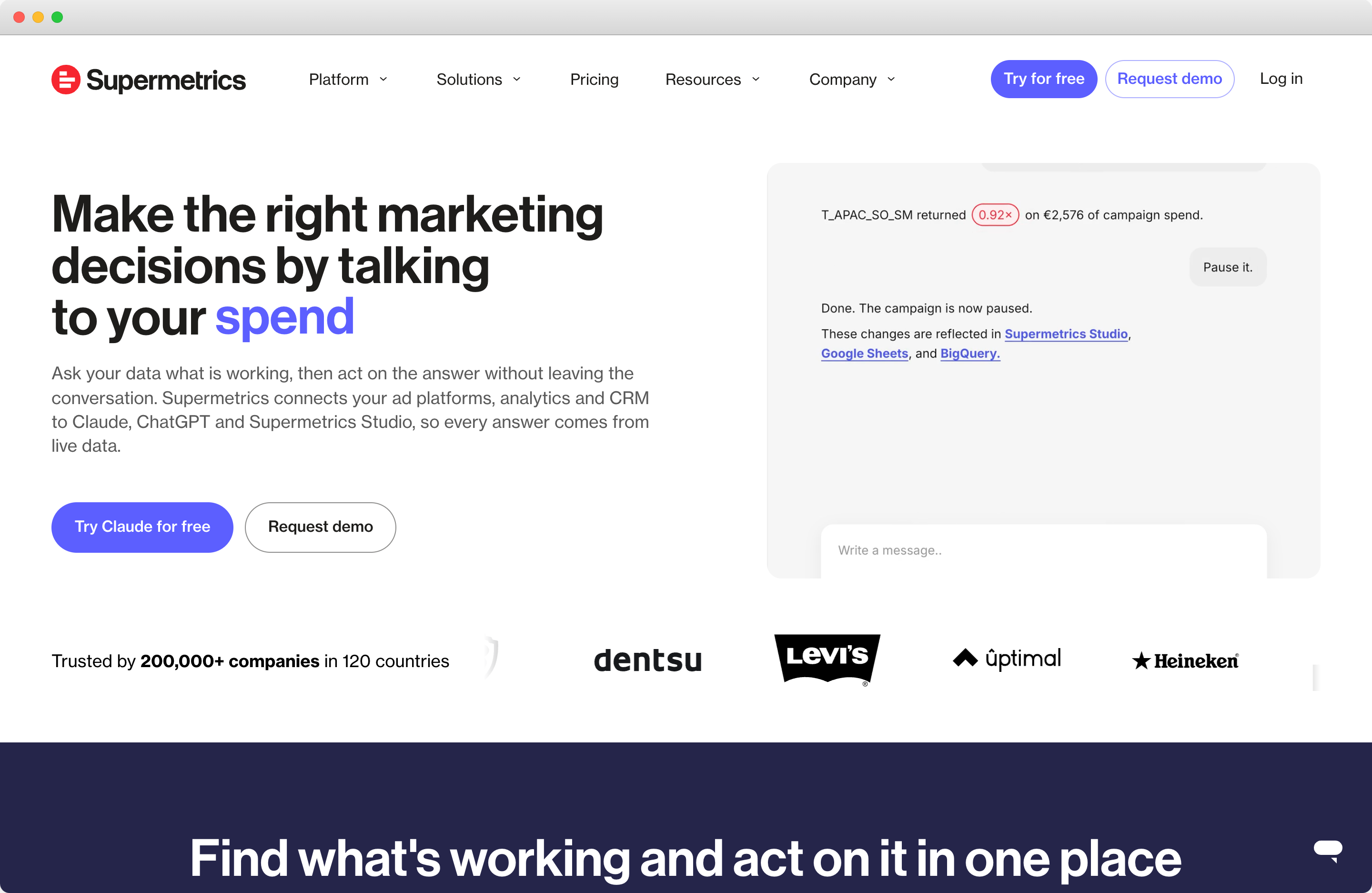
Supermetrics connects ad platforms, analytics and CRMs to the places marketers already report, Claude and ChatGPT included. It began as a spreadsheet add-on and is still bought that way. You choose your data sources, the accounts inside each one and a destination, and the price follows 3.
Starter covers two data sources with two accounts each, and Growth covers seven. A second destination, a third source or another ad account is an add-on with its own price. BigQuery and Snowflake wait for the quoted Enterprise package, along with transformations and data storage 3.
Whoever owns the setup also owns its limits. Go past your package’s limits and Supermetrics may pause your transfers until you upgrade 3. A head of marketing on G2 also describes reports that fail on metric combinations the tool lets you select, which leaves a senior person fixing them.
Pricing
- Starter: $44 a month billed yearly, or $59 monthly, for 2 data sources with 2 accounts each, 1 user and 1 destination.
- Growth: $177 a month billed yearly, or $222 monthly, for 7 data sources with 7 accounts each and 2 users.
- Enterprise: quoted, with BigQuery and Snowflake, transformations and data storage.
- Add-ons, billed yearly: an extra destination at $49 a month on Starter or $149 on Growth, an extra data source at $37 and an extra ad account at $11.
- Trial: 14 days free, with no card.
Beware
- Going past your package’s limits on sources, accounts or destinations can pause your transfers until you upgrade or cut back 3.
Pros and cons
Supermetrics is the easy start for a team that lives in spreadsheets, and the add-ons decide what it ends up costing:
Pros
- Sheets, Looker Studio, Excel, Power BI and AI chats as destinations on every plan
- A 14-day trial with no card
- Campaign management from an AI chat on every package
Cons
- Warehouse destinations only on Enterprise
- Every extra destination, source and ad account billed on top
- Transfers that can pause when you go past a limit
What G2 reviewers and Reddit say
The praise is for how rarely the connection drops. The complaints are about the reports built on top, and about the bill:
Sometimes the data connection fails, but I think that’s fair given how infrequently it happens and how quickly it usually comes back.
Marketing and advertising user, small business, G2 reviewOct 2026 The interface is quite basic and has not kept pace with developments in many tools that it connects to - most notably GA4. As a result, many metrics that cannot be combined, can in fact be selected in Supermetrics, leading to failed reports.
Head of Marketing, mid-market company, G2 reviewMay 2026 r/PPC
View threadWe switched from SuperMetrics to DataSlayer. Hardly noticed the change but found a big decrease in cost. DataSlayer support has been extremely responsive too.
Feb 2026
Verdict: buy Supermetrics if your reporting lives in Sheets or Looker Studio and one person on your marketing team already maintains it, because that person becomes its owner. Price the add-ons for every source and destination you report on today before you compare starting prices. Skip it if you want the data in your own warehouse this year, since that means the quoted Enterprise package from day one.
Funnel
Best for: a marketing ops team that wants its ad data stored, mapped and cleaned in one hosted hub before any report reads it, with no warehouse of its own.
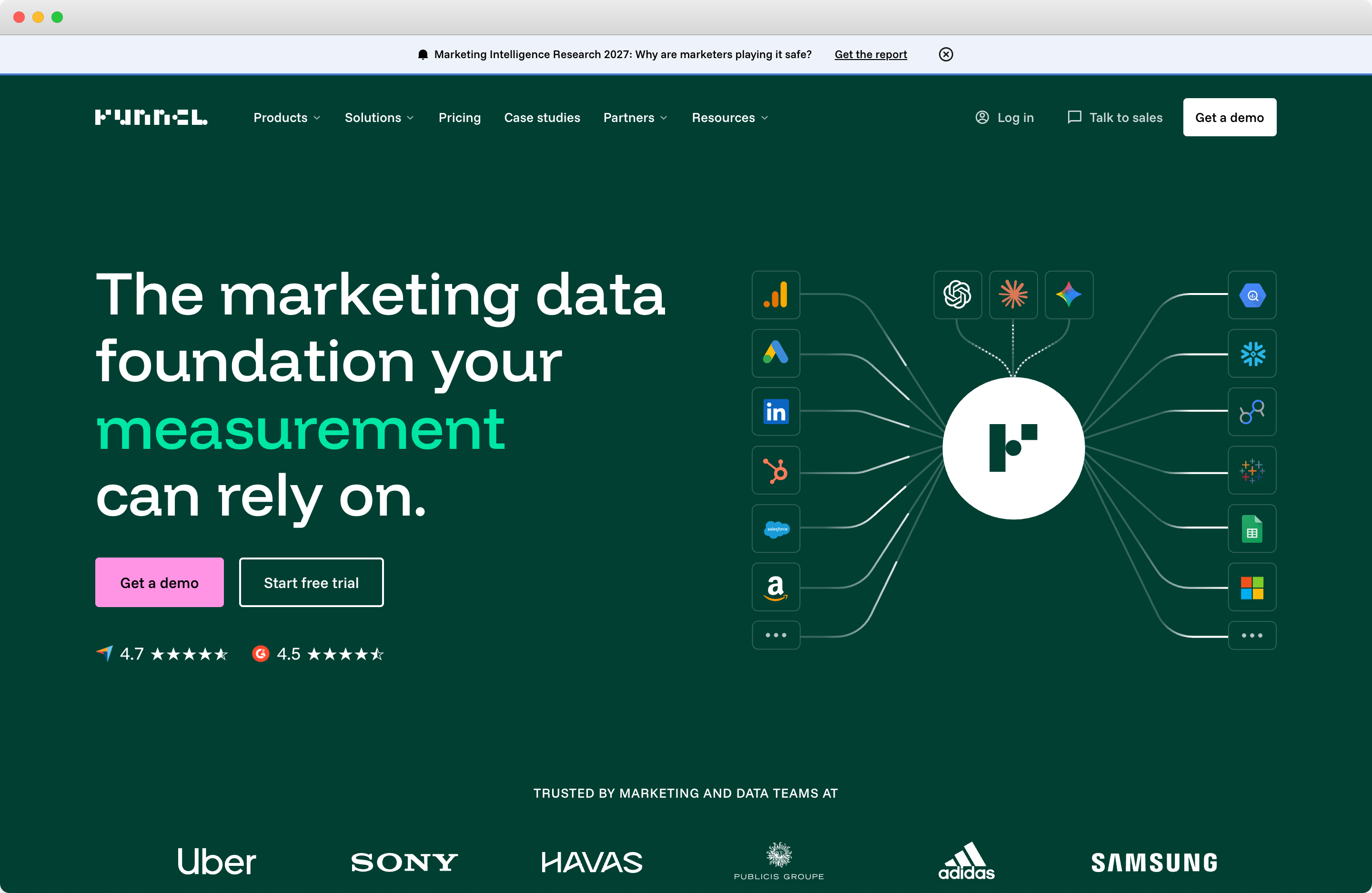
Funnel is a hosted data hub. It pulls marketing data into its own storage and maps each platform’s fields onto one set of names. You add business rules, budgets and targets, and Funnel sends the result to Looker Studio, Sheets, Power BI or a warehouse. It describes its connectors as fully managed and maintained 4.
You pay for a plan and for capacity, counted in flexpoints. Every plan needs at least 400 flexpoints, sold in steps of 100, and a connector takes 50. Funnel’s own small example, two connectors, two ad accounts and one Data Studio destination, needs 260 and still buys the 400 5. Starter exports once a day, and Business adds Power BI, Tableau and BigQuery with exports every two hours 4.
Two costs stay with you. A small team pays for 400 flexpoints whatever it uses, and every connection still runs on the credentials of the person who opened it. One enterprise reviewer with more than 170 connections says a couple of them always need someone to log in again.
Pricing
- Starter: from $300 a month billed annually, with Funnel Dashboards, Google Sheets and Looker Studio, daily exports and unlimited users.
- Business: from $600 a month billed annually, adding Power BI, Tableau, BigQuery and Amazon S3, with exports every two hours.
- Enterprise: custom, adding single sign-on, an audit log, a service-level agreement and Snowflake.
- Capacity: at least 400 flexpoints on every plan, added in steps of 100, with 50 for each connector 5.
- Trial: 14 days free.
Beware
- The 400-flexpoint floor bills a two-connector setup for the same capacity as a much larger one, so price your real setup against the floor before you sign.
Pros and cons
Funnel takes the field mapping off your team, and charges a minimum for doing it:
Pros
- Data stored and mapped in one place before any report reads it
- Unlimited users on every plan
- Capacity you can move from one connector to another when your channel mix changes
Cons
- A 400-flexpoint minimum on every plan
- Daily exports and no warehouse destination on Starter
- Connections that still need your people to log in again
What G2 reviewers say
Reviewers praise how quickly channels connect and how far the data travels. The complaints are the logins, and a bill that climbs with every new source:
The biggest advantage of Funnel for me is how easy it is to connect channels, work with the data using custom dimensions and metrics, and then export everything to Power BI.
Reviewer, mid-market company, G2 reviewOct 2026 That we need to refresh Data Source connections from time to time. Considering that we have 170+ connections, ca 10 data source types and ca 20 users from different markets with credentials to their platform accounts - there's always a couple of connections which need our attention - to reach out to respective person asking to re-authenticate.
Reviewer, enterprise company, G2 reviewOct 2026 As the number of data sources keeps increasing, the price is also rising significantly, especially when you start diversifying the marketing mix.
Reviewer, enterprise company, G2 reviewSep 2026
Verdict: buy Funnel if a marketing ops lead will own the hub and you report across several channels or markets. It maps the data once instead of in every report. Write down who logs each connection back in before launch day. Skip it for two or three sources feeding one dashboard, where the floor charges you for capacity you will not use.
Adverity
Best for: a data team that wants governed marketing data landing in its own warehouse, under its own rules.
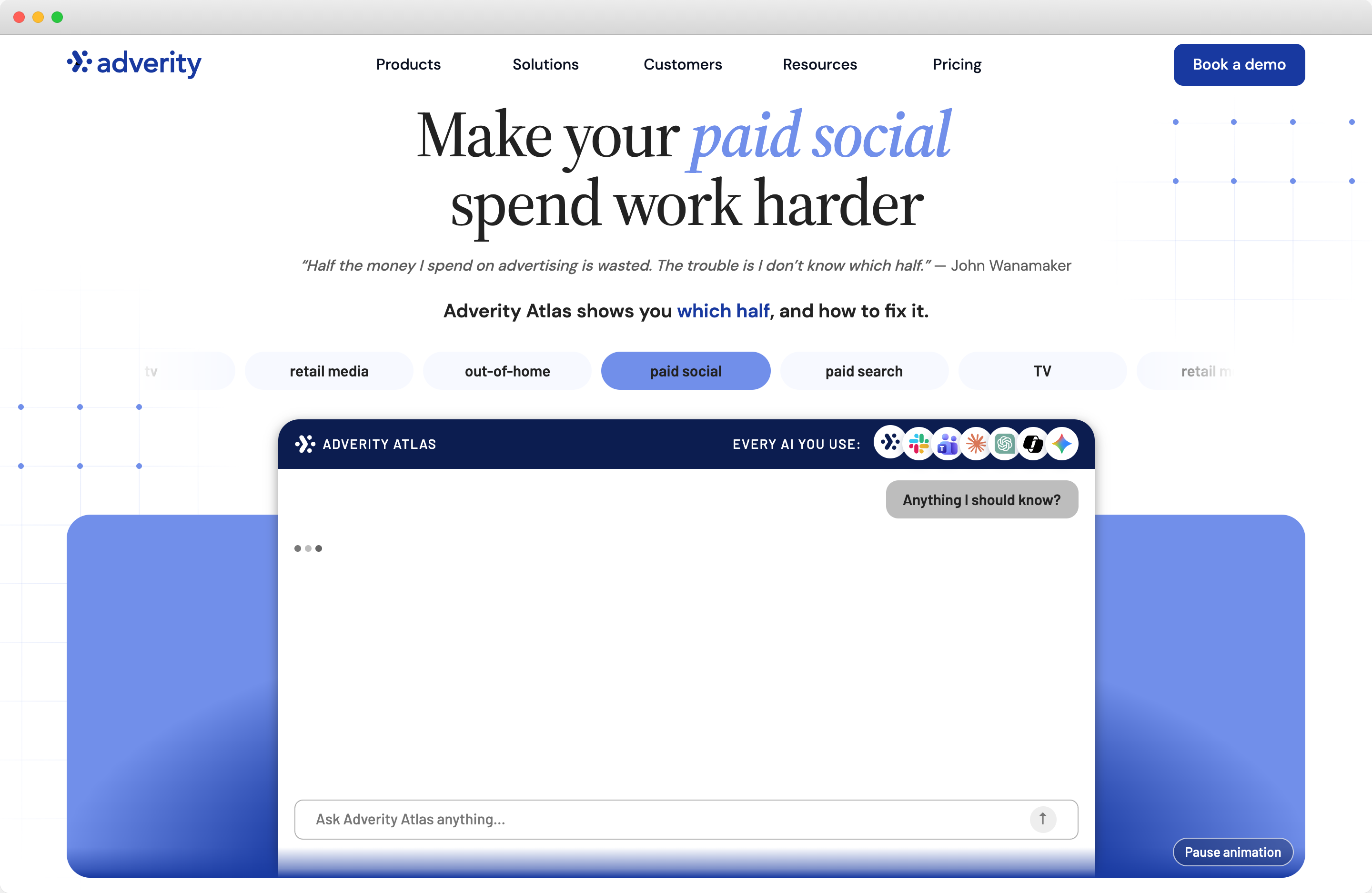
Adverity now sells two products. Adverity Connect is the pipeline. It loads marketing data into your own warehouse, with transformations written in plain language. Adverity says it goes live in days, depending on how much of the setup you hand over. Adverity Atlas puts AI agents on that data, and the pricing page sends marketing teams to Atlas and data teams to Connect 6.
Connect’s three plans are annual and quoted, priced by data sources, rows and destinations. Core allows 10 sources, one destination and 25 million rows a month. Standard raises that to 25 sources and 60 million rows with a yearly health check, and Professional to 40 sources and 100 million rows with separate development and production environments 6.
A marketer buying alone will struggle with it. You cannot price Connect without a sales call, and Atlas costs $15,500 a month on its Standard plan 6. Its reviewers describe connectors that lag behind API changes, and backlogs once the sources multiply.
Pricing
- Connect Core: quoted, annual, up to 10 data sources, one destination and 25 million rows a month.
- Connect Standard: quoted, annual, up to 25 sources, two destinations, 60 million rows and a yearly health check.
- Connect Professional: quoted, annual, up to 40 sources, four destinations, 100 million rows, development and production environments and quarterly health checks.
- Atlas Standard: $15,500 a month on an annual plan for the AI agents, and running both lowers the price of Connect.
- Trial: Atlas opens with a free Discovery phase on your own data, while Connect is quoted after a call.
Beware
- Every Connect plan caps rows a month and destinations, so a second warehouse or a jump in ad volume can push you up a plan 6.
Pros and cons
Adverity Connect gives a data team the controls it expects in its own warehouse, and needs that team to run it:
Pros
- Data lands in a warehouse you own
- Development and production environments on Professional
- Health checks of your setup from Standard up
Cons
- No published price for Connect
- Row and destination caps on every plan
- Atlas priced on its own, at $15,500 a month on Standard
What G2 reviewers say
The praise is for how simply the data reaches a warehouse. The complaints arrive as the sources add up:
The ease of joining my marketing data into a data warehouse is so simple
Account Director, small business, G2 reviewOct 2026 Due to the nature of utilizing vendor APIs, sometimes changes to API versions & upgrades aren't captured as quickly as needed.
Marketing and advertising user, enterprise, G2 reviewJun 2026 So as our data sources have increased, we have been facing issues with backlogs. There have been many instances where Adverity just couldn't keep up with the load of data that we wanted to process.
Associate Data Engineer, mid-market company, G2 reviewJun 2026
Verdict: buy Adverity Connect if a data team already runs a warehouse and wants marketing data in it under its own rules and environments. We would bring the row count of your busiest month to the first call, since rows set the plan. Skip it if marketers will run the pipeline themselves, because the product is built for the people who write the transformations.
Improvado
Improvado
Best for: an enterprise marketing team with nobody in-house to run a pipeline, that wants the vendor’s own people to run it.
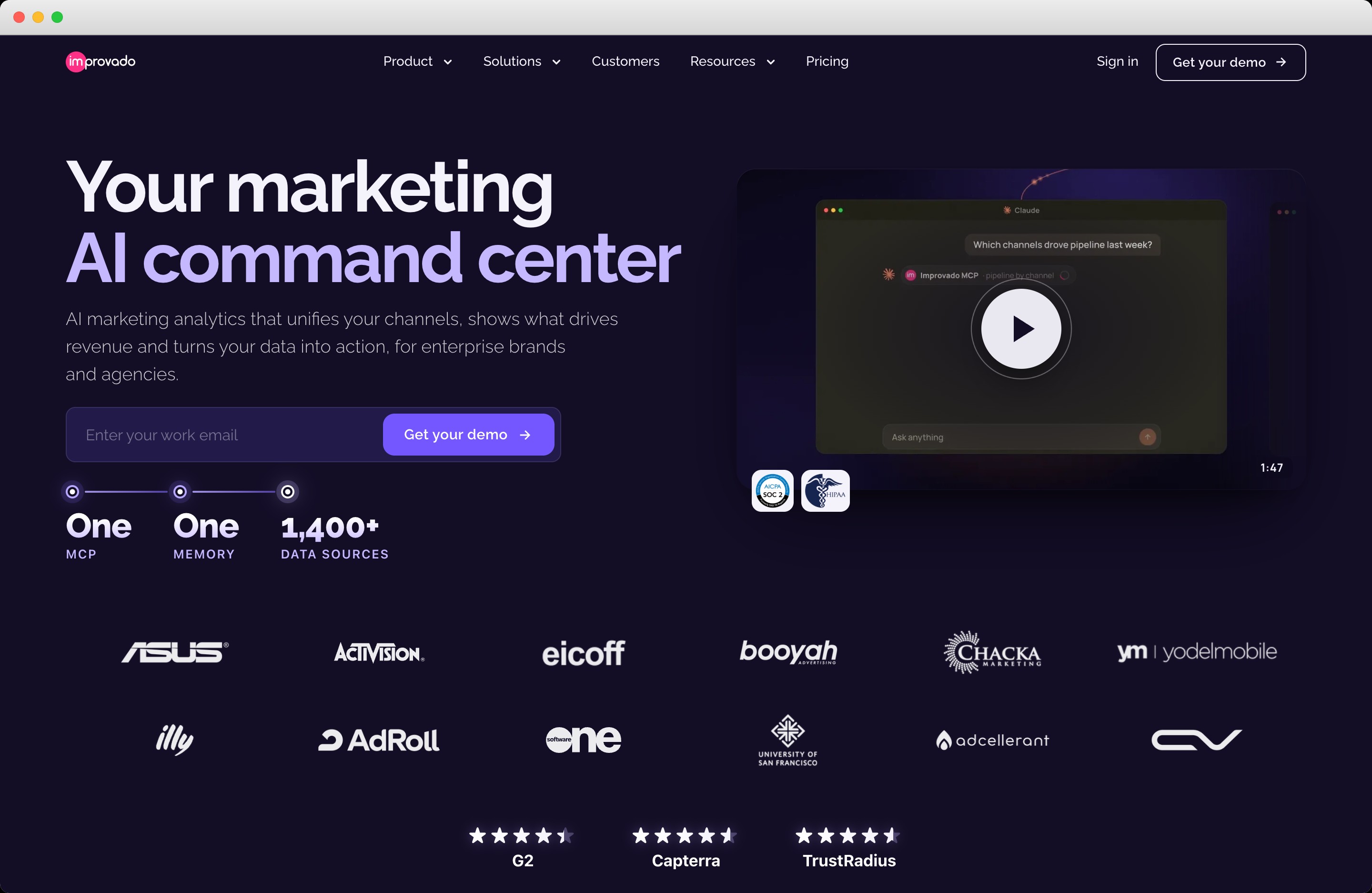
Improvado is the managed option. On its Starter, Growth and Enterprise plans, the pricing page says Improvado manages the marketing data for you, with every connector and destination included in each plan. A separate plan at $100 a month connects your own AI assistant to the data through the Model Context Protocol (MCP), and nothing more 7.
You pay by rows of data a year. Starter starts at $20,000 for 20 million rows synced daily. Growth starts at $41,700 for 60 to 200 million rows, with premium support and professional services credits, and Enterprise adds hands-on services 7. One enterprise BI manager on G2 feeds 17 data sources and more than 220 accounts into their warehouse through it.
Handing the pipeline over has a cost in visibility, by that same BI manager’s account. When data breaks, they cannot see what happens behind the connectors. A paid media strategist needed six months of weekly support calls to learn what the product can do.
Pricing
- MCP Only: $100 a month, with 2 million rows a year, for your own AI assistant.
- Starter: from $20,000 a year, with 20 million rows, daily sync and every connector and destination.
- Growth: from $41,700 a year, with 60 to 200 million rows, up to 10 workspaces, premium support and 120 to 240 professional services credits.
- Enterprise: quoted, with 1 billion rows a year, single sign-on and hands-on professional services.
- Trial: none listed, and every plan above MCP Only starts with a demo.
Beware
- Starter includes no premium support and no professional services credits, so check what help comes with the plan you can afford before you sign 7.
Pros and cons
Improvado takes the upkeep off your team, and one reviewer says it took their view into the pipeline too:
Pros
- Improvado’s team manages the data on every pipeline plan
- Every connector and destination included, with no fee per connector
- Professional services credits from Growth up
Cons
- $20,000 a year before anything runs
- Little visibility into the managed connectors when data breaks, by one reviewer’s account
- A long learning curve, by one reviewer’s account
What G2 reviewers say
Reviewers who have it running praise how little they touch it. Their complaints are about what they can no longer see, and how long it took to learn:
Every integration I’ve set up has run smoothly, and the data extract/refresh scheduling feature in particular ensures our database stays updated and working exactly when we need it.
Data Analyst, mid-market company, G2 reviewOct 2026 The main limitation is the limited visibility and control over what happens behind the managed connectors. When data issues occur, it can be difficult to independently identify whether the root cause is a source API, a connector configuration or an extraction process.
IT Business Intelligence Project Manager, enterprise, G2 reviewSep 2026 The learning curve is long. It took about six months of weekly calls with support to understand what the product can really do.
Sr Paid Media Strategist, small business, G2 reviewOct 2026
Verdict: buy Improvado if you have the budget, nobody in-house to run a pipeline, and you want a vendor answerable for keeping the data flowing. Ask in the demo who picks up when a number looks wrong, and how fast. Skip it below the Growth plan’s budget, since Starter comes without premium support or services credits.
Windsor.ai
Best for: a lean team with a handful of sources that will fix its own connections to keep the bill low.
Windsor.ai moves marketing and CRM data into Sheets, Looker Studio, Power BI, warehouses and AI chats, and every destination comes with every plan 8. In January 2026 it took a strategic investment from team.blue, a European hosting group, and its own management still runs the company, so the team you buy from has not changed 9 10.
Windsor.ai is the cheapest start of the five. Basic costs $19 a month billed yearly for three data sources, Standard $99 for seven, and the plans climb to $499 for 14 8.
The low price assumes you are the support team. A user on r/PPC reports accounts logging out of their connections almost weekly, and on Basic each backfill uses up one of the five scheduled syncs the plan allows 8.
Pricing
- Free plan: a 30-day trial, then 1 data source and 1 account.
- Basic: $19 a month billed yearly, or $23 monthly, for 3 data sources, 75 accounts and 5 scheduled syncs, each updating one table daily.
- Standard: $99 a month billed yearly, or $118 monthly, for 7 data sources, 75 accounts and unlimited scheduled syncs, refreshed hourly.
- Plus: $249 a month billed yearly, or $299 monthly, for 10 data sources and 200 accounts.
- Professional: $499 a month billed yearly, or $598 monthly, for 14 data sources, 500 accounts and syncs every 15 minutes.
- Enterprise: quoted, with custom connectors, single sign-on and an account manager.
Beware
- Accounts count across every source, and 20 ad accounts under one Google Ads manager account count as 20. The 75 on Basic and Standard run out faster than they look 8.
Pros and cons
Windsor.ai gives a small team the lowest bill here, and leaves the upkeep with that team:
Pros
- Plans from $19 a month, with a free plan to start
- Every destination, AI chats included, on every plan
- Unlimited users from Basic up
Cons
- Live chat as the support channel below Enterprise
- Each backfill counted against Basic’s five scheduled syncs
- Logins that drop, by one user’s account
What G2 reviewers and Reddit say
Users like what it costs and how fast it connects. The complaint that matters for this choice is the one about logins:
The most helpful part of Windsor.ai is its ability to connect multiple marketing data sources quickly and reliably.
Administrador, small business, G2 reviewJan 2026 r/PPC
View threadAbsolutely. They are value for money. The only challenge I found was the UI was not very user friendly. But once you connect your data sources, you're off to the races.
Feb 2026 r/PPC
View threadI'm actually looking to switch from windsor to something else due to constant issues. Your accounts will log out almost weekly to your connections.
Feb 2026
Verdict: buy Windsor.ai if you report on a handful of sources, the budget is tight and the person who set it up will check the connections every week. Count every ad account under each manager account before you pick a plan. Skip it if a missed login would put wrong numbers in front of your board and nobody on your team checks the connections each week.
Which Pipeline Fits the Team That Will Maintain It
Start with the person who will keep the data flowing, because that rules tools out faster than price does. Then match the tool to where your reports already live:
- Supermetrics: the marketer who owns the reports, in Sheets or Looker Studio, with every add-on priced before you sign.
- Funnel: a marketing ops lead with several channels and no warehouse, and a setup big enough to use the 400-flexpoint floor.
- Adverity Connect: a data team that already runs a warehouse.
- Improvado: nobody in-house and an enterprise budget, from the Growth plan up.
- Windsor.ai: you, a handful of sources and a tight budget.
If your team fits none of those lines and has no enterprise budget, buying a tool will not change who fixes it when it breaks.
Name Who Fixes a Broken Sync Before You Buy
Read the knocks in the five entries again and none of them is about a missing connector. They are about logins that expire and API changes that reach a connector late. They are about failures nobody outside the vendor can trace, a plan limit that pauses transfers and reports that fail on a metric combination.
Every one of them needs a person to notice it and fix it, and the tools differ most on who that person is. Most of what Improvado’s higher price buys is its own people in that seat.
The cost that grows after a pipeline goes live is the hours someone spends logging accounts back in and checking the numbers.
The cheapest way out of the subscription moves that cost onto your team. The top answer in an r/PPC thread about leaving Supermetrics tells the poster to have Claude build the connector instead. With an engineer to spare, that can work. It also makes your engineer the person who logs accounts back in, rewrites the code when an ad platform changes its API and backfills the missing days.
So answer three questions before the first demo. Each one takes tools off the table:
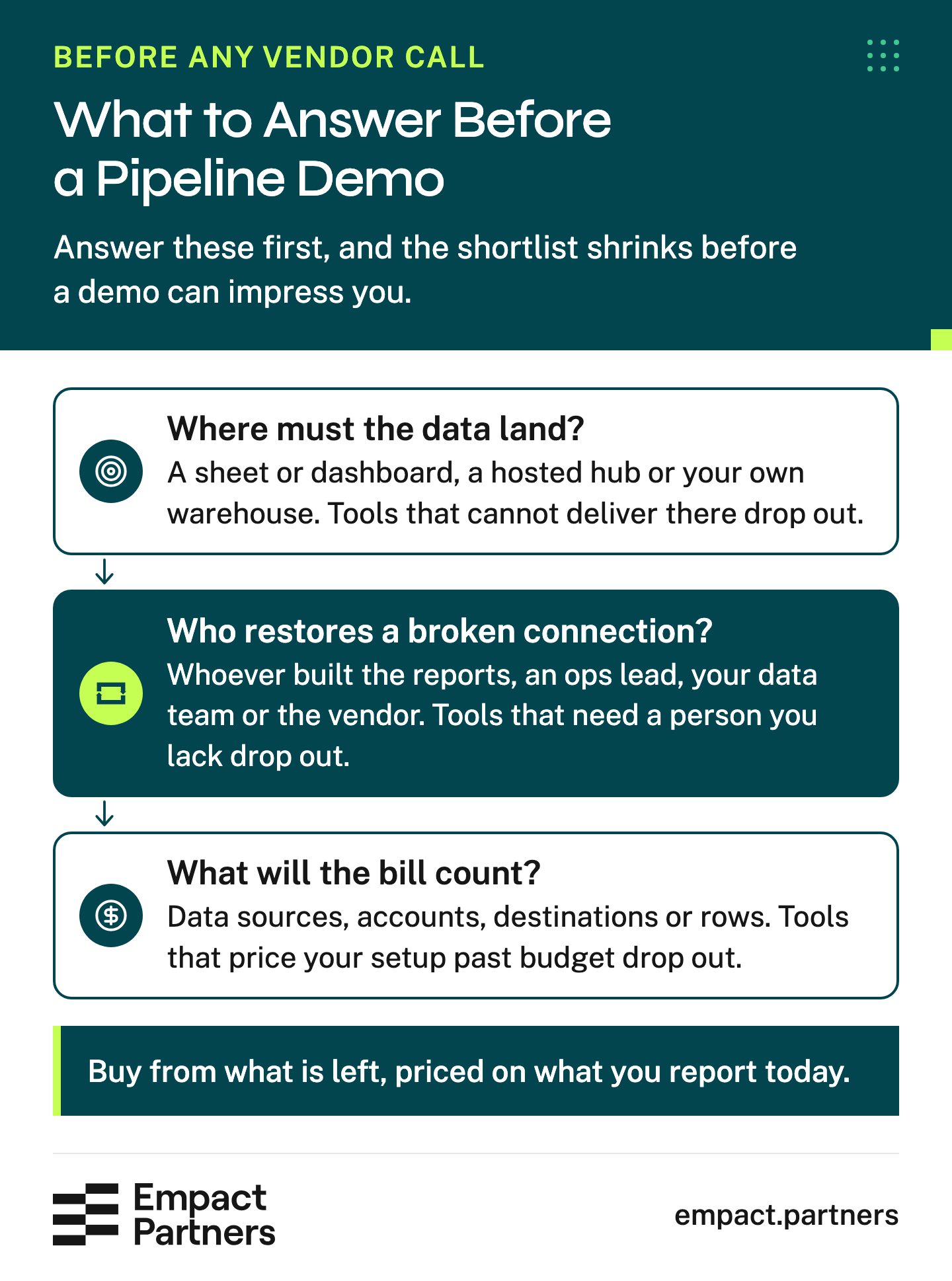
The question about broken connections is the one teams skip, because a demo only ever shows a connection that works. Write the answers down before you talk to a vendor, along with these:
- The name of the person who logs a dropped ad account back in
- How many data sources, accounts, destinations and rows a month you report on today
- How far back you need history, and who checks the numbers after a backfill
- What your reports show while a connection is down
- When the contract renews, and what happens if you go past a plan’s limits
A team that leaves the first line blank finds out who owns its pipeline the week a dashboard goes flat. By then the person who connected the accounts may have moved on.
A reporting setup with no owner breaks quietly. The connection drops, the dashboard keeps loading, and the report goes out with a week of zeros in it. Ask every vendor what its tool does when a sync fails and who it tells. If the answer is nobody, someone on your team has to look every Monday.
 Garith Prior on LinkedInOpens in a new tab
Empact Partners would start with the steps your team still does by hand every reporting cycle, because they show which data has to move and who will keep it moving. If one of the five tools fits that person, buy it.
Where none does, a named senior GTM consultant and our Marketing Engineering team build the pipeline and the dashboard in a repository your company owns. It comes documented and handed over with training, so your team can change it without us.
Maybe your reporting still runs through a shared sheet. Give it to our free Spreadsheet to App Blueprint, and it returns the app that sheet could become, with clickable screens and what the build would take. Our partners get the whole agent, and this version previews it on your own sheet:
Building is not always the answer either. A custom pipeline earns its place only where owning it beats every cheaper route, a tool you already pay for included. Our playbook on cutting the software stack sorts the tools worth dropping from the ones worth building:
Whichever tool you choose, count the days in its first month when a dashboard showed stale or missing data before anyone noticed. If that count is above zero, fix how a failure reaches a person before you judge the tool.
Frequently Asked Questions
What is a marketing data pipeline tool?
A pipeline tool pulls data from your ad platforms, analytics and CRM on a schedule, maps it into one shape and delivers it to a spreadsheet, a business intelligence tool such as Looker Studio or Power BI, or a data warehouse. It replaces exporting files and pasting them together, but not the person who checks that the numbers arrived.
Do we need a data warehouse before we buy a pipeline tool?
No. Supermetrics and Windsor.ai deliver straight to Sheets and Looker Studio, and Funnel stores the data in its own hub, so a team without a warehouse can start with any of them. You need one to join marketing data with product or finance data. Supermetrics puts warehouses on Enterprise, Funnel on Business, and Adverity Connect assumes you run one.
How much does a marketing data pipeline cost?
On the vendors’ own pages on 25 November 2026, Windsor.ai started at $19 a month billed yearly and Supermetrics at $44. Funnel started at $300 billed annually and Improvado at $20,000 a year, while Adverity quotes every Connect plan. The starting price matters less than what grows it. Count your data sources, ad accounts, destinations and monthly rows, then price each tool on those four numbers.
What makes a pipeline bill grow after the first year?
Each tool counts something different. Supermetrics counts data sources, accounts and destinations, and Windsor.ai counts sources and accounts. Funnel counts flexpoint capacity, while Adverity and Improvado count rows of data. A new market or ad platform can push you past any of those allowances, and row-based pricing climbs fastest with ad data, because impressions and events produce a great many rows.
Why do our data connections keep logging out?
A connection runs on the login of the person who authorized it. When that person changes a password, loses access or leaves, or when the platform expires the token, the sync stops until someone logs in again. Reviewers of Funnel and Windsor.ai both describe it. Keep a record of who authorized each connection, and walk through it whenever someone leaves the team.
What happens when an ad platform changes its API?
The vendor has to update its connector, and until it does, fields can go missing or a sync can fail. A seven-year Adverity user still says API changes are not always captured as quickly as needed. Ask each vendor how it tells you about connector changes, and watch for a sudden drop in row counts after a platform announces an update.
Can we build our own pipeline with Claude instead of buying one?
You can. An engineer working with Claude can write connectors from each platform’s API into a warehouse, and general tools such as Fivetran or Airbyte cover the plumbing for a data team. Building swaps a subscription for upkeep, since your team then handles every expired login, API change and backfill. Compare the hours that upkeep would take each month with the price of the subscription.
How long does it take to get a pipeline running?
You can try the self-serve tools on your own accounts the same day, with 14-day trials from Supermetrics and Funnel and 30 days from Windsor.ai. Adverity says Connect goes live in days, depending on how much setup you hand over. Improvado’s pipeline plans start with a demo, and one reviewer took six months of weekly support calls to learn the product. Plan a first month of checking the numbers by hand either way.
Are the AI features in these tools worth paying for?
AI features earn their price once the data underneath is reliable. All five now connect your data to an AI assistant such as Claude or ChatGPT, and Supermetrics and Adverity sell agents that act on it. An assistant reading from a connection that stopped last Tuesday gives you a confident wrong answer. Fix the upkeep first, and make the AI layer a later decision.
What should we check in the contract before signing?
Check the renewal date, the notice period and what happens when you exceed a limit. Funnel bills annually, Adverity sells annual contracts and Improvado prices by the year. One Supermetrics reviewer on G2 missed a 60-day cancellation window and was renewed for another full year. Put the notice date in a calendar the day you sign.
Should marketing or the data team own the pipeline?
Whoever reads the reports first should own the tool that feeds them, as long as they have time each week to check it. Supermetrics, Funnel and Windsor.ai are built for marketers to run, Adverity Connect for a data team that writes transformations, and Improvado for teams that want neither to carry the upkeep. Write the owner’s name down before you sign, next to the renewal date.
When is a custom reporting app worth building instead?
When your reporting depends on a spreadsheet that holds rules, approvals or targets only one person understands. Or when no tool here fits the person who will maintain it. Either way, keep the app in a repository your company owns, documented, so whoever runs it next can read and change it without its builder.
Sources (10)
- Supermetrics, "Redefines Marketing Intelligence with the Acquisition of Relay42" (2025)↩1
- Supermetrics, "Relay42 is now Supermetrics" (2026)↩1
- Supermetrics, "Choose your Supermetrics package" (2026)↩1↩2↩3↩4↩5
- Funnel, "plans and pricing" (2026)↩1↩2
- Funnel, "Flexpoints" (2026)↩1↩2
- Adverity, "Atlas and Adverity Connect pricing and plans" (2026)↩1↩2↩3↩4
- Improvado, "Pricing: Plans for the AI Marketing Agent" (2026)↩1↩2↩3
- Windsor.ai, "pricing" (2026)↩1↩2↩3↩4
- Windsor.ai, "AI-powered data integration platform Windsor.ai joins team.blue" (2026)↩1
- webhosting.today, "team.blue acquires Windsor.ai, adds another SaaS to its growing portfolio" (2026)↩1
Keep reading
Marketing Engineering Approving Marketing Tools When You Sell to Healthcare or Finance
Most marketing tools touch only your buyers’ records. Trace each one, and review hardest the ones that reach data you hold for customers.
Marketing Engineering 5 Best Programmatic SEO Tools for SaaS Websites
Five programmatic SEO tools compared by where each page’s facts live and what happens to the live page when one of them changes.

Marketing Engineering 5 Best ROI Calculator Builders for B2B Lead Generation
Five ROI calculator builders for B2B teams, routed by what happens after the number: a lead form, a quote, a score, a payment or an answer.